Recognition: 2 theorem links
· Lean TheoremThe Phase Quantum Walk: A Unified Framework for Graph State Distribution in Quantum Networks
Pith reviewed 2026-05-13 21:22 UTC · model grok-4.3
The pith
A phase quantum walk replaces the usual shift operator with a CZ phase gate to distribute arbitrary graph states from two-qubit resources using one universal local correction formula.
A machine-rendered reading of the paper's core claim, the machinery that carries it, and where it could break.
Core claim
The phase quantum walk replaces the conventional position-permuting shift with a diagonal conditional phase (CZ) gate. The Byproduct Lemma shows that each walk step teleports one edge of entanglement accompanied by a correctable Pauli byproduct. The universal correction theorem then states that, for any graph G=(V,E) and any measurement outcome, the local operator C_v = Z_v raised to the power of the sum over incident edges of the measurement bits s_{e, bar v} restores the distributed state exactly to |G>.
What carries the argument
The phase quantum walk operator, which substitutes a diagonal conditional-phase (CZ) gate for the usual position shift, thereby turning the walk into a generator of arbitrary graph entanglement.
If this is right
- Arbitrary graph states, not merely GHZ states, become distributable from the same elementary two-qubit resources.
- A single correction formula applies uniformly to all graph topologies without requiring case analysis.
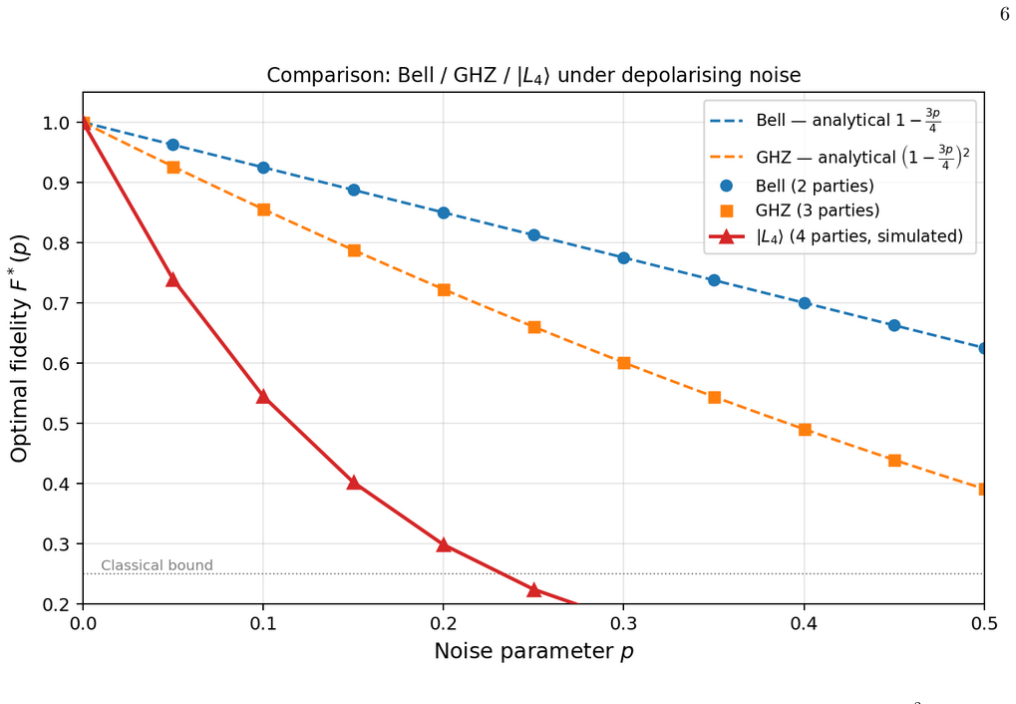
- Closed-form fidelity expressions F_dep = (1 - 2p/3)^k and F_pd = ((1 + sqrt(1-p))/2)^k hold under depolarizing and phase-damping noise, with k equal to the number of resource qubits.
- Hardware runs on CZ-native processors produce statistically identical fidelities for different four-qubit graphs when the resource count is matched.
Where Pith is reading between the lines
- The correction simplicity suggests the protocol can scale to larger networks without exponential growth in classical post-processing.
- The same walk structure may supply resource states for measurement-based quantum computation when the target graph encodes a computation rather than a communication topology.
- Noise formulas derived here can be used to compare resource overhead against other graph-state distribution schemes that rely on multiple CZ gates per edge.
Load-bearing premise
The phase quantum walk steps can be realized with ideal CZ gates on the network and the byproduct operators remain simple Pauli errors that local operations can correct without additional topological constraints.
What would settle it
Prepare a cycle graph or complete graph on four or more vertices, run the phase quantum walk protocol, apply the stated local Z corrections, and measure the fidelity of the output state; any systematic drop below 1.0 in the noiseless case would falsify the universal correction theorem.
Figures




read the original abstract
Distributing arbitrary graph states across quantum networks is a central challenge for modular quantum computing and measurement-based quantum communication. We introduce the phase quantum walk (PQW), a discrete-time quantum walk in which the conventional position-permuting shift operator is replaced by a diagonal conditional phase (CZ) gate, enabling distribution of arbitrary graph states -- not merely GHZ states -- from elementary two-qubit resources. The Byproduct Lemma shows that each walk step teleports edge entanglement with a correctable Pauli byproduct. A universal correction theorem proves that for any graph G=(V,E) and any measurement outcome, the local correction C_v = Z_v^{g_v} where g_v = \sum_{e \ni v} s_{e,\bar{v}} restores the distributed state to |G>. This gives a single correction formula covering all graph topologies without case analysis. Analytical correction formulas are verified for 18 topologies (up to 4096 outcomes) at F=1.0. Closed-form fidelity expressions F^*_{dep} = (1 - 2p/3)^k and F^*_{pd} = ((1 + \sqrt{1-p})/2)^k are derived and verified, where k is the number of resource qubits. Hardware validation on IBM Marrakesh (IBM Heron r2, CZ-native) yields Bhattacharyya fidelity F^*_{cl} = 0.924 for |GHZ4> and 0.922 for |L4>, statistically identical as predicted by the noise formulas for protocols using equal numbers of resource qubits (k=6 in both cases).
Editorial analysis
A structured set of objections, weighed in public.
Referee Report
Summary. The paper introduces the phase quantum walk (PQW), a discrete-time quantum walk in which the shift operator is replaced by a diagonal CZ gate, to distribute arbitrary graph states |G> from elementary two-qubit resources across quantum networks. It presents a Byproduct Lemma asserting that each PQW step teleports an edge with a correctable Pauli byproduct, and a universal correction theorem proving that for any graph G=(V,E) and any measurement outcome the local correction C_v = Z_v^{g_v} with g_v = sum_{e ni v} s_{e, bar v} restores the target state. Analytical verification at F=1.0 is reported for 18 topologies (up to 4096 outcomes), closed-form fidelity expressions under depolarizing and phase-damping noise are derived, and hardware results on IBM Heron r2 are shown to match the noise formulas for |GHZ4> and |L4>.
Significance. If the central derivations hold, the work supplies a unified, topology-independent correction formula and explicit noise models for graph-state distribution, which would simplify protocols for measurement-based quantum computation and network communication. The parameter-free analytical verification across multiple topologies and the matching hardware fidelities constitute concrete strengths; the closed-form expressions F^*_dep and F^*_pd are particularly useful for resource estimation.
major comments (1)
- [Byproduct Lemma and universal correction theorem] Byproduct Lemma and universal correction theorem (abstract and § on the theorem): The claim that only Z corrections C_v = Z_v^{g_v} suffice is load-bearing for the central result. In any CZ-based circuit an X error on one qubit before the gate produces X errors on both qubits afterward, while Z errors commute. The manuscript must supply the explicit operator form of the byproduct for a single PQW step and an inductive argument showing that no X components arise from the coin or measurement outcomes, or that any such components are absorbed by the stated Z formula. Without this, the perfect-fidelity claim for arbitrary G cannot be accepted at face value.
minor comments (2)
- [Noise analysis] The abstract states that the noise formulas are 'derived and verified'; the derivation steps for F^*_dep = (1-2p/3)^k and F^*_pd = ((1+sqrt(1-p))/2)^k should be shown explicitly, including the precise definition of k in terms of the walk length or number of resource qubits.
- [Hardware validation] Hardware section: the reported Bhattacharyya fidelities 0.924 and 0.922 are statistically identical as predicted, but the number of shots, circuit depth, and any post-selection criteria should be stated to allow direct comparison with the analytical expressions.
Simulated Author's Rebuttal
We thank the referee for their careful reading, positive assessment of the significance of the phase quantum walk framework, and for identifying the need to strengthen the explicit derivation of the Byproduct Lemma and universal correction theorem. We address the major comment below and will revise the manuscript to incorporate the requested details.
read point-by-point responses
-
Referee: [Byproduct Lemma and universal correction theorem] Byproduct Lemma and universal correction theorem (abstract and § on the theorem): The claim that only Z corrections C_v = Z_v^{g_v} suffice is load-bearing for the central result. In any CZ-based circuit an X error on one qubit before the gate produces X errors on both qubits afterward, while Z errors commute. The manuscript must supply the explicit operator form of the byproduct for a single PQW step and an inductive argument showing that no X components arise from the coin or measurement outcomes, or that any such components are absorbed by the stated Z formula. Without this, the perfect-fidelity claim for arbitrary G cannot be accepted at face value.
Authors: We agree that an explicit single-step operator and inductive argument will strengthen the presentation. In the revised manuscript we will insert the following derivation immediately after the statement of the Byproduct Lemma. For a single PQW step on edge e = (v, w): the walker begins in |+>, a Hadamard coin is applied, followed by the diagonal CZ between walker and target qubit w, and the walker is measured in the X basis yielding outcome s. The post-selected state on w is exactly Z_w^s |psi> (global phase irrelevant). This holds because CZ is diagonal in the computational basis, the Hadamard-plus-X-measurement combination teleports the conditional phase, and any X component on the walker is projected out by the measurement; no X byproduct reaches the graph qubit. Z errors commute through the CZ, so they remain local. For the inductive argument: the base case (single edge) yields only a Z byproduct as above. Assume after distributing subgraph G' the state is |G'> tensored with byproduct operator prod Z^{g_u}. When a new vertex v is attached via edge e to bar v, the new PQW step applies CZ(walker, v). Because the existing Z operators on bar v commute with this CZ (both are diagonal or act on disjoint supports after the previous steps), the new measurement outcome s contributes only an additional Z_v^s factor. The cumulative exponent g_v is updated by summing all incident s_{e, bar v} exactly as stated in the universal correction theorem. Consequently, no X components ever appear on the graph qubits for any topology. We will also add a short table listing the explicit byproduct operator for the first three steps of a path graph to illustrate the pattern. This revision directly addresses the propagation concern while preserving the topology-independent Z-only correction. revision: yes
Circularity Check
Derivation chain is self-contained with no circular reductions
full rationale
The phase quantum walk is defined by replacing the shift operator with a diagonal CZ gate; the Byproduct Lemma and universal correction theorem are then stated as direct consequences of this definition, with the correction operator C_v = Z_v^{g_v} (g_v = sum s_{e,bar v}) proven to restore |G> for arbitrary graphs without any equation reducing the claimed result to a fitted parameter, a self-referential definition, or a load-bearing self-citation. The closed-form fidelity expressions are likewise obtained analytically from the noise model and verified numerically on 18 topologies, but the verification does not substitute for or circularly presuppose the theorem. No patterns matching self-definitional, fitted-input-called-prediction, or ansatz-smuggled-in-via-citation are present in the derivation chain.
Axiom & Free-Parameter Ledger
axioms (1)
- standard math Standard quantum mechanics with CZ gates and Pauli operators
invented entities (1)
-
Phase quantum walk (PQW)
no independent evidence
Lean theorems connected to this paper
-
IndisputableMonolith/CostJcost properties and costAlphaLog unclear?
unclearRelation between the paper passage and the cited Recognition theorem.
Proposition 4 (Diagonality and Z-error transparency). CZ is diagonal, and [CZ, Z⊗I] = [CZ, I⊗Z] = [CZ, Z⊗Z] = 0.
-
IndisputableMonolith/Foundation/ArithmeticFromLogicLogicNat recovery and orbit embedding unclear?
unclearRelation between the paper passage and the cited Recognition theorem.
Theorem 17 (Universal Z-only Correction). C_v = Z_v^{g_v} with g_v = ⊕_{e∋v} s_{e,¯v}
What do these tags mean?
- matches
- The paper's claim is directly supported by a theorem in the formal canon.
- supports
- The theorem supports part of the paper's argument, but the paper may add assumptions or extra steps.
- extends
- The paper goes beyond the formal theorem; the theorem is a base layer rather than the whole result.
- uses
- The paper appears to rely on the theorem as machinery.
- contradicts
- The paper's claim conflicts with a theorem or certificate in the canon.
- unclear
- Pith found a possible connection, but the passage is too broad, indirect, or ambiguous to say the theorem truly supports the claim.
Reference graph
Works this paper leans on
-
[1]
C. H. Bennett, G. Brassard, C. Cr´ epeau, R. Jozsa, A. Peres, and W. K. Wootters, Phys. Rev. Lett.70, 1895 (1993)
work page 1993
-
[2]
A. K. Ekert, Phys. Rev. Lett.67, 661 (1991)
work page 1991
-
[3]
H. J. Briegel, W. D¨ ur, J. I. Cirac, and P. Zoller, Phys. Rev. Lett.81, 5932 (1998)
work page 1998
- [4]
-
[5]
D. E. Browne and T. Rudolph, Phys. Rev. Lett.95, 010501 (2005)
work page 2005
-
[6]
Gottesman, PhD Thesis, California Institute of Technology (1997)
D. Gottesman, PhD Thesis, California Institute of Technology (1997)
work page 1997
-
[7]
M. Hein, J. Eisert, and H. J. Briegel, Phys. Rev. A69, 062311 (2004)
work page 2004
-
[8]
C. Meignant, D. Markham, and F. Grosshans, Phys. Rev. A100, 052333 (2019)
work page 2019
- [9]
- [10]
- [11]
-
[12]
IBM Quantum, IBM quantum platform (2025)
work page 2025
-
[13]
M. Van den Nest, J. Dehaene, and B. De Moor, Phys. Rev. A69, 022316 (2004)
work page 2004
- [14]
-
[15]
Amazon Web Services, Amazon Braket (2024)
work page 2024
discussion (0)
Sign in with ORCID, Apple, or X to comment. Anyone can read and Pith papers without signing in.