Recognition: 2 theorem links
· Lean TheoremQuadratic gravity corrections to scalar QNMs of rapidly rotating black holes
Pith reviewed 2026-05-13 20:31 UTC · model grok-4.3
The pith
Scalar quasinormal mode corrections in quadratic gravity grow sharply for high-spin black holes
A machine-rendered reading of the paper's core claim, the machinery that carries it, and where it could break.
Core claim
In an effective-field-theory framework for gravity, black-hole quasinormal mode spectra acquire corrections in quadratic-curvature, scalar-tensor extensions of general relativity. Using recently constructed numerical black-hole solutions valid for large spin, the leading-order deviations from general relativity in the scalar quasinormal mode spectrum of rotating black holes in scalar Gauss-Bonnet and dynamical Chern-Simons gravity are computed. The perturbation equations are solved with pseudo-spectral collocation methods, allowing determination of the quasinormal-mode corrections for dimensionless spins up to a/M=0.99, with accuracy better than 10^{-3} for the l=m=0 mode and 10^{-6} for the
What carries the argument
Numerical black-hole background solutions in scalar Gauss-Bonnet and dynamical Chern-Simons gravity, combined with pseudo-spectral collocation solution of the scalar perturbation equations
If this is right
- The method extends previous spin-expansion calculations to near-extremal regimes where corrections become much larger.
- Certain scalar modes exhibit significantly enhanced sensitivity to the quadratic curvature couplings at high spins.
- Accurate spectra with quantified numerical errors are now available for comparison with gravitational-wave ringdown signals.
Where Pith is reading between the lines
- Gravitational-wave observations of high-spin mergers could therefore place stronger bounds on the effective coupling constants.
- Spin-dependent enhancements imply that slowly rotating approximations miss important beyond-GR signatures.
- The same numerical approach could be used to study other perturbation sectors or different quadratic gravity models.
Load-bearing premise
The recently constructed numerical black-hole background solutions remain accurate and stable up to a/M = 0.99.
What would settle it
An independent recalculation of the scalar quasinormal mode corrections at a/M = 0.95 that fails to reproduce the reported order-of-magnitude increase would falsify the central claim.
Figures



read the original abstract
In an effective-field-theory framework for gravity, black-hole quasinormal mode spectra acquire corrections in quadratic-curvature, scalar-tensor extensions of general relativity. Previous calculations of such corrections were limited to moderate spins, since the corresponding background solutions relied on expansions in the spin parameter. Using recently constructed numerical black-hole solutions valid for large spin, we compute the leading-order deviations from general relativity in the scalar quasinormal mode spectrum of rotating black holes in scalar Gauss-Bonnet and dynamical Chern-Simons gravity. We solve the resulting perturbation equations with pseudo-spectral collocation methods, allowing us to determine the quasinormal-mode corrections for dimensionless spins up to $a/M=0.99$, with accuracy better than $\lesssim 10^{-3}$ for the $l=m=0$ mode and $\lesssim 10^{-6}$ for higher multipoles. For spins $a/M>0.9$, the corrections to certain modes can increase by orders of magnitude.
Editorial analysis
A structured set of objections, weighed in public.
Referee Report
Summary. The paper computes leading-order corrections to the scalar quasinormal-mode spectrum of rapidly rotating black holes in scalar Gauss-Bonnet and dynamical Chern-Simons gravity. It employs recently constructed numerical background solutions valid at high spin, solves the linearized perturbation equations with pseudo-spectral collocation, and reports results up to a/M = 0.99 with stated accuracies ≲10^{-3} (l=m=0) and ≲10^{-6} (higher multipoles). The central finding is that, for a/M > 0.9, corrections to certain modes grow by orders of magnitude.
Significance. If the imported numerical backgrounds are accurate at a/M = 0.99, the work meaningfully extends prior perturbative-spin calculations into the near-extremal regime and demonstrates that quadratic-gravity corrections can become observationally relevant for high-spin black holes. The adoption of pseudo-spectral collocation on independently constructed backgrounds is a technical strength that supports the reported precision.
major comments (1)
- [Numerical background construction] The quantitative claim that corrections increase by orders of magnitude for a/M > 0.9 rests on the accuracy of the numerical black-hole backgrounds at a/M = 0.99. The manuscript provides no explicit convergence tests, residual norms, or comparisons against analytic limits for these backgrounds within the present work, even though the abstract asserts the stated accuracies for the QNM corrections themselves.
Simulated Author's Rebuttal
We thank the referee for their careful reading of our manuscript and for highlighting the importance of the background accuracy. We address the single major comment below and agree that additional clarification will strengthen the presentation.
read point-by-point responses
-
Referee: [Numerical background construction] The quantitative claim that corrections increase by orders of magnitude for a/M > 0.9 rests on the accuracy of the numerical black-hole backgrounds at a/M = 0.99. The manuscript provides no explicit convergence tests, residual norms, or comparisons against analytic limits for these backgrounds within the present work, even though the abstract asserts the stated accuracies for the QNM corrections themselves.
Authors: We agree that the accuracy of the imported numerical backgrounds is central to our claims. These backgrounds were constructed and validated in our companion paper (cited as Ref. [X] in the manuscript), which contains the requested convergence tests, residual norms, and comparisons to analytic limits up to a/M = 0.99. The present work focuses on the perturbation sector and therefore cites rather than repeats that material. To address the referee's concern directly, we will add a brief dedicated paragraph in Section II summarizing the key validation metrics from Ref. [X] (including maximum residual norms and convergence orders at a/M = 0.99). This addition will make the manuscript self-contained without altering any results. revision: yes
Circularity Check
No significant circularity; derivation relies on independent numerical backgrounds and standard perturbation solving
full rationale
The paper computes leading-order QNM corrections by linearizing scalar perturbation equations on numerical rotating black-hole backgrounds (imported from prior literature) and solving the resulting system with pseudo-spectral collocation. No step reduces a claimed prediction to a fitted parameter, self-definition, or unverified self-citation chain. The backgrounds are treated as external inputs whose accuracy is asserted via the cited construction; the present work adds only the perturbation analysis. This is a standard, non-circular numerical pipeline.
Axiom & Free-Parameter Ledger
axioms (2)
- domain assumption Validity of the effective-field-theory framework for quadratic-curvature scalar-tensor gravity at leading order
- domain assumption Accuracy of the recently constructed numerical black-hole solutions for spins up to a/M = 0.99
Lean theorems connected to this paper
-
IndisputableMonolith/Cost/FunctionalEquation.leanwashburn_uniqueness_aczel unclear?
unclearRelation between the paper passage and the cited Recognition theorem.
We solve the resulting perturbation equations with pseudo-spectral collocation methods... for dimensionless spins up to a/M=0.99
-
IndisputableMonolith/Foundation/AlexanderDuality.leanalexander_duality_circle_linking unclear?
unclearRelation between the paper passage and the cited Recognition theorem.
Using recently constructed numerical black-hole solutions valid for large spin
What do these tags mean?
- matches
- The paper's claim is directly supported by a theorem in the formal canon.
- supports
- The theorem supports part of the paper's argument, but the paper may add assumptions or extra steps.
- extends
- The paper goes beyond the formal theorem; the theorem is a base layer rather than the whole result.
- uses
- The paper appears to rely on the theorem as machinery.
- contradicts
- The paper's claim conflicts with a theorem or certificate in the canon.
- unclear
- Pith found a possible connection, but the passage is too broad, indirect, or ambiguous to say the theorem truly supports the claim.
Forward citations
Cited by 2 Pith papers
-
Beyond Three Terms: Continued Fractions for Rotating Black Holes in Modified Gravity
A reduction scheme transforms arbitrary N-term scalar and matrix recurrence relations from black hole perturbations in modified gravity into three-term relations solvable by continued fractions.
-
Ringing of rapidly rotating black holes in effective field theory
Leading-order cubic-curvature corrections to scalar quasinormal modes of black holes with spins up to 0.99M are computed numerically for modes up to l=5 with relative errors below 10^{-4}.
Reference graph
Works this paper leans on
-
[1]
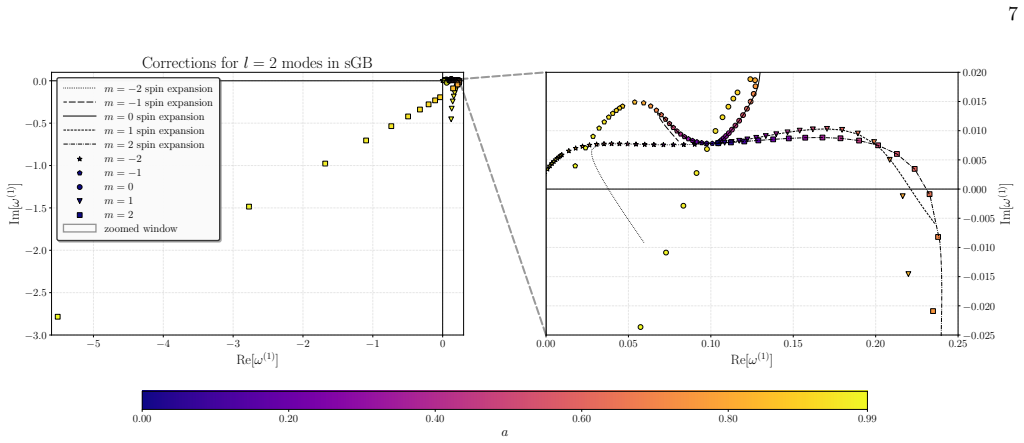
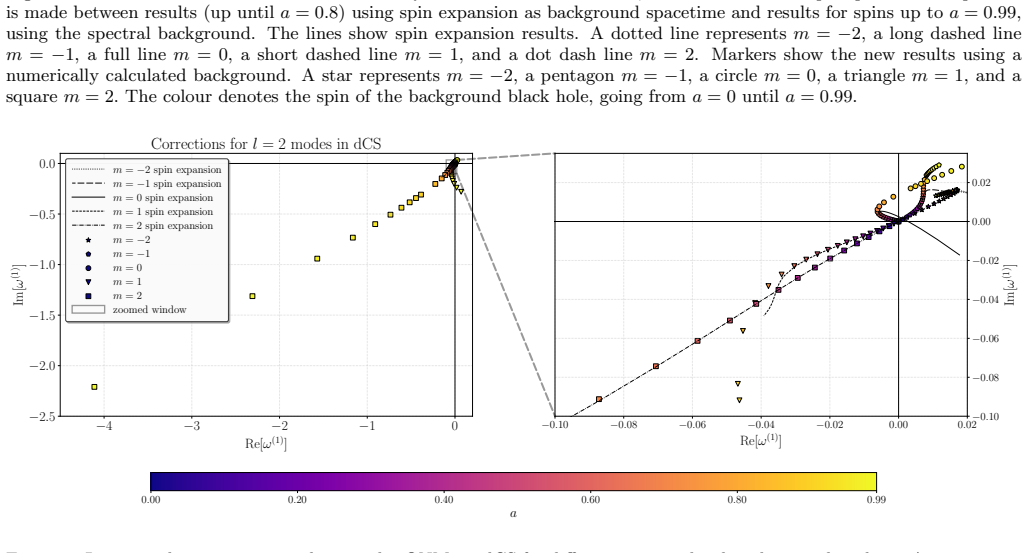
with ¯µcr ≈0.744 [96, 97]. Assuming that the lowest-order approximation re- 0 1 2 3 4 5 l −6 −4 −2 0 2 4 6 m Large spin behaviour in sGB & dCS m = ¯µcr(l + 1 2) well-behaved large corrections Figure 5. Phase space diagram to illustrate which modes seem to diverge in the large-spin limit and which remain well- behaved, along with the DM-ZDM phase boundary ...
-
[2]
for the cubic higher-derivative corrections). For all spins considered, we obtain reliable frequency shifts with exponential convergence, as expected for pseudo-spectral schemes. As can be seen in Fig. 1a and Fig. 1b, spin 9 expansions of the background metric cease to be reliable at high spins, highlighting the importance of using fully numerical backgro...
-
[3]
Israel, Event horizons in static vacuum space-times, Physical Review164, 1776 (1967)
W. Israel, Event horizons in static vacuum space-times, Physical Review164, 1776 (1967)
work page 1967
-
[4]
W. Israel, Event horizons in static electrovac space- times, Communications in Mathematical Physics8, 245 (1968)
work page 1968
-
[5]
B. Carter, Axisymmetric Black Hole Has Only Two Degrees of Freedom, Physical Review Letters26, 331 (1971)
work page 1971
-
[6]
M. Zajaˇ cek and A. Tursunov, Electric charge of black holes: Is it really always negligible? (2019), arXiv:1904.04654 [astro-ph.GA]
-
[7]
A. Abac, I. Abouelfettouh, F. Acernese,et al.(LIGO- Virgo-KAGRA Collaboration), GWTC-4.0: Updating the Gravitational-Wave Transient Catalog with Obser- vations from the First Part of the Fourth LIGO-Virgo- KAGRA Observing Run (2025), arXiv:2508.18082 [gr- qc]
work page internal anchor Pith review Pith/arXiv arXiv 2025
- [8]
-
[9]
A. Abac, I. Abouelfettouh, F. Acernese,et al.(LIGO- Virgo-KAGRA Collaboration), GW250114: Testing Hawking’s Area Law and the Kerr Nature of Black Holes, Physical Review Letters135, 111403 (2025), arXiv:2509.08054 [gr-qc]
work page internal anchor Pith review arXiv 2025
- [10]
- [11]
- [12]
- [13]
- [14]
-
[15]
Empirical tests of the black hole no-hair conjecture using gravitational-wave observations
G. Carullo, L. Van Der Schaaf, L. London,et al., Em- pirical tests of the black hole no-hair conjecture using gravitational-wave observations, Physical Review D98, 104020 (2018), arXiv:1805.04760 [gr-qc]
work page Pith review arXiv 2018
- [16]
-
[17]
Black hole spectroscopy: from theory to experiment
E. Berti, V. Cardoso, G. Carullo,et al., Black hole spectroscopy: from theory to experiment, Classical and Quantum Gravity (2026), arXiv:2505.23895 [gr-qc]
work page internal anchor Pith review Pith/arXiv arXiv 2026
-
[18]
Black Hole Spectroscopy: Testing General Relativity through Gravitational Wave Observations
O. Dreyer, B. J. Kelly, B. Krishnan, L. S. Finn, D. Gar- rison, and R. Lopez-Aleman, Black hole spectroscopy: Testing general relativity through gravitational wave observations, Classical and Quantum Gravity21, 787 (2004), arXiv:gr-qc/0309007
work page internal anchor Pith review Pith/arXiv arXiv 2004
-
[19]
On gravitational-wave spectroscopy of massive black holes with the space interferometer LISA
E. Berti, V. Cardoso, and C. M. Will, On gravitational- wave spectroscopy of massive black holes with the space interferometer LISA, Physical Review D73, 064030 (2006), arXiv:gr-qc/0512160
work page internal anchor Pith review Pith/arXiv arXiv 2006
-
[20]
Quasinormal modes of black holes and black branes
E. Berti, V. Cardoso, and A. O. Starinets, Quasinormal modes of black holes and black branes, Class. Quant. Grav.26, 163001 (2009), arXiv:0905.2975 [gr-qc]
work page internal anchor Pith review Pith/arXiv arXiv 2009
-
[21]
N. Franchini and S. H. V¨ olkel, Testing General Rela- tivity with Black Hole Quasi-normal Modes, inRecent Progress on Gravity Tests: Challenges and Future Per- spectives(Springer Nature Singapore, Singapore, 2024) pp. 361–416, arXiv:2305.01696 [gr-qc]
-
[22]
Vishveshwara, Stability of the schwarzschild metric, Physical Review D1, 2870 (1970)
C. Vishveshwara, Stability of the schwarzschild metric, Physical Review D1, 2870 (1970)
work page 1970
-
[23]
W. H. Press and S. A. Teukolsky, Perturbations of a Rotating Black Hole. II. Dynamical Stability of the Kerr Metric, The Astrophysical Journal185, 649 (1973)
work page 1973
-
[24]
J. F. Donoghue, General relativity as an effective field theory: The leading quantum corrections, Physical Re- view D50, 3874 (1994), arXiv:gr-qc/9405057
work page Pith review arXiv 1994
-
[25]
S. Endlich, V. Gorbenko, J. Huang, and L. Senatore, An effective formalism for testing extensions to General Relativity with gravitational waves, Journal of High En- ergy Physics09, 122 (2017), arXiv:1704.01590 [gr-qc]
-
[26]
K. S. Stelle, Classical Gravity with Higher Derivatives, General Relativity and Gravitation9, 353 (1978)
work page 1978
-
[27]
Stelle, Renormalization of Higher Derivative Quan- tum Gravity, Physical Review D16, 953 (1977)
K. Stelle, Renormalization of Higher Derivative Quan- tum Gravity, Physical Review D16, 953 (1977)
work page 1977
- [28]
-
[29]
S. Alexander, G. Gabadadze, L. Jenks, and N. Yunes, Cosmology of Gravi-Axions (2025), arXiv:2512.00154 [hep-ph]
-
[30]
S. Alexander and N. Yunes, Chern-Simons Modified General Relativity, Physics Reports480, 1 (2009), arXiv:0907.2562 [hep-th]
-
[31]
V. Cardoso, M. Kimura, A. Maselli, and L. Senatore, Black Holes in an Effective Field Theory Extension of General Relativity, Physical Review Letters121, 251105 (2018), arXiv:1808.08962 [gr-qc]
- [32]
-
[33]
F. Moura and R. Schiappa, Higher-derivative corrected black holes: Perturbative stability and absorption cross- section in heterotic string theory, Classical and Quan- tum Gravity24, 361 (2007), arXiv:hep-th/0605001
work page internal anchor Pith review Pith/arXiv arXiv 2007
-
[34]
E. Bergshoeff, M. de Roo, B. de Wit, and P. van Nieuwenhuizen, Ten-Dimensional Maxwell-Einstein Su- pergravity, Its Currents, and the Issue of Its Auxiliary Fields, Nuclear Physics B195, 97 (1982)
work page 1982
-
[35]
M. B. Green and J. H. Schwarz, Anomaly Cancella- tion in Supersymmetric D=10 Gauge Theory and Su- perstring Theory, Physics Letters B149, 117 (1984)
work page 1984
-
[36]
V. Cardoso and L. Gualtieri, Perturbations of Schwarzschild black holes in Dynamical Chern-Simons modified gravity, Physical Review D: Particles and Fields80, 064008 (2009), arXiv:0907.5008 [gr-qc]. 11
- [37]
-
[38]
J. L. Bl´ azquez-Salcedo, C. F. B. Macedo, V. Car- doso, V. Ferrari, L. Gualtieri, F. S. Khoo, J. Kunz, and P. Pani, Perturbed black holes in Einstein- dilaton-Gauss-Bonnet gravity: Stability, ringdown, and gravitational-wave emission, Physical Review D: Par- ticles and Fields94, 104024 (2016), arXiv:1609.01286 [gr-qc]
- [39]
-
[40]
O. J. Tattersall and P. G. Ferreira, Quasinormal modes of black holes in Horndeski gravity, Physical Review D: Particles and Fields97, 104047 (2018), arXiv:1804.08950 [gr-qc]
work page Pith review arXiv 2018
-
[41]
V. Cardoso, M. Kimura, A. Maselli, E. Berti, C. F. Macedo, and R. McManus, Parametrized black hole quasinormal ringdown: Decoupled equations for non- rotating black holes, Physical Review D: Particles and Fields99, 104077 (2019), arXiv:1901.01265 [gr-qc]
-
[42]
R. McManus, E. Berti, C. F. Macedo, M. Kimura, A. Maselli, and V. Cardoso, Parametrized black hole quasinormal ringdown. II. Coupled equations and quadratic corrections for nonrotating black holes, Phys- ical Review D: Particles and Fields100, 044061 (2019), arXiv:1906.05155 [gr-qc]
-
[43]
R. Konoplya and A. Zinhailo, Quasinormal modes, stability and shadows of a black hole in the 4D Einstein–Gauss–Bonnet gravity, The European Physi- cal Journal C: Particles and Fields80, 1049 (2020), arXiv:2003.01188 [gr-qc]
-
[44]
C. de Rham, J. Francfort, and J. Zhang, Black Hole Gravitational Waves in the Effective Field Theory of Gravity, Physical Review D: Particles and Fields102, 024079 (2020), arXiv:2005.13923 [hep-th]
- [45]
-
[46]
L. Pierini and L. Gualtieri, Quasi-normal modes of rotating black holes in Einstein-dilaton Gauss-Bonnet gravity: The first order in rotation, Physical Re- view D: Particles and Fields103, 124017 (2021), arXiv:2103.09870 [gr-qc]
-
[47]
M. Srivastava, Y. Chen, and S. Shankaranarayanan, An- alytical computation of quasinormal modes of slowly ro- tating black holes in dynamical Chern-Simons gravity, Physical Review D: Particles and Fields104, 064034 (2021), arXiv:2106.06209 [gr-qc]
- [48]
- [49]
-
[50]
L. Pierini and L. Gualtieri, Quasinormal modes of ro- tating black holes in Einstein-dilaton Gauss-Bonnet gravity: The second order in rotation, Physical Re- view D: Particles and Fields106, 104009 (2022), arXiv:2207.11267 [gr-qc]
-
[51]
A. Hussain and A. Zimmerman, Approach to comput- ing spectral shifts for black holes beyond Kerr, Physical Review D106, 104018 (2022), arXiv:2206.10653 [gr-qc]
- [52]
- [53]
- [54]
- [55]
- [56]
- [57]
- [58]
- [59]
- [60]
- [61]
- [62]
-
[63]
W. L. Boyce and J. E. Santos, Kerr Black Hole Ringdown in Effective Field Theory (2026), arXiv:2603.10102 [gr-qc]
work page internal anchor Pith review Pith/arXiv arXiv 2026
-
[64]
Dynamical Chern-Simons Modified Gravity I: Spinning Black Holes in the Slow-Rotation Approximation
N. Yunes and F. Pretorius, Dynamical Chern-Simons Modified Gravity. I. Spinning Black Holes in the Slow- Rotation Approximation, Physical Review D79, 084043 12 (2009), arXiv:0902.4669 [gr-qc]
work page internal anchor Pith review Pith/arXiv arXiv 2009
- [65]
-
[66]
D. Ayzenberg and N. Yunes, Slowly rotating black holes in Einstein-Dilaton-Gauss-Bonnet gravity: Quadratic order in spin solutions, Physical Review D90, 044066 (2014), arXiv:1405.2133 [gr-qc]
-
[67]
A. Maselli, P. Pani, L. Gualtieri, and V. Ferrari, Rotat- ing black holes in Einstein-Dilaton-Gauss-Bonnet grav- ity with finite coupling, Physical Review D92, 083014 (2015), arXiv:1507.00680 [gr-qc]
- [68]
- [69]
- [70]
- [71]
- [72]
- [73]
- [74]
-
[75]
P. G. Fernandes, Leading effective field theory cor- rections to the Kerr metric at all spins (2025), arXiv:2512.02338 [gr-qc]
work page internal anchor Pith review Pith/arXiv arXiv 2025
-
[76]
Ringing of rapidly rotating black holes in effective field theory
T. van der Steen, S. Maenaut, S. J. Husken, P. G. Fer- nandes, M. D. Jockwer, V. Cardoso, T. Hertog, and T. G. Li, Ringing of rapidly rotating black holes in ef- fective field theory (2026), arXiv:2604.11755 [gr-qc]
work page internal anchor Pith review Pith/arXiv arXiv 2026
- [77]
- [78]
- [79]
-
[80]
R. Abbottet al.(LIGO Scientific, Virgo), Tests of gen- eral relativity with binary black holes from the sec- ond LIGO-Virgo gravitational-wave transient catalog (2021), arXiv:2010.14529 [gr-qc]
work page internal anchor Pith review arXiv 2021
discussion (0)
Sign in with ORCID, Apple, or X to comment. Anyone can read and Pith papers without signing in.