Adiabatic Fast Passage Spin Manipulation Measurements in Solid Polarized Targets
Pith reviewed 2026-05-15 01:21 UTC · model grok-4.3
The pith
Adiabatic fast passage reverses polarization rapidly in solid targets while a new lineshape analysis extracts vector and tensor components from non-Boltzmann NMR spectra.
A machine-rendered reading of the paper's core claim, the machinery that carries it, and where it could break.
Core claim
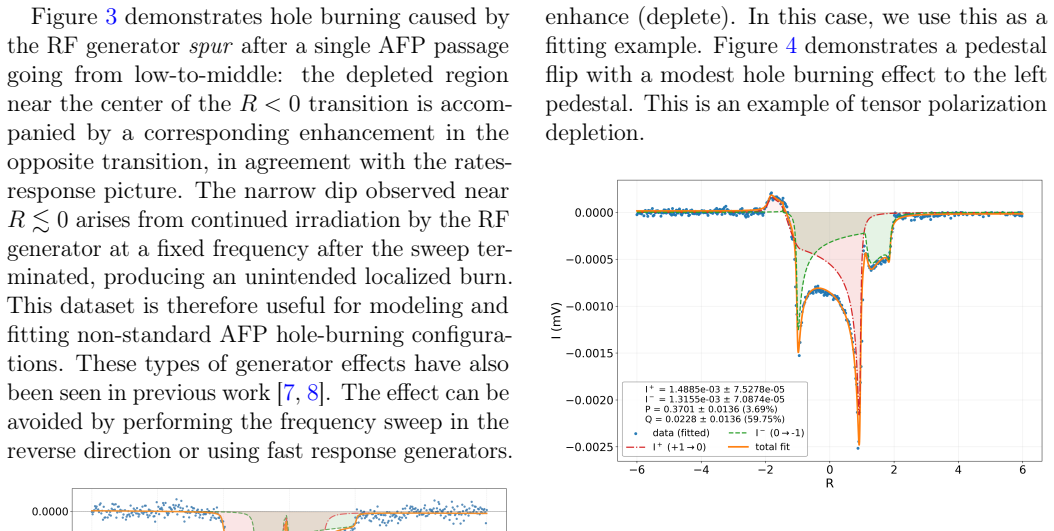
AFP manipulation combined with joint lineshape fitting of the resulting NMR spectra extracts both vector and tensor polarization components for spin-1 nuclei, including in non-Boltzmann half-flip states that defeat standard ratio methods.
What carries the argument
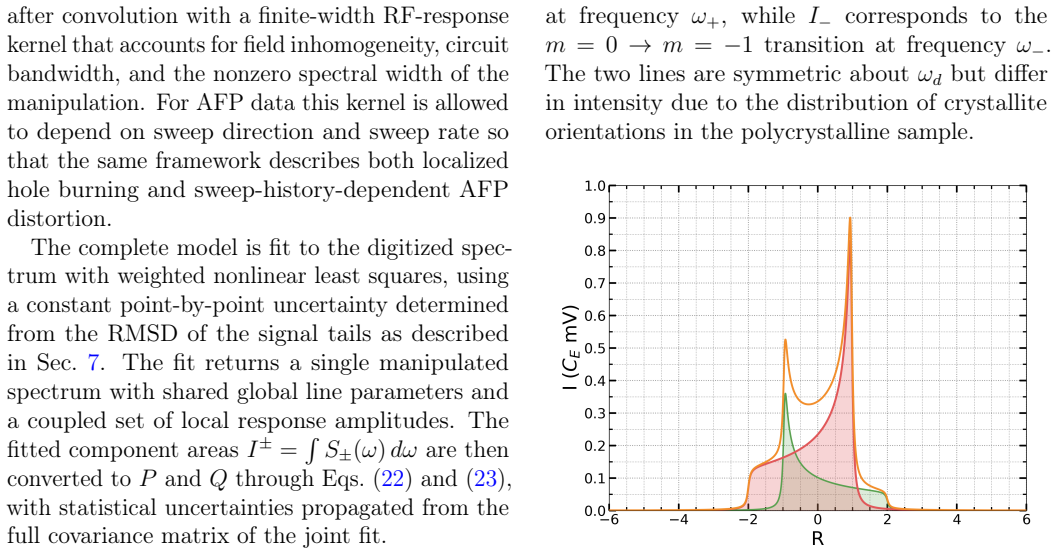
Joint manipulated-lineshape analysis of AFP-altered NMR spectra, which fits the entire spectral shape to isolate vector and tensor contributions.
If this is right
- Polarization can be flipped many times in a single target run without long repolarization pauses.
- Polarization monitoring becomes possible in deliberately manipulated, non-thermal states.
- AFP efficiency can be tuned by choosing the right initial polarization level in irradiated ammonia.
Where Pith is reading between the lines
- The method may allow real-time feedback control of polarization direction during an experiment.
- Similar lineshape fitting could be tested on other spin-1 materials to check whether the same extraction holds.
- Target design could incorporate AFP stages to reduce overall experiment time by minimizing DNP downtime.
Load-bearing premise
The lineshape fit correctly separates vector and tensor polarizations without hidden systematic distortions in the NMR signal from non-Boltzmann states.
What would settle it
An independent polarization measurement on the same half-flip state that disagrees with the values obtained from the manipulated-lineshape fit.
Figures


read the original abstract
Adiabatic fast passage (AFP) is a rapid method for reversing nuclear polarization and manipulating spin populations in polarized solid targets, avoiding the long repolarization times associated with dynamic nuclear polarization (DNP). We report AFP measurements in a 5~T, 1~K polarized-target system for irradiated $^{15}$NH$_3$, irradiated $^{14}$ND$_3$, and butanol-based materials prepared either with TEMPO doping or by irradiation. We also present a joint manipulated-lineshape analysis for spin-1 targets and demonstrate that vector and tensor polarizations can be extracted from AFP-manipulated deuteron NMR spectra even when the populations are not described by a single Boltzmann spin temperature. Finally, we report a reproducible polarization- and direction-dependent AFP response in a large irradiated $^{15}$NH$_3$ sample. These ammonia results are presented as empirical observations under the specific sample-coil conditions of the experiment, with possible circuit-mediated mechanisms such as radiation damping or superradiant behavior discussed but not assigned as a definitive cause.
Editorial analysis
A structured set of objections, weighed in public.
Referee Report
Summary. The manuscript reports new measurements of adiabatic fast passage (AFP) efficiency in irradiated 15NH3, irradiated 14ND3, and butanol polarized target systems prepared with TEMPO doping or irradiation. It introduces a joint manipulated-lineshape analysis demonstrated on irradiated deuterated butanol AFP spectra to extract vector and tensor polarization components from NMR spectra of spin-1 systems in non-Boltzmann half-flip states, and presents an efficiency study of irradiated 15NH3 showing strong dependence on initial polarization.
Significance. If the joint analysis is shown to be free of fitting biases, the new efficiency data across multiple materials and the lineshape method for handling non-Boltzmann states would provide practical advances for rapid polarization reversal in solid targets, reducing reliance on time-consuming DNP repolarization cycles in nuclear physics experiments.
major comments (1)
- [Joint manipulated-lineshape analysis] The joint manipulated-lineshape analysis (demonstrated on irradiated deuterated butanol spectra) lacks quantitative cross-validation such as recovery tests on synthetic spectra with injected known polarizations or direct comparison to standard intensity-ratio methods on subsets where both apply. Without this, it is unclear whether the extracted vector and tensor components in half-flip states are free of unmodeled broadening, baseline artifacts, or parameter trade-offs unique to the manipulated regime.
minor comments (1)
- [Abstract and results] The abstract and results sections do not report error bars, data exclusion criteria, or validation against independent methods for the AFP efficiency measurements, which would improve the verifiability of the tabulated results.
Simulated Author's Rebuttal
We thank the referee for their positive evaluation of the significance of our work and for the detailed comments provided. Below we respond to the major comment and outline the revisions we will make to the manuscript.
read point-by-point responses
-
Referee: The joint manipulated-lineshape analysis (demonstrated on irradiated deuterated butanol spectra) lacks quantitative cross-validation such as recovery tests on synthetic spectra with injected known polarizations or direct comparison to standard intensity-ratio methods on subsets where both apply. Without this, it is unclear whether the extracted vector and tensor components in half-flip states are free of unmodeled broadening, baseline artifacts, or parameter trade-offs unique to the manipulated regime.
Authors: We agree with the referee that quantitative cross-validation is important to establish the reliability of the new joint manipulated-lineshape analysis. In the revised manuscript, we will add recovery tests on synthetic spectra where known vector and tensor polarizations are injected, allowing us to quantify any biases or artifacts in the extraction. We will also include direct comparisons to the standard intensity-ratio method on subsets of the data where the latter is applicable (i.e., near-Boltzmann states). This will demonstrate that the method performs accurately in the manipulated regime without unmodeled effects dominating the results. revision: yes
Circularity Check
No significant circularity in experimental measurements or lineshape analysis
full rationale
The paper reports direct experimental AFP efficiency measurements across target materials and demonstrates an empirical joint manipulated-lineshape fitting procedure on observed NMR spectra to extract vector and tensor polarizations. No derivation chain, first-principles prediction, or parameter extraction is claimed that reduces by the paper's own equations to a fitted input or self-referential definition. The analysis is presented as a practical method applied to data rather than a theoretically derived result whose validity loops back to its assumptions. Any self-citations are peripheral and not load-bearing for the core claims, which rest on new measurements. This matches the expected profile of an experimental methods paper with no circular reduction.
discussion (0)
Sign in with ORCID, Apple, or X to comment. Anyone can read and Pith papers without signing in.