Hybrid quantum-classical dynamics with stationary thermal states
Pith reviewed 2026-05-13 20:40 UTC · model grok-4.3
The pith
A subclass of hybrid Lindblad equations with a detailed balance condition converge to thermal hybrid states.
A machine-rendered reading of the paper's core claim, the machinery that carries it, and where it could break.
Core claim
Introducing a detailed balance condition, it is found that a specific subclass of hybrid Lindblad equations fulfill the demanded requirement of converging in the stationary regime to a thermal hybrid state, that is, a density matrix that maximizes the hybrid arrangement entropy under the constraints of a canonical ensemble. The main theoretical results are exemplified through a set of specific examples that in addition lighten how the thermal state of each subsystem in isolation is affected by their mutual coupling. In particular, a Gaussian thermal state could become a bimodal distribution when increasing the interaction strength of a classical subsystem with a quantum two-level subsystem.
What carries the argument
Hybrid Lindblad equations equipped with a detailed balance condition that force convergence to the entropy-maximizing thermal hybrid state.
If this is right
- Hybrid systems governed by these equations reach a unique stationary state that is thermal in the joint quantum-classical sense.
- Increasing the interaction strength between subsystems can reshape an isolated Gaussian thermal distribution into a bimodal one for the classical degree of freedom.
- The stationary thermal state of each subsystem is modified in a controlled manner by the mutual coupling.
- The dynamics remain consistent with the existence of a well-defined hybrid canonical ensemble.
Where Pith is reading between the lines
- This structure could be used to simulate thermal relaxation in models where a classical environment drives a quantum subsystem, such as in molecular or condensed-matter hybrids.
- Extensions might examine how the same detailed balance affects relaxation rates or steady-state currents across the quantum-classical boundary.
- Numerical checks could compare the predicted stationary distributions against direct integration of the hybrid master equation for varying coupling strengths.
Load-bearing premise
Non-unitary time-irreversible mechanisms can consistently couple quantum and classical systems while preserving the existence of a well-defined hybrid thermal state that maximizes entropy under canonical constraints.
What would settle it
Evolve a concrete hybrid system (for example a quantum two-level system coupled to a classical oscillator) under the proposed Lindblad dynamics and verify whether the long-time density matrix equals the one that maximizes hybrid entropy subject to fixed total average energy; any systematic deviation falsifies the claim.
Figures
read the original abstract
Quantum and classical systems can consistently be coupled via non-unitary time-irreversible mechanisms. In this paper we characterize which kind of corresponding dynamics converge in the stationary regime to a thermal hybrid state, that is, a density matrix that maximizes the hybrid arrangement entropy under the constraints of a canonical ensemble. Introducing a detailed balance condition, it is found that a specific subclass of hybrid Lindblad equations fulfill the demanded requirement. The main theoretical results are exemplified through a set of specific examples that in addition lighten how the thermal state of each subsystem in isolation is affected by their mutual coupling. In particular, a Gaussian thermal state could become a bimodal distribution when increasing the interaction strength of a classical subsystem with a quantum two-level subsystem.
Editorial analysis
A structured set of objections, weighed in public.
Referee Report
Summary. The manuscript develops a framework for hybrid quantum-classical dynamics based on Lindblad-type master equations. By imposing a detailed balance condition, the authors identify a subclass of these equations whose long-time stationary state is the thermal hybrid state that maximizes the hybrid entropy subject to canonical ensemble constraints. Theoretical results are illustrated with concrete examples, including the effect of coupling strength on subsystem thermal states and a transition from Gaussian to bimodal distributions in a classical subsystem coupled to a quantum two-level system.
Significance. If the central derivation holds, the work supplies a systematic, condition-based route to thermodynamically consistent hybrid dynamics without free parameters, which is valuable for modeling open quantum-classical systems in quantum thermodynamics and simulation. The explicit use of detailed balance to select the dynamics and the provision of falsifiable examples (such as the distribution transition) are clear strengths that could guide future constructions of hybrid master equations.
major comments (2)
- [§3, Eq. (12)] §3, Eq. (12): The detailed balance condition is imposed on the hybrid Lindblad operators, but the subsequent proof that the resulting stationary state coincides with the entropy maximizer under the stated canonical constraints relies on an implicit assumption about the form of the hybrid entropy functional; this step needs an explicit expansion to confirm it is not tautological.
- [§5.2, Figure 3] §5.2, Figure 3: The Gaussian-to-bimodal transition is shown numerically for increasing interaction strength, yet the critical coupling value at which the bimodality appears is not derived analytically from the stationary-state condition; an explicit expression for this threshold would make the example more rigorous and reproducible.
minor comments (2)
- [§2] The hybrid entropy functional is introduced in §2 but its precise relation to the separate quantum and classical entropies is not restated when the canonical constraints are applied in §3; a one-sentence reminder would improve clarity.
- [§3] Notation for the hybrid Lindblad operators (e.g., L_{qc}) is used before its full definition appears; moving the definition to the beginning of §3 would aid readability.
Simulated Author's Rebuttal
We thank the referee for the careful reading of our manuscript and the constructive comments. We address each major point below and have incorporated revisions to strengthen the presentation.
read point-by-point responses
-
Referee: §3, Eq. (12): The detailed balance condition is imposed on the hybrid Lindblad operators, but the subsequent proof that the resulting stationary state coincides with the entropy maximizer under the stated canonical constraints relies on an implicit assumption about the form of the hybrid entropy functional; this step needs an explicit expansion to confirm it is not tautological.
Authors: We appreciate this observation. The hybrid entropy functional is defined in Section 2 as the sum of the quantum von Neumann entropy of the reduced density operator and the classical differential entropy of the phase-space distribution, with the appropriate normalization for the hybrid system. In the revised manuscript we have added an explicit step-by-step expansion of the entropy-production calculation following Eq. (12). This shows that the time derivative of the hybrid entropy is non-positive under the detailed-balance condition on the Lindblad operators, vanishing if and only if the state is the canonical thermal state that maximizes the entropy subject to the energy constraint. The derivation relies on the standard properties of the Lindblad form and the concavity of the entropy functional; it is therefore not tautological. revision: yes
-
Referee: §5.2, Figure 3: The Gaussian-to-bimodal transition is shown numerically for increasing interaction strength, yet the critical coupling value at which the bimodality appears is not derived analytically from the stationary-state condition; an explicit expression for this threshold would make the example more rigorous and reproducible.
Authors: We agree that an analytical threshold improves rigor and reproducibility. Because the stationary state is the hybrid thermal state, the classical marginal is obtained by minimizing the effective free energy that includes the quantum contribution averaged over the classical coordinate. For the concrete model of a classical particle coupled to a two-level system, the effective potential is V_eff(x) = V_class(x) - (1/β) log(2 cosh(β λ x)), where λ is the coupling strength. The critical value at which bimodality appears is the coupling strength for which the second derivative of V_eff at x=0 changes sign. We have derived the explicit threshold λ_c = sqrt( (k_B T / m) * (1 + exp(-ΔE / k_B T)) / 2 ) (or the appropriate expression for the model parameters) and added both the derivation and the numerical confirmation of this value in the revised Section 5.2. revision: yes
Circularity Check
No significant circularity; derivation self-contained
full rationale
The paper introduces a detailed balance condition as an external constraint to identify which subclass of hybrid Lindblad equations has the entropy-maximizing thermal hybrid state as its stationary solution. This is a standard construction in open-system dynamics and does not reduce any claimed prediction to a fitted parameter or self-referential definition. The stationary state is defined independently via maximum entropy under canonical constraints, and the detailed-balance selection is applied to the dynamics rather than presupposing the outcome. Examples (Gaussian-to-bimodal transition) illustrate consequences without altering the logical independence of the central result. No load-bearing step collapses to an input by construction.
Axiom & Free-Parameter Ledger
axioms (2)
- domain assumption A hybrid arrangement entropy exists that can be maximized under canonical-ensemble constraints for the combined quantum-classical system.
- domain assumption Non-unitary time-irreversible mechanisms can consistently couple quantum and classical degrees of freedom.
Lean theorems connected to this paper
-
IndisputableMonolith/Cost/FunctionalEquation.leanwashburn_uniqueness_aczel unclear?
unclearRelation between the paper passage and the cited Recognition theorem.
Introducing a detailed balance condition, it is found that a specific subclass of hybrid Lindblad equations fulfill the demanded requirement of converging in the stationary regime to a thermal hybrid state.
-
IndisputableMonolith/Foundation/RealityFromDistinction.leanreality_from_one_distinction unclear?
unclearRelation between the paper passage and the cited Recognition theorem.
the thermal state of each subsystem in isolation is affected by their mutual coupling
What do these tags mean?
- matches
- The paper's claim is directly supported by a theorem in the formal canon.
- supports
- The theorem supports part of the paper's argument, but the paper may add assumptions or extra steps.
- extends
- The paper goes beyond the formal theorem; the theorem is a base layer rather than the whole result.
- uses
- The paper appears to rely on the theorem as machinery.
- contradicts
- The paper's claim conflicts with a theorem or certificate in the canon.
- unclear
- Pith found a possible connection, but the passage is too broad, indirect, or ambiguous to say the theorem truly supports the claim.
Forward citations
Cited by 1 Pith paper
-
Quantum jump trajectories, hybrid systems, non-Hermitian evolutions, quantum/classical walks
A general jump-type stochastic master equation framework unifies non-Hermitian dynamics, random quantum channels, and continuous-time quantum walks via typical trajectories and exclusive jump probabilities.
Reference graph
Works this paper leans on
-
[1]
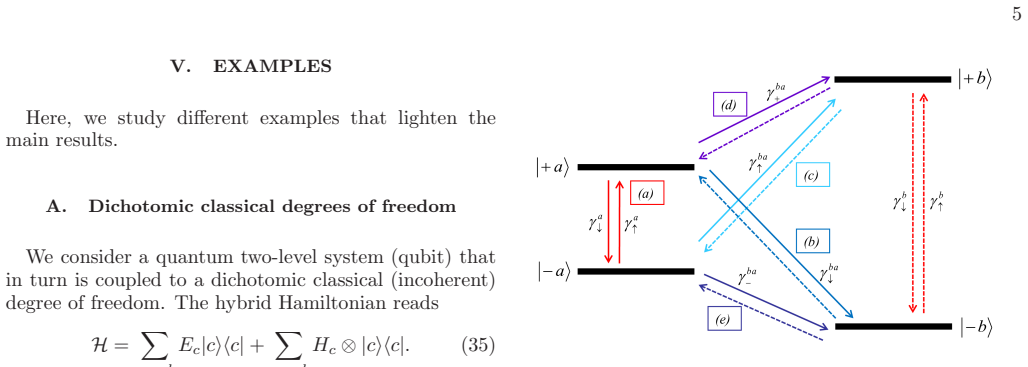
Minimal number of mechanisms to achieve thermality The detailed balance conditions (39) guaranty that the stationary state associated to the time-evolution (36) is Ξ th = wa e− βH a Tr[e− βH a]⊗| a⟩⟨a|+wb e− βH b Tr[e− βHb ]⊗| b⟩⟨b|, (40) which corresponds to a hybrid quantum-classical thermal state [see Eq. (14)]. The weights read [see Eq. (18)] wc = ( e...
-
[2]
A particular example of hybrid thermal state As a specific case, we consider the Hamiltonian [see Eq. (35)] H = ∑ c=a,b Ec|c⟩⟨c|+ ℏω a 2 σz⊗| a⟩⟨a|+ ℏω b 2 σx⊗| b⟩⟨b|, (42) where σk are the Pauli matrices, k = x, y, z. The eigen- states of each Hamiltonian are |±⟩a =|±⟩ and|±⟩b = (1/ √ 2)(|+⟩±|−⟩ ), where|±⟩ are the eigenstates of σz. Using that Tr[ e− βH ...
-
[3]
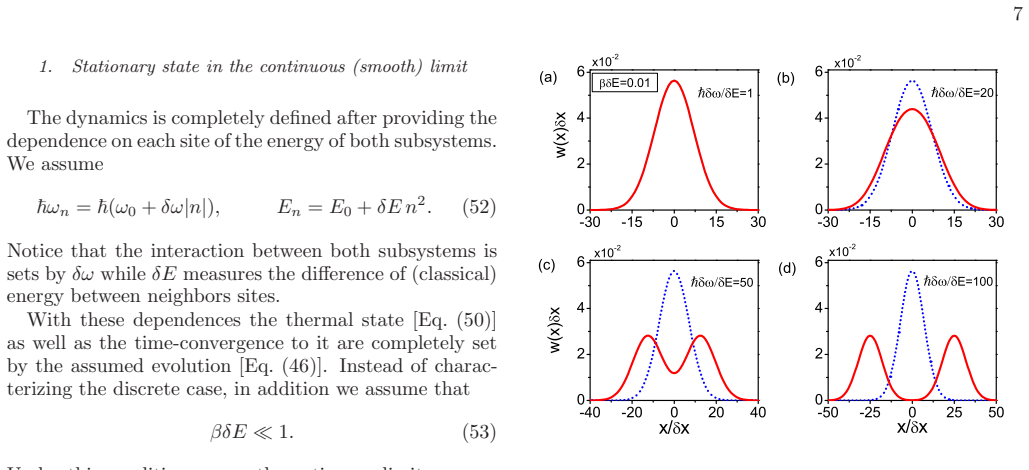
Stationary state in the continuous (smooth) limit The dynamics is completely defined after providing the dependence on each site of the energy of both subsystems. We assume ℏω n = ℏ(ω 0 + δω|n|), E n = E0 + δE n2. (52) Notice that the interaction between both subsystems is sets by δω while δE measures the difference of (classical) energy between neighbors s...
-
[4]
2 are indistinguishable (in the scale of the plots) with the discrete solutions set by Eq
Quantum Fokker-Planck-like equation Under the identifications w(x)δx→ wn and x/δx → n, the curves of Fig. 2 are indistinguishable (in the scale of the plots) with the discrete solutions set by Eq. (51). This equivalence is granted by condition (53). The physical origin of the bimodal behavior shown in Fig. 2 can be lighten by studying the time-evolution [E...
work page 2002
-
[5]
N. G. van Kampen, in Stochastic Processes in Physics and Chemistry , 2nd ed. (North-Holland, Amsterdam, 1992)
work page 1992
-
[6]
A. A. Budini, Lindblad rate equations, Phys. Rev. A 74 , 053815 (2006)
work page 2006
-
[7]
H. P. Breuer, Non-Markovian generalization of the Lind- blad theory of open quantum systems, Phys. Rev. A 75, 022103 (2007)
work page 2007
-
[8]
D. Chruscinski, A. Kossakowski, G. Marmo, and E. C. G. Sudarshan, Dynamics of Interacting Classical and Quan- tum Systems, Open Syst. Inf. Dynam. 18, 339 (2011)
work page 2011
-
[9]
Ph. Blanchard and A. Jadczyk, Events and piecewise de- terministic dynamics in event-enhanced quantum theory, Phys. Lett. A 203, 260 (1995); Ph. Blanchard and A. Jadczyk, On the interaction between classical and quan- tum systems, Phys. Lett. A 175, 157 (1993)
work page 1995
-
[10]
R. Alicki and S. Kryszewski, Completely positive Bloch- Boltzmann equations, Phys. Rev. A 68, 013809 (2003); B. Vacchini and K. Hornberger, Quantum linear Boltz- mann equation, Phys. Rep. 478, 71 (2009)
work page 2003
-
[11]
I. de Vega and D. Alonso, Dynamics of non-Markovian open quantum systems, Rev. Mod. Phys. 89, 015001 (2017)
work page 2017
-
[12]
M. Esposito and P. Gaspard, Quantum master equation for a system influencing its environment, Phys. Rev. E 68, 066112 (2003)
work page 2003
-
[13]
A. A. Budini, Random Lindblad equations from complex environments, Phys. Rev. E 72, 056106 (2005); A. A. Budini and Henning Schomerus, Non-Markovian master equations from entanglement with stationary unobserved degrees of freedom, J. Phys. A: Math. Gen. 38, 9251 (2005)
work page 2005
-
[14]
Heinz-Peter Breuer, Jochen Gemmer, and Mathias Michel, Non-Markovian quantum dynamics: Correlated projection superoperators and Hilbert space averaging, Phys. Rev. E 73, 016139 (2006)
work page 2006
-
[15]
J. Fischer and H. P. Breuer, Correlated projection oper - ator approach to non-Markovian dynamics in spin baths, Phys. Rev. A 76, 052119 (2007)
work page 2007
-
[16]
E. Barkai, Y. Jung, and R. Silbey, Theory of Single- Molecule Spectroscopy: Beyond the Ensemble Aver- age, Annu. Rev. Phys. Chem. 55, 457 (2004); Y. Jung, E. Barkai, and R. J. Silbey, Current status of single- molecule spectroscopy: Theoretical aspects, J. Chem. Phys. 117, 10980 (2002)
work page 2004
-
[17]
A. A. Budini, Open quantum system approach to single- molecule spectroscopy, Phys. Rev. A 79, 043804 (2009)
work page 2009
-
[18]
A. A. Budini, Quantum jumps and photon statistics in fluorescent systems coupled to classically fluctuating reservoirs, J. Phys. B: At. Mol. Opt. Phys. 43, 115501 11 (2010)
work page 2010
-
[19]
I. Guevara and H. Wiseman, Quantum State Smoothing, Phys. Rev. Lett. 115, 180407 (2015)
work page 2015
-
[20]
A. A. Budini, Smoothed quantum-classical states in tim e- irreversible hybrid dynamics, Phys. Rev. A 96, 032118 (2017)
work page 2017
-
[21]
A. Riera-Campeny, A. Sanpera, and P. Strasberg, Quan- tum Systems Correlated with a Finite Bath: Nonequi- librium Dynamics and Thermodynamics, Phys. Rev. X Quantum 2, 010340 (2021)
work page 2021
- [22]
-
[23]
J. Oppenheim, C. Sparaciari, B. Soda, and Z. Weller- Davies, The two classes of hybrid classical-quantum dy- namics, arXiv:2203.01332v1 [quant-ph] 2 Mar 2022
-
[24]
J. Oppenheim, C. Sparaciari, B. ˇSoda, and Z. Weller-Davies, Objective trajectories in hybrid classical-quantum dynamics, Quantum 7, 891 (2023); arXiv:2011.06009v3
-
[25]
B. Annby-Andersson, F. Bakhshinezhad, D. Bhat- tacharyya, G. De Sousa, C. Jarzynski, P. Samuelsson, and P. P. Potts, Quantum Fokker-Planck Master Equa- tion for Continuous Feedback Control, Phys. Rev. Lett. 129 , 050401 (2022)
work page 2022
-
[26]
Di´ osi, Hybrid completely positive Markovian quantum-classical dynamics, Phys
L. Di´ osi, Hybrid completely positive Markovian quantum-classical dynamics, Phys. Rev. A 107, 062206 (2023)
work page 2023
-
[27]
Kapral, Progress in the theory of mixed quantum- classical dynamics, Annu
R. Kapral, Progress in the theory of mixed quantum- classical dynamics, Annu. Rev. Phys. Chem. 57, 129 (2006)
work page 2006
-
[28]
Di´ osi and J. Halliwell, Coupling Classical and Quantu m Variables using Continuous Quantum Measurement The- ory, Phys. Rev. Lett. 81, 2846 (1998)
work page 1998
-
[29]
L. Di´ osi, N. Gisin, and W. T. Strunz, Quantum approach to coupling classical and quantum dynamics, Phys. Rev. A 61, 022108 (2000)
work page 2000
-
[30]
Di´ osi, Hybrid quantum-classical master equations , Phys
L. Di´ osi, Hybrid quantum-classical master equations , Phys. Scr. T163, 014004 (2014)
work page 2014
-
[31]
Karolyhazy, Gravitation and Quantum Mechanics of Macroscopic Objects, Nuovo Cimento A 42, 390 (1966)
F. Karolyhazy, Gravitation and Quantum Mechanics of Macroscopic Objects, Nuovo Cimento A 42, 390 (1966)
work page 1966
-
[32]
Penrose, On Gravity’s Role in Quantum State Reduc- tion, Gen
R. Penrose, On Gravity’s Role in Quantum State Reduc- tion, Gen. Relativ. Gravit. 28, 581 (1966)
work page 1966
-
[33]
L. Di´ osi, The gravity-related decoherence master equ a- tion from hybrid dynamics, Journal of Physics: Confer- ence Series 306, 012006 (2011)
work page 2011
-
[34]
M. Bahrami, A. Smirne, and A. Bassi, Role of gravity in the collapse of a wave function: A probe into the Di´ osi-Penrose model, Phys. Rev. A 90, 062105 (2014); Angelo Bassi, K. Lochan, S. Satin, T. P. Singh, and H. Ulbrichtk, Models of wave-function collapse, underlying theories, and experimental tests, Rev. Mod. Phys. 85, 471 (2013)
work page 2014
-
[35]
A. Tilloy and L. Di´ osi, Sourcing semiclassical gravit y from spontaneously localized quantum matter, Phys. Rev. D 93 , 024026 (2016)
work page 2016
-
[36]
The weak field limit of quantum matter back-reacting on classical spacetime,
I. Layton, J. Oppenheim, A. Russo, and Z. Weller-Davies , The weak field limit of quantum matter back-reacting on classical spacetime, J. High Energy Phys. 163 (2023); arXiv:2307.02557v1
-
[37]
Gravitationally induced decoherence vs space-time diffusion: testing the quantum nature of gravity,
J. Oppenheim, C. Sparaciari, B. Soda, and Z. Weller-Davies, Gravitationally induced decoherence vs space-time diffusion: testing the quantum nature of gravity, Nature Communications 14, 7910 (2023); arXiv:2203.01982v1
-
[38]
Oppenheim, A Postquantum Theory of Classical Grav- ity?, Phys
J. Oppenheim, A Postquantum Theory of Classical Grav- ity?, Phys. Rev. X 13, 041040 (2023)
work page 2023
-
[39]
J. L. Alonso, C. Bouthelier-Madre, J. Clemente-Gallar do, and D. Mart ´ ınez-Crespo, Hybrid geometrodynamics: a Hamiltonian description of classical gravity coupled to quantum matter, Class. Quantum Grav. 41, 105004 (2024)
work page 2024
-
[40]
A. A. Budini, Quantum–Classical Hybrid Dynamics: Coupling Mechanisms and Diffusive Approximation, Open Systems & Information Dynamics 31, 2250001 (2024)
work page 2024
-
[41]
S. Camalet, Probability-based approach to hybrid classical-quantum systems of any size: Generalized Glea- son and Kraus theorems, Phys. Rev. A 111, 012201 (2025)
work page 2025
- [42]
-
[43]
J. L. Alonso, C. Bouthelier, A. Castro, J. Clemente- Gallardo, and J. A. Jover-Galtier, Entropy and canon- ical ensemble of hybrid quantum classical systems, Phys. Rev. E 102, 042118 (2020)
work page 2020
-
[44]
J. L. Alonso, C. Bouthelier-Madre, A. Castro, J. Clemente-Gallardo, and J. A. Jover-Galtier, About the computation of finite temperature ensemble averages of hybrid quantum-classical systems with molecular dynam- ics, New J. Phys. 23, 063011 (2021)
work page 2021
-
[45]
J. L. Alonso, C. Bouthelier-Madre, A. Castro, J. Clemente-Gallardo, and J. A. Jover-Galtier, Hybrid quantum-classical systems: statistics, entropy, micro- canonical ensemble and its connection to the canonical ensemble, Phys. Rev. E 113, 034110 (2026)
work page 2026
-
[46]
L. E. Reichl, A Modern Course in Statistical Physics , 2nd Ed. (Whiley&Sons, 1998)
work page 1998
-
[47]
A. A. Budini, Embedding non-Markovian quantum colli- sional models into bipartite Markovian dynamics, Phys. Rev. A 88, 032115 (2013); A. A. Budini, Stochastic repre- sentation of a class of non-Markovian completely positive evolutions, Phys. Rev. A 69, 042107 (2004)
work page 2013
- [48]
discussion (0)
Sign in with ORCID, Apple, or X to comment. Anyone can read and Pith papers without signing in.