Recognition: 2 theorem links
· Lean TheoremSpherical Antenna Arrays for Future Communications: Principles, Applications, and Research Directions
Pith reviewed 2026-05-13 18:55 UTC · model grok-4.3
The pith
Spherical antenna arrays provide 3D full-space coverage and higher angular resolution than traditional planar arrays for 6G systems.
A machine-rendered reading of the paper's core claim, the machinery that carries it, and where it could break.
Core claim
Spherical antenna arrays (SAAs), with elements uniformly distributed on a spherical surface, provide an effective solution for three-dimensional (3D) full-space coverage and high angular resolution in 6G. The paper shows that traditional uniform linear arrays and uniform planar arrays fall short on these requirements, demonstrates the superiority of SAAs over UPAs through a case study, and identifies key challenges and research directions for their development in future wireless communications.
What carries the argument
Spherical Antenna Arrays (SAAs) with elements placed uniformly on a spherical surface, which enable isotropic 3D coverage and improved angular resolution by exploiting spherical geometry rather than flat or linear layouts.
If this is right
- SAAs can support 6G scenarios that require simultaneous coverage in all directions, such as integrated satellite-terrestrial networks.
- Higher angular resolution from spherical geometry enables more precise beamforming and interference management in dense user environments.
- The case study establishes concrete performance edges over uniform planar arrays in key metrics relevant to 6G.
- Overcoming placement precision and processing complexity is presented as the next required step for practical use.
Where Pith is reading between the lines
- If SAAs scale in manufacturing cost, they could reduce the total number of elements needed for equivalent 3D performance compared with planar grids.
- Hybrid arrays that combine spherical and planar elements might offer a practical compromise during early 6G rollouts.
- Advances in distributed signal processing could lower the complexity barrier identified in the paper and accelerate testing.
Load-bearing premise
That the performance advantages shown in the case study will carry over to real deployments once element placement precision and signal-processing complexity are solved.
What would settle it
Field measurements in a 3D environment that find no statistically significant improvement in angular resolution or coverage area for spherical arrays compared with equivalent planar arrays would falsify the central claim.
Figures



read the original abstract
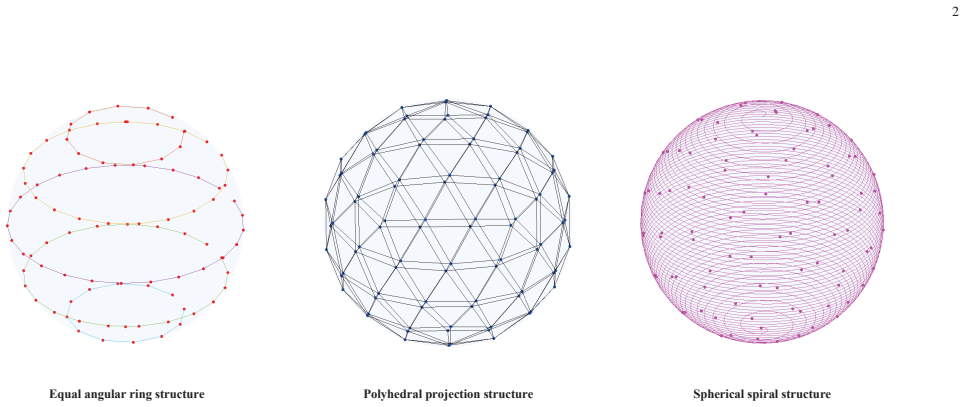
With the development of 6G technologies, traditional uniform linear arrays (ULAs) and uniform planar arrays (UPAs) can hardly meet the demands of three-dimensional (3D) full-space coverage and high angular resolution. Spherical antenna arrays (SAAs), with elements uniformly distributed on a spherical surface, provide an effective solution. This article analyzes the issues of traditional arrays, summarizes the advantages and typical structures of SAAs, discusses their potential application scenarios, and verifies their superiority over UPAs via a case study. Finally, key technical challenges and corresponding research directions of SAAs are identified, providing a reference for their research and application in future wireless communications.
Editorial analysis
A structured set of objections, weighed in public.
Referee Report
Summary. The manuscript reviews spherical antenna arrays (SAAs) for 6G communications, arguing that elements uniformly distributed on a spherical surface enable effective 3D full-space coverage and high angular resolution, outperforming traditional uniform linear arrays (ULAs) and uniform planar arrays (UPAs). It analyzes limitations of conventional arrays, summarizes SAA advantages and typical structures, discusses application scenarios, verifies superiority via a case study, and identifies technical challenges with corresponding research directions.
Significance. As a survey synthesizing SAA principles, structures, and open problems (including placement precision and processing complexity), the paper could serve as a useful reference for antenna design in future wireless systems if the case study gains are shown to hold under realistic conditions. It consolidates existing work and points to research directions without introducing new derivations or proofs.
major comments (2)
- [Case Study] Case Study section: The verification of SAA superiority over UPAs provides no details on simulation parameters (array size, frequency, channel model), error bars, or sensitivity to position perturbations, despite the paper itself listing element placement precision as a key challenge; this leaves the central claim of measurable gains unsupported by the presented evidence.
- [Advantages of SAAs] Section on advantages of SAAs: The discussion of 3D coverage benefits does not incorporate quantitative modeling of mutual coupling or non-ideal element placement (e.g., deviations of 0.05λ), which the skeptic note and paper's own challenges section indicate would be required to substantiate practical superiority over UPAs.
minor comments (2)
- [Abstract] The abstract and introduction could clarify that this is a review paper with an illustrative case study rather than a primary research contribution with new derivations.
- Figure captions for array geometries would benefit from explicit mention of coordinate systems and element count to improve reproducibility.
Simulated Author's Rebuttal
We thank the referee for the constructive and detailed comments, which will help improve the clarity and rigor of our survey. We address each major comment below, indicating planned revisions to strengthen the case study and advantages discussion while preserving the manuscript's scope as a review of principles, applications, and directions.
read point-by-point responses
-
Referee: [Case Study] Case Study section: The verification of SAA superiority over UPAs provides no details on simulation parameters (array size, frequency, channel model), error bars, or sensitivity to position perturbations, despite the paper itself listing element placement precision as a key challenge; this leaves the central claim of measurable gains unsupported by the presented evidence.
Authors: We agree that the case study lacks explicit simulation details, which weakens the support for the claimed gains. In the revised manuscript, we will expand this section to include all relevant parameters: array sizes (number of elements for both SAA and UPA), operating frequency, the specific channel model, and error bars on the performance curves. We will also add a short sensitivity analysis showing the impact of small position perturbations, directly linking to the placement precision challenge already identified in the paper. These additions will make the verification more transparent and robust. revision: yes
-
Referee: [Advantages of SAAs] Section on advantages of SAAs: The discussion of 3D coverage benefits does not incorporate quantitative modeling of mutual coupling or non-ideal element placement (e.g., deviations of 0.05λ), which the skeptic note and paper's own challenges section indicate would be required to substantiate practical superiority over UPAs.
Authors: The advantages section focuses on the fundamental geometric properties of uniform spherical distributions for ideal 3D coverage and resolution, consistent with the survey style of the paper. We acknowledge that practical factors such as mutual coupling and placement errors are critical for real-world claims. In revision, we will augment the section with a concise quantitative discussion, including references to existing work on mutual coupling in spherical arrays and an estimate of performance degradation for deviations around 0.05λ drawn from the challenges section. This will clarify the distinction between ideal benefits and practical considerations without expanding into a full non-ideal simulation, which we view as outside the current scope. revision: partial
Circularity Check
No circularity: review paper with descriptive case study
full rationale
The manuscript is a survey-style article that reviews limitations of ULAs/UPAs, summarizes SAA advantages and structures, discusses applications, and verifies superiority via a case study. No derivation chain, equations, or fitted parameters are present that reduce any claimed prediction or result to the inputs by construction. The case study is presented as empirical verification rather than a self-referential fit, and no self-citation load-bearing steps or ansatz smuggling appear in the abstract or described content. This is a standard non-circular review structure.
Axiom & Free-Parameter Ledger
Lean theorems connected to this paper
-
IndisputableMonolith/Foundation/AlexanderDuality.leanalexander_duality_circle_linking echoes?
echoesECHOES: this paper passage has the same mathematical shape or conceptual pattern as the Recognition theorem, but is not a direct formal dependency.
a golden-angle spiral distribution is adopted to ensure uniform spatial coverage. The coordinates of each element are determined based on the golden angle
-
IndisputableMonolith/Foundation/AlexanderDuality.leanD3_admits_circle_linking echoes?
echoesECHOES: this paper passage has the same mathematical shape or conceptual pattern as the Recognition theorem, but is not a direct formal dependency.
Spherical antenna arrays (SAAs), with elements uniformly distributed on a spherical surface, provide an effective solution for three-dimensional (3D) full-space coverage
What do these tags mean?
- matches
- The paper's claim is directly supported by a theorem in the formal canon.
- supports
- The theorem supports part of the paper's argument, but the paper may add assumptions or extra steps.
- extends
- The paper goes beyond the formal theorem; the theorem is a base layer rather than the whole result.
- uses
- The paper appears to rely on the theorem as machinery.
- contradicts
- The paper's claim conflicts with a theorem or certificate in the canon.
- unclear
- Pith found a possible connection, but the passage is too broad, indirect, or ambiguous to say the theorem truly supports the claim.
Reference graph
Works this paper leans on
-
[1]
On th e road to 6G: Visions, requirements, key technologies, and te stbeds,
C.-X. Wang, X. Y ou, X. Gao, X. Zhu, Z. Li, C. Zhang, H. Wang, Y . Huang, Y . Chen, H. Haas, J. S. Thompson, E. G. Larsson, M. D. Renzo, W. Tong, P . Zhu, X. Shen, H. V . Poor, and L. Hanzo, “On th e road to 6G: Visions, requirements, key technologies, and te stbeds,” IEEE Commun. Surveys Tuts. , vol. 25, no. 2, pp. 905–974, 2nd Quart. 2023. 7
work page 2023
-
[2]
Deep learning based be am training for extremely large-scale massive MIMO in near-fie ld domain,
W. Liu, H. Ren, C. Pan, and J. Wang, “Deep learning based be am training for extremely large-scale massive MIMO in near-fie ld domain,” IEEE Commun. Lett. , vol. 27, no. 1, pp. 170–174, Jan. 2023
work page 2023
-
[3]
3D beamforming technologies and field trials in 5G ma ssive MIMO systems,
J. Wang, W. Deng, X. Li, H. Zhu, M. Nair, T. Chen, N. Yi, and N . J. Gomes, “3D beamforming technologies and field trials in 5G ma ssive MIMO systems,” IEEE Open J. V eh.Technol., vol. 1, pp. 362–371, 2020
work page 2020
-
[4]
X. Chen, H. Ren, C. Pan, C.-X. Wang, and J. Wang, “Explorin g the advantages of sparse arrays in near-field xl-mimo system s: Beam analysis and EDoF function,” IEEE Trans. Commun., 2026, early access
work page 2026
-
[5]
3D spherical dire ctly- connected antenna array for low-altitude UA V swarm ISAC,
H. Jiang, Z. Dong, Z. Zhou, and Y . Zeng, “3D spherical dire ctly- connected antenna array for low-altitude UA V swarm ISAC,” 2 026. [Online]. Available: https://arxiv.org/abs/2603.17620
-
[6]
M. Mahmood, A. Koc, and T. Le-Ngoc, “3-D antenna array str uctures for millimeter wave multi-user massive MIMO hybrid precode r design: A performance comparison,” IEEE Commun. Lett. , vol. 26, no. 6, pp. 1393–1397, Jun. 2022
work page 2022
-
[7]
Spherical arrays - des ign consider- ations,
B. Tomasic, J. Turtle, and S. Liu, “Spherical arrays - des ign consider- ations,” in 2005 18th International Conference on Applied Electromag- netics and Communications , 2005, pp. 1–8
work page 2005
-
[8]
Spatial chan nel degrees of freedom for optimum antenna arrays,
Y . Huang, P . Karadimas, and A. Pour Sohrab, “Spatial chan nel degrees of freedom for optimum antenna arrays,” IEEE Trans. Wireless Commun. , vol. 22, no. 8, pp. 5129–5144, Aug. 2023
work page 2023
-
[9]
W. Ryoo and W. Sung, “Beamforming using uniform spherica l arrays: Array construction, beam characteristics, and multi-rank transmission,” IEEE Access , vol. 9, pp. 38 731–38 741, Mar. 2021
work page 2021
-
[10]
Spherical arrays for wire less channel characterization and emulation,
O. Franek and G. F. Pedersen, “Spherical arrays for wire less channel characterization and emulation,” in 2014 IEEE-APS Topical Conference on Antennas and Propagation in Wireless Communications (AP WC), 2014, pp. 480–483
work page 2014
-
[11]
Non-unifo rm 3D mas- sive mimo arrays topology optimization for near-field commu nications,
Y . Guo, Y . Zhang, L. Pang, Y . Liu, and Z. Ding, “Non-unifo rm 3D mas- sive mimo arrays topology optimization for near-field commu nications,” in 2024 IEEE 35th International Symposium on Personal, Indoor and Mobile Radio Communications (PIMRC) , 2024, pp. 1–5
work page 2024
-
[12]
Spherical RIS-assiste d mmwave MIMO wireless communications with concentric UCAs,
H. Jing, W. Cheng, and W. Zhang, “Spherical RIS-assiste d mmwave MIMO wireless communications with concentric UCAs,” IEEE Trans. Commun., vol. 73, no. 10, pp. 9676–9688, Oct. 2025
work page 2025
-
[13]
O. J. Famoriji and T. Shongwe, “Source localization of E M waves in the near-field of spherical antenna array in the presence of unkn own mutual coupling,” Wirel. Commun. Mob. Comput. , vol. 2021, no. 1, p. 3237219, 2021
work page 2021
discussion (0)
Sign in with ORCID, Apple, or X to comment. Anyone can read and Pith papers without signing in.