Recognition: 2 theorem links
· Lean TheoremA Route to Nonrelativistic Altermagnetic Spin Splitting via Ultrafast Light
Pith reviewed 2026-05-13 18:25 UTC · model grok-4.3
The pith
Linearly polarized light induces altermagnetic spin splitting by breaking effective time-reversal symmetry in antiferromagnets.
A machine-rendered reading of the paper's core claim, the machinery that carries it, and where it could break.
Core claim
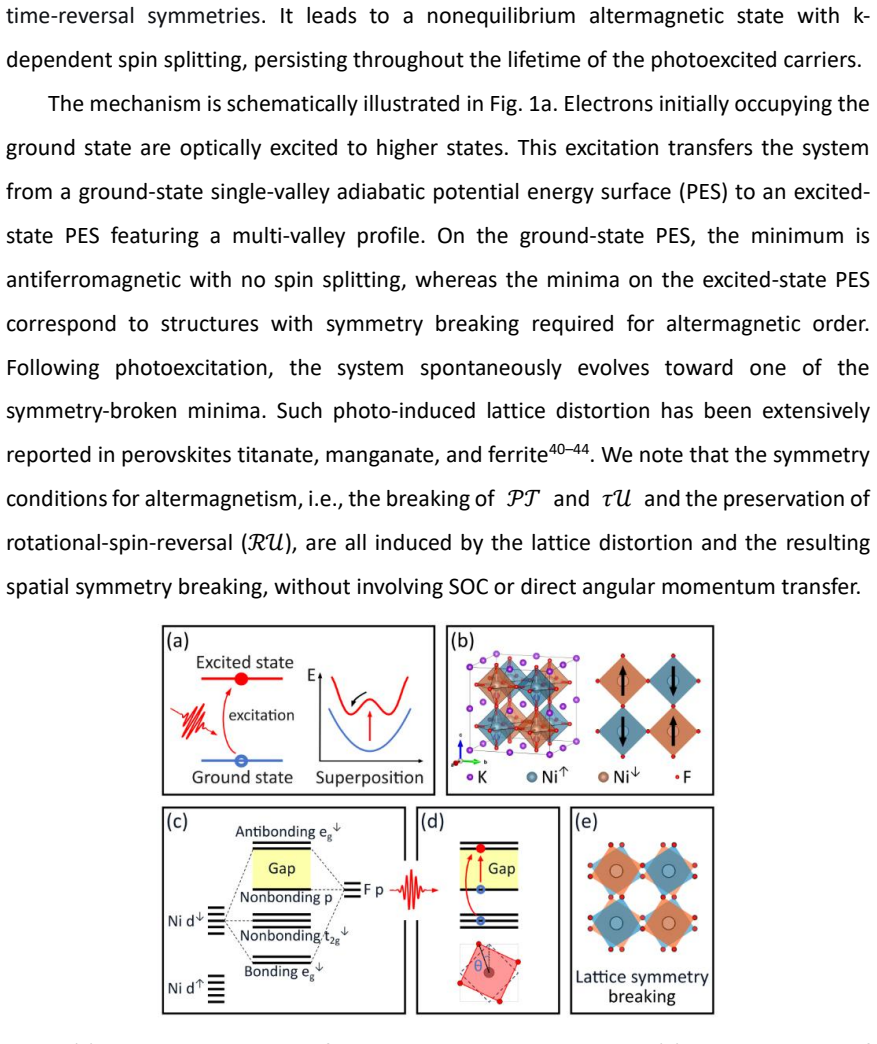
Using real-time time-dependent density functional theory simulations on the antiferromagnetic perovskite KNiF3, the authors show that linearly polarized light can induce momentum-dependent altermagnetic spin splitting by breaking the effective time-reversal symmetry through photoexcited charge redistribution and the resulting lattice distortion, without requiring relativistic angular-momentum transfer, static symmetry breaking, or auxiliary external fields.
What carries the argument
Photoexcited charge redistribution and lattice distortion that effectively breaks time-reversal symmetry.
If this is right
- Altermagnetic spin splitting becomes accessible in the nonequilibrium regime via light.
- The method avoids the need for relativistic effects or permanent structural changes.
- A symmetry selection rule generalizes the effect to other antiferromagnetic materials.
- Ultrafast optical control of altermagnetism is possible.
Where Pith is reading between the lines
- This mechanism may allow for rapid switching in altermagnetic spintronic devices using light pulses.
- Similar light-induced effects could be explored in other magnetic phases to induce hidden order parameters.
- It opens the possibility of studying altermagnetism in transient states not stable in equilibrium.
Load-bearing premise
That the photoexcited charge redistribution and lattice distortion break time-reversal symmetry in a way that produces pure altermagnetic spin splitting without relativistic contributions.
What would settle it
Observation of no momentum-dependent spin splitting after applying linearly polarized light to KNiF3, or calculations showing the splitting disappears when spin-orbit coupling is turned off.
Figures


read the original abstract
We identify a nonequilibrium route for generating altermagnetic spin splitting in antiferromagnet by ultrafast light. Unlike existing strategies, this route does not require relativistic angular-momentum transfer, static symmetry breaking, or auxiliary external fields. Using real-time time-dependent density functional theory, we demonstrate in the antiferromagnetic perovskite KNiF3 that linearly polarized light can induce momentum-dependent altermagnetic spin splitting by breaking the effective time-reversal symmetry through photoexcited charge redistribution and the resulting lattice distortion. We provide a general symmetry selection rule for this route. These results establish a mechanism for ultrafast control of altermagnetism and extend its material realization into the nonequilibrium regime.
Editorial analysis
A structured set of objections, weighed in public.
Referee Report
Summary. The paper claims that linearly polarized ultrafast light induces momentum-dependent altermagnetic spin splitting in the antiferromagnetic perovskite KNiF3 via photoexcited charge redistribution and resulting lattice distortion, without relativistic spin-orbit coupling or external fields. This is demonstrated using real-time time-dependent density functional theory (TDDFT) simulations, accompanied by a general symmetry selection rule for the nonequilibrium route.
Significance. If the central mechanism is confirmed, the work would establish a new ultrafast, nonrelativistic pathway to altermagnetism in nonequilibrium regimes, extending material realizations and enabling light-based control of compensated spin splitting for potential spintronic applications. The explicit TDDFT dynamics and symmetry rule provide a concrete, falsifiable demonstration rather than a fitted or abstract construction.
major comments (2)
- [TDDFT results] The TDDFT results section: the central claim of genuine altermagnetic (zero-net-M) spin splitting requires explicit confirmation that the total integrated spin magnetization remains zero after the light pulse and lattice relaxation. No such post-excitation magnetization check, fixed-lattice control run, or error-bar analysis on the spin density is reported, leaving open the possibility that the observed k-odd splitting arises from net polarization rather than compensated altermagnetic order.
- [symmetry selection rule] The symmetry selection rule (presented after the simulations): while the rule is stated as general, its derivation and applicability beyond KNiF3 are not shown to be independent of the specific TDDFT charge redistribution; a concrete test case or counter-example material would strengthen the claim that the route is broadly nonrelativistic and parameter-free.
minor comments (2)
- [abstract] The abstract and introduction should explicitly state the computational parameters (pulse duration, intensity, k-point sampling) used in the real-time TDDFT to allow reproducibility.
- [figures] Figure captions for the spin-splitting plots should include the time delay at which the bands are shown and note whether ionic motion is included.
Simulated Author's Rebuttal
We thank the referee for the careful reading and constructive comments on our manuscript. We address each major point below and have revised the manuscript to incorporate additional checks and clarifications.
read point-by-point responses
-
Referee: [TDDFT results] The TDDFT results section: the central claim of genuine altermagnetic (zero-net-M) spin splitting requires explicit confirmation that the total integrated spin magnetization remains zero after the light pulse and lattice relaxation. No such post-excitation magnetization check, fixed-lattice control run, or error-bar analysis on the spin density is reported, leaving open the possibility that the observed k-odd splitting arises from net polarization rather than compensated altermagnetic order.
Authors: We agree that explicit verification of zero net magnetization is necessary to substantiate the altermagnetic character. In the revised manuscript we have added a dedicated paragraph and supplementary figure documenting the time evolution of the total spin magnetization, which remains zero to within numerical precision (10^{-4} μ_B per formula unit) after the pulse and during ionic relaxation. We also include a fixed-lattice control simulation in which the observed k-odd splitting vanishes, confirming that the effect requires the photoinduced lattice distortion. Convergence tests with respect to k-point sampling and time step are now reported, providing error estimates on the spin density. revision: yes
-
Referee: [symmetry selection rule] The symmetry selection rule (presented after the simulations): while the rule is stated as general, its derivation and applicability beyond KNiF3 are not shown to be independent of the specific TDDFT charge redistribution; a concrete test case or counter-example material would strengthen the claim that the route is broadly nonrelativistic and parameter-free.
Authors: The selection rule follows from the magnetic space-group symmetries that allow photoexcited charge redistribution to break effective time-reversal symmetry while preserving zero net magnetization; the derivation itself does not depend on the details of the TDDFT charge density. To make this independence explicit we have expanded the symmetry analysis section with a step-by-step group-theoretic argument and have added a brief discussion of its application to a second antiferromagnet (MnF2) under the same light polarization, where the same nonequilibrium altermagnetic splitting is symmetry-allowed. This addition demonstrates that the route is not tied to KNiF3-specific parameters. revision: yes
Circularity Check
No circularity: result obtained from explicit real-time TDDFT simulation
full rationale
The paper's central demonstration proceeds from real-time time-dependent density functional theory dynamics that explicitly evolve the electronic charge density and ionic positions under a linearly polarized light pulse in KNiF3. This computational procedure is not equivalent to its inputs by construction, nor does it rename a fitted parameter as a prediction. The symmetry selection rule is stated as independently derivable from group-theoretic considerations on the nonequilibrium state and does not reduce to a self-citation chain or ansatz imported from prior work by the same authors. No load-bearing step collapses to a tautology or to a parameter fitted to the target observable itself.
Axiom & Free-Parameter Ledger
axioms (1)
- domain assumption Standard real-time TDDFT approximations for electron and lattice dynamics
Lean theorems connected to this paper
-
IndisputableMonolith/Cost/FunctionalEquationwashburn_uniqueness_aczel unclear?
unclearRelation between the paper passage and the cited Recognition theorem.
linearly polarized light can induce momentum-dependent altermagnetic spin splitting by breaking the effective time-reversal symmetry through photoexcited charge redistribution and the resulting lattice distortion
-
IndisputableMonolith/Foundation/AlexanderDualityalexander_duality_circle_linking unclear?
unclearRelation between the paper passage and the cited Recognition theorem.
the symmetry conditions for altermagnetism, i.e., the breaking of PT and tau-U and the preservation of rotational-spin-reversal (R-U), are all induced by the lattice distortion
What do these tags mean?
- matches
- The paper's claim is directly supported by a theorem in the formal canon.
- supports
- The theorem supports part of the paper's argument, but the paper may add assumptions or extra steps.
- extends
- The paper goes beyond the formal theorem; the theorem is a base layer rather than the whole result.
- uses
- The paper appears to rely on the theorem as machinery.
- contradicts
- The paper's claim conflicts with a theorem or certificate in the canon.
- unclear
- Pith found a possible connection, but the passage is too broad, indirect, or ambiguous to say the theorem truly supports the claim.
Reference graph
Works this paper leans on
-
[1]
Hayami, S., Yanagi, Y . & Kusunose, H. Momentum -Dependent Spin Splitting by Collinear Antiferromagnetic Ordering. J. Phys. Soc. Jpn. 88, 123702 (2019)
work page 2019
-
[2]
Šmejkal, L., Sinova, J. & Jungwirth, T. Emerging Research Landscape of Altermagnetism. Phys. Rev. X 12, 040501 (2022)
work page 2022
-
[3]
Yuan, L.-D., Wang, Z., Luo, J.-W., Rashba, E. I. & Zunger, A. Giant momentum-dependent spin splitting in centrosymmetric low- Z antiferromagnets. Phys. Rev. B 102, 014422 (2020)
work page 2020
-
[4]
Šmejkal, L., González-Hernández, R., Jungwirth, T. & Sinova, J. Crystal time-reversal symmetry breaking and spontaneous Hall effect in collinear antiferromagnets. Sci. Adv. 6, eaaz8809 (2020)
work page 2020
-
[5]
I., Koepernik, K., Johannes, M
Mazin, I. I., Koepernik, K., Johannes, M. D., González -Hernández, R. & Šmejkal, L. Prediction of unconventional magnetism in doped FeSb2. Proc. Natl. Acad. Sci. U.S.A. 118, e2108924118 (2021)
work page 2021
-
[6]
Yuan, L.-D., Georgescu, A. B. & Rondinelli, J. M. Nonrelativistic Spin Splitting at the Brillouin Zone Center in Compensated Magnets. Phys. Rev. Lett. 133, 216701 (2024)
work page 2024
-
[7]
Yuan, L.-D., Wang, Z., Luo, J. -W. & Zunger, A. Prediction of low -Z collinear and noncollinear antiferromagnetic compounds having momentum -dependent spin splitting even without spin-orbit coupling. Phys. Rev. Materials 5, 014409 (2021)
work page 2021
- [8]
-
[9]
Zhang, X., Xiong, J.-X., Yuan, L.-D. & Zunger, A. Prototypes of Nonrelativistic Spin Splitting and Polarization in Symmetry Broken Antiferromagnets. Phys. Rev. X 15, 031076 (2025)
work page 2025
-
[10]
Liu, J. et al. Absence of Altermagnetic Spin Splitting Character in Rutile Oxide RuO 2. Phys. Rev. Lett. 133, 176401 (2024)
work page 2024
-
[11]
Šmejkal, L. et al. Chiral Magnons in Altermagnetic RuO 2. Phys. Rev. Lett. 131, 256703 (2023)
work page 2023
-
[12]
Fedchenko, O. et al. Observation of time-reversal symmetry breaking in the band structure of altermagnetic RuO2. Sci. Adv. 10, eadj4883 (2024). 11 / 14
work page 2024
- [13]
-
[14]
Devaraj, N., Bose, A. & Narayan, A. Interplay of altermagnetism and pressure in hexagonal and orthorhombic MnTe. Phys. Rev. Materials 8, 104407 (2024)
work page 2024
-
[15]
Liu, Z., Ozeki, M., Asai, S., Itoh, S. & Masuda, T. Chiral Split Magnon in Altermagnetic MnTe. Phys. Rev. Lett. 133, 156702 (2024)
work page 2024
-
[16]
Krempaský, J. et al. Altermagnetic lifting of Kramers spin degeneracy. Nature 626, 517–522 (2024)
work page 2024
-
[17]
Zhu, Y .-P . et al. Observation of plaid -like spin splitting in a noncoplanar antiferromagnet. Nature 626, 523–528 (2024)
work page 2024
-
[18]
Ding, J. et al. Large Band Splitting in g -Wave Altermagnet CrSb. Phys. Rev. Lett. 133, 206401 (2024)
work page 2024
-
[19]
Reimers, S. et al. Direct observation of altermagnetic band splitting in CrSb thin films. Nat Commun 15, 2116 (2024)
work page 2024
-
[20]
Santhosh, S. et al. Altermagnetic Band Splitting in 10 nm Epitaxial CrSb Thin Films. Advanced Materials 37, e08977 (2025)
work page 2025
-
[21]
Mandujano, H. C. et al. Evolution of Altermagnetism to Spin Density Waves in Co x NbSe2. J. Am. Chem. Soc. 147, 44926–44940 (2025)
work page 2025
-
[22]
Regmi, R. B. et al. Altermagnetism in the layered intercalated transition metal dichalcogenide CoNb4Se8. Nat Commun 16, 4399 (2025)
work page 2025
-
[23]
Sah, A. et al. Altermagnetism, Kagome Flat Band, and Weyl Fermion States in Magnetically Intercalated Transition Metal Dichalcogenides. Preprint at https://doi.org/10.48550/arXiv.2510.21968 (2025)
-
[24]
Graham, J. N. et al. Local probe evidence supporting altermagnetism in Co$_{1/4}$NbSe$_2$. Preprint at https://doi.org/10.48550/arXiv.2503.09193 (2025)
-
[25]
Bai, L. et al. Altermagnetism: Exploring New Frontiers in Magnetism and Spintronics. Adv Funct Materials 34, 2409327 (2024). 12 / 14
work page 2024
-
[26]
Mazin, I., González -Hernández, R. & Šmejkal, L. Induced Monolayer Altermagnetism in MnP(S,Se)$_3$ and FeSe. Preprint at https://doi.org/10.48550/arXiv.2309.02355 (2023)
-
[27]
Zhou, P . et al. Transition from antiferromagnets to altermagnets: Symmetry-Breaking Theory. Phys. Rev. B 112, 144419 (2025)
work page 2025
-
[28]
Spaldin, N. A. Multiferroics beyond electric -field control of magnetism. Proc. R. Soc. A. 476, 20190542 (2020)
work page 2020
-
[29]
Spaldin, N. A. & Ramesh, R. Advances in magnetoelectric multiferroics. Nature Mater 18, 203– 212 (2019)
work page 2019
- [30]
-
[31]
Sun, W., Yang, C., Wang, X., Huang, S. & Cheng, Z. Altermagnetic multiferroics with symmetry- locked magnetoelectric coupling. Nat. Mater. https://doi.org/10.1038/s41563-026-02518-5 (2026) doi:10.1038/s41563-026-02518-5
-
[32]
Gu, M. et al. Ferroelectric Switchable Altermagnetism. Phys. Rev. Lett. 134, 106802 (2025)
work page 2025
-
[33]
Duan, X. et al. Antiferroelectric Altermagnets: Antiferroelectricity Alters Magnets. Phys. Rev. Lett. 134, 106801 (2025)
work page 2025
- [34]
-
[35]
Wan, X., Mandal, S., Guo, Y . & Haule, K. High-Throughput Search for Metallic Altermagnets by Embedded Dynamical Mean Field Theory. Phys. Rev. Lett. 135, 106501 (2025)
work page 2025
-
[36]
Li, G. et al. Ultrafast kinetics of the antiferromagnetic-ferromagnetic phase transition in FeRh. Nat Commun 13, 2998 (2022)
work page 2022
-
[37]
Leenders, R. A., Afanasiev, D., Kimel, A. V. & Mikhaylovskiy, R. V. Canted spin order as a platform for ultrafast conversion of magnons. Nature 630, 335–339 (2024)
work page 2024
-
[38]
Igarashi, J. et al. Optically induced ultrafast magnetization switching in ferromagnetic spin valves. Nat. Mater. 22, 725–730 (2023)
work page 2023
-
[39]
Davies, C. S. et al. Phononic switching of magnetization by the ultrafast Barnett effect. Nature 13 / 14 628, 540–544 (2024)
work page 2024
-
[40]
Subedi, A., Cavalleri, A. & Georges, A. Theory of nonlinear phononics for coherent light control of solids. Phys. Rev. B 89, 220301 (2014)
work page 2014
-
[41]
Först, M. et al. Nonlinear phononics as an ultrafast route to lattice control. Nature Phys 7, 854–856 (2011)
work page 2011
-
[42]
Disa, A. S., Nova, T. F. & Cavalleri, A. Engineering crystal structures with light. Nat. Phys. 17, 1087–1092 (2021)
work page 2021
-
[43]
Juraschek, D. M., Fechner, M. & Spaldin, N. A. Ultrafast Structure Switching through Nonlinear Phononics. Phys. Rev. Lett. 118, 054101 (2017)
work page 2017
-
[44]
Song, C. et al. Electronic Origin of Laser-Induced Ferroelectricity in SrTiO3. J. Phys. Chem. Lett. 14, 576–583 (2023)
work page 2023
-
[45]
Ceriotti, D. et al. Mechanochemical synthesis of fluorinated perovskites KCuF3 and KNiF3. RSC Mechanochem. 1, 520–530 (2024)
work page 2024
-
[46]
Markovin, P . A., Petrov, S. V . & Pisarev, R. V. Isotropic and anisotropic magnetic refraction of light in the antiferromagnets KNiF, and RbMnF,
-
[47]
Bradley, C. J. & Cracknell, A. P . The mathematical theory of symmetry in solids;: Representation theory for point groups and space groups,. in (1972)
work page 1972
-
[48]
Ghorashi, S. A. A. & Li, Q. Dynamical Generation of Higher -order Spin -Orbit Couplings, Topology and Persistent Spin Texture in Light -Irradiated Altermagnets. Phys. Rev. Lett. 135, 236702 (2025)
work page 2025
-
[49]
Schilberth, F. et al. Magneto-optical detection of topological contributions to the anomalous Hall effect in a kagome ferromagnet. Phys. Rev. B 106, 144404 (2022)
work page 2022
-
[50]
Matsuda, T. et al. Ultrafast Dynamics of Intrinsic Anomalous Hall Effect in the Topological Antiferromagnet Mn 3 Sn. Phys. Rev. Lett. 130, 126302 (2023)
work page 2023
-
[51]
Trimarchi, G., Wang, Z. & Zunger, A. Polymorphous band structure model of gapping in the antiferromagnetic and paramagnetic phases of the Mott insulators MnO, FeO, CoO, and NiO. Phys. Rev. B 97, 035107 (2018). 14 / 14 ACKNOWLEDGMENTS This work is supported by the National Natural Science Foundation of China (12174380) . Z.W. is supported by the CAS projec...
work page 2018
discussion (0)
Sign in with ORCID, Apple, or X to comment. Anyone can read and Pith papers without signing in.