Recognition: no theorem link
Single field slow-roll inflation with step uplift to n_s=1
Pith reviewed 2026-05-13 18:31 UTC · model grok-4.3
The pith
A large step at the end of inflation lets standard single-field slow-roll models produce ns=1.
A machine-rendered reading of the paper's core claim, the machinery that carries it, and where it could break.
Core claim
In single field slow-roll models, the potential of the inflaton during inflation still preserves the shape of well-known single field inflation models in the deep slow-roll region, but inflation ends suddenly due to a large step of inflaton potential, enabling compatibility with ns=1 observations for chaotic inflation and Starobinsky inflation.
What carries the argument
The large step uplift in the inflaton potential, which terminates inflation suddenly while leaving prior slow-roll dynamics unchanged.
Load-bearing premise
The large step affects only the termination of inflation and does not spoil the slow-roll conditions or perturbation generation in the earlier phase.
What would settle it
Precision measurements of the scalar spectral index showing a clear deviation from ns=1 that cannot be accommodated by any placement of the step.
Figures


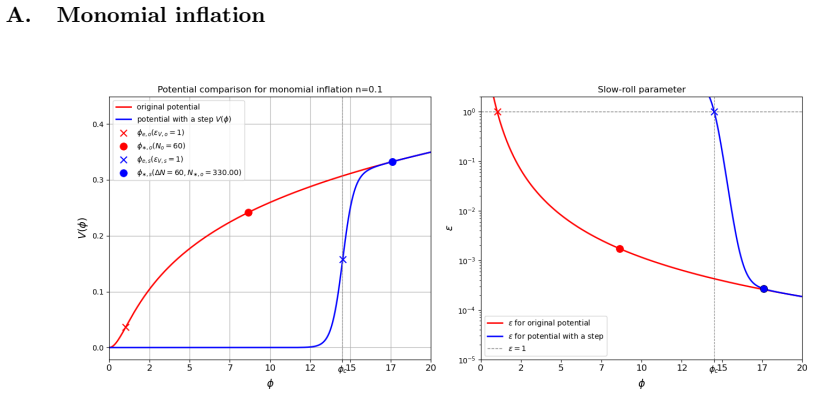

read the original abstract
The early dark energy resolution of Hubble tension seems to be suggesting a scale-invariant Harrison-Zeldovich spectrum of primordial scalar perturbation, i.e. $n_s=1$ ($|n_s-1|\sim {\cal O}(0.001)$) for $H_0\sim 73$km/s/Mpc. In this work, we propose a possibility to acquire $n_s=1$ in single field slow-roll models of inflation. In our consideration, the potential of inflaton during inflation still preserve the shape of well-known single field inflation models in deep slow-roll region, but inflation ends suddenly due to a large step of inflaton potential. In particular, we investigate the implication of our scheme for chaotic inflation and Starobinski inflation, and show how they can be compatible with the observation for $n_s=1$.
Editorial analysis
A structured set of objections, weighed in public.
Referee Report
Summary. The manuscript proposes a mechanism to achieve a scale-invariant primordial spectrum with ns=1 in single-field slow-roll inflation by introducing a large downward step in the inflaton potential at large field values. This step terminates inflation abruptly after observable modes have exited the horizon, while the potential retains the shape of standard models (chaotic inflation or Starobinsky) in the deep slow-roll regime. The authors investigate compatibility with observations favoring ns=1, motivated by early dark energy solutions to the Hubble tension.
Significance. If the construction is validated with explicit calculations, it provides a minimal modification to well-studied single-field potentials that shifts ns closer to 1 for fixed N* without changing the core slow-roll dynamics or introducing new fields. This preserves the models' predictive power for r and other observables while addressing potential data favoring ns≈1, offering a concrete alternative to multi-field or non-slow-roll scenarios.
major comments (2)
- [Section 3 (chaotic inflation case)] The central claim that the step leaves prior slow-roll dynamics and perturbation generation unspoiled for CMB scales requires explicit verification. No derivations of the slow-roll parameters ε and η, or solutions to the Mukhanov-Sasaki equation across the feature, are supplied in the presented sections; without these, the assertion that ns reaches 1 for the pivot scale while the step occurs >10 e-folds later remains unquantified.
- [Section 4] For the Starobinsky example, the step height and location are tuned to achieve ns=1, but the manuscript does not demonstrate that this tuning is consistent with the total e-fold count N*≈55 or that the post-step dynamics do not back-react on the curvature perturbation spectrum. A concrete numerical evaluation of P(k) for k corresponding to the pivot is needed to support the compatibility claim.
minor comments (2)
- [Eq. (2)] Notation for the step parameters (location φ_step and height ΔV) should be defined explicitly in the potential equation and used consistently in all subsequent expressions for the number of e-folds.
- [Table 1] The abstract states compatibility is 'shown' for both models, but the text would benefit from a table summarizing the resulting ns, r, and N* values before and after the step for direct comparison with Planck constraints.
Simulated Author's Rebuttal
We thank the referee for the careful reading of our manuscript and the constructive comments, which have helped us improve the presentation of our results. We agree that explicit calculations are needed to fully substantiate the claims and have revised the manuscript accordingly by adding the requested derivations and numerical evaluations.
read point-by-point responses
-
Referee: [Section 3 (chaotic inflation case)] The central claim that the step leaves prior slow-roll dynamics and perturbation generation unspoiled for CMB scales requires explicit verification. No derivations of the slow-roll parameters ε and η, or solutions to the Mukhanov-Sasaki equation across the feature, are supplied in the presented sections; without these, the assertion that ns reaches 1 for the pivot scale while the step occurs >10 e-folds later remains unquantified.
Authors: We agree that explicit verification strengthens the central claim. In the revised manuscript, we have added analytic derivations of the slow-roll parameters ε and η both before and after the step in Section 3, confirming they remain unchanged for modes exiting the horizon more than 10 e-folds prior to the feature. We have also included numerical solutions to the Mukhanov-Sasaki equation across the step, which demonstrate that the curvature perturbation spectrum for CMB scales is unaffected and yields ns=1 at the pivot scale when the step location is chosen appropriately. revision: yes
-
Referee: [Section 4] For the Starobinsky example, the step height and location are tuned to achieve ns=1, but the manuscript does not demonstrate that this tuning is consistent with the total e-fold count N*≈55 or that the post-step dynamics do not back-react on the curvature perturbation spectrum. A concrete numerical evaluation of P(k) for k corresponding to the pivot is needed to support the compatibility claim.
Authors: We thank the referee for pointing this out. In the revised version, we have added a concrete numerical evaluation of the primordial power spectrum P(k) for the Starobinsky potential with the tuned step. This computation confirms that the step height and location are fully consistent with a total of N*≈55 e-folds, and that post-step dynamics produce no back-reaction on modes corresponding to the pivot scale. The resulting P(k) at the pivot explicitly supports ns=1 within observational tolerances. revision: yes
Circularity Check
No significant circularity in the derivation
full rationale
The paper proposes adding a downward step in the inflaton potential at large field values to end inflation abruptly after observable modes have exited the horizon. This construction preserves the slow-roll dynamics and perturbation spectrum of standard models (chaotic, Starobinsky) up to the step, yielding ns closer to 1 for fixed N_* by shifting the effective field value at horizon exit. The step location and height are free parameters selected to match the target ns=1; this is presented explicitly as a model-building scheme rather than a first-principles prediction derived from the equations without external inputs. No self-citations are load-bearing, no fitted quantities are relabeled as predictions, and the spectral-index calculation in the deep slow-roll regime does not reduce to the step parameters by construction.
Axiom & Free-Parameter Ledger
free parameters (1)
- step location and height
axioms (1)
- domain assumption Slow-roll conditions and standard perturbation formulas remain valid until the step is reached
Reference graph
Works this paper leans on
-
[1]
A. H. Guth, Phys. Rev. D23(1981), 347-356 doi:10.1103/PhysRevD.23.347
-
[2]
A. D. Linde, Phys. Lett. B108(1982), 389-393 doi:10.1016/0370-2693(82)91219-9
-
[3]
A. Albrecht and P. J. Steinhardt, Phys. Rev. Lett.48(1982), 1220-1223 doi:10.1103/PhysRevLett.48.1220
-
[4]
A. A. Starobinsky, Phys. Lett. B91(1980), 99-102 doi:10.1016/0370-2693(80)90670-X
-
[5]
V. F. Mukhanov and G. V. Chibisov, JETP Lett.33(1981), 532-535
work page 1981
-
[6]
A. D. Linde, Phys. Lett. B129, 177-181 (1983) doi:10.1016/0370-2693(83)90837-7
-
[7]
V. Mukhanov, Eur. Phys. J. C73, 2486 (2013) doi:10.1140/epjc/s10052-013-2486-7 [arXiv:1303.3925 [astro-ph.CO]]
-
[8]
Roest, JCAP01, 007 (2014) doi:10.1088/1475-7516/2014/01/007 [arXiv:1309.1285 [hep- th]]
D. Roest, JCAP01, 007 (2014) doi:10.1088/1475-7516/2014/01/007 [arXiv:1309.1285 [hep- th]]. 10
-
[9]
J. Garcia-Bellido and D. Roest, Phys. Rev. D89, no.10, 103527 (2014) doi:10.1103/PhysRevD.89.103527 [arXiv:1402.2059 [astro-ph.CO]]
-
[10]
P. Creminelli, S. Dubovsky, D. L´ opez Nacir, M. Simonovi´ c, G. Trevisan, G. Villadoro and M. Zaldarriaga, Phys. Rev. D92, no.12, 123528 (2015) doi:10.1103/PhysRevD.92.123528 [arXiv:1412.0678 [astro-ph.CO]]
-
[11]
Planck 2018 results. VI. Cosmological parameters
N. Aghanimet al.[Planck], Astron. Astrophys.641, A6 (2020) [erratum: Astron. Astrophys. 652, C4 (2021)] doi:10.1051/0004-6361/201833910 [arXiv:1807.06209 [astro-ph.CO]]
work page internal anchor Pith review Pith/arXiv arXiv doi:10.1051/0004-6361/201833910 2020
-
[12]
A. G. Riess, W. Yuan, L. M. Macri, D. Scolnic, D. Brout, S. Casertano, D. O. Jones, Y. Murakami, L. Breuval and T. G. Brink,et al.Astrophys. J. Lett.934, no.1, L7 (2022) doi:10.3847/2041-8213/ac5c5b [arXiv:2112.04510 [astro-ph.CO]]
work page internal anchor Pith review Pith/arXiv arXiv doi:10.3847/2041-8213/ac5c5b 2022
-
[13]
Classical and Quantum Gravity , keywords =
E. Di Valentino, O. Mena, S. Pan, L. Visinelli, W. Yang, A. Melchiorri, D. F. Mota, A. G. Riess and J. Silk, Class. Quant. Grav.38, no.15, 153001 (2021) doi:10.1088/1361-6382/ac086d [arXiv:2103.01183 [astro-ph.CO]]
-
[14]
E. Di Valentinoet al.[CosmoVerse Network], Phys. Dark Univ.49, 101965 (2025) doi:10.1016/j.dark.2025.101965 [arXiv:2504.01669 [astro-ph.CO]]
-
[15]
V. Poulin, T. L. Smith, T. Karwal and M. Kamionkowski, Phys. Rev. Lett.122, no.22, 221301 (2019) doi:10.1103/PhysRevLett.122.221301 [arXiv:1811.04083 [astro-ph.CO]]
-
[16]
T. L. Smith, V. Poulin and M. A. Amin, Phys. Rev. D101, no.6, 063523 (2020) doi:10.1103/PhysRevD.101.063523 [arXiv:1908.06995 [astro-ph.CO]]
-
[17]
G. Ye and Y. S. Piao, Phys. Rev. D101, no.8, 083507 (2020) doi:10.1103/PhysRevD.101.083507 [arXiv:2001.02451 [astro-ph.CO]]
-
[18]
J. Q. Jiang and Y. S. Piao, Phys. Rev. D104, no.10, 103524 (2021) doi:10.1103/PhysRevD.104.103524 [arXiv:2107.07128 [astro-ph.CO]]
-
[19]
G. Ye and Y. S. Piao, Phys. Rev. D102(2020) no.8, 083523 doi:10.1103/PhysRevD.102.083523 [arXiv:2008.10832 [astro-ph.CO]]
-
[20]
H. Wang and Y. S. Piao, Phys. Lett. B832(2022), 137244 doi:10.1016/j.physletb.2022.137244 [arXiv:2201.07079 [astro-ph.CO]]
-
[21]
G. Ye, B. Hu and Y. S. Piao, Phys. Rev. D104, no.6, 063510 (2021) doi:10.1103/PhysRevD.104.063510 [arXiv:2103.09729 [astro-ph.CO]]
-
[22]
J. Q. Jiang and Y. S. Piao, Phys. Rev. D105(2022) no.10, 103514 doi:10.1103/PhysRevD.105.103514 [arXiv:2202.13379 [astro-ph.CO]]. 11
-
[23]
T. L. Smith, M. Lucca, V. Poulin, G. F. Abellan, L. Balkenhol, K. Benabed, S. Galli and R. Murgia, Phys. Rev. D106(2022) no.4, 043526 doi:10.1103/PhysRevD.106.043526 [arXiv:2202.09379 [astro-ph.CO]]
-
[24]
J. Q. Jiang, G. Ye and Y. S. Piao, Mon. Not. Roy. Astron. Soc.527(2023) no.1, L54-L59 doi:10.1093/mnrasl/slad137 [arXiv:2210.06125 [astro-ph.CO]]
-
[25]
J. Q. Jiang, G. Ye and Y. S. Piao, Phys. Lett. B851, 138588 (2024) doi:10.1016/j.physletb.2024.138588 [arXiv:2303.12345 [astro-ph.CO]]
-
[26]
Z. Y. Peng and Y. S. Piao, Phys. Rev. D109(2024) no.2, 023519 doi:10.1103/PhysRevD.109.023519 [arXiv:2308.01012 [astro-ph.CO]]
-
[27]
H. Wang and Y. S. Piao, Phys. Lett. B873(2026), 140180 doi:10.1016/j.physletb.2026.140180 [arXiv:2404.18579 [astro-ph.CO]]
-
[28]
H. Wang, G. Ye, J. Q. Jiang and Y. S. Piao, Phys. Rev. D111(2025) no.12, 123505 doi:10.1103/w19x-trrq [arXiv:2409.17879 [astro-ph.CO]]
- [29]
-
[30]
E. Di Valentino, A. Melchiorri, Y. Fantaye and A. Heavens, Phys. Rev. D98(2018) no.6, 063508 doi:10.1103/PhysRevD.98.063508 [arXiv:1808.09201 [astro-ph.CO]]
-
[31]
W. Giar` e, F. Renzi, O. Mena, E. Di Valentino and A. Melchiorri, Mon. Not. Roy. Astron. Soc. 521(2023) no.2, 2911-2918 doi:10.1093/mnras/stad724 [arXiv:2210.09018 [astro-ph.CO]]
-
[33]
W. Giar` e, Phys. Rev. D109(2024) no.12, 123545 doi:10.1103/PhysRevD.109.123545 [arXiv:2404.12779 [astro-ph.CO]]
-
[34]
R. Kallosh and A. Linde, Phys. Rev. D106, no.2, 023522 (2022) doi:10.1103/PhysRevD.106.023522 [arXiv:2204.02425 [hep-th]]
-
[36]
G. Ye, J. Q. Jiang and Y. S. Piao, Phys. Rev. D106, no.10, 103528 (2022) doi:10.1103/PhysRevD.106.103528 [arXiv:2205.02478 [astro-ph.CO]]
-
[37]
C. Fu and S. J. Wang, Phys. Rev. D109, no.4, L041304 (2024) doi:10.1103/PhysRevD.109.L041304 [arXiv:2310.12932 [astro-ph.CO]]
-
[38]
C. Fu, D. Lu and S. J. Wang, [arXiv:2510.24682 [astro-ph.CO]]. 12
work page internal anchor Pith review Pith/arXiv arXiv
-
[39]
Y. S. Piao, Phys. Rev. D74(2006), 047302 doi:10.1103/PhysRevD.74.047302 [arXiv:gr- qc/0606034 [gr-qc]]
-
[40]
W. Giar` e, M. De Angelis, C. van de Bruck and E. Di Valentino, JCAP12(2023), 014 doi:10.1088/1475-7516/2023/12/014 [arXiv:2306.12414 [astro-ph.CO]]
-
[41]
F. Felegary, S. A. Hosseini Mansoori, T. F. Serish and P. Channuie, Phys. Dark Univ.48 (2025), 101924 doi:10.1016/j.dark.2025.101924 [arXiv:2412.01428 [gr-qc]]
-
[42]
F. Takahashi and W. Yin, Phys. Lett. B830, 137143 (2022) doi:10.1016/j.physletb.2022.137143 [arXiv:2112.06710 [astro-ph.CO]]
-
[43]
N. Aghanimet al.[Planck], Astron. Astrophys.641, A5 (2020) doi:10.1051/0004- 6361/201936386 [arXiv:1907.12875 [astro-ph.CO]]
-
[44]
DESI DR2 Results II: Measurements of Baryon Acoustic Oscillations and Cosmological Constraints
M. Abdul Karimet al.[DESI], Phys. Rev. D112, no.8, 083515 (2025) doi:10.1103/tr6y-kpc6 [arXiv:2503.14738 [astro-ph.CO]]
work page internal anchor Pith review Pith/arXiv arXiv doi:10.1103/tr6y-kpc6 2025
-
[45]
The Pantheon+ Analysis: The Full Dataset and Light-Curve Release
D. Scolnic, D. Brout, A. Carr, A. G. Riess, T. M. Davis, A. Dwomoh, D. O. Jones, N. Ali, P. Charvu and R. Chen,et al.Astrophys. J.938, no.2, 113 (2022) doi:10.3847/1538- 4357/ac8b7a [arXiv:2112.03863 [astro-ph.CO]]
work page internal anchor Pith review Pith/arXiv arXiv doi:10.3847/1538- 2022
-
[48]
E. Camphuiset al.[SPT-3G], [arXiv:2506.20707 [astro-ph.CO]]
work page internal anchor Pith review arXiv
-
[49]
L. Balkenhol, C. Trendafilova, K. Benabed and S. Galli, Astron. Astrophys.686, A10 (2024) doi:10.1051/0004-6361/202449432 [arXiv:2401.13433 [astro-ph.CO]]
-
[50]
G. R. Dvali and S. H. H. Tye, Phys. Lett. B450(1999), 72-82 doi:10.1016/S0370- 2693(99)00132-X [arXiv:hep-ph/9812483 [hep-ph]]
-
[51]
C. P. Burgess, M. Majumdar, D. Nolte, F. Quevedo, G. Rajesh and R. J. Zhang, JHEP07 (2001), 047 doi:10.1088/1126-6708/2001/07/047 [arXiv:hep-th/0105204 [hep-th]]
-
[52]
S. Kachru, R. Kallosh, A. D. Linde, J. M. Maldacena, L. P. McAllister and S. P. Trivedi, JCAP10(2003), 013 doi:10.1088/1475-7516/2003/10/013 [arXiv:hep-th/0308055 [hep-th]]
-
[53]
H. H. Li, G. Ye, Y. Cai and Y. S. Piao, Phys. Rev. D101(2020) no.6, 063527 doi:10.1103/PhysRevD.101.063527 [arXiv:1911.06148 [gr-qc]]
-
[54]
H. Wang and Y. S. Piao, Phys. Rev. D112(2025) no.8, 083553 doi:10.1103/pgrx-w8rh 13 [arXiv:2506.04306 [gr-qc]]
-
[55]
Y. S. Piao, Phys. Rev. D71(2005), 087301 doi:10.1103/PhysRevD.71.087301 [arXiv:astro- ph/0502343 [astro-ph]]
-
[56]
J. A. Adams, B. Cresswell and R. Easther, Phys. Rev. D64, 123514 (2001) doi:10.1103/PhysRevD.64.123514 [arXiv:astro-ph/0102236 [astro-ph]]
-
[57]
L. Covi, J. Hamann, A. Melchiorri, A. Slosar and I. Sorbera, Phys. Rev. D74, 083509 (2006) doi:10.1103/PhysRevD.74.083509 [arXiv:astro-ph/0606452 [astro-ph]]
-
[58]
X. Chen, R. Easther and E. A. Lim, JCAP06, 023 (2007) doi:10.1088/1475-7516/2007/06/023 [arXiv:astro-ph/0611645 [astro-ph]]
-
[59]
J. Hamann, L. Covi, A. Melchiorri and A. Slosar, Phys. Rev. D76, 023503 (2007) doi:10.1103/PhysRevD.76.023503 [arXiv:astro-ph/0701380 [astro-ph]]
-
[60]
X. Chen, R. Easther and E. A. Lim, JCAP04, 010 (2008) doi:10.1088/1475-7516/2008/04/010 [arXiv:0801.3295 [astro-ph]]
-
[61]
M. J. Mortonson, C. Dvorkin, H. V. Peiris and W. Hu, Phys. Rev. D79, 103519 (2009) doi:10.1103/PhysRevD.79.103519 [arXiv:0903.4920 [astro-ph.CO]]
-
[62]
C. Dvorkin and W. Hu, Phys. Rev. D81, 023518 (2010) doi:10.1103/PhysRevD.81.023518 [arXiv:0910.2237 [astro-ph.CO]]
-
[63]
D. K. Hazra, M. Aich, R. K. Jain, L. Sriramkumar and T. Souradeep, JCAP10, 008 (2010) doi:10.1088/1475-7516/2010/10/008 [arXiv:1005.2175 [astro-ph.CO]]
-
[64]
Z. G. Liu, J. Zhang and Y. S. Piao, Phys. Lett. B697, 407-411 (2011) doi:10.1016/j.physletb.2010.12.055 [arXiv:1012.0673 [gr-qc]]
-
[65]
P. Adshead, C. Dvorkin, W. Hu and E. A. Lim, Phys. Rev. D85, 023531 (2012) doi:10.1103/PhysRevD.85.023531 [arXiv:1110.3050 [astro-ph.CO]]
-
[66]
P. Adshead and W. Hu, Phys. Rev. D85, 103531 (2012) doi:10.1103/PhysRevD.85.103531 [arXiv:1203.0012 [astro-ph.CO]]
-
[67]
P. Adshead, W. Hu and V. Miranda, Phys. Rev. D88, no.2, 023507 (2013) doi:10.1103/PhysRevD.88.023507 [arXiv:1303.7004 [astro-ph.CO]]
-
[68]
M. Benetti, S. Pandolfi, M. Lattanzi, M. Martinelli and A. Melchiorri, Phys. Rev. D87, no.2, 023519 (2013) doi:10.1103/PhysRevD.87.023519 [arXiv:1210.3562 [astro-ph.CO]]
-
[69]
M. Benetti, Phys. Rev. D88, 087302 (2013) doi:10.1103/PhysRevD.88.087302 [arXiv:1308.6406 [astro-ph.CO]]. 14
-
[70]
V. Miranda and W. Hu, Phys. Rev. D89, no.8, 083529 (2014) doi:10.1103/PhysRevD.89.083529 [arXiv:1312.0946 [astro-ph.CO]]
-
[71]
Y. F. Cai, E. G. M. Ferreira, B. Hu and J. Quintin, Phys. Rev. D92, no.12, 121303 (2015) doi:10.1103/PhysRevD.92.121303 [arXiv:1507.05619 [astro-ph.CO]]
-
[72]
V. Miranda, W. Hu, C. He and H. Motohashi, Phys. Rev. D93, no.2, 023504 (2016) doi:10.1103/PhysRevD.93.023504 [arXiv:1510.07580 [astro-ph.CO]]
-
[73]
A. Gallego Cadavid, A. E. Romano and S. Gariazzo, Eur. Phys. J. C77, no.4, 242 (2017) doi:10.1140/epjc/s10052-017-4797-6 [arXiv:1612.03490 [astro-ph.CO]]
-
[74]
M. A. Fard and S. Baghram, JCAP01, 051 (2018) doi:10.1088/1475-7516/2018/01/051 [arXiv:1709.05323 [astro-ph.CO]]
-
[75]
K. Kefala, G. P. Kodaxis, I. D. Stamou and N. Tetradis, Phys. Rev. D104, no.2, 023506 (2021) doi:10.1103/PhysRevD.104.023506 [arXiv:2010.12483 [astro-ph.CO]]
-
[76]
I. Dalianis, G. P. Kodaxis, I. D. Stamou, N. Tetradis and A. Tsigkas-Kouvelis, Phys. Rev. D104, no.10, 103510 (2021) doi:10.1103/PhysRevD.104.103510 [arXiv:2106.02467 [astro- ph.CO]]
-
[77]
K. Inomata, E. McDonough and W. Hu, Phys. Rev. D104, no.12, 123553 (2021) doi:10.1103/PhysRevD.104.123553 [arXiv:2104.03972 [astro-ph.CO]]
-
[79]
C. Rojas and R. Hern´ andez-Jim´ enez, Phys. Dark Univ.40, 101188 (2023) doi:10.1016/j.dark.2023.101188 [arXiv:2205.00575 [gr-qc]]
-
[80]
J. Mastache, W. Barrera and R. Henrıquez-Ortiz, JCAP05, 070 (2024) doi:10.1088/1475- 7516/2024/05/070 [arXiv:2311.13737 [astro-ph.CO]]
-
[81]
R. Thomas, J. Thomas and M. Joy, Phys. Dark Univ.42, 101313 (2023) doi:10.1016/j.dark.2023.101313
-
[82]
R. Thomas, J. Thomas and M. Joy, Class. Quant. Grav.41, no.20, 205001 (2024) doi:10.1088/1361-6382/ad74d4 [arXiv:2411.10076 [astro-ph.CO]]
-
[83]
A. Mohammadi, Yogesh, Q. Wu and T. Zhu, [arXiv:2512.05435 [astro-ph.CO]]
-
[84]
L. McAllister, E. Silverstein and A. Westphal, Phys. Rev. D82(2010), 046003 doi:10.1103/PhysRevD.82.046003 [arXiv:0808.0706 [hep-th]]
-
[85]
P. A. R. Adeet al.[BICEP and Keck], Phys. Rev. Lett.127, no.15, 151301 (2021) 15 doi:10.1103/PhysRevLett.127.151301 [arXiv:2110.00483 [astro-ph.CO]]
discussion (0)
Sign in with ORCID, Apple, or X to comment. Anyone can read and Pith papers without signing in.