Recognition: 2 theorem links
· Lean TheoremDisorder-induced chirality in superconductor-ferromagnet heterostructures revealed by neutron scattering and multiscale modeling
Pith reviewed 2026-05-13 18:22 UTC · model grok-4.3
The pith
Chemical disorder and compositional gradients in FePd generate net magnetic chirality through finite Dzyaloshinskii-Moriya interactions.
A machine-rendered reading of the paper's core claim, the machinery that carries it, and where it could break.
Core claim
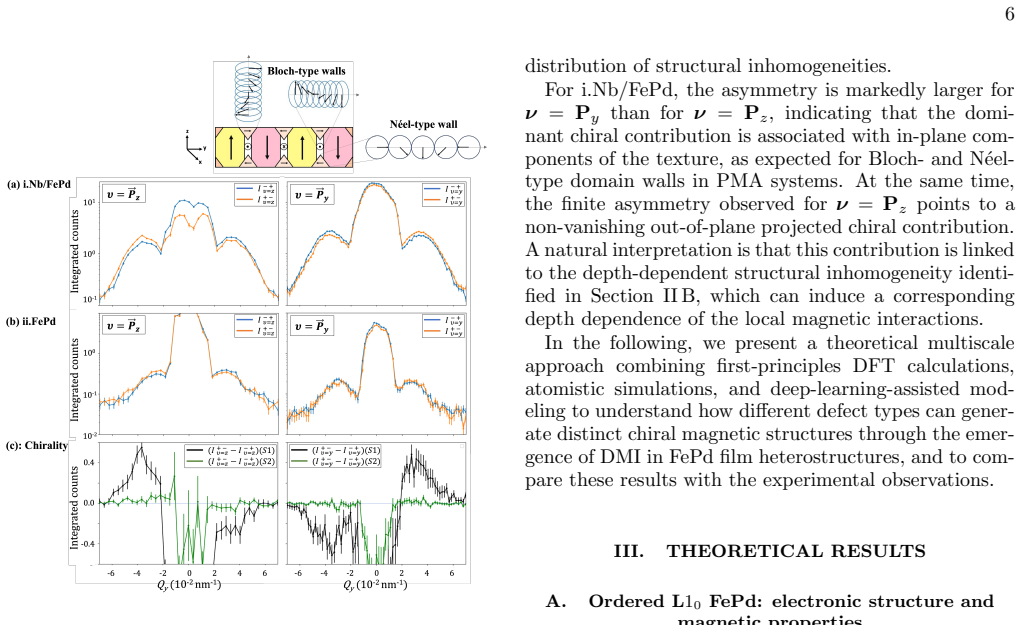
Chemical disorder in FePd, especially when paired with a compositional gradient, produces finite Dzyaloshinskii-Moriya interactions that stabilize chiral finite-q magnetic modulations of mixed Bloch-Néel character; the resulting in-plane modulation length approaches the value measured by PA-GISANS, demonstrating that the observed net chirality is an intrinsic property of the disordered FePd layer rather than solely an interface effect.
What carries the argument
Depth-dependent defect gradient combined with atomic intermixing that induces dominant Dzyaloshinskii-Moriya interactions and finite-q chiral modulations.
If this is right
- Net chirality is generated inside the FePd volume and does not require an external interface.
- The main chiral component lies in-plane while an out-of-plane component tracks the depth-dependent inhomogeneity.
- The in-plane modulation length produced by the disorder-induced Dzyaloshinskii-Moriya terms falls in the experimentally observed range.
- Similar disorder profiles in other centrosymmetric ferromagnets can be expected to produce comparable chiral modulations.
Where Pith is reading between the lines
- Growth protocols that control intermixing and defect gradients could be used to tune the strength of chirality in device stacks.
- The same mechanism may operate in other Fe-based or Pd-based thin films where anti-phase boundaries and composition slopes are common.
- Modeling of triplet superconductivity in these hybrids should now incorporate bulk disorder contributions to the magnetic texture rather than interface-only terms.
Load-bearing premise
The multiscale model correctly maps the measured defect gradient and intermixing profile onto the Dzyaloshinskii-Moriya terms that set the observed modulation length and mixed character.
What would settle it
Observation of zero net chirality and zero Dzyaloshinskii-Moriya strength in a perfectly ordered, compositionally uniform FePd film of the same thickness would falsify the claim.
Figures




read the original abstract
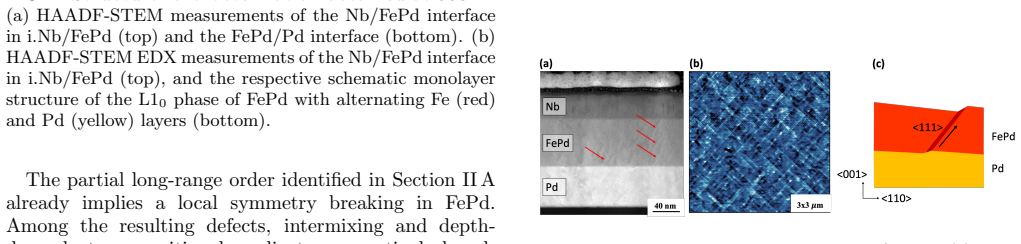
Chirality in superconductor-ferromagnet hybrids strongly influences phenomena such as the observable signatures of long-range triplet superconductivity, but its microscopic origin in nominally centrosymmetric ferromagnets is still unclear. Here, we combine structural characterization, polarization-analyzed grazing-incidence small-angle neutron scattering (PA-GISANS), first-principles calculations, and deep-learning-assisted multiscale modeling to study FePd and Nb/FePd heterostructures. Experimentally, we observe partial L1$_0$ order, atomic intermixing, anti-phase boundaries, and a depth-dependent defect gradient across the FePd layer, together with a finite net magnetic chirality at room temperature. The GISANS asymmetry indicates that the main chiral contribution lies in-plane, with an additional out-of-plane component associated with depth-dependent magnetic inhomogeneity. Theoretically, we show that chemical disorder in FePd, especially when combined with a compositional gradient, produces finite Dzyaloshinskii-Moriya interactions and stabilizes chiral finite-$\mathbf{q}$ magnetic modulations with mixed Bloch-N\'eel character. In the mesoscopic model, the resulting in-plane modulation length approaches the experimentally observed range. These results identify disorder and compositional gradients as intrinsic microscopic sources of net chirality in FePd-based films, showing that the observed chirality does not arise only from interface effects.
Editorial analysis
A structured set of objections, weighed in public.
Referee Report
Summary. The manuscript combines PA-GISANS neutron scattering, structural characterization, first-principles calculations, and deep-learning-assisted multiscale modeling on FePd and Nb/FePd heterostructures. It reports partial L1_{0} order, atomic intermixing, anti-phase boundaries, and a depth-dependent defect gradient in the FePd layer, together with finite net magnetic chirality at room temperature. The modeling shows that chemical disorder combined with a compositional gradient generates finite Dzyaloshinskii-Moriya interactions that stabilize chiral finite-q modulations of mixed Bloch-Néel character whose in-plane length approaches the experimental value, leading to the claim that disorder and gradients are intrinsic sources of net chirality rather than interface effects alone.
Significance. If the central claim is substantiated, the work would be significant for understanding chirality in nominally centrosymmetric ferromagnets and its role in triplet superconductivity. The multiscale approach linking measured defect gradients to DMI and modulation lengths provides a concrete microscopic mechanism that could guide materials design, and the combination of polarization-analyzed GISANS with first-principles-derived mesoscopic modeling is a methodological strength.
major comments (2)
- [Theoretical modeling / mesoscopic model] The abstract and modeling description state that disorder plus compositional gradient produces finite DMI and that the resulting in-plane modulation length approaches experiment, yet no control simulation with uniform composition (zero gradient) or with interface DMI terms explicitly set to zero is presented. This control is required to isolate the internal contributions and to support the claim that 'the observed chirality does not arise only from interface effects.'
- [Experimental results and data analysis] The GISANS asymmetry is used to assign the main chiral contribution as in-plane with an additional out-of-plane component tied to depth-dependent inhomogeneity. Quantitative details on how the measured defect gradient is converted into the dominant DMI terms (including any fitting or scaling choices) are needed to confirm that the model translation is not post-hoc.
minor comments (2)
- [Abstract] The abstract could quote the numerical range of the modeled modulation length alongside the experimental value for direct comparison.
- [Throughout] Notation for the mixed Bloch-Néel character and the definition of the modulation wavevector q should be made consistent between the abstract and the main text.
Simulated Author's Rebuttal
We thank the referee for the careful reading of our manuscript and the constructive comments. We are pleased that the significance of the work is recognized. Below we address the major comments point by point and outline the revisions we will make.
read point-by-point responses
-
Referee: [Theoretical modeling / mesoscopic model] The abstract and modeling description state that disorder plus compositional gradient produces finite DMI and that the resulting in-plane modulation length approaches experiment, yet no control simulation with uniform composition (zero gradient) or with interface DMI terms explicitly set to zero is presented. This control is required to isolate the internal contributions and to support the claim that 'the observed chirality does not arise only from interface effects.'
Authors: We agree that control simulations are necessary to rigorously isolate the contributions from chemical disorder and compositional gradients versus potential interface effects. In the revised version, we will add two sets of control simulations: (1) with uniform composition (zero gradient) across the FePd layer, which we expect to yield vanishing net DMI and no stable finite-q modulations, and (2) with the interface DMI terms explicitly set to zero while retaining the internal disorder and gradient terms. These results will be presented in a new figure or supplementary section to directly support our claim that the observed chirality originates intrinsically from the disorder and gradients within the FePd film. revision: yes
-
Referee: [Experimental results and data analysis] The GISANS asymmetry is used to assign the main chiral contribution as in-plane with an additional out-of-plane component tied to depth-dependent inhomogeneity. Quantitative details on how the measured defect gradient is converted into the dominant DMI terms (including any fitting or scaling choices) are needed to confirm that the model translation is not post-hoc.
Authors: We will revise the manuscript to include more quantitative details on the conversion process. Specifically, we will describe how the depth-dependent defect gradient measured by structural characterization (e.g., from XRD and TEM) is mapped to the DMI coefficients in the mesoscopic model using parameters derived from first-principles calculations. This will include the explicit scaling factors, any averaging or fitting procedures used to match the experimental modulation length, and the sensitivity analysis to these choices. We believe this addition will demonstrate that the modeling is grounded in the experimental inputs rather than being post-hoc. revision: yes
Circularity Check
No significant circularity; derivation remains self-contained
full rationale
The paper's chain proceeds from measured structural defects and gradients (via PA-GISANS and characterization) to first-principles calculations on explicit disordered supercells that compute DMI terms, followed by a mesoscopic model whose output modulation length is compared to (rather than fitted to) the experimental range. No equation reduces a claimed prediction to a fitted parameter by construction, no self-citation is invoked as a uniqueness theorem that forbids alternatives, and no ansatz is smuggled via prior work. The central claim that disorder plus gradients produce net chirality is therefore an independent computational result rather than a tautology.
Axiom & Free-Parameter Ledger
axioms (2)
- standard math Heisenberg spin Hamiltonian with Dzyaloshinskii-Moriya terms derived from first-principles on disordered configurations
- domain assumption Mesoscopic model parameters can be upscaled from the atomistic DMI without loss of the dominant modulation length
Lean theorems connected to this paper
-
IndisputableMonolith/Cost/FunctionalEquation.leanwashburn_uniqueness_aczel unclearchemical disorder in FePd, especially when combined with a compositional gradient, produces finite Dzyaloshinskii-Moriya interactions and stabilizes chiral finite-q magnetic modulations
-
IndisputableMonolith/Foundation/RealityFromDistinction.leanreality_from_one_distinction unclearmodified two-sublattice gradient model ... deep-learning-assisted multiscale modeling
Reference graph
Works this paper leans on
-
[1]
Modeling via deep learning Figure 8(a-h) shows the parity plots for the obtained Jij,|D ij|, andµ i and the corresponding error distribu- tions (insets). The first aspect to note is that the net- work captures a much more complex scenario than the baseline model (see Methods), which produces, by con- struction, a series of discrete values (plateaus) for e...
-
[2]
Construction and analysis of the mesoscopic FePd model To construct the mesoscopic model of the FePd thick- ness in the FePd/Nb system, we employed the modified version of the gradient model (MGM), as described in detail in Supplementary Note 4, aiming to reproduce, as closely as possible, the observed characteristics of sam- ples i.Nb/FePd and ii.FePd. S...
-
[3]
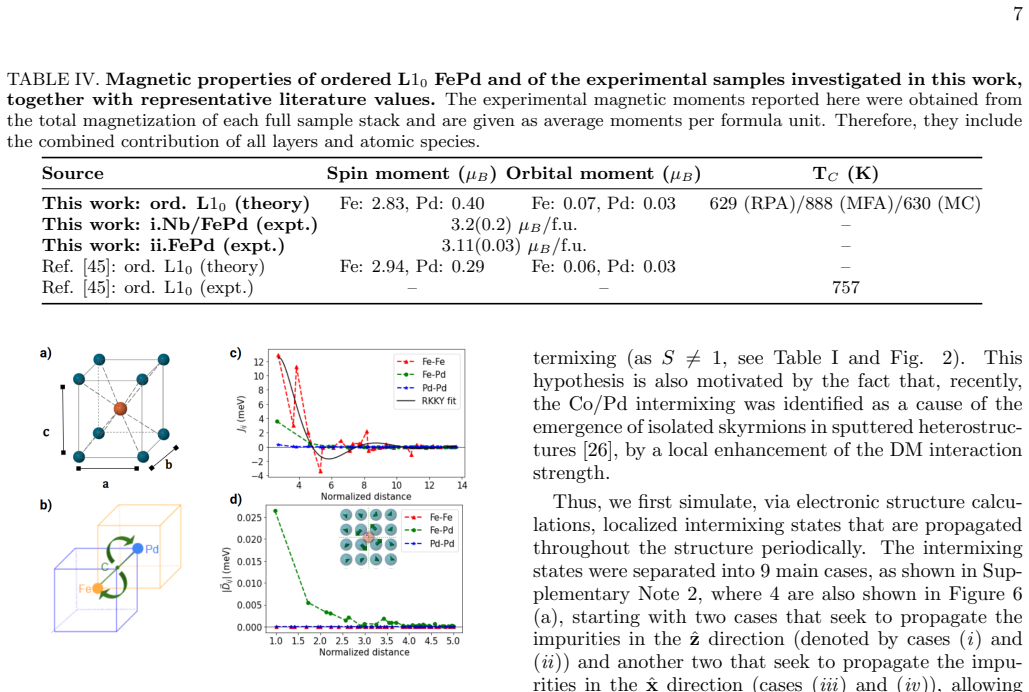
Nature of the disorder-induced DMI: insights from the DFT dataset Apart from serving as a reference for training and com- parison withSAGNNpredictions on the validation set, the DFT results that constitute the database can also pro- vide some interesting and non-trivial insights into the nature of the DMI induced by chemical disorder, par- ticularly for F...
work page 2022
-
[4]
The schematic scattering geometry is shown in Fig. 11(a). In this schematic, the domain walls are drawn as straight lines for simplicity, whereas the actual domain- wall network in i.Nb/FePd and ii.FePd forms a maze- like pattern. All experiments have been performed at room temperature, under a guide field of 10 G, with a wavelength of 8 ˚A, a sample-to-d...
-
[5]
computed in each variational step [78], whereLand Shere denote the orbital and spin angular momentum operators, respectively. All calculations were performed within the local spin density approximation (LSDA) as parametrized by von Barth and Hedin [79]. As we fo- cus on spin-related quantities, no orbital polarization [80] was included. Since the main ele...
-
[6]
Graph neural network architecture Supplementary Figure 7 shows the architecture of the Species-Aware Graph Neural Network (SAGNN), as used in this work. The data are divided into shells (s) and pair types (p), so that the neural network training is fo- cused on such subspaces of the whole dataset. A total of 9197 graphs were used for training, and 2300 fo...
-
[7]
Baseline models The baseline model predictedJ ij and|D ij|using the mean value computed over the training set for each shell sand pair typep. Formally, ¯Jbase ij (s, p) = 1 n(Etrains,p ) X (i,j)∈E trains,p Jij | ¯Dij|base(s, p) = 1 n(Etrains,p ) X (i,j)∈E trains,p |Dij| ,(20) whereE train s,p denotes the set of edges in the training data with shellsand pa...
-
[8]
Computational details The weighted atom-centered symmetry functions (ACSFs), here modified from the original formulation of Ref. [91] and as described in the Supplementary Note 5, were implemented in Python, employing the open-source libraries Numpy 2.0.2 (for dataset handling) and PyTorch 2.7.1/PyTorch Geometric [92] 2.6.1 (for GNN handling). To overcome...
-
[9]
Dataset filtering The dataset was constructed fromab-initiocalcula- tions of 100 4×2×2 supercells (32 atoms each), composed of 50% Pd and 50% Fe. The atoms were arranged in the ideal fcc crystal structure, with Pd and Fe randomly dis- tributed over the lattice sites to represent chemical disor- der. Magnetic interactions were evaluated by considering ever...
-
[10]
A. I. Buzdin, Rev. Mod. Phys.77, 935 (2005)
work page 2005
- [11]
-
[12]
I. P. Kulik, Sov. Phys. JETP22, 841 (1966)
work page 1966
-
[13]
Z. Yang, M. Lange, A. Volodin, R. Szymczak, and V. Moshchalkov, Nat. Mater.3, 793 (2004)
work page 2004
-
[14]
A. F. Volkov, Y. V. Fominov, and K. B. Efetov, Phys. Rev. B72, 184504 (2005)
work page 2005
-
[15]
A. F. Volkov, F. S. Bergeret, and K. B. Efetov, Phys. Rev. Lett.90, 117006 (2003)
work page 2003
-
[16]
A. Di Bernardo, S. Komori, G. Livanas, G. Divitini, P. Gentile, M. Cuoco, and J. W. A. Robinson, Nat. Mater.18, 1194 (2019)
work page 2019
-
[17]
D. Nikoli´ c, N. L. Schulz, A. I. Buzdin, and M. Eschrig, Phys. Rev. B112, 224507 (2025)
work page 2025
-
[18]
A. Y. Aladyshkin, A. V. Silhanek, W. Gillijns, and V. V. Moshchalkov, Supercond. Sci. Technol.22, 053001 (2009)
work page 2009
-
[19]
L. R. Tagirov, Phys. Rev. Lett.83, 2058 (1999)
work page 2058
- [20]
-
[21]
K. L. Svalland, M. T. Mercaldo, and M. Cuoco, Phys. Rev. B111, 184501 (2025)
work page 2025
-
[22]
I. Sardinero, R. S. Souto, and P. Burset, Phys. Rev. B 110, L060505 (2024)
work page 2024
-
[23]
J. Nothhelfer, S. A. D´ ıaz, S. Kessler, T. Meng, M. Rizzi, K. M. D. Hals, and K. Everschor-Sitte, Phys. Rev. B105, 224509 (2022)
work page 2022
-
[24]
S. Rex, I. V. Gornyi, and A. D. Mirlin, Phys. Rev. B100, 064504 (2019)
work page 2019
-
[25]
S. M. Dahir, A. F. Volkov, and I. M. Eremin, Phys. Rev. Lett.122, 097001 (2019)
work page 2019
-
[26]
S. S. Apostoloff, E. S. Andriyakhina, and I. S. Bur- mistrov, Phys. Usp.68, 1092 (2025)
work page 2025
-
[27]
A. P. Petrovi´ c, M. Raju, X. Y. Tee, A. Louat, I. Maggio- Aprile, R. M. Menezes, M. J. Wyszy´ nski, N. K. Duong, M. Reznikov, C. Renner, M. V. Miloˇ sevi´ c, and C. Panagopoulos, Phys. Rev. Lett.126, 117205 (2021)
work page 2021
-
[28]
Y.-J. Xie, A. Qian, B. He, Y.-B. Wu, S. Wang, B. Xu, G. Yu, X. Han, and X. G. Qiu, Phys. Rev. Lett.133, 166706 (2024)
work page 2024
-
[29]
S.-H. Yang, R. Naaman, Y. Paltiel, and S. S. P. Parkin, Nat. Rev. Phys.3, 328 (2021)
work page 2021
- [30]
- [31]
-
[32]
R. E. Camley and K. L. Livesey, Surf. Sci. Rep.78, 100605 (2023)
work page 2023
-
[33]
R. Allenspach, A. Bischof, B. Boehm, U. Drechsler, O. Reich, M. Sousa, S. Tacchi, and G. Carlotti, Phys. Rev. B110, 014402 (2024)
work page 2024
-
[34]
E. Chen, A. Tamm, T. Wang, M. E. Epler, M. Asta, and T. Frolov, npj Comput Mater.8(2022)
work page 2022
-
[35]
P. Carvalho, I. Miranda, J. Brand˜ ao, A. Bergman, J. Cezar, A. Klautau, and H. Petrilli, Nano Lett.23, 10.1021/acs.nanolett.3c00428 (2023)
-
[36]
A. Michels, D. Mettus, I. Titov, A. Malyeyev, M. Ber- sweiler, P. Bender, I. Peral, R. Birringer, Y. Quan, P. H¨ autle, J. Kohlbrecher, D. Honecker, J. R. Fern´ andez, L. F. Barqu´ ın, and K. L. Metlov, Phys. Rev. B99, 014416 (2019)
work page 2019
- [37]
-
[38]
I. P. Miranda, A. B. Klautau, A. Bergman, and H. M. Petrilli, Phys. Rev. B105, 224413 (2022)
work page 2022
- [39]
- [40]
- [41]
-
[42]
E. Kentzinger, H. Frielinghaus, U. R”ucker, A. Ioffe, D. Richter, and T. Br”uckel, Phys. B Condens. Matter 397, 43 (2007)
work page 2007
-
[44]
B. E. Warren,X-ray Diffraction(Addison-Wesley, 1969)
work page 1969
-
[45]
V. Gehanno, R. Hoffmann, Y. Samson, A. Marty, and S. Auffret, Eur. Phys. J. B10, 457 (1999)
work page 1999
-
[46]
Gehanno,Perpendicular magnetic anisotropy of epi- taxial thin films of FePd ordered alloys, Ph.D
V. Gehanno,Perpendicular magnetic anisotropy of epi- taxial thin films of FePd ordered alloys, Ph.D. thesis, Uni- versit´ e Joseph-Fourier – Grenoble I (1997). 21
work page 1997
-
[47]
Stellhorn,Interplay of proximity effects in super- conductor/ferromagnet heterostructures, Ph.D
A. Stellhorn,Interplay of proximity effects in super- conductor/ferromagnet heterostructures, Ph.D. thesis, RWTH Aachen (2021)
work page 2021
- [48]
-
[49]
E. Kentzinger, U. R”ucker, B. Toperverg, F. Ott, and T. Br”uckel, Phys. Rev. B77, 104435 (2008)
work page 2008
- [50]
- [51]
- [52]
- [53]
- [54]
-
[55]
G. Yu, T. Cheng, X. Zhang, and W. Gong, J. Magn. Magn. Mater.510, 166904 (2020)
work page 2020
- [56]
-
[57]
G. Yu, T. Cheng, Z. Cheng, and X. Zhang, Comput. Mater. Sci.188, 110168 (2021)
work page 2021
- [58]
-
[59]
S. V. Meschel, J. Pavlu, and P. Nash, J. Alloys Compd. 509, 5256 (2011)
work page 2011
-
[60]
M. A. Ruderman and C. Kittel, Phys. Rev.96, 99 (1954)
work page 1954
-
[61]
Y. O. Kvashnin, R. Cardias, A. Szilva, I. Di Marco, M. I. Katsnelson, A. I. Lichtenstein, L. Nordstr”om, A. B. Klautau, and O. Eriksson, Phys. Rev. Lett.116, 217202 (2016)
work page 2016
-
[62]
J. A. Mydosh, Phys. Rev. Lett.33, 1562 (1974)
work page 1974
-
[63]
S.-W. Cheong and X. Xu, npj Quantum Mater.7, 10.1038/s41535-022-00447-5 (2022)
-
[64]
This can be seen by considering a flat-spiralansatz m(r) =m 0[ˆe1 cos(q0 ·r) + ˆe2 sin(q0 ·r)], with ˆe1 ⊥ ˆe2, ˆe1,2 ⊥ ˆq0. EvaluatingC(Eq. 2) and theα-component of the chirality tensorL α = (∂ αm)×m(see Supplemen- tary Note 3), one finds, up to a proportionality constant, C(q0)∝K α(q= 0), whereK α is the Fourier transform ofL α. Explicitly,K α(q= 0) =−2...
-
[65]
A. Zunger, S.-H. Wei, L. G. Ferreira, and J. E. Bernard, Phys. Rev. Lett.65, 353 (1990)
work page 1990
-
[66]
The specific heat at constant volume was calculated as the change in specific internal energy (e) with respect to temperature at constant volumec v = ∂e dT v
-
[67]
S. Frota-Pessˆ oa, R. B. Muniz, and J. Kudrnovsk´ y, Phys. Rev. B62, 5293 (2000)
work page 2000
-
[68]
W. L. Bragg and E. J. Williams, Proc. R. Soc. London, Ser. A145, 699 (1934)
work page 1934
-
[69]
D. E. Laughlin, K. Srinivasan, M. Tanase, and L. Wang, Scr. Mater.53, 383 (2005)
work page 2005
-
[70]
P. Kamp, A. Marty, B. Gilles, R. Hoffmann, S. March- esini, M. Belakhovsky, C. Boeglin, H. A. D”urr, S. S. Dhesi, G. van der Laan, and A. Rogalev, Phys. Rev. B 59, 1105 (1999)
work page 1999
-
[71]
J. Cui, T. W. Shield, and R. D. James, Acta Mater.52, 35 (2004)
work page 2004
- [72]
- [73]
- [74]
-
[75]
R. Reho, N. Wittemeier, A. H. Kole, P. Ordej´ on, and Z. Zanolli, Phys. Rev. B110, 134505 (2024)
work page 2024
-
[76]
A. Stellhorn, A. Sarkar, E. Kentzinger, M. Waschk, P. Sch”offmann, S. Schr”oder, G. Abuladze, Z. Fu, V. Pipich, and T. Br”uckel, J. Magn. Magn. Mater.476, 483 (2019)
work page 2019
-
[77]
A. Kov´ acs, R. Schierholz, and K. Tillmann, JLSRF2, 10.17815/jlsrf-2-68 (2016)
-
[78]
A. R. Wildes, Rev. Sci. Instrum.70, 4241 (1999)
work page 1999
-
[79]
W. T. Lee, J. Hagman, D. Martin Rodriguez, A. Stell- horn, A. Backs, T. Arnold, E. Blackburn, P. Deen, C. Durniak, M. Feygenson, A. T. Holmes, J. Hous- ton, S. Jaksch, O. Kirstein, D. Mannix, M. M˚ ansson, M. Morgano, G. Nilsen, D. Noferini, T. Nylan- der, D. Orlov, V. Santoro, S. Schmidt, M. Schulz, W. Schweika, M. Strobl, A. Tartaglione, R. Toft- Peters...
work page 2023
- [80]
-
[82]
O. K. Andersen, Phys. Rev. B12, 3060 (1975)
work page 1975
discussion (0)
Sign in with ORCID, Apple, or X to comment. Anyone can read and Pith papers without signing in.