Recognition: 2 theorem links
· Lean TheoremThe Bell-Bloom-type optically-pumped FID Rubidium atomic magnetometer with a multi-passing probe beam and two counter-propagating pump beams
Pith reviewed 2026-05-13 18:37 UTC · model grok-4.3
The pith
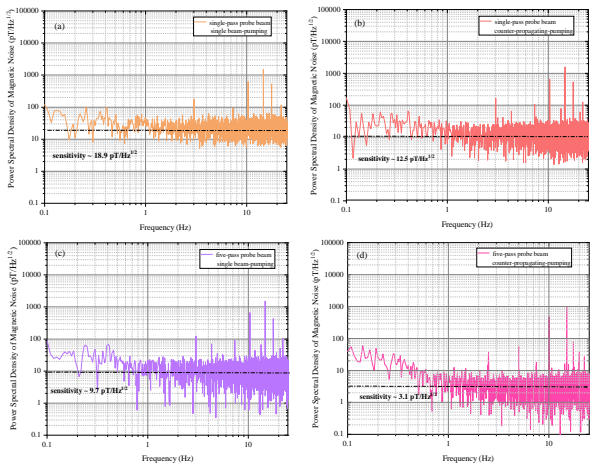
A Bell-Bloom rubidium magnetometer using two counter-propagating orthogonal pump beams and a five-pass probe beam improves sensitivity from 18.9 pT/√Hz to 3.1 pT/√Hz.
A machine-rendered reading of the paper's core claim, the machinery that carries it, and where it could break.
Core claim
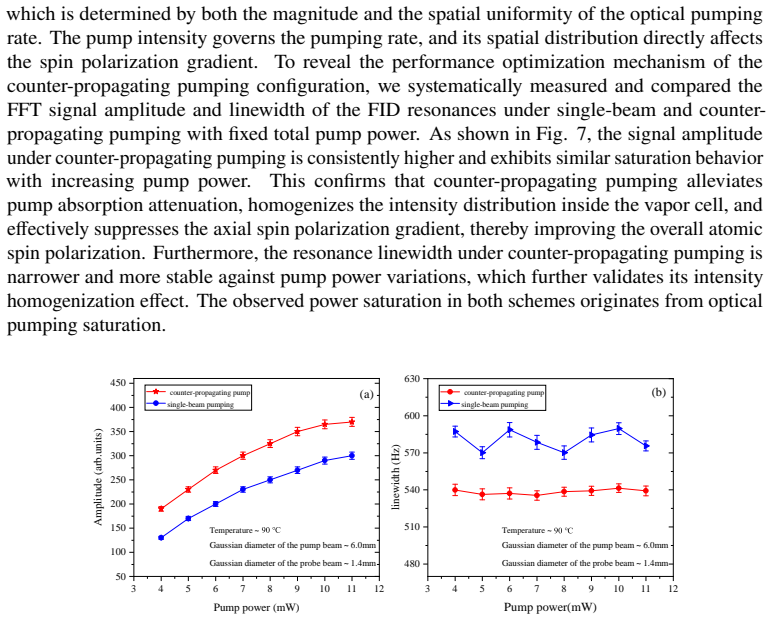
Integrating orthogonally polarized counter-propagating pumping beams with a multi-pass probe configuration homogenizes the atomic spin polarization distribution inside the rubidium cell, suppresses light shifts and power broadening from the pump light, and increases the detected signal amplitude, thereby raising magnetic-field sensitivity from 18.9 pT/√Hz to 3.1 pT/√Hz relative to the traditional single-beam pumping and single-pass detection scheme.
What carries the argument
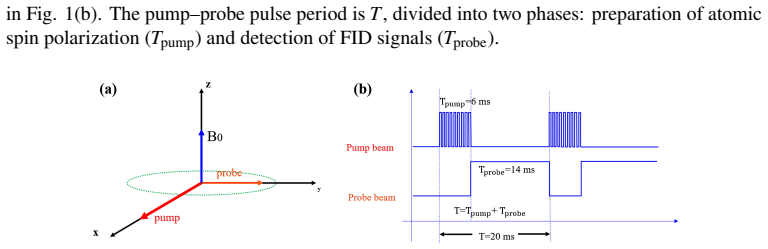
Orthogonally polarized counter-propagating pump beams combined with a five-pass probe beam; the geometry equalizes spin polarization throughout the cell and multiplies the optical rotation signal while limiting pump-induced artifacts.
If this is right
- Higher-accuracy detection of geomagnetic and other weak fields becomes feasible in compact devices.
- The same beam-arrangement principle can be applied to arrays of magnetometers for spatially resolved measurements.
- Light-shift and power-broadening effects are reduced without additional optical filters or frequency stabilization.
- Signal amplitude increases directly from the multi-pass probe, improving signal-to-noise ratio at fixed atomic density.
Where Pith is reading between the lines
- The approach may extend to other alkali atoms or to different magnetometer protocols that currently suffer from polarization gradients.
- Lower pump power could become usable while maintaining the same sensitivity, aiding battery-powered or miniaturized sensors.
- Integration with existing vapor-cell fabrication methods could accelerate development of portable, high-performance magnetic sensors for navigation or geophysical surveys.
Load-bearing premise
The measured sensitivity gain arises entirely from the new beam geometry homogenizing spin polarization and suppressing light shifts, with no significant contribution from unstated changes in cell temperature, laser power stability, or post-processing.
What would settle it
Repeat the side-by-side comparison of the traditional single-beam single-pass arrangement versus the counter-propagating multi-pass arrangement while holding cell temperature, laser intensities, and data-analysis methods fixed; any large deviation from the reported sixfold improvement would falsify the claim.
Figures



read the original abstract
The Bell-Bloom-type optically pumped atomic magnetometers are well suited for weak geomagnetic field detection. However, conventional single-beam pumping introduces an atomic spin polarization gradient, which limits the measurement accuracy and sensitivity. To address this issue, this paper proposes and experimentally demonstrates a Bell-Bloom-type rubidium FID magnetometer scheme integrating orthogonally polarized counter-propagating pumping and multi-pass probe detection. This design homogenizes the atomic spin polarization distribution and suppresses light shifts and power broadening effects induced by the pump beam. Meanwhile, the five-pass probe configuration significantly enhances the signal amplitude. Experimental results reveal that, compared with the traditional single-beam pumping and single-pass detection scheme, the proposed magnetometer achieves a remarkable improvement in magnetic field measurement accuracy, and the magnetic field sensitivity is improved from 18.9 pT/\sqrt{Hz} to 3.1 pT/\sqrt{Hz}. This work provides an effective technical approach and reference for optimizing the performance of atomic magnetometers and extending their applications in integrated arrays.
Editorial analysis
A structured set of objections, weighed in public.
Referee Report
Summary. The paper proposes and experimentally demonstrates a Bell-Bloom-type Rb FID magnetometer that uses orthogonally polarized counter-propagating pump beams together with a five-pass probe beam. The design is intended to homogenize atomic spin polarization, suppress light shifts and power broadening, and increase signal amplitude relative to a conventional single-beam single-pass scheme. Direct experimental comparison is reported to yield a sensitivity improvement from 18.9 pT/√Hz to 3.1 pT/√Hz.
Significance. If the observed sensitivity gain can be shown to arise exclusively from the optical geometry rather than from uncontrolled changes in cell temperature, laser intensity, or detection bandwidth, the scheme would constitute a practical and relatively simple route to higher-performance FID magnetometers suitable for geomagnetic applications and sensor arrays.
major comments (2)
- [Experimental Results] Experimental Results: The headline sensitivity figures (18.9 pT/√Hz vs. 3.1 pT/√Hz) are presented without error bars, explicit measurement bandwidth, averaging time, or statistical details of the noise spectral density extraction. This omission prevents quantitative assessment of whether the factor-of-six improvement is statistically significant and reproducible.
- [Experimental setup] Experimental setup and methods: No table, statement, or auxiliary data confirm that cell temperature, absolute pump intensity, probe detuning, and post-processing parameters remained identical between the traditional and proposed configurations. Because FID sensitivity depends sensitively on these quantities, the causal attribution of the entire gain to counter-propagating pumps plus multi-pass detection cannot be verified from the reported information.
minor comments (1)
- The abstract and main text would benefit from a concise statement of the probe-beam detuning and the precise definition of the noise bandwidth used to quote the pT/√Hz figures.
Simulated Author's Rebuttal
We thank the referee for the thorough review and constructive feedback on our manuscript. The comments highlight important aspects of experimental rigor that we will address in the revision. Below we respond point-by-point to the major comments.
read point-by-point responses
-
Referee: The headline sensitivity figures (18.9 pT/√Hz vs. 3.1 pT/√Hz) are presented without error bars, explicit measurement bandwidth, averaging time, or statistical details of the noise spectral density extraction. This omission prevents quantitative assessment of whether the factor-of-six improvement is statistically significant and reproducible.
Authors: We agree that these statistical details are necessary for a complete assessment. In the revised manuscript we will add error bars obtained from five independent runs, state that the noise spectral density was computed from the FFT of 60-second FID traces over a 1–100 Hz bandwidth with 1 Hz resolution, and report the averaging procedure. These additions will allow readers to evaluate the reproducibility and significance of the reported improvement. revision: yes
-
Referee: No table, statement, or auxiliary data confirm that cell temperature, absolute pump intensity, probe detuning, and post-processing parameters remained identical between the traditional and proposed configurations. Because FID sensitivity depends sensitively on these quantities, the causal attribution of the entire gain to counter-propagating pumps plus multi-pass detection cannot be verified from the reported information.
Authors: We acknowledge that an explicit parameter comparison was not provided. The experimental methods section states that the same Rb cell, laser sources, temperature controller, and detection chain were used for both configurations, with only the beam geometry modified. To eliminate any ambiguity we will insert a table in the revised manuscript that lists cell temperature (80 °C), pump intensity (5 mW cm⁻²), probe detuning (1 GHz red of D1), and post-processing bandwidth for both setups, confirming they were held constant. This will strengthen the attribution of the sensitivity gain to the optical design. revision: yes
Circularity Check
No circularity: sensitivity figures are direct experimental measurements
full rationale
The manuscript presents an experimental demonstration of an improved Bell-Bloom FID Rb magnetometer. The headline result (sensitivity improving from 18.9 pT/√Hz to 3.1 pT/√Hz) is obtained by direct measurement in the two optical configurations; no derivation, fitted parameter, or self-citation chain is invoked to obtain or predict these numbers. The paper contains no equations that define a quantity in terms of itself or that rename a fitted input as a prediction. All load-bearing claims rest on side-by-side experimental data rather than on any self-referential logic. This is the normal, non-circular case for an experimental instrumentation paper.
Axiom & Free-Parameter Ledger
axioms (1)
- domain assumption Standard optical pumping and spin polarization dynamics in alkali atoms under resonant laser illumination
Lean theorems connected to this paper
-
IndisputableMonolith/Cost/FunctionalEquation.leanwashburn_uniqueness_aczel unclear?
unclearRelation between the paper passage and the cited Recognition theorem.
The evolution of the macroscopic atomic spin polarization vector P in a magnetic field is governed by the Bloch equation... R(x) = R0 (exp(−n ∫[1−Px(x′)]dx′) + ...
-
IndisputableMonolith/Foundation/AlexanderDuality.leanalexander_duality_circle_linking unclear?
unclearRelation between the paper passage and the cited Recognition theorem.
counter-propagating pumping... homogenizes the pump intensity... five-pass probe configuration significantly enhances the signal amplitude
What do these tags mean?
- matches
- The paper's claim is directly supported by a theorem in the formal canon.
- supports
- The theorem supports part of the paper's argument, but the paper may add assumptions or extra steps.
- extends
- The paper goes beyond the formal theorem; the theorem is a base layer rather than the whole result.
- uses
- The paper appears to rely on the theorem as machinery.
- contradicts
- The paper's claim conflicts with a theorem or certificate in the canon.
- unclear
- Pith found a possible connection, but the passage is too broad, indirect, or ambiguous to say the theorem truly supports the claim.
Reference graph
Works this paper leans on
-
[1]
Ultrabroadband and sensitive cavity optomechanical magnetometry,
B. B. Li, G. Brawley, H. Greenall,et al., “Ultrabroadband and sensitive cavity optomechanical magnetometry,” Photonics Res.8, 1064–1071 (2020)
work page 2020
-
[2]
High-sensitivity magnetometry based on quantum beats in diamond nitrogen-vacancy centers,
K. Fang, V. M. Acosta, C. Santori,et al., “High-sensitivity magnetometry based on quantum beats in diamond nitrogen-vacancy centers,” Phys. Rev. Lett.110, 130802 (2013)
work page 2013
-
[3]
Broadband magnetometry and temperature sensing with a light-trapping diamond waveguide,
H. Clevenson, M. E. Trusheim, C. Teale,et al., “Broadband magnetometry and temperature sensing with a light-trapping diamond waveguide,” Nat. Phys.11, 393–397 (2015)
work page 2015
-
[4]
Magnetoencephalography with a chip-scale atomic magnetometer,
T. H. Sander, J. Preusser, R. Mhaskar,et al., “Magnetoencephalography with a chip-scale atomic magnetometer,” Biomed. Opt. Express3, 981–990 (2012)
work page 2012
-
[5]
A kilohertz bandwidth and sensitive scalar atomic magnetometer using an optical multipass cell,
S. G. Li, J. S. Liu, M. Jin,et al., “A kilohertz bandwidth and sensitive scalar atomic magnetometer using an optical multipass cell,” Measurement190, 110704 (2022)
work page 2022
-
[6]
Recording brain activities in unshielded earth’s field with optically pumped atomic magnetometers,
R. Zhang, W. Xiao, Y. D. Ding,et al., “Recording brain activities in unshielded earth’s field with optically pumped atomic magnetometers,” Sci. Adv.6, eaba8792 (2020)
work page 2020
-
[7]
The historical development of the magnetic method in exploration,
M. N. Nabighian, V. Grauch, R. Hansen,et al., “The historical development of the magnetic method in exploration,” Geophysics70, 33–61 (2005)
work page 2005
-
[8]
Magnetic microscopic imaging with an optically pumped magnetometer and flux guides,
Y. J. Kim, I. Savukov, J.-H. Huang, and P. Nath, “Magnetic microscopic imaging with an optically pumped magnetometer and flux guides,” Appl. Phys. Lett.110(2017)
work page 2017
-
[9]
Search for axion-like dark matter with spin-based amplifiers,
M. Jiang, H. W. Su, A. Garcon,et al., “Search for axion-like dark matter with spin-based amplifiers,” Nat. Phys.17, 1402–1407 (2021)
work page 2021
-
[10]
Y. J. Kim, P.-H. Chu, and I. Savukov, “Experimental constraint on an exotic spin- and velocity-dependent interaction in the sub-mev range of axion mass with a spin-exchange relaxation-free magnetometer,” Phys. Rev. Lett.121, 091802 (2018)
work page 2018
-
[11]
SERF atomic magnetometer - recent advances and applications: a review,
J. Liet al., “SERF atomic magnetometer - recent advances and applications: a review,” IEEE Sensors J.18, 8198 (2018)
work page 2018
-
[12]
Optically driven spin precession,
W. E. Bell and A. L. Bloom, “Optically driven spin precession,” Phys. Rev. Lett.6, 280 (1961)
work page 1961
-
[13]
Robust,high-speed,all-opticalatomicmagnetometer,
J.M.Higbie,E.Corsini,andD.Budker,“Robust,high-speed,all-opticalatomicmagnetometer,”Rev.Sci.Instruments 77(2006)
work page 2006
-
[14]
Enhanced all-optical vector atomic magnetometer enabled by artificial neural network,
J. Qin, J. Xu, Z. Jiang, and J. Qu, “Enhanced all-optical vector atomic magnetometer enabled by artificial neural network,” Appl. Phys. Lett.125(2024)
work page 2024
-
[15]
Polarization-improved bidirectional-pump atomic magnetometer based on spin-decoupled metasurface,
S. Sun, J. Zhang, R. Zhu,et al., “Polarization-improved bidirectional-pump atomic magnetometer based on spin-decoupled metasurface,” Adv. Sci.12, e09028 (2025)
work page 2025
-
[16]
J. Zhao, G. Liu, J. Lu,et al., “Improvement of spin polarization spatial uniformity in optically pumped atomic magnetometers based on counter-propagating pump beams and atomic diffusion,” Meas. Sci. Technol.32, 035902 (2020)
work page 2020
-
[17]
Femtoteslaatomicmagnetometerwithcounter-propagatingopticalsidebandpumping,
J.Peng,A.-N.Xu,andB.Liu,“Femtoteslaatomicmagnetometerwithcounter-propagatingopticalsidebandpumping,” Opt. Lett.49, 6177 (2024)
work page 2024
-
[18]
Modeling and measuring of light shift in optically pumped atomic magnetometers,
Y. Zou, X. Zhou, J. Liu,et al., “Modeling and measuring of light shift in optically pumped atomic magnetometers,” IEEE Photonics J. (2026)
work page 2026
-
[19]
Free-induction-decay magnetometer based on a microfabricated cs vapor cell,
D. Hunter, S. Piccolomo, J. D. Pritchard,et al., “Free-induction-decay magnetometer based on a microfabricated cs vapor cell,” Phys. Rev. Appl.10, 014002 (2018)
work page 2018
-
[20]
A high-precision frequency measurement algorithm for FID signal of proton magnetometer,
H. B. Dong, H. Liu, J. Geet al., “A high-precision frequency measurement algorithm for FID signal of proton magnetometer,” IEEE Trans. on Instrum. Meas.65, 898–904 (2016)
work page 2016
-
[21]
Free-induction-decay magnetometer based on synchronous optical pump and RF pulse modulation,
J. Xu, L. Jiang, J. Liu,et al., “Free-induction-decay magnetometer based on synchronous optical pump and RF pulse modulation,” EPJ Quantum Technol.12, 62 (2025)
work page 2025
-
[22]
All-optical single-species cesium atomic comagnetometer with optical free induction decay detection,
Y. Yang, T. Wu, J. Chen,et al., “All-optical single-species cesium atomic comagnetometer with optical free induction decay detection,” Appl. Phys. B127, 40 (2021)
work page 2021
-
[23]
Enhancingthesensitivityofatomicmagnetometerwithamulti-passedprobelight,
R.Li,C.Perrella,andA.Luiten,“Enhancingthesensitivityofatomicmagnetometerwithamulti-passedprobelight,” Appl. Phys. Lett.121, 172402 (2022)
work page 2022
-
[24]
Subfemtotesla scalar atomic magnetometry using multipass cells,
D. Sheng, S. Li, N. Dural, and M. V. Romalis, “Subfemtotesla scalar atomic magnetometry using multipass cells,” Phys. Rev. Lett.110, 160802 (2013)
work page 2013
-
[25]
Femtotesla direct magnetic gradiometer using a single multipass cell,
V. G. Lucivero, W. Lee, N. Dural, and M. V. Romalis, “Femtotesla direct magnetic gradiometer using a single multipass cell,” Phys. Rev. Appl.15, 014004 (2021)
work page 2021
-
[26]
A multi-pass optically pumped rubidium atomic magnetometer with free induction decay,
L. Zhang, Y. Yang, N. Zhao,et al., “A multi-pass optically pumped rubidium atomic magnetometer with free induction decay,” Sensors22, 7598 (2022)
work page 2022
-
[27]
C. Troullinou, R. Jiménez-Martínez, J. Kong,et al., “Squeezed-light enhancement and backaction evasion in a high sensitivity optically pumped magnetometer,” Phys. Rev. Lett.127, 193601 (2021)
work page 2021
discussion (0)
Sign in with ORCID, Apple, or X to comment. Anyone can read and Pith papers without signing in.