Recognition: 2 theorem links
· Lean TheoremOptimization and vectorization of a Mz-type optically-pumped Rubidium magnetometer
Pith reviewed 2026-05-13 18:32 UTC · model grok-4.3
The pith
Tri-axial modulation and frequency-domain demodulation convert an Mz-type rubidium magnetometer from scalar to vector operation.
A machine-rendered reading of the paper's core claim, the machinery that carries it, and where it could break.
Core claim
By implementing tri-axial modulation and frequency-domain demodulation on an optimized Mz-type rubidium magnetometer, the device measures the full vector magnetic field rather than only its magnitude, while maintaining high sensitivity in both open- and closed-loop modes.
What carries the argument
Tri-axial modulation with frequency-domain demodulation, which applies distinct modulation frequencies along x, y, and z axes and extracts each component from the corresponding frequency peak in the noise spectrum.
If this is right
- The closed-loop system tracks step changes in magnetic field stably.
- The vector capability enables applications in geomagnetic navigation and magnetic anomaly detection.
- Paraffin-coated anti-relaxation cells support the reported sensitivity levels inside magnetic shielding.
- Joint optimization of pump intensity and RF field using linewidth-amplitude ratio improves overall performance.
Where Pith is reading between the lines
- This technique might extend to other vapor-cell magnetometer geometries without major hardware changes.
- Vector output could improve accuracy in environments where field direction varies rapidly.
- Further bandwidth increases might be possible by adjusting the feedback parameters.
Load-bearing premise
The three modulation frequencies can be chosen so that the demodulated signals for each axis remain independent with negligible crosstalk.
What would settle it
A measurement showing significant mixing between the three axis signals or a large drop in sensitivity when tri-axial modulation is applied would falsify the vectorization claim.
Figures





read the original abstract
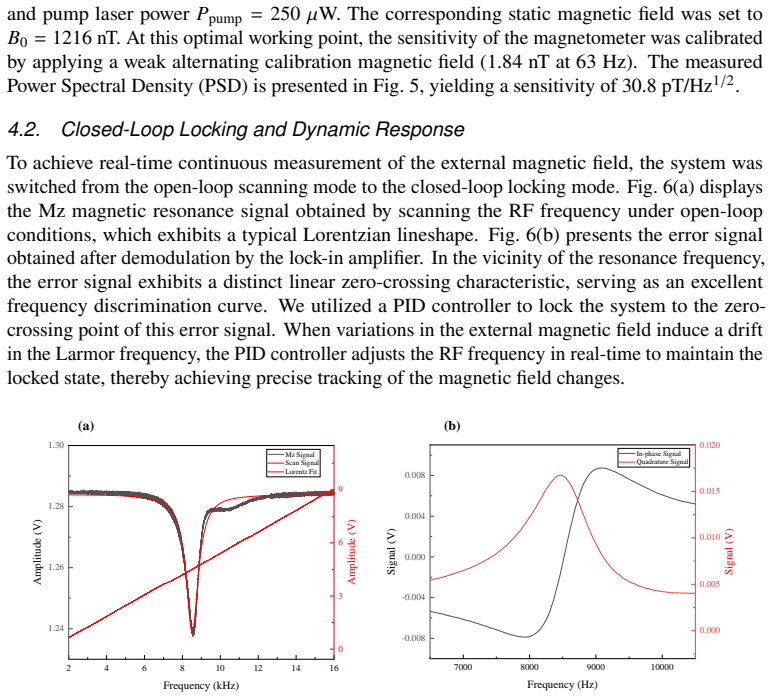
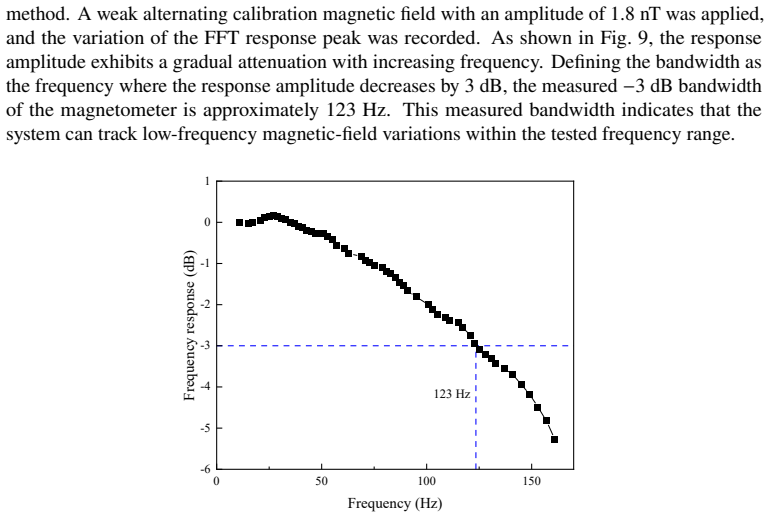
Optically pumped magnetometers (OPMs) have demonstrated significant potential in weak magnetic field detection due to their high sensitivity. In this study, we developed an Mz-type optically pumped rubidium magnetometer using a paraffin-coated anti-relaxation vapor cell. The system optimization and performance characterization were conducted inside a magnetic shield. Specifically, the pump light intensity and radio-frequency (RF) magnetic field were jointly optimized by using the linewidth-amplitude ratio as the core metric. Based on the frequency-domain noise spectrum, the sensitivity in open-loop mode was measured to be approximately 30.8 pT/Hz^{1/2}. Furthermore, a closed-loop feedback locking technique was applied, reducing the measured noise floor under the tested conditions and improving the sensitivity to 22.9 pT/Hz^{1/2}, with a measured -3 dB bandwidth of 123 Hz. The dynamic characteristics were evaluated via magnetic-field step response, showing that the system could track magnetic-field changes stably under closed-loop operation. Finally, by using tri-axial modulation and frequency-domain demodulation, we overcame the scalar measurement limitation of traditional Mz magnetometers. This work realizes vector magnetic field detection and provides a technical basis for applications such as geomagnetic navigation and magnetic anomaly detection.
Editorial analysis
A structured set of objections, weighed in public.
Referee Report
Summary. The paper reports optimization of an Mz-type optically pumped rubidium magnetometer in a paraffin-coated cell inside a magnetic shield. Joint optimization of pump intensity and RF field using linewidth-amplitude ratio yields open-loop sensitivity of ~30.8 pT/Hz^{1/2}; closed-loop locking improves this to 22.9 pT/Hz^{1/2} with 123 Hz bandwidth. Dynamic response is characterized via step inputs, and tri-axial modulation plus frequency-domain demodulation is used to convert the scalar sensor into a vector magnetometer for applications such as geomagnetic navigation.
Significance. If the vectorization maintains the reported sensitivity and bandwidth with low crosstalk, the work supplies a practical route to vector capability on existing scalar Mz OPM hardware, directly supporting the cited applications. The closed-loop locking and modulation approach are standard but the concrete numbers and experimental realization add useful engineering detail.
major comments (2)
- [Vector detection] Vector detection section: the claim that tri-axial modulation and frequency-domain demodulation overcomes the scalar limitation requires quantitative crosstalk data (e.g., off-diagonal response amplitudes when only one axis is modulated). No such matrix or cross-talk spectra are shown, leaving the independence of the three channels unverified.
- [Closed-loop operation] Closed-loop results: the improvement from 30.8 pT/Hz^{1/2} to 22.9 pT/Hz^{1/2} is stated without reported uncertainties, number of averaged spectra, or integration time, so the statistical significance of the gain cannot be assessed from the given data.
minor comments (2)
- [Figures] Figure captions for noise spectra and step responses should explicitly state the measurement bandwidth, averaging, and whether the traces are single-shot or averaged.
- [Abstract and Results] The abstract lists sensitivity values to one decimal place; the main text should confirm whether these are rounded or exact and under what exact conditions (e.g., at what frequency the floor is quoted).
Simulated Author's Rebuttal
We thank the referee for the constructive comments and positive overall assessment of our work. We address each major comment below and will revise the manuscript to incorporate the requested clarifications and data.
read point-by-point responses
-
Referee: Vector detection section: the claim that tri-axial modulation and frequency-domain demodulation overcomes the scalar limitation requires quantitative crosstalk data (e.g., off-diagonal response amplitudes when only one axis is modulated). No such matrix or cross-talk spectra are shown, leaving the independence of the three channels unverified.
Authors: We agree that quantitative crosstalk data would strengthen the demonstration of independent vector channels. In the revised manuscript we will add measurements of the response matrix (or equivalent cross-talk spectra) obtained by modulating a single axis while recording the demodulated outputs on all three channels. This will directly quantify the off-diagonal amplitudes and confirm the effectiveness of the frequency-domain separation. revision: yes
-
Referee: Closed-loop results: the improvement from 30.8 pT/Hz^{1/2} to 22.9 pT/Hz^{1/2} is stated without reported uncertainties, number of averaged spectra, or integration time, so the statistical significance of the gain cannot be assessed from the given data.
Authors: We acknowledge that the manuscript lacks the statistical details needed to evaluate the significance of the sensitivity improvement. In the revision we will specify the number of averaged spectra, the integration time per spectrum, and the uncertainties obtained from repeated acquisitions, allowing readers to assess the reliability of the reported open-loop and closed-loop values. revision: yes
Circularity Check
No significant circularity in derivation chain
full rationale
The manuscript reports experimental optimization of an Mz-type Rb magnetometer using direct measurements of linewidth-amplitude ratio, noise spectra, and step responses. All claimed sensitivities (30.8 pT/Hz^{1/2} open-loop, 22.9 pT/Hz^{1/2} closed-loop) and the vector extension via tri-axial modulation are obtained from hardware measurements and standard lock-in demodulation; no equations, fitted parameters, or predictions reduce by construction to inputs defined by the same dataset. No self-citations, uniqueness theorems, or ansatzes are invoked as load-bearing steps. The derivation chain is therefore self-contained against external experimental benchmarks.
Axiom & Free-Parameter Ledger
axioms (2)
- domain assumption The linewidth-amplitude ratio is a reliable single metric for jointly optimizing pump intensity and RF field amplitude.
- domain assumption Tri-axial modulation combined with frequency-domain demodulation can extract orthogonal vector components from a scalar Mz resonance without significant cross-talk.
Lean theorems connected to this paper
-
IndisputableMonolith/Cost/FunctionalEquation.leanwashburn_uniqueness_aczel unclear?
unclearRelation between the paper passage and the cited Recognition theorem.
the pump light intensity and radio-frequency (RF) magnetic field were jointly optimized by using the linewidth-amplitude ratio as the core metric... closed-loop feedback locking technique... tri-axial modulation and frequency-domain demodulation
-
IndisputableMonolith/Foundation/RealityFromDistinction.leanreality_from_one_distinction unclear?
unclearRelation between the paper passage and the cited Recognition theorem.
dynamic behavior... described by the Bloch equations... Mz exhibits a characteristic Lorentzian absorption dip
What do these tags mean?
- matches
- The paper's claim is directly supported by a theorem in the formal canon.
- supports
- The theorem supports part of the paper's argument, but the paper may add assumptions or extra steps.
- extends
- The paper goes beyond the formal theorem; the theorem is a base layer rather than the whole result.
- uses
- The paper appears to rely on the theorem as machinery.
- contradicts
- The paper's claim conflicts with a theorem or certificate in the canon.
- unclear
- Pith found a possible connection, but the passage is too broad, indirect, or ambiguous to say the theorem truly supports the claim.
Reference graph
Works this paper leans on
-
[1]
Distributed network of optically pumped magnetometers for space weather monitoring,
M.S.Mrozowski,A.S.Bell,P.F.Griffin,D.Hunter,D.Burt,J.P.McGilligan,E.Riis,C.D.Beggan,andS.J.Ingleby, “Distributed network of optically pumped magnetometers for space weather monitoring,” Sci. Rep.14, 28229 (2024)
work page 2024
-
[2]
The solar orbiter magnetometer,
T.S.Horbury,H.O’Brien,I.CarrascoBlazquez,M.Bendyk,P.Brown,R.Hudson,V.Evans,T.M.Oddy,C.M.Carr, T. J. Beek, E. Cupido, S. Bhattacharya, J. A. Dominguez, L. Matthews, V. R. Myklebust, B. Whiteside, S. D. Bale, W. Baumjohann, D. Burgess, and A. P. Walsh, “The solar orbiter magnetometer,” Astron. Astrophys.642, A9 (2020)
work page 2020
-
[3]
Recent progress of atomic magnetometers for geomagnetic applications,
Y. Lu, T. Zhao, W. Zhu, L. Liu, X. Zhuang, G. Fang, and X. Zhang, “Recent progress of atomic magnetometers for geomagnetic applications,” Sensors23, 5318 (2023)
work page 2023
-
[4]
Detection and analysis of MEG signals in occipital region with double-channel OPM sensors,
X. Zhang, C. Q. Chen, M. K. Zhang, C. Y. Ma, Y. Zhang, H. Wang, Q. Q. Guo, T. Hu, Z. B. Liu, Y. Chang, K. J. Hu, and X. D. Yang, “Detection and analysis of MEG signals in occipital region with double-channel OPM sensors,” J. Neurosci. Methods346, 108948 (2020)
work page 2020
-
[5]
Compacthigh-bandwidthsingle-beamoptically-pumpedmagnetometer for biomagnetic measurement,
T.Wu,W.Xiao,X.Peng,T.Wu,andH.Guo,“Compacthigh-bandwidthsingle-beamoptically-pumpedmagnetometer for biomagnetic measurement,” Opt. Express16, 235 (2024)
work page 2024
-
[6]
D. Budker and M. Romalis, “Optical magnetometry,” Nat. Phys.3, 227 (2007)
work page 2007
-
[7]
How to build a magnetometer with thermal atomic vapor: a tutorial,
A. Fabricant, I. Novikova, and G. Bison, “How to build a magnetometer with thermal atomic vapor: a tutorial,” New J. Phys.25, 025001 (2023)
work page 2023
-
[8]
Ahigh-sensitivitylaser-pumpedMxmagnetometer,
S.Groeger, G.Bison, J. L.Schenker, R.Wynands, andA.Weis, “Ahigh-sensitivitylaser-pumpedMxmagnetometer,” Eur. Phys. J. D38, 239 (2006)
work page 2006
-
[9]
Study on sensitivity-related parameters of distributed feedback laser pumped rubidium magnetometer,
Y. Gu, R. Shi, and Y. Wang, “Study on sensitivity-related parameters of distributed feedback laser pumped rubidium magnetometer,” Acta Phys. Sinica63, 110701 (2014). (in Chinese)
work page 2014
-
[10]
Improving the sensitivity of optically pumpedrubidiumatomicmagnetometerbyusingrepumpinglight,
L. Zhang, L. Bai, Y. Yang, Y. Yang, Y. Wang, X. Wen, J. He, and J. Wang, “Improving the sensitivity of optically pumpedrubidiumatomicmagnetometerbyusingrepumpinglight,”ActaPhys.Sinica70,230702(2021).(inChinese)
work page 2021
-
[11]
K. Xu, X. Ren, Y. Xiang, M. Zhang, X. Zhao, K. Ma, Y. Tian, D. Wu, Z. Zeng, and G. Wang, “Multi-parameter optimization of rubidium laser optically pumped magnetometers with geomagnetic field intensity,” Sensors23, 8919 (2023)
work page 2023
-
[12]
Magnetic field stabilization system designed for the cold-atom coherent population-trapping clock,
C. Zhan, Z. Ma, J. Wu, M. Li, C. Han, B. Lu, and C. Lee, “Magnetic field stabilization system designed for the cold-atom coherent population-trapping clock,” Chin. Opt. Lett.22, 080202 (2024)
work page 2024
-
[13]
R. Zhu, Y. Zhang, P. Du, Y. Xuan, F. Yang, Y. Zhou, K. Zhang, X. Li, S. Sun, T. Cheng, J. Li, S. Zheng, W. Quan, and J. Li, “A compact optically pumped potassium atomic magnetometer with high sensitivity under geomagnetic field intensity,” Measurement250, 117099 (2025)
work page 2025
-
[14]
Improving the sensitivity of a dark-resonance atomic magnetometer,
H. Zhai, W. Li, and G. Jin, “Improving the sensitivity of a dark-resonance atomic magnetometer,” Sensors25, 1229 (2025)
work page 2025
-
[15]
C. Cohen-Tannoudji, J. Dupont-Roc, S. Haroche, and F. Laloë, “Diverses résonances de croisement de niveaux sur des atomes pompés optiquement en champ nul. I. Théorie,” Rev. Phys. Appl. (Paris)5, 95 (1970)
work page 1970
-
[16]
Single-beam three-axis optically pumped magnetometers with sub-100 femtotesla sensitivity,
W. Xiao, Y. Wu, X. Zhang, Y. Feng, C. Sun, T. Wu, J. Chen, X. Peng, and H. Guo, “Single-beam three-axis optically pumped magnetometers with sub-100 femtotesla sensitivity,” Appl. Phys. Express14, 066002 (2021)
work page 2021
-
[17]
R. Dawson, M. S. Mrozowski, D. Hunter, C. O’Dwyer, E. Riis, P. F. Griffin, and S. Ingleby, “A triaxial vectorization technique for a single-beam zero-field atomic magnetometer to suppress cross-axis projection error,” arXiv Preprint arXiv:2408.12994 (2024)
-
[18]
Vector magnetometry employing a rotating RF field in a single-beam optically pumped magnetometer,
Y. Zou, L. Jiang, H. Bai, J. Liu, C. Fang, J. Zhu, Q. Shao, J. Xu, X. Zhou, and W. Quan, “Vector magnetometry employing a rotating RF field in a single-beam optically pumped magnetometer,” Sensors Actuators A379, 115009 (2024)
work page 2024
-
[19]
Design of a vectorized rubidium scalar magnetometer for SmallSat applications,
C.T.Chism,R.A.Marshall,A.Aguilar-Nadalini,S.Knappe,D.Malaspina,K.J.Hughes,M.Ellmeier,S.Wankmueller, C. Cunningham, T. Maydew, and O. Alem, “Design of a vectorized rubidium scalar magnetometer for SmallSat applications,” Adv. Space Res.76, 4635 (2025)
work page 2025
-
[20]
Pulsed vector atomic magnetometer using an alternating fast-rotating field,
T. Wang, W. Lee, M. Limes, T. Kornack, E. Foley, and M. Romalis, “Pulsed vector atomic magnetometer using an alternating fast-rotating field,” Nat. Commun.16, 1374 (2025)
work page 2025
-
[21]
Q. Gan, J. Shang, Y. Ji, and L. Wu, “Simultaneous excitation of85Rb and87Rb isotopes inside a microfabricated vapor cell with double-RF fields for a chip-scale Mz magnetometer,” Rev. Sci. Instrum.88, 115009 (2017)
work page 2017
-
[22]
FVM400 Vector Magnetometer Instruction Manual,
MEDA, Inc., “FVM400 Vector Magnetometer Instruction Manual,” Dulles, VA, USA (2018)
work page 2018
-
[23]
TM4300B Hand-held Three-axis Fluxgate Magnetometer User Manual,
TUNKIA Co., Ltd., “TM4300B Hand-held Three-axis Fluxgate Magnetometer User Manual,” Changsha, China
discussion (0)
Sign in with ORCID, Apple, or X to comment. Anyone can read and Pith papers without signing in.