Recognition: no theorem link
Non-equilibrium Dynamical Attractors and Thermalisation of Charm Quarks in Nuclear Collisions at the LHC Energy
Pith reviewed 2026-05-13 18:23 UTC · model grok-4.3
The pith
Charm quarks in the quark-gluon plasma develop dynamical attractors but fail to fully thermalize with lattice QCD diffusion coefficients, producing order-one deviations from equilibrium already at pT around 3 GeV.
A machine-rendered reading of the paper's core claim, the machinery that carries it, and where it could break.
Core claim
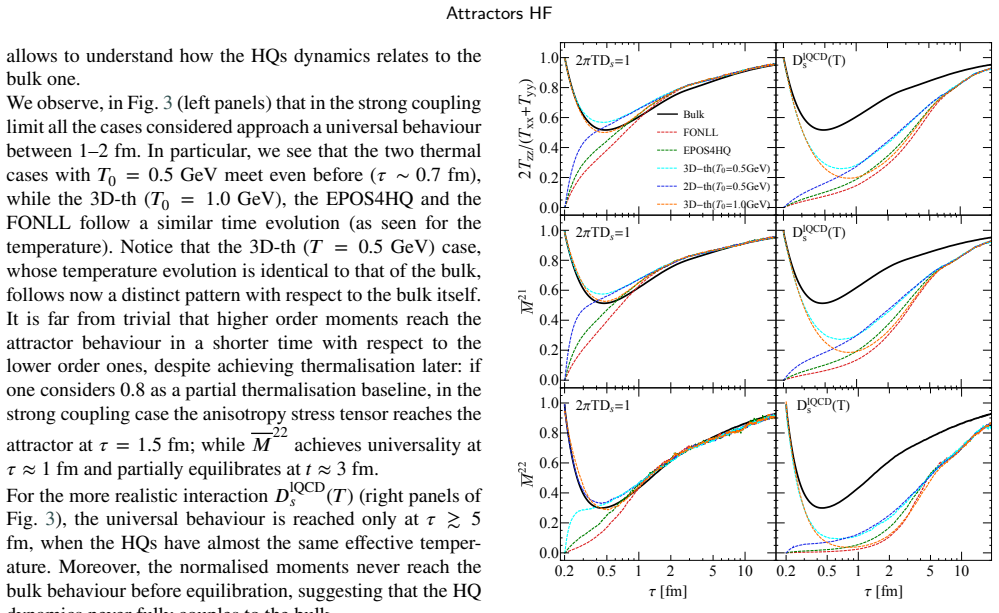
Charm quarks exhibit dynamical attractors in the longitudinally expanding plasma. With constant 2πT Ds = 1 the attractors form within 1-1.5 fm/c. With the lattice QCD Ds^lQCD(T) the relaxation time lengthens to about 5 fm/c. Consequently the deviation from equilibrium reaches δf_HQ/f_eq ~ p_T^β with β ~ 4.5 and already equals order one at p_T ≃ 3 GeV, while effective temperatures and momentum moments evolve more slowly than in the strong-coupling case.
What carries the argument
The temperature-dependent heavy-quark spatial diffusion coefficient Ds^lQCD(T) taken from unquenched lattice QCD simulations, inserted into the relativistic Boltzmann transport equation under 1+1D Bjorken expansion to evolve distribution functions, effective temperatures, and momentum moments from FONLL or EPOS4HQ initial spectra.
If this is right
- Charm quarks remain far from equilibrium throughout the QGP lifetime in most ultra-relativistic nuclear collisions, especially peripheral or light-ion systems.
- Viscous hydrodynamic descriptions become unreliable for charm-quark dynamics once lattice-based diffusion coefficients are used.
- Effective temperature and low-order momentum moments of charm quarks relax more slowly under temperature-dependent Ds than under constant strong-coupling Ds.
- Initial spectra from FONLL and EPOS4HQ both reach the same attractor family, but the approach is delayed when Ds^lQCD(T) is employed.
Where Pith is reading between the lines
- Incorporating realistic transverse expansion would likely increase the effective relaxation time further and enlarge the non-equilibrium deviations.
- Direct comparison of predicted versus measured D-meson spectra in small systems could distinguish the lattice diffusion scenario from full thermalization assumptions.
- The same framework applied to bottom quarks would predict even slower thermalization and larger deviations at accessible momenta.
- The steep pT dependence of the deviation may alter estimates of heavy-quark energy loss and flow coefficients extracted from data.
Load-bearing premise
A one-dimensional Bjorken expansion together with the chosen initial spectra and the specific lattice QCD diffusion coefficient fully captures the relevant charm dynamics without missing transverse expansion or other medium effects.
What would settle it
A measurement of D-meson transverse-momentum spectra or elliptic flow in peripheral or light-ion collisions at the LHC that either reproduces the predicted non-equilibrium shape with deviations of order one near 3 GeV or instead matches the shape expected from full thermal equilibrium.
Figures




read the original abstract
We study the non-equilibrium dynamics, thermalisation and attractor behaviour of charm quarks in a longitudinally expanding Quark-Gluon Plasma within the Relativistic Boltzmann Transport approach in 1+1D Bjorken expansion. Considering both a strong AdS/CFT coupling scenario with constant $2\pi T D_s=1$ and a temperature-dependent diffusion coefficient $D_s^\text{lQCD}(T)$ from the recent unquenched lattice QCD data, we analyse the evolution of effective temperature, momentum moments and distribution functions for different initial conditions, including FONLL and EPOS4HQ spectra. We find that charm quarks exhibit dynamical attractors; however, the temperature dependence of $D_s^\text{lQCD}(T)$ leads to significantly longer relaxation times compared to the strong coupling limit. While dynamical attractors occur within $\sim 1-1.5 \rm \,fm$ for $2\pi T D_s=1$, they are delayed to $\sim 5 \rm \,fm$ for $D_s^\text{lQCD}(T)$, becoming comparable to the lifetime of the Quark-Gluon Plasma phase in ultra-relativistic collisions. This indicates that charm quarks may not fully thermalise, especially in small systems such as peripheral or light-ion collisions. We further show that, for $D_s^\text{lQCD}(T)$, the deviation from equilibrium becomes as large as $\delta f_{HQ}/f_{eq} \sim p_T^\beta \sim \mathcal{O}(1)$ already at $p_T\simeq 3\rm\, GeV$, rising with $\beta \sim 4.5$, thus questioning the applicability of viscous hydrodynamics to charm dynamics.
Editorial analysis
A structured set of objections, weighed in public.
Referee Report
Summary. The paper studies non-equilibrium dynamics and attractor behavior of charm quarks in a 1+1D Bjorken-expanding QGP using relativistic Boltzmann transport. It compares a constant strong-coupling scenario (2πT Ds = 1) with temperature-dependent lattice QCD Ds^lQCD(T), reporting that attractors form within 1-1.5 fm for the former but are delayed to ~5 fm for the latter. For Ds^lQCD(T), deviations reach δf_HQ/f_eq ~ p_T^β with β ~ 4.5 and O(1) magnitude already at p_T ≃ 3 GeV, leading to the claim that charm quarks may not fully thermalize (especially in small systems) and that viscous hydrodynamics is inapplicable to charm dynamics. Results are shown for FONLL and EPOS4HQ initial spectra.
Significance. If robust, the work would provide concrete evidence that charm quarks remain far from equilibrium throughout the QGP phase at LHC energies when using realistic Ds(T), with direct implications for heavy-flavor R_AA and v_n modeling. The direct Boltzmann solution with lattice input yields falsifiable predictions for the p_T scaling of non-equilibrium deviations. The 1+1D setup and numerical integration are strengths, but the quantitative claims on relaxation time and hydro inapplicability hinge on an approximation whose corrections are unquantified.
major comments (2)
- [Model setup and results on relaxation times] The headline results (attractor delay to ~5 fm and δf_HQ/f_eq ~ p_T^{4.5} reaching O(1) at p_T ≃ 3 GeV) are obtained under pure 1+1D Bjorken flow with T(τ) ∝ τ^{-1/3}. This geometry omits transverse expansion, which accelerates cooling and reduces the integrated drag time. The manuscript must either extend the calculation to include transverse flow or provide a quantitative estimate of how the attractor onset and deviation magnitude change, because this directly underpins the conclusion that viscous hydrodynamics is inapplicable to charm.
- [Results on distribution functions and moments] The power-law exponent β ~ 4.5 and the statement that deviations become O(1) at p_T ≃ 3 GeV for Ds^lQCD(T) are central to questioning hydro applicability. These must be tied to a specific figure or equation showing δf_HQ/f_eq(p_T) at the relevant proper time, with explicit checks of robustness against the two initial spectra (FONLL vs EPOS4HQ) and against variations in the Ds(T) parametrization.
minor comments (2)
- [Abstract and results] The abstract and results section should clarify the p_T range over which the β ~ 4.5 fit is performed and whether it is obtained from a log-log plot or direct fitting procedure.
- [Methods] Add a brief discussion or appendix on numerical convergence of the Boltzmann solver, time-stepping, and momentum-space discretization used to extract the reported relaxation times and distribution functions.
Simulated Author's Rebuttal
We thank the referee for the careful reading of our manuscript and the constructive comments, which help clarify the scope and limitations of our results. We address each major comment point by point below, indicating the revisions we will implement.
read point-by-point responses
-
Referee: [Model setup and results on relaxation times] The headline results (attractor delay to ~5 fm and δf_HQ/f_eq ~ p_T^{4.5} reaching O(1) at p_T ≃ 3 GeV) are obtained under pure 1+1D Bjorken flow with T(τ) ∝ τ^{-1/3}. This geometry omits transverse expansion, which accelerates cooling and reduces the integrated drag time. The manuscript must either extend the calculation to include transverse flow or provide a quantitative estimate of how the attractor onset and deviation magnitude change, because this directly underpins the conclusion that viscous hydrodynamics is inapplicable to charm.
Authors: We agree that the 1+1D Bjorken setup omits transverse expansion, which would accelerate cooling and shorten the integrated interaction time for charm quarks. This is a genuine limitation of the current geometry. While a full (3+1)D extension is beyond the scope of the present work, we will add a quantitative estimate in the revised manuscript by incorporating a simple transverse cooling term into T(τ) (following standard hydrodynamic parametrizations) and recomputing the relaxation timescale and δf deviations for the Ds^lQCD(T) case. This estimate will show that the attractor onset remains delayed to several fm/c and that O(1) deviations persist at p_T ≃ 3 GeV, supporting our conclusions while explicitly acknowledging the approximation. We will also note that transverse effects are even stronger in small systems, reinforcing rather than weakening the claim of incomplete thermalization. revision: partial
-
Referee: [Results on distribution functions and moments] The power-law exponent β ~ 4.5 and the statement that deviations become O(1) at p_T ≃ 3 GeV for Ds^lQCD(T) are central to questioning hydro applicability. These must be tied to a specific figure or equation showing δf_HQ/f_eq(p_T) at the relevant proper time, with explicit checks of robustness against the two initial spectra (FONLL vs EPOS4HQ) and against variations in the Ds(T) parametrization.
Authors: We will revise the text to explicitly reference the relevant figure (showing δf_HQ/f_eq versus p_T at τ ≈ 5 fm) and the associated equation for the power-law fit. The exponent β ≈ 4.5 and O(1) magnitude at p_T ≃ 3 GeV are obtained from that plot for the Ds^lQCD(T) case. We have already verified that both FONLL and EPOS4HQ initial spectra yield consistent exponents (within 0.2) and comparable deviation magnitudes; this robustness check will now be stated explicitly in the manuscript. For Ds(T) variations, we will add a short paragraph discussing the sensitivity to the lattice parametrization slope, confirming that the qualitative conclusions remain unchanged. These additions will be included in the revised version. revision: yes
Circularity Check
No significant circularity; results are direct numerical outputs from Boltzmann transport with external lattice input
full rationale
The derivation consists of numerically solving the relativistic Boltzmann equation under 1+1D Bjorken flow for given initial spectra (FONLL, EPOS4HQ) and an externally supplied Ds^lQCD(T) taken from unquenched lattice QCD. The reported relaxation times, attractors, and δf_HQ/f_eq ~ p_T^β deviations are computed outputs of this integration; they are not obtained by fitting parameters to the target observables or by reducing to self-citations. Any prior author works on the transport code are standard methodological references and do not supply the load-bearing result. The 1+1D geometry is an explicit modeling choice whose limitations are separate from circularity.
Axiom & Free-Parameter Ledger
free parameters (2)
- initial charm spectra
- diffusion coefficient Ds(T)
axioms (2)
- domain assumption 1+1D Bjorken expansion
- standard math Relativistic Boltzmann Transport framework
Reference graph
Works this paper leans on
-
[1]
X. Dong, V. Greco, Heavy quark production and properties of Quark–Gluon Plasma, Prog. Part. Nucl. Phys. 104 (2019) 97–141. doi:10.1016/j.ppnp.2018.08.001
-
[2]
M. He, H. van Hees, R. Rapp, Heavy-quark diffusion in the quark–gluon plasma, Prog. Part. Nucl. Phys. 130 (2023) 104020. arXiv:2204.09299,doi:10.1016/j.ppnp.2023.104020
-
[3]
F.Scardina,S.K.Das,V.Minissale,S.Plumari,V.Greco,Estimating thecharmquarkdiffusioncoefficientandthermalizationtimefromD mesonspectraatenergiesavailableattheBNLRelativisticHeavyIon Collider and the CERN Large Hadron Collider, Phys. Rev. C 96 (4) (2017) 044905.arXiv:1707.05452,doi:10.1103/PhysRevC.96.044905
-
[4]
H. van Hees, V. Greco, R. Rapp, Heavy-quark probes of the quark- gluon plasma at RHIC, Phys. Rev. C 73 (2006) 034913.arXiv: nucl-th/0508055,doi:10.1103/PhysRevC.73.034913
-
[5]
H. van Hees, M. Mannarelli, V. Greco, R. Rapp, Nonperturbative heavy-quark diffusion in the quark-gluon plasma, Phys. Rev. Lett. 100 (2008) 192301.arXiv:0709.2884,doi:10.1103/PhysRevLett.100. 192301
-
[6]
P. B. Gossiaux, J. Aichelin, Towards an understanding of the RHIC singleelectrondata,Phys.Rev.C78(2008)014904.arXiv:0802.2525, doi:10.1103/PhysRevC.78.014904
-
[7]
S. K. Das, J.-e. Alam, P. Mohanty, Probing quark gluon plasma properties by heavy flavours, Phys. Rev. C 80 (2009) 054916.arXiv: 0908.4194,doi:10.1103/PhysRevC.80.054916
-
[8]
W. M. Alberico, A. Beraudo, A. De Pace, A. Molinari, M. Monteno, M. Nardi, F. Prino, Heavy-flavour spectra in high energy nucleus- nucleus collisions, Eur. Phys. J. C 71 (2011) 1666.arXiv:1101.6008, doi:10.1140/epjc/s10052-011-1666-6
-
[9]
J.Uphoff,O.Fochler,Z.Xu,C.Greiner,OpenHeavyFlavorinPb+Pb Collisionsat √ 𝑠= 2.76TeVwithinaTransportModel,Phys.Lett.B 717 (2012)430–435.arXiv:1205.4945,doi:10.1016/j.physletb.2012. 09.069
-
[10]
T. Lang, H. van Hees, J. Steinheimer, G. Inghirami, M. Bleicher, Heavy quark transport in heavy ion collisions at energies available at the BNL Relativistic Heavy Ion Collider and at the CERN Large HadronColliderwithintheUrQMDhybridmodel,Phys.Rev.C93(1) (2016) 014901.arXiv:1211.6912,doi:10.1103/PhysRevC.93.014901
-
[11]
T. Song, H. Berrehrah, D. Cabrera, J. M. Torres-Rincon, L. Tolos, W. Cassing, E. Bratkovskaya, Tomography of the Quark-Gluon- PlasmabyCharmQuarks,Phys.Rev.C92(1)(2015)014910.arXiv: 1503.03039,doi:10.1103/PhysRevC.92.014910
-
[12]
T. Song, H. Berrehrah, D. Cabrera, W. Cassing, E. Bratkovskaya, Charm production in Pb + Pb collisions at energies available at the CERN Large Hadron Collider, Phys. Rev. C 93 (3) (2016) 034906. arXiv:1512.00891,doi:10.1103/PhysRevC.93.034906
-
[13]
Rev.C90(2014)044901.arXiv:1312.6857,doi:10.1103/PhysRevC.90
S.K.Das,F.Scardina,S.Plumari,V.Greco,Heavy-flavorin-medium momentum evolution: Langevin versus Boltzmann approach, Phys. Rev.C90(2014)044901.arXiv:1312.6857,doi:10.1103/PhysRevC.90. 044901
- [14]
-
[15]
S. K. Das, F. Scardina, S. Plumari, V. Greco, Toward a solution to the𝑅 𝐴𝐴 and𝑣 2 puzzle for heavy quarks, Phys. Lett. B 747 (2015) 260–264.arXiv:1502.03757,doi:10.1016/j.physletb.2015.06.003
-
[16]
S. Cao, T. Luo, G.-Y. Qin, X.-N. Wang, Heavy and light flavor jet quenchingatRHICandLHCenergies,Phys.Lett.B777(2018)255– 259.arXiv:1703.00822,doi:10.1016/j.physletb.2017.12.023
-
[17]
S. K. Das, M. Ruggieri, F. Scardina, S. Plumari, V. Greco, Effect of pre-equilibrium phase on𝑅𝐴𝐴 and𝑣 2 of heavy quarks in heavy S. Chen et al.:Preprint submitted to ElsevierPage 8 of 11 Attractors HF ion collisions, J. Phys. G 44 (9) (2017) 095102.arXiv:1701.05123, doi:10.1088/1361-6471/aa815a
-
[18]
M. Y. Jamal, S. K. Das, M. Ruggieri, Energy Loss Versus Energy GainofHeavyQuarksinaHotMedium,Phys.Rev.D103(5)(2021) 054030.arXiv:2009.00561,doi:10.1103/PhysRevD.103.054030
-
[19]
M. Ruggieri, S. K. Das, Cathode tube effect: Heavy quarks probing the glasma in p -Pb collisions, Phys. Rev. D 98 (9) (2018) 094024. arXiv:1805.09617,doi:10.1103/PhysRevD.98.094024
-
[20]
Y.Sun,G.Coci,S.K.Das,S.Plumari,M.Ruggieri,V.Greco,Impact of Glasma on heavy quark observables in nucleus-nucleus collisions at LHC, Phys. Lett. B 798 (2019) 134933.arXiv:1902.06254,doi: 10.1016/j.physletb.2019.134933
-
[21]
S. Cao, et al., Toward the determination of heavy-quark transport co- efficients in quark-gluon plasma, Phys. Rev. C 99 (5) (2019) 054907. arXiv:1809.07894,doi:10.1103/PhysRevC.99.054907
-
[22]
A.Beraudo,etal.,ExtractionofHeavy-FlavorTransportCoefficients in QCD Matter, Nucl. Phys. A 979 (2018) 21–86.arXiv:1803.03824, doi:10.1016/j.nuclphysa.2018.09.002
-
[23]
M. L. Sambataro, V. Minissale, S. Plumari, V. Greco, B meson production in Pb+Pb at 5.02 ATeV at LHC: Estimating the diffusion coefficientintheinfinitemasslimit,Phys.Lett.B849(2024)138480. arXiv:2304.02953,doi:10.1016/j.physletb.2024.138480
-
[24]
M. L. Sambataro, Y. Sun, V. Minissale, S. Plumari, V. Greco, Event- shape engineering analysis of D meson in ultrarelativistic heavy-ion collisions, Eur. Phys. J. C 82 (9) (2022) 833.arXiv:2206.03160, doi:10.1140/epjc/s10052-022-10802-2
-
[25]
S.Plumari,G.Coci,V.Minissale,S.K.Das,Y.Sun,V.Greco,Heavy -lightflavorcorrelationsofanisotropicflowsatLHCenergieswithin event-by-event transport approach, Phys. Lett. B 805 (2020) 135460. arXiv:1912.09350,doi:10.1016/j.physletb.2020.135460
-
[27]
S. Acharya, et al., Transverse-momentum and event-shape depen- dence of D-meson flow harmonics in Pb–Pb collisions at√𝑠𝑁𝑁 = 5.02 TeV, Phys. Lett. B 813 (2021) 136054.arXiv:2005.11131, doi:10.1016/j.physletb.2020.136054
-
[28]
S. Acharya, et al., J/𝜓elliptic and triangular flow in Pb-Pb collisions at √𝑠NN = 5.02 TeV, JHEP 10 (2020) 141.arXiv:2005.14518,doi: 10.1007/JHEP10(2020)141
-
[29]
F. Capellino, A. Beraudo, A. Dubla, S. Floerchinger, S. Masciocchi, J. Pawlowski, I. Selyuzhenkov, Fluid-dynamic approach to heavy- quark diffusion in the quark-gluon plasma, Phys. Rev. D 106 (3) (2022) 034021.arXiv:2205.07692,doi:10.1103/PhysRevD.106.034021
-
[30]
F. Capellino, A. Dubla, S. Floerchinger, E. Grossi, A. Kirchner, S. Masciocchi, Fluid dynamics of charm quarks in the quark-gluon plasma, Phys. Rev. D 108 (11) (2023) 116011.arXiv:2307.14449, doi:10.1103/PhysRevD.108.116011
- [31]
-
[32]
Final result of the ma- jorana demonstrator’s search for neutrinoless double-β decay in 76Ge (2023)
L. Altenkort, O. Kaczmarek, R. Larsen, S. Mukherjee, P. Petreczky, H.-T. Shu, S. Stendebach, Heavy Quark Diffusion from 2+1 Flavor Lattice QCD with 320 MeV Pion Mass, Phys. Rev. Lett. 130 (23) (2023) 231902.arXiv:2302.08501,doi:10.1103/PhysRevLett.130. 231902
-
[33]
L. Altenkort, D. de la Cruz, O. Kaczmarek, R. Larsen, G. D. Moore, S. Mukherjee, P. Petreczky, H.-T. Shu, S. Stendebach, Quark Mass DependenceofHeavyQuarkDiffusionCoefficientfromLatticeQCD, Phys. Rev. Lett. 132 (5) (2024) 051902.arXiv:2311.01525,doi:10. 1103/PhysRevLett.132.051902
-
[34]
D. Bollweg, J. L. Dasilva Golán, O. Kaczmarek, R. N. Larsen, G. D. Moore, S. Mukherjee, P. Petreczky, H.-T. Shu, S. Stendebach, J. H. Weber, Temperature dependence of heavy quark diffusion from (2+1)-flavor lattice QCD, JHEP 09 (2025) 180.arXiv:2506.11958, doi:10.1007/JHEP09(2025)180
-
[35]
R. D. Weller, P. Romatschke, One fluid to rule them all: viscous hydrodynamic description of event-by-event central p+p, p+Pb and Pb+Pb collisions at √ 𝑠= 5.02TeV, Phys. Lett. B 774 (2017) 351– 356.arXiv:1701.07145,doi:10.1016/j.physletb.2017.09.077
-
[36]
M. P. Heller, M. Spalinski, Hydrodynamics Beyond the Gradient Expansion: Resurgence and Resummation, Phys. Rev. Lett. 115 (7) (2015) 072501.arXiv:1503.07514,doi:10.1103/PhysRevLett.115. 072501
-
[37]
M. Strickland, The non-equilibrium attractor for kinetic theory in relaxation time approximation, JHEP 12 (2018) 128.arXiv:1809. 01200,doi:10.1007/JHEP12(2018)128
-
[38]
D.Almaalol, A.Kurkela, M.Strickland, NonequilibriumAttractor in High-Temperature QCD Plasmas, Phys. Rev. Lett. 125 (12) (2020) 122302.arXiv:2004.05195,doi:10.1103/PhysRevLett.125.122302
-
[39]
J. Noronha, M. Spaliński, E. Speranza, Transient Relativistic Fluid Dynamics in a General Hydrodynamic Frame, Phys. Rev. Lett. 128(25)(2022)252302.arXiv:2105.01034,doi:10.1103/PhysRevLett. 128.252302
-
[40]
J.-P. Blaizot, L. Yan, Fluid dynamics of out of equilibrium boost invariant plasmas, Phys. Lett. B 780 (2018) 283–286.arXiv:1712. 03856,doi:10.1016/j.physletb.2018.02.058
-
[41]
Soloviev, Hydrodynamic attractors in heavy ion collisions: a review, Eur
A. Soloviev, Hydrodynamic attractors in heavy ion collisions: a review, Eur. Phys. J. C 82 (4) (2022) 319.arXiv:2109.15081,doi: 10.1140/epjc/s10052-022-10282-4
-
[42]
C.Cartwright,M.Kaminski,M.Knipfer,Hydrodynamicattractorsfor thespeedofsoundinholographicBjorkenflow,Phys.Rev.D107(10) (2023) 106016.arXiv:2207.02875,doi:10.1103/PhysRevD.107.106016
-
[43]
M. Strickland, J. Noronha, G. Denicol, Anisotropic nonequilibrium hydrodynamic attractor, Phys. Rev. D 97 (3) (2018) 036020.arXiv: 1709.06644,doi:10.1103/PhysRevD.97.036020
-
[44]
A. Kurkela, W. van der Schee, U. A. Wiedemann, B. Wu, Early- and Late-Time Behavior of Attractors in Heavy-Ion Collisions, Phys. Rev. Lett. 124 (10) (2020) 102301.arXiv:1907.08101,doi:10.1103/ PhysRevLett.124.102301
-
[45]
M. Spaliński, Universal behaviour, transients and attractors in su- persymmetric Yang–Mills plasma, Phys. Lett. B 784 (2018) 21–25. arXiv:1805.11689,doi:10.1016/j.physletb.2018.07.003
-
[46]
G. S. Denicol, J. Noronha, Exact hydrodynamic attractor of an ul- trarelativistic gas of hard spheres, Phys. Rev. Lett. 124 (15) (2020) 152301.arXiv:1908.09957,doi:10.1103/PhysRevLett.124.152301
-
[47]
A.Behtash,C.N.Cruz-Camacho,M.Martinez,Far-from-equilibrium attractors and nonlinear dynamical systems approach to the Gubser flow, Phys. Rev. D 97 (4) (2018) 044041.arXiv:1711.01745,doi: 10.1103/PhysRevD.97.044041
-
[48]
C.Chattopadhyay,U.W.Heinz,Hydrodynamicsfromfree-streaming to thermalization and back again, Phys. Lett. B 801 (2020) 135158. arXiv:1911.07765,doi:10.1016/j.physletb.2019.135158
-
[49]
G.Giacalone,A.Mazeliauskas,S.Schlichting,Hydrodynamicattrac- tors, initial state energy and particle production in relativistic nuclear collisions,Phys.Rev.Lett.123(26)(2019)262301.arXiv:1908.02866, doi:10.1103/PhysRevLett.123.262301
-
[50]
A. Mazeliauskas, J. Berges, Prescaling and far-from-equilibrium hy- drodynamics in the quark-gluon plasma, Phys. Rev. Lett. 122 (12) (2019) 122301.arXiv:1810.10554,doi:10.1103/PhysRevLett.122. 122301
-
[51]
J. Brewer, B. Scheihing-Hitschfeld, Y. Yin, Scaling and adiabaticity in a rapidly expanding gluon plasma, JHEP 05 (2022) 145.arXiv: 2203.02427,doi:10.1007/JHEP05(2022)145
-
[52]
Schlichting,R.Venugopalan,Universal attractor in a highly occupied non-Abelian plasma, Phys
J.Berges,K.Boguslavski,S. Schlichting,R.Venugopalan,Universal attractor in a highly occupied non-Abelian plasma, Phys. Rev. D 89 (11) (2014) 114007.arXiv:1311.3005,doi:10.1103/PhysRevD.89. 114007
- [53]
-
[54]
J.Jankowski,M.Spaliński,Hydrodynamicattractorsinultrarelativis- tic nuclear collisions, Prog. Part. Nucl. Phys. 132 (2023) 104048. arXiv:2303.09414,doi:10.1016/j.ppnp.2023.104048. S. Chen et al.:Preprint submitted to ElsevierPage 9 of 11 Attractors HF
-
[55]
M. Alqahtani, Far-from-equilibrium attractors with a realistic non- conformalequationofstate,Nucl.Phys.B989(2023)116148.arXiv: 2210.06712,doi:10.1016/j.nuclphysb.2023.116148
-
[56]
H. Alalawi, M. Strickland, Far-from-equilibrium attractors for mas- sive kinetic theory in the relaxation time approximation, JHEP 12 (2022) 143, [Erratum: JHEP 07, 217 (2023)].arXiv:2210.00658, doi:10.1007/JHEP12(2022)143
-
[57]
M.Spaliński,Farfromequilibriumattractorsinphasespace(82025). arXiv:2508.21039
-
[58]
V. E. Ambrus, S. Busuioc, J. A. Fotakis, K. Gallmeister, C. Greiner, Bjorken flow attractors with transverse dynamics, Phys. Rev. D 104(9)(2021)094022.arXiv:2102.11785,doi:10.1103/PhysRevD.104. 094022
-
[59]
S. Chen, S. Shi, Attractor for (1+1)D viscous hydrodynamics with general rapidity distribution, Phys. Rev. C 111 (2) (2025) L021902. arXiv:2407.15209,doi:10.1103/PhysRevC.111.L021902
-
[60]
V. Nugara, S. Plumari, L. Oliva, V. Greco, Far-from-equilibrium attractorswithfullrelativisticBoltzmannapproachinboost-invariant and non-boost-invariant systems, Eur. Phys. J. C 84 (8) (2024) 861. arXiv:2311.11921,doi:10.1140/epjc/s10052-024-13227-1
-
[61]
V. Nugara, V. Greco, S. Plumari, Far-from-equilibrium attractors with Full Relativistic Boltzmann approach in 3+1D: moments of distribution function and anisotropic flows𝑣𝑛, Eur. Phys. J. C 85 (3) (2025)311.arXiv:2409.12123,doi:10.1140/epjc/s10052-025-14029-9
-
[62]
F.Frascà,A.Beraudo,M.Strickland,Far-from-equilibriumattractors in kinetic theory for a mixture of quark and gluon fluids, Nucl. Phys. A 1055 (2025) 123008.arXiv:2407.17327,doi:10.1016/j.nuclphysa. 2024.123008
-
[63]
S. Plumari, A. Puglisi, F. Scardina, V. Greco, Shear Viscosity of a strongly interacting system: Green-Kubo vs. Chapman-Enskog and Relaxation Time Approximation, Phys. Rev. C 86 (2012) 054902. arXiv:1208.0481,doi:10.1103/PhysRevC.86.054902
-
[64]
M. Ruggieri, F. Scardina, S. Plumari, V. Greco, Thermalization, Isotropization and Elliptic Flow from Nonequilibrium Initial Condi- tions with a Saturation Scale, Phys. Rev. C 89 (5) (2014) 054914. arXiv:1312.6060,doi:10.1103/PhysRevC.89.054914
-
[65]
F. Scardina, D. Perricone, S. Plumari, M. Ruggieri, V. Greco, Rel- ativistic Boltzmann transport approach with Bose-Einstein statistics and the onset of gluon condensation, Phys. Rev. C 90 (5) (2014) 054904.arXiv:1408.1313,doi:10.1103/PhysRevC.90.054904
-
[66]
S. Plumari, G. L. Guardo, F. Scardina, V. Greco, Initial state fluc- tuations from mid-peripheral to ultra-central collisions in a event- by-event transport approach, Phys. Rev. C 92 (5) (2015) 054902. arXiv:1507.05540,doi:10.1103/PhysRevC.92.054902
-
[67]
S. Plumari, Anisotropic flows and the shear viscosity of the QGP within an event-by-event massive parton transport approach, Eur. Phys. J. C 79 (1) (2019) 2.doi:10.1140/epjc/s10052-018-6510-9
-
[68]
Y. Sun, S. Plumari, V. Greco, Study of collective anisotropies𝑣2 and 𝑣3 and their fluctuations in𝑝𝐴collisions at LHC within a relativistic transportapproach,Eur.Phys.J.C80(1)(2020)16.arXiv:1907.11287, doi:10.1140/epjc/s10052-019-7577-7
-
[69]
M. L. Sambataro, V. Greco, G. Parisi, S. Plumari, Quasi particle model vs lattice QCD thermodynamics: extension to𝑁𝑓 = 2 + 1 + 1 flavorsandmomentumdependentquarkmasses,Eur.Phys.J.C84(9) (2024)881.arXiv:2404.17459,doi:10.1140/epjc/s10052-024-13276-6
-
[70]
S.Borsanyi,Z.Fodor,J.N.Guenther,R.Kara,S.D.Katz,P.Parotto, A. Pasztor, C. Ratti, K. K. Szabo, QCD Crossover at Finite Chemical Potential from Lattice Simulations, Phys. Rev. Lett. 125 (5) (2020) 052001.arXiv:2002.02821,doi:10.1103/PhysRevLett.125.052001
-
[71]
V. Nugara, N. Borghini, V. Greco, S. Plumari, Knudsen number and universal behavior of collective flows in conformal and non- conformal systems, Phys. Lett. B 872 (2026) 140122.arXiv:2509. 05495,doi:10.1016/j.physletb.2025.140122
-
[72]
G. Parisi, V. Nugara, S. Plumari, V. Greco, Shear viscosity of a binary mixture for a relativistic fluid at high temperature, Phys. Rev. D 113 (1) (2026) 014001.arXiv:2510.20704,doi:10.1103/qd2t-2sdp
-
[73]
P. Huovinen, D. Molnar, The Applicability of causal dissipative hydrodynamics to relativistic heavy ion collisions, Phys. Rev. C 79 (2009) 014906.arXiv:0808.0953,doi:10.1103/PhysRevC.79.014906
-
[74]
A. El, Z. Xu, C. Greiner, Third-order relativistic dissipative hydro- dynamics, Phys. Rev. C 81 (2010) 041901.arXiv:0907.4500,doi: 10.1103/PhysRevC.81.041901
-
[75]
S. Plumari, G. L. Guardo, V. Greco, J.-Y. Ollitrault, Viscous cor- rections to anisotropic flow and transverse momentum spectra from transport theory, Nucl. Phys. A 941 (2015) 87–96.arXiv:1502.04066, doi:10.1016/j.nuclphysa.2015.06.005
-
[76]
A. Gabbana, S. Plumari, G. Galesi, V. Greco, D. Simeoni, S. Succi, R.Tripiccione,Dissipativehydrodynamicsofrelativisticshockwaves in a Quark Gluon Plasma: comparing and benchmarking alternate numerical methods, Phys. Rev. C 101 (6) (2020) 064904.arXiv: 1912.10455,doi:10.1103/PhysRevC.101.064904
-
[77]
M.L.Sambataro,V.Minissale,S.Plumari,V.Greco,Assessinglattice QCD charm space diffusion coefficient and thermalization time by mean of D meson observables at LHC, Phys. Lett. B 872 (2026) 140049.arXiv:2508.01024,doi:10.1016/j.physletb.2025.140049
-
[78]
S. S. Gubser, Comparing the drag force on heavy quarks in N=4 super-Yang-Mills theory and QCD, Phys. Rev. D 76 (2007) 126003. arXiv:hep-th/0611272,doi:10.1103/PhysRevD.76.126003
-
[79]
W. A. Horowitz, Fluctuating heavy quark energy loss in a strongly coupled quark-gluon plasma, Phys. Rev. D 91 (8) (2015) 085019. arXiv:1501.04693,doi:10.1103/PhysRevD.91.085019
-
[80]
J. Casalderrey-Solana, D. Teaney, Heavy quark diffusion in strongly coupled N=4 Yang-Mills, Phys. Rev. D 74 (2006) 085012.arXiv: hep-ph/0605199,doi:10.1103/PhysRevD.74.085012
- [81]
discussion (0)
Sign in with ORCID, Apple, or X to comment. Anyone can read and Pith papers without signing in.