Recognition: 2 theorem links
· Lean TheoremWhich filaments matter: the relative scalings of anisotropic infall
Pith reviewed 2026-05-13 19:09 UTC · model grok-4.3
The pith
The tidal field around collapsing haloes most strongly influences formation at scales 2-3 times the Lagrangian patch size.
A machine-rendered reading of the paper's core claim, the machinery that carries it, and where it could break.
Core claim
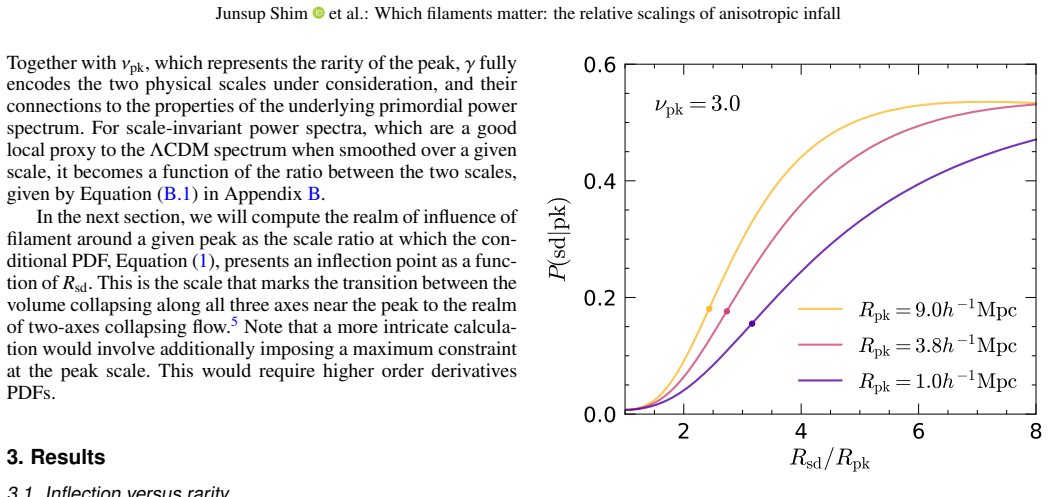
We identify the inflection point of the conditional probability that the tidal field, smoothed on a scale Rsd, undergoes two-dimensional compression, given the presence of a density peak of rarity nu on a smaller scale Rpk. For a standard LambdaCDM cosmology, we find (Rsd/Rpk)infl = 2.2 + (nu-2.5) for Rpk corresponding to a tophat filter of 8Mpc/h. This result implies that the anisotropic tidal influence on a collapsing halo typically extends to 2-3 times the size of its Lagrangian patch. Recast as a function of formation redshift z, the characteristic filament scale around 2.5 sigma peaks can be approximated by Rsd(z) = 31 / (2+(1+z)**2) Mpc/h.
What carries the argument
The inflection point of the conditional probability that the tidal field undergoes two-dimensional compression given a density peak of rarity nu.
If this is right
- The characteristic filament scale around 2.5-sigma peaks follows Rsd(z) ≈ 31 / (2 + (1+z)^2) Mpc/h.
- Dynamically relevant smoothing scales in large-scale surveys can be chosen using the derived ratio and its nu dependence.
- Initial patch sizes in high-resolution zoom simulations should extend to roughly 2-3 times the target halo's Lagrangian radius to capture the full anisotropic infall.
- The scale ratio grows mildly with rarer (higher-nu) peaks, so more massive haloes feel tidal influence from proportionally larger filaments.
Where Pith is reading between the lines
- The scaling could be checked directly by stacking filament widths measured around haloes binned by peak rarity in cosmological simulations.
- Zoom simulations that truncate the environment below 2.5 times the target Lagrangian radius may systematically under-estimate anisotropic accretion.
- Because the result depends on peak height nu, the same formalism could be applied in modified-gravity or warm-dark-matter cosmologies to predict different filament scales.
- The derived relation supplies a prior for the expected environment size when modeling galaxy spin or morphology alignment with the cosmic web.
Load-bearing premise
The inflection point in the conditional probability distribution marks the exact scale at which the anisotropic tidal field most strongly influences halo formation.
What would settle it
Compare the measured scale of anisotropic gas and dark-matter infall around haloes of known peak height in N-body simulations against the predicted ratio (Rsd/Rpk) = 2.2 + (nu-2.5).
Figures


read the original abstract
Dark-matter haloes do not form in isolation but within the surrounding cosmic web. By the time a halo begins to collapse, its larger-scale environment has typically collapsed along two axes, forming filaments that channel anisotropic infall toward the halo. In this work, we derive from first principles the characteristic Lagrangian scale ratio at which such an anisotropic tidal field most strongly influences halo formation. Specifically, we identify the inflection point of the conditional probability that the tidal field, smoothed on a scale Rsd, undergoes two-dimensional compression, given the presence of a density peak of rarity nu on a smaller scale Rpk. For a standard LambdaCDM cosmology, we find (Rsd/Rpk)infl = 2.2 + (nu-2.5) for Rpk corresponding to a tophat filter of 8Mpc/h. This result implies that the anisotropic tidal influence on a collapsing halo typically extends to 2-3 times the size of its Lagrangian patch. Recast as a function of formation redshift z, the characteristic filament scale around 2.5 sigma peaks can be approximated by Rsd(z) = 31 /(2+(1+z)**2)Mpc/h. We provide practical scaling laws for selecting dynamically relevant smoothing scales in large-scale surveys and for setting initial patch sizes in high-resolution zoom simulations.
Editorial analysis
A structured set of objections, weighed in public.
Referee Report
Summary. The paper derives from first principles, using the joint Gaussian statistics of the smoothed density and tidal tensor, the characteristic Lagrangian scale ratio (R_sd/R_pk)_infl at which anisotropic tidal fields most strongly influence halo formation. It identifies this ratio with the inflection point of the conditional probability that the tidal field smoothed on R_sd undergoes two-dimensional compression, given a density peak of rarity ν on smaller scale R_pk. For a standard ΛCDM cosmology and tophat filter at R_pk = 8 Mpc/h, the result is (R_sd/R_pk)_infl = 2.2 + (ν - 2.5). The paper also provides redshift-dependent scalings and practical recommendations for survey smoothing scales and zoom-simulation initial patches.
Significance. If the interpretive step from statistical inflection to dynamical influence is validated, the result supplies a first-principles, largely parameter-free prescription for selecting the relevant filamentary smoothing scale around collapsing peaks. This would be useful for setting initial conditions in high-resolution simulations and for interpreting anisotropic infall in large-scale structure surveys. The derivation rests on standard Gaussian random-field statistics and yields explicit, cosmology-dependent scaling laws rather than purely empirical fits.
major comments (1)
- [Abstract] Abstract and central derivation: the manuscript equates the inflection point of P(2D tidal compression | ν-peak on R_pk) directly to the scale at which the anisotropic tidal field 'most strongly influences' halo formation. This mapping is interpretive; no explicit check is provided that the inflection coincides with a dynamical feature such as the scale where tidal shear begins to dominate velocity divergence or modifies the excursion-set collapse barrier. The central claim therefore rests on an uncalibrated identification between a linear-field statistic and non-linear collapse physics.
minor comments (1)
- The numerical coefficient 2.2 is stated for a specific tophat filter and ΛCDM parameters; a brief sensitivity test to filter shape or cosmology would strengthen the practical scaling laws.
Simulated Author's Rebuttal
We thank the referee for the careful reading and insightful comments on our paper. Below we provide a point-by-point response to the major comment.
read point-by-point responses
-
Referee: [Abstract] Abstract and central derivation: the manuscript equates the inflection point of P(2D tidal compression | ν-peak on R_pk) directly to the scale at which the anisotropic tidal field 'most strongly influences' halo formation. This mapping is interpretive; no explicit check is provided that the inflection coincides with a dynamical feature such as the scale where tidal shear begins to dominate velocity divergence or modifies the excursion-set collapse barrier. The central claim therefore rests on an uncalibrated identification between a linear-field statistic and non-linear collapse physics.
Authors: The referee correctly notes that our identification of the inflection point with the scale of strongest anisotropic influence is an interpretive one, grounded in the linear Gaussian statistics rather than direct non-linear dynamical modeling. We chose the inflection point because it is the location where the derivative of the conditional probability is extremal, corresponding to the scale at which small changes in smoothing radius most affect the probability of 2D tidal compression. This provides a well-defined, first-principles characteristic scale without introducing additional parameters. We agree that validating this against non-linear features, such as the scale where tidal torques dominate the velocity field or alter the collapse threshold, would be valuable but requires separate simulation campaigns that are outside the scope of the current manuscript. In response, we have updated the abstract to more precisely state that the scale is the characteristic one derived from the conditional probability inflection, and we have added a paragraph in the conclusions discussing the linear-regime assumptions and the need for future numerical tests. This revision clarifies the scope of the claim without altering the core derivation. revision: partial
Circularity Check
No significant circularity: inflection point derived directly from Gaussian random field statistics
full rationale
The central result computes the inflection point of the conditional probability that the tidal field undergoes 2D compression given a density peak of rarity nu, using the joint Gaussian statistics of the smoothed density and tidal tensor. This is a first-principles statistical derivation with no fitted parameters, no self-definitional loops, and no load-bearing self-citations that reduce the result to prior inputs by construction. The mapping from this statistical inflection to the physical claim that it identifies the scale at which anisotropic infall most strongly influences halo formation is an interpretive step outside the equations themselves. The derivation remains self-contained against the stated Gaussian random field model and does not reduce any prediction to a quantity defined in terms of itself.
Axiom & Free-Parameter Ledger
free parameters (1)
- numerical coefficient 2.2
axioms (2)
- domain assumption The tidal field is a Gaussian random field
- domain assumption LambdaCDM cosmology with tophat filter at 8 Mpc/h
Lean theorems connected to this paper
-
IndisputableMonolith/Cost/FunctionalEquation.lean (Jcost uniqueness, Aczél classification)washburn_uniqueness_aczel unclear?
unclearRelation between the paper passage and the cited Recognition theorem.
identify the inflection point of the conditional probability that the tidal field... undergoes two-dimensional compression, given... density peak of rarity ν... (Rsd/Rpk)infl ≈ 2.2+(ν-2.5)
-
IndisputableMonolith/Foundation/AbsoluteFloorClosure.lean; AlexanderDuality.leanreality_from_one_distinction; alexander_duality_circle_linking unclear?
unclearRelation between the paper passage and the cited Recognition theorem.
Gaussian Random Field (GRF) theory... joint probability distribution functions (JPDFs) of GRF variables... rotational invariants
What do these tags mean?
- matches
- The paper's claim is directly supported by a theorem in the formal canon.
- supports
- The theorem supports part of the paper's argument, but the paper may add assumptions or extra steps.
- extends
- The paper goes beyond the formal theorem; the theorem is a base layer rather than the whole result.
- uses
- The paper appears to rely on the theorem as machinery.
- contradicts
- The paper's claim conflicts with a theorem or certificate in the canon.
- unclear
- Pith found a possible connection, but the passage is too broad, indirect, or ambiguous to say the theorem truly supports the claim.
Reference graph
Works this paper leans on
-
[1]
The DESI Experiment Part I: Science,Targeting, and Survey Design
Aragón-Calvo, M. A., van de Weygaert, R., Jones, B. J. T., & van der Hulst, J. M. 2007, ApJ, 655, L5 Arnold, V . I. 2006, Ordinary differential equations (Berlin, Germany New York: Springer) Arora, A., Garavito-Camargo, N., Sanderson, R. E., et al. 2025, ApJ, 988, 190 Bardeen, J. M., Bond, J. R., Kaiser, N., & Szalay, A. S. 1986, ApJ, 304, 15 Bond, J. R.,...
work page internal anchor Pith review Pith/arXiv arXiv 2007
-
[2]
γrepresents the correlation between density and its Laplacian at the same scale, whereas in this paper it represents the density correlation at different scales but at the same point. We are once again interested in statistical measures that are rotation-invariant at arbitrary points in space. Therefore, the results of (Gay et al. 2012), including the dev...
work page 2012
discussion (0)
Sign in with ORCID, Apple, or X to comment. Anyone can read and Pith papers without signing in.