Recognition: 2 theorem links
· Lean TheoremHyperFitS -- Hypernetwork Fitting Spectra for metabolic quantification of {}¹H MR spectroscopic imaging
Pith reviewed 2026-05-13 19:35 UTC · model grok-4.3
The pith
HyperFitS uses a hypernetwork to adapt spectral fitting to different baselines and water suppression without retraining, matching LCModel results in seconds instead of hours.
A machine-rendered reading of the paper's core claim, the machinery that carries it, and where it could break.
Core claim
HyperFitS is a hypernetwork that produces weights for a main spectral-fitting network conditioned on baseline and water-suppression parameters. Applied to human 1H MRSI data at 3T and 7T with resolutions from 10 mm down to 2 mm, it yields metabolite concentration maps in substantial quantitative agreement with LCModel while reducing whole-brain processing time from hours to a few seconds. Unlike earlier neural fitting methods, the hypernetwork supports configurability across acquisition settings without new training runs.
What carries the argument
Hypernetwork that outputs weights for a spectral fitting network conditioned on baseline correction and water suppression parameters.
If this is right
- Metabolite maps from HyperFitS show substantial agreement with LCModel across 3T and 7T acquisitions and multiple resolutions.
- Whole-brain spectral fitting completes in seconds rather than the hours required by conventional methods.
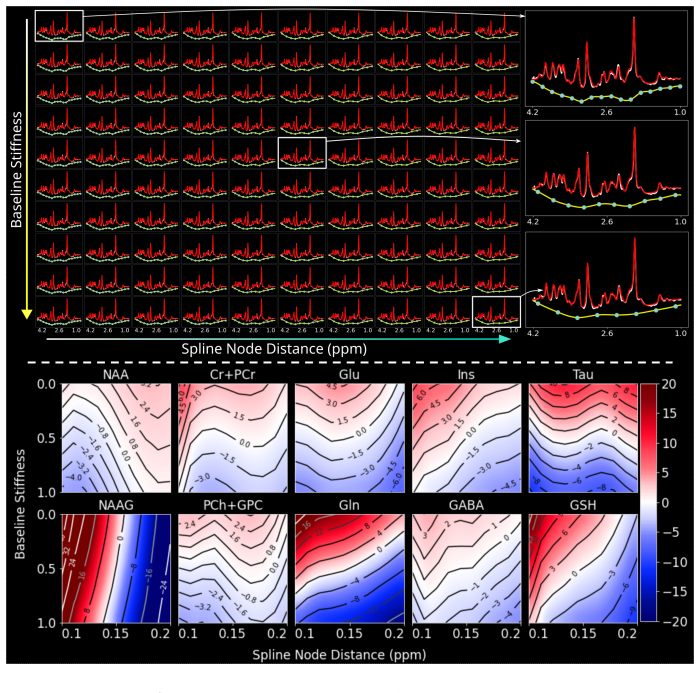
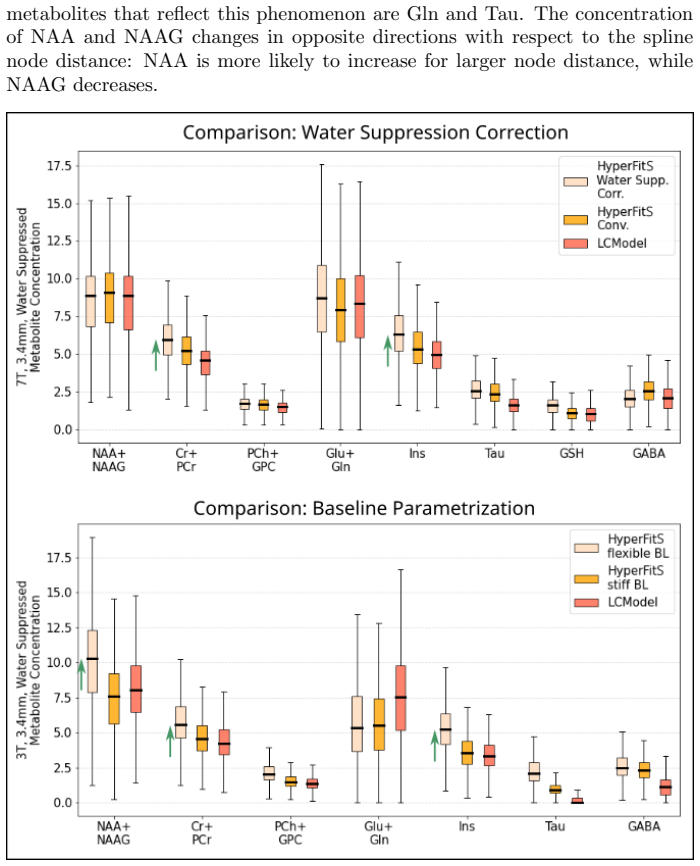
- Baseline parametrization choices can alter quantified metabolite levels by up to 30 percent.
- The model handles both water-suppressed and water-unsuppressed data without retraining.
- Configurability across protocols and field strengths is achieved through the hypernetwork without new training.
Where Pith is reading between the lines
- Near-real-time metabolite mapping could become practical during clinical scan sessions.
- The same model might handle spectra from pathological tissue without retraining if baseline variability is the main change.
- Integration into reconstruction pipelines could enable on-the-fly quantification for adaptive scanning.
- Extension to other spectroscopic modalities with similar parameter variability becomes plausible.
Load-bearing premise
The hypernetwork can flexibly adapt its fitting to a broad range of baseline corrections and water suppression factors while maintaining accuracy comparable to LCModel across different field strengths and protocols without retraining.
What would settle it
MRSI spectra acquired with baseline distortions or water suppression factors far outside the tested range that produce metabolite values differing by more than 15 percent from LCModel fits on the same data would challenge the adaptability claim.
Figures




read the original abstract
Purpose: Proton magnetic resonance spectroscopic imaging ($^1$H MRSI) enables the mapping of whole-brain metabolites concentrations in-vivo. However, a long-standing problem for its clinical applicability is the metabolic quantification, which can require extensive time for spectral fitting. Recently, deep learning methods have been able to provide whole-brain metabolic quantification in only a few seconds. However, neural network implementations often lack configurability and require retraining to change predefined parameter settings. Methods: We introduce HyperFitS, a hypernetwork for spectral fitting for metabolite quantification in whole-brain $^1$H MRSI that flexibly adapts to a broad range of baseline corrections and water suppression factors. Metabolite maps of human subjects acquired at 3T and 7T with isotropic resolutions of 10 mm, 3.4 mm and 2 mm by water-suppressed and water-unsuppressed MRSI were quantified with HyperFitS and compared to conventional LCModel fitting. Results: Metabolic maps show a substantial agreement between the new and gold-standard methods, with significantly faster fitting times by HyperFitS. Quantitative results further highlight the impact of baseline parametrization on metabolic quantification, which can alter results by up to 30%. Conclusion: HyperFitS shows strong agreement with state-of-the-art conventional methods, while reducing processing times from hours to a few seconds. Compared to prior deep learning based spectral fitting methods, HyperFitS enables a wide range of configurability and can adapt to data quality acquired with multiple protocols and field strengths without retraining.
Editorial analysis
A structured set of objections, weighed in public.
Referee Report
Summary. The paper introduces HyperFitS, a hypernetwork-based spectral fitting method for metabolite quantification in whole-brain 1H MRSI. It claims the approach flexibly adapts to a range of baseline corrections and water suppression factors without retraining, achieves substantial agreement with LCModel on human data acquired at 3T and 7T (isotropic resolutions 10 mm, 3.4 mm, 2 mm; water-suppressed and unsuppressed), and reduces fitting times from hours to seconds while highlighting up to 30% variation due to baseline parametrization.
Significance. If the central claims of cross-protocol, cross-field-strength adaptability hold with quantitative validation, the work would be significant for enabling rapid, configurable MRSI quantification in clinical settings, addressing a key practical barrier compared to conventional fitting and prior DL methods.
major comments (2)
- [Abstract/Methods] Abstract/Methods: The claim that a single trained hypernetwork adapts to 3T/7T data, multiple resolutions, and protocols without retraining is load-bearing but unsupported by details on whether field strength or resolution is provided as a conditioning input, the training distribution (mixed vs. single-field), or any held-out protocol test. The reported 30% baseline sensitivity makes unmodeled field-dependent effects (chemical-shift scaling, J-coupling, linewidth) a concrete risk to the zero-shot assertion.
- [Results] Results: The abstract states 'substantial agreement' with LCModel but supplies no quantitative metrics (correlation coefficients, mean absolute errors, sample sizes, error bars, or statistical tests), preventing assessment of whether the performance supports the cross-field and cross-protocol claims.
minor comments (2)
- Clarify the precise conditioning mechanism in the hypernetwork (e.g., how baseline correction parameters and water-suppression factors are encoded and injected).
- Add explicit dataset statistics (number of subjects, exact acquisition parameters per field strength/resolution) and any ablation studies on the hypernetwork's configurability.
Simulated Author's Rebuttal
We thank the referee for the detailed and constructive review. The comments identify areas where additional methodological clarity and quantitative reporting will strengthen the manuscript. We address each major comment below and will revise the paper accordingly.
read point-by-point responses
-
Referee: [Abstract/Methods] Abstract/Methods: The claim that a single trained hypernetwork adapts to 3T/7T data, multiple resolutions, and protocols without retraining is load-bearing but unsupported by details on whether field strength or resolution is provided as a conditioning input, the training distribution (mixed vs. single-field), or any held-out protocol test. The reported 30% baseline sensitivity makes unmodeled field-dependent effects (chemical-shift scaling, J-coupling, linewidth) a concrete risk to the zero-shot assertion.
Authors: We agree that the manuscript requires more explicit description of the conditioning mechanism and training protocol to fully support the cross-field and cross-protocol claims. In the revised Methods section we will specify that field strength, voxel resolution, baseline correction parameters, and water-suppression factors are supplied as conditioning inputs to the hypernetwork. We will also document that the training set comprised a mixed distribution of 3T and 7T spectra acquired at the reported resolutions, and we will add results from held-out protocol evaluations. Regarding field-dependent effects, we will expand the discussion to explain how the hypernetwork explicitly conditions on linewidth and other protocol-specific parameters, thereby mitigating the risk highlighted by the 30% baseline sensitivity; we will further quantify this mitigation in the revised results. revision: yes
-
Referee: [Results] Results: The abstract states 'substantial agreement' with LCModel but supplies no quantitative metrics (correlation coefficients, mean absolute errors, sample sizes, error bars, or statistical tests), preventing assessment of whether the performance supports the cross-field and cross-protocol claims.
Authors: We concur that quantitative metrics are necessary to substantiate the agreement claims. Although the original manuscript contains visual metabolite maps and qualitative statements of agreement, we will revise the Results section and abstract to report Pearson correlation coefficients, mean absolute errors (or percentage errors), the number of subjects and voxels analyzed per field strength and resolution, error bars or confidence intervals, and appropriate statistical comparisons (e.g., Bland-Altman analysis). These additions will directly address the cross-field and cross-protocol performance. revision: yes
Circularity Check
No circularity: HyperFitS is an independently trained hypernetwork benchmarked against external LCModel results
full rationale
The paper presents a hypernetwork architecture whose weights are learned from training spectra (simulated or acquired) and whose outputs are compared to LCModel on separate test acquisitions at 3T/7T. No equation or claim reduces by construction to a fitted parameter being relabeled as a prediction, nor does any load-bearing step rely on a self-citation whose content is itself unverified. The configurability claim is an empirical statement about generalization across protocols, not a definitional identity. The derivation chain is therefore self-contained and externally falsifiable.
Axiom & Free-Parameter Ledger
Reference graph
Works this paper leans on
-
[1]
Antoine Klauser, Bernhard Strasser, Wolfgang Bogner, Lukas Hingerl, Se- bastien Courvoisier, Claudiu Schirda, Bruce R Rosen, Francois Lazeyras, and Ovidiu C Andronesi. Eccentric: a fast and unrestrained approach for high-resolution in vivo metabolic imaging at ultra-high field mr.Imaging Neuroscience, 2:1–20, 2024
work page 2024
-
[2]
Gilbert Hangel, Cornelius Cadrien, Philipp Lazen, Julia Furtner, Alexandra Lipka, Eva Heˇ ckov´ a, Lukas Hingerl, Stanislav Motyka, Stephan Gruber, Bernhard Strasser, et al. High-resolution metabolic imaging of high-grade gliomas using 7t-crt-fid-mrsi.NeuroImage: Clinical, 28:102433, 2020. 17
work page 2020
-
[3]
Fan Lam, Chao Ma, Bryan Clifford, Curtis L Johnson, and Zhi-Pei Liang. High-resolution 1h-mrsi of the brain using spice: data acquisition and image reconstruction.Magnetic resonance in medicine, 76(4):1059–1070, 2016
work page 2016
-
[4]
Martin Wilson, Ovidiu Andronesi, Peter B Barker, Robert Bartha, Alberto Bizzi, Patrick J Bolan, Kevin M Brindle, In-Young Choi, Cristina Cudalbu, Ulrike Dydak, et al. Methodological consensus on clinical proton mrs of the brain: Review and recommendations.Magnetic resonance in medicine, 82(2):527–550, 2019
work page 2019
-
[5]
Stephen W Provencher. Estimation of metabolite concentrations from localized in vivo proton nmr spectra.Magnetic resonance in medicine, 30(6):672–679, 1993
work page 1993
-
[6]
Jamie Near, Ashley D Harris, Christoph Juchem, Roland Kreis, Ma lgorzata Marja´ nska, G¨ ulin¨Oz, Johannes Slotboom, Martin Wilson, and Charles Gasparovic. Preprocessing, analysis and quantification in single-voxel mag- netic resonance spectroscopy: experts’ consensus recommendations.NMR in Biomedicine, 34(5):e4257, 2021
work page 2021
-
[7]
H Ratiney, Micha¨ el Sdika, Y Coenradie, S Cavassila, D van Ormondt, and D Graveron-Demilly. Time-domain semi-parametric estimation based on a metabolite basis set.NMR in Biomedicine: An International Journal Devoted to the Development and Application of Magnetic Resonance In vivo, 18(1):1–13, 2005
work page 2005
-
[8]
Martin Wilson, Greg Reynolds, Risto A Kauppinen, Theodoros N Arvani- tis, and Andrew C Peet. A constrained least-squares approach to the au- tomated quantitation of in vivo 1h magnetic resonance spectroscopy data. Magnetic resonance in medicine, 65(1):1–12, 2011
work page 2011
-
[9]
William T Clarke, Charlotte J Stagg, and Saad Jbabdi. Fsl-mrs: An end- to-end spectroscopy analysis package.Magnetic resonance in medicine, 85(6):2950–2964, 2021
work page 2021
-
[10]
Brian J Soher, Philip Semanchuk, David Todd, Xiao Ji, Dinesh Deelchand, James Joers, Gulin Oz, and Karl Young. Vespa: integrated applications for rf pulse design, spectral simulation and mrs data analysis.Magnetic resonance in medicine, 90(3):823–838, 2023
work page 2023
-
[11]
Daniel GQ Chong, Roland Kreis, Christine S Bolliger, Chris Boesch, and Johannes Slotboom. Two-dimensional linear-combination model fitting of magnetic resonance spectra to define the macromolecule baseline using fi- taid, a fitting tool for arrays of interrelated datasets.Magnetic Resonance Materials in Physics, Biology and Medicine, 24(3):147–164, 2011
work page 2011
-
[12]
Inspector-magnetic resonance spectroscopy software.Columbia TechVenture (CTV): p
C Juchem. Inspector-magnetic resonance spectroscopy software.Columbia TechVenture (CTV): p. License CU17130, 2016. 18
work page 2016
-
[13]
A Naressi, C Couturier, JM Devos, M Janssen, C Mangeat, R de Beer, and D Graveron-Demilly. Java-based graphical user interface for the mrui quantitation package.Magnetic resonance materials in physics, biology and medicine, 12(2):141–152, 2001
work page 2001
-
[14]
Andrew A Maudsley, C Domenig, V Govind, A Darkazanli, C Studholme, K Arheart, and C Bloomer. Mapping of brain metabolite distributions by volumetric proton mr spectroscopic imaging (mrsi).Magnetic Resonance in Medicine: An Official Journal of the International Society for Magnetic Resonance in Medicine, 61(3):548–559, 2009
work page 2009
-
[15]
AA Maudsley, A Darkazanli, JR Alger, LO Hall, N Schuff, C Studholme, Y Yu, A Ebel, A Frew, D Goldgof, et al. Comprehensive processing, display and analysis for in vivo mr spectroscopic imaging.NMR in Biomedicine, 19(4):492–503, 2006
work page 2006
-
[16]
Jason C Crane, Marram P Olson, and Sarah J Nelson. Sivic: open-source, standards-based software for dicom mr spectroscopy workflows.Interna- tional journal of biomedical imaging, 2013(1):169526, 2013
work page 2013
-
[17]
Cristina Cudalbu, Kevin L Behar, Pallab K Bhattacharyya, Wolfgang Bogner, Tamas Borbath, Robin A de Graaf, Rolf Gruetter, Anke Henning, Christoph Juchem, Roland Kreis, et al. Contribution of macromolecules to brain 1h mr spectra: experts’ consensus recommendations.NMR in Biomedicine, 34(5):e4393, 2021
work page 2021
-
[18]
Paul J Weiser, Georg Langs, Wolfgang Bogner, Stanislav Motyka, Bernhard Strasser, Polina Golland, Nalini Singh, Jorg Dietrich, Erik Uhlmann, Tracy Batchelor, et al. Deep-er: Deep learning eccentric reconstruction for fast high-resolution neurometabolic imaging.NeuroImage, 309:121045, 2025
work page 2025
-
[19]
Saumya S Gurbani, Sulaiman Sheriff, Andrew A Maudsley, Hyunsuk Shim, and Lee AD Cooper. Incorporation of a spectral model in a convolu- tional neural network for accelerated spectral fitting.Magnetic resonance in medicine, 81(5):3346–3357, 2019
work page 2019
-
[20]
Amirmohammad Shamaei, Jana Starcukova, and Zenon Starcuk Jr. Physics-informed deep learning approach to quantification of human brain metabolites from magnetic resonance spectroscopy data.Computers in Bi- ology and Medicine, 158:106837, 2023
work page 2023
-
[21]
Aaron Paul Osburg, Amirmohammed Shamaei, Bernhard Strasser, Fabian Niess, Anna Duguid, Viola Bader, Sabina Frese, Lukas Hingerl, Hauke Fis- cher, William T Clarke, et al. A deep autoencoder for fast spectral-temporal fitting of dynamic deuterium metabolic imaging data at 7t.NeuroImage, page 121632, 2025
work page 2025
-
[22]
Federico Turco, Milena Capiglioni, Guodong Weng, and Johannes Slot- boom. Tensorfit: A torch-based tool for ultrafast metabolite fitting of large mrsi data sets.Magnetic Resonance in Medicine, 92(2):447–458, 2024. 19
work page 2024
-
[23]
Yrj¨ o Hiltunen, Jouni Kaartinen, Juhani Pulkkinen, Anna-Maija H¨ akkinen, Nina Lundbom, and Risto A Kauppinen. Quantification of human brain metabolites from in vivo1h nmr magnitude spectra using automated arti- ficial neural network analysis.Journal of Magnetic Resonance, 154(1):1–5, 2002
work page 2002
-
[24]
Himanshu Bhat, Balasrinivasa Rao Sajja, and Ponnada A Narayana. Fast quantification of proton magnetic resonance spectroscopic imaging with artificial neural networks.Journal of Magnetic Resonance, 183(1):110–122, 2006
work page 2006
-
[25]
Magnetic resonance spectroscopy quantification using deep learning
Nima Hatami, Micha¨ el Sdika, and H´ el` ene Ratiney. Magnetic resonance spectroscopy quantification using deep learning. InInternational Confer- ence on Medical Image Computing and Computer-Assisted Intervention, pages 467–475. Springer, 2018
work page 2018
-
[26]
Hyeong Hun Lee and Hyeonjin Kim. Intact metabolite spectrum mining by deep learning in proton magnetic resonance spectroscopy of the brain. Magnetic resonance in medicine, 82(1):33–48, 2019
work page 2019
-
[27]
M Chandler, C Jenkins, SM Shermer, and FC Langbein. Mrsnet: metabo- lite quantification from edited magnetic resonance spectra with convolu- tional neural networks.arXiv preprint arXiv:1909.03836, 2019
-
[28]
A wavelet scattering convolutional network for magnetic resonance spec- troscopy signal quantitation
Amirmohammad Shamaei, Jana Starcukov´ a, and Zenon Starcuk Jr. A wavelet scattering convolutional network for magnetic resonance spec- troscopy signal quantitation. InBiosignals, pages 268–275, 2021
work page 2021
-
[29]
Rudy Rizzo, Martyna Dziadosz, Sreenath P Kyathanahally, Amirmoham- mad Shamaei, and Roland Kreis. Quantification of mr spectra by deep learning in an idealized setting: Investigation of forms of input, network architectures, optimization by ensembles of networks, and training bias. Magnetic Resonance in Medicine, 89(5):1707–1727, 2023
work page 2023
-
[30]
Julian P Merkofer, Antonia Kaiser, Anouk Schrantee, Oliver J Gurney- Champion, and Ruud JG van Sloun. Strategies to minimize out-of- distribution effects in data-driven mrs quantification.arXiv preprint arXiv:2511.23135, 2025
-
[31]
Zohaib Iqbal, Dan Nguyen, Michael Albert Thomas, and Steve Jiang. Deep learning can accelerate and quantify simulated localized correlated spec- troscopy.Scientific Reports, 11(1):8727, 2021
work page 2021
-
[32]
Dicheng Chen, Meijin Lin, Huiting Liu, Jiayu Li, Yirong Zhou, Taishan Kang, Liangjie Lin, Zhigang Wu, Jiazheng Wang, Jing Li, et al. Mag- netic resonance spectroscopy quantification aided by deep estimations of imperfection factors and macromolecular signal.IEEE Transactions on Biomedical Engineering, 71(6):1841–1852, 2024. 20
work page 2024
-
[33]
Amirmohammad Shamaei, Amir Buchali, Eva Niess, Lukas Hingerl, Bern- hard Strasser, Aaron Osburg, Korbinian Eckstein, Wolfgang Bogner, and Stanislav Motyka. Phive: A physics-informed variational encoder enables rapid spectral fitting of brain metabolite mapping at 7t.Medical Image Analysis, page 104014, 2026
work page 2026
-
[34]
A ‘self-referential’weight matrix
J¨ urgen Schmidhuber. A ‘self-referential’weight matrix. InInternational conference on artificial neural networks, pages 446–450. Springer, 1993
work page 1993
-
[35]
David Ha, Andrew Dai, and Quoc V Le. Hypernetworks.arXiv preprint arXiv:1609.09106, 2016
work page internal anchor Pith review arXiv 2016
-
[36]
Hypermorph: Amortized hyperparameter learning for image registration
Andrew Hoopes, Malte Hoffmann, Bruce Fischl, John Guttag, and Adrian V Dalca. Hypermorph: Amortized hyperparameter learning for image registration. InInternational conference on information processing in medical imaging, pages 3–17. Springer, 2021
work page 2021
-
[37]
Bayesian hypernetworks.arXiv preprint arXiv:1710.04759, 2017
David Krueger, Chin-Wei Huang, Riashat Islam, Ryan Turner, Alexandre Lacoste, and Aaron Courville. Bayesian hypernetworks.arXiv preprint arXiv:1710.04759, 2017
-
[38]
Quantifying generative model un- certainty in posterior sampling methods for computational imaging
Canberk Ekmekci and Mujdat Cetin. Quantifying generative model un- certainty in posterior sampling methods for computational imaging. In Conference on Neural Information Processing Systems (NeurIPS), Deep Inverse Workshop. Curran Associates, 2023
work page 2023
-
[39]
Matthew Chan, Maria Molina, and Chris Metzler. Estimating epistemic and aleatoric uncertainty with a single model.Advances in Neural Infor- mation Processing Systems, 37:109845–109870, 2024
work page 2024
-
[40]
Sim- ple and scalable predictive uncertainty estimation using deep ensembles
Balaji Lakshminarayanan, Alexander Pritzel, and Charles Blundell. Sim- ple and scalable predictive uncertainty estimation using deep ensembles. Advances in neural information processing systems, 30, 2017
work page 2017
-
[41]
Martin Uecker, Peng Lai, Mark J Murphy, Patrick Virtue, Michael Elad, John M Pauly, Shreyas S Vasanawala, and Michael Lustig. Espirit—an eigenvalue approach to autocalibrating parallel mri: where sense meets grappa.Magnetic resonance in medicine, 71(3):990–1001, 2014
work page 2014
-
[42]
Paul J Weiser, Georg Langs, Stanislav Motyka, Wolfgang Bogner, S´ ebastien Courvoisier, Malte Hoffmann, Antoine Klauser, and Ovidiu C Andronesi. Walinet: A water and lipid identification convolutional neural network for nuisance signal removal in 1 hˆ 1 h mr spectroscopic imaging.Magnetic Resonance in Medicine, 93(4):1430–1442, 2025
work page 2025
-
[43]
Paul Weiser, Georg Langs, Stanislav Motyka, Wolfgang Bogner, Sebastien Courvoisier, Gulnur Ungan, Malte Hoffmann, Antoine Klauser, and Ovidiu Andronesi. Walinet+: A water and lipid identification neural network for nuisance removal of water-unsuppressed magnetic resonance spectroscopic 21 imaging. InProceedings of the International Society for Magnetic Re...
work page 2025
discussion (0)
Sign in with ORCID, Apple, or X to comment. Anyone can read and Pith papers without signing in.