Recognition: 2 theorem links
· Lean TheoremBelief Propagation and Tensor Network Expansions for Many-Body Quantum Systems: Rigorous Results and Fundamental Limits
Pith reviewed 2026-05-13 19:12 UTC · model grok-4.3
The pith
For PEPS states satisfying loop-decay, belief propagation plus cluster corrections approximates local observables with exponentially small relative error.
A machine-rendered reading of the paper's core claim, the machinery that carries it, and where it could break.
Core claim
For a state represented as a PEPS satisfying a loop-decay condition, belief propagation supplemented by cluster corrections approximates local observables with exponentially small relative error. Explicit formulas express local expectation values as BP predictions dressed by connected clusters intersecting the observable region. Loop-decay necessarily implies exponential decay of connected correlations, yielding rigorous criteria for when BP succeeds and fails.
What carries the argument
The loop-decay condition on the PEPS tensor network, which forces loop contributions to decay exponentially and thereby lets the cluster expansion control the error between belief propagation and the exact contraction.
If this is right
- Local observables deep inside gapped phases can be computed to exponential accuracy by running BP and adding only the intersecting connected clusters.
- Connected correlation functions must decay exponentially whenever loop-decay holds.
- The method necessarily fails at critical points where loop-decay is violated.
- Cluster corrections are directly identified with physical correlation functions, giving a transparent error diagnostic.
Where Pith is reading between the lines
- The result suggests testing whether loop-decay can be derived from the microscopic Hamiltonian in concrete gapped models rather than assumed.
- Numerical algorithms could monitor the size of the first few cluster corrections as a practical indicator of whether the underlying state satisfies the condition.
- The link between loop-decay and correlation decay offers a route to prove absence of long-range order from tensor-network assumptions alone.
Load-bearing premise
The quantum state must admit a PEPS representation that obeys the loop-decay condition.
What would settle it
A concrete PEPS tensor network that satisfies loop-decay yet produces either polynomially decaying connected correlations or BP errors larger than exponentially small.
Figures


read the original abstract
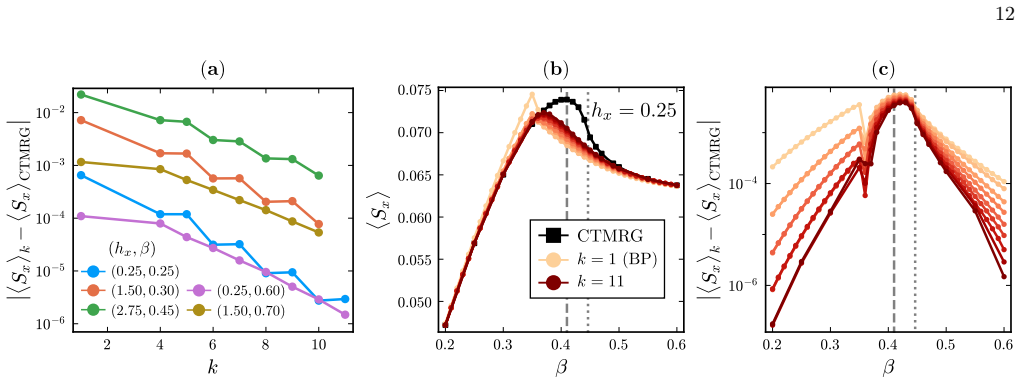
Belief propagation (BP) provides a scalable heuristic for contracting tensor networks on loopy graphs, but its success in quantum many-body settings has largely rested on empirical evidence. Developing upon a recently introduced cluster-expansion framework for tensor networks, we rigorously study the applicability of BP to many-body quantum systems. For a state represented as a PEPS satisfying a ``loop-decay" condition, we prove that BP supplemented by cluster corrections approximates local observables with exponentially small relative error, and we give explicit formulas expressing local expectation values as BP predictions dressed by connected clusters intersecting the observable region. This representation establishes a direct link between cluster corrections and physical correlation functions. As a result, we show that ``loop-decay" \emph{necessarily implies} exponential decay of connected correlations, yielding sharp, rigorous criteria for when BP can and cannot succeed, and ruling out its validity at critical points. Numerical simulations of the two- and three-dimensional transverse field Ising model at zero and finite temperature confirm our analytical predictions, demonstrating quantitative accuracy deep in gapped phases and systematic failure near criticality.
Editorial analysis
A structured set of objections, weighed in public.
Referee Report
Summary. The manuscript develops a cluster-expansion framework for tensor networks and rigorously analyzes belief propagation (BP) for PEPS representations of quantum states. It proves that under a 'loop-decay' condition on the PEPS, BP with cluster corrections approximates local observables with exponentially small relative error, provides explicit formulas linking corrections to correlation functions, and shows that loop-decay implies exponential decay of connected correlations. Numerical simulations on the 2D and 3D transverse-field Ising model support the analytical predictions in gapped phases.
Significance. If the loop-decay condition holds, the results provide rigorous, quantitative criteria for when BP succeeds or fails in many-body quantum systems, directly connecting approximation error to physical correlation decay. This advances beyond empirical evidence by offering sharp bounds and ruling out BP at critical points. The explicit cluster formulas are a notable strength.
major comments (2)
- [§3 (proofs of approximation and implication)] The central approximation theorem (likely §3 or Theorem 1) and the implication for correlation decay are explicitly conditional on the loop-decay assumption; while the derivations appear internally consistent, the manuscript provides no derivation or bound showing when loop-decay holds for generic gapped PEPS, which limits the scope of the 'sharp criteria' claim.
- [Numerical section on TFIM] Numerical results on TFIM (likely §5) demonstrate accuracy in gapped regimes but rely on post-hoc phase identification; without an independent, a priori computation of the loop-decay rates from the PEPS tensors, the numerics do not fully verify the assumption underlying the error bounds.
minor comments (2)
- [Abstract] Clarify in the abstract and introduction that all criteria and error bounds are conditional on the loop-decay property rather than holding unconditionally for PEPS.
- [§2 (cluster-expansion framework)] Notation for connected clusters and the explicit formulas for BP corrections could be made more uniform across sections to improve readability.
Simulated Author's Rebuttal
We thank the referee for their careful reading and positive recommendation for minor revision. We address each major comment below.
read point-by-point responses
-
Referee: [§3 (proofs of approximation and implication)] The central approximation theorem (likely §3 or Theorem 1) and the implication for correlation decay are explicitly conditional on the loop-decay assumption; while the derivations appear internally consistent, the manuscript provides no derivation or bound showing when loop-decay holds for generic gapped PEPS, which limits the scope of the 'sharp criteria' claim.
Authors: We agree that the main theorems are conditional on the loop-decay assumption, which is stated explicitly in the manuscript. The 'sharp criteria' we claim are that loop-decay is sufficient for the exponential accuracy of BP plus cluster corrections and, moreover, that loop-decay necessarily implies exponential decay of connected correlations (thereby ruling out BP at critical points). Deriving general bounds on the validity of loop-decay for arbitrary gapped PEPS lies outside the scope of the present work and would require separate techniques for analyzing tensor contraction properties under a spectral gap. We will add a short clarifying paragraph in the introduction and conclusion to emphasize the conditional nature of the criteria and their expected applicability in gapped phases away from criticality. revision: partial
-
Referee: [Numerical section on TFIM] Numerical results on TFIM (likely §5) demonstrate accuracy in gapped regimes but rely on post-hoc phase identification; without an independent, a priori computation of the loop-decay rates from the PEPS tensors, the numerics do not fully verify the assumption underlying the error bounds.
Authors: The numerical experiments are intended to illustrate the analytical predictions in regimes where loop-decay is expected on physical grounds (deep in the gapped phases of the TFIM). Phase identification follows well-established results for the model rather than post-hoc fitting. An a priori numerical extraction of loop-decay rates directly from the PEPS tensors is computationally demanding and not the primary focus of the paper. We will expand the discussion in §5 to relate the observed approximation errors more explicitly to the known correlation lengths in the gapped phases. revision: partial
Circularity Check
No significant circularity; results conditional on explicit loop-decay assumption
full rationale
The paper assumes the loop-decay condition on PEPS as an input premise and applies its cluster-expansion framework to derive approximation bounds for BP plus cluster corrections and the implication of exponential correlation decay. No derivation step reduces a claimed prediction to a fitted parameter, self-definition, or unverified self-citation chain; the loop-decay property is stated outright rather than smuggled in or renamed from prior results. Numerical Ising simulations serve only as confirmation outside the formal chain.
Axiom & Free-Parameter Ledger
axioms (1)
- domain assumption loop-decay condition on the PEPS tensor network state
Forward citations
Cited by 3 Pith papers
-
Algorithmic Locality via Provable Convergence in Quantum Tensor Networks
For PEPS with strong injectivity above a threshold, belief propagation finds fixed points efficiently and cluster-corrected BP approximates observables to 1/poly(N) error in poly(N) time, with local perturbations affe...
-
Contracting Tensor Networks with Generalized Belief Propagation
Generalized belief propagation approximates tensor network contractions via hierarchical region messages and fixed-point solutions, demonstrated on Ising, ice, AKLT, and random tensor networks.
-
Tensor Networks with Belief Propagation Cannot Feasibly Simulate Google's Quantum Echoes Experiment
Tensor networks with belief propagation fail to simulate Google's quantum echoes OTOC experiment because the circuits produce largely incompressible entanglement.
Reference graph
Works this paper leans on
-
[1]
S. R. White, Density matrix formulation for quantum renormalization groups, Phys. Rev. Lett.69, 2863 (1992)
work page 1992
-
[2]
S. R. White, Density-matrix algorithms for quantum renormalization groups, Phys. Rev. B48, 10345 (1993)
work page 1993
-
[3]
U. Schollw¨ ock, The density-matrix renormalization group in the age of matrix product states, Annals of Physics 326, 96–192 (2011)
work page 2011
-
[4]
R. Or´ us, A practical introduction to tensor networks: Matrix product states and projected entangled pair states, Annals of Physics349, 117–158 (2014)
work page 2014
-
[5]
J. I. Cirac, D. P´ erez-Garc´ ıa, N. Schuch, and F. Ver- straete, Matrix product states and projected entangled pair states: Concepts, symmetries, theorems, Reviews of Modern Physics93, 10.1103/revmodphys.93.045003 14 (2021)
-
[6]
F. Verstraete and J. I. Cirac, Matrix product states, pro- jected entangled pair states, and variational renormaliza- tion group methods for quantum spin systems, Advances in Physics57, 143 (2008)
work page 2008
-
[7]
Vidal, Entanglement renormalization, Phys
G. Vidal, Entanglement renormalization, Phys. Rev. Lett.99, 220405 (2007)
work page 2007
- [8]
-
[9]
Matrix Product State Representations
D. Perez-Garcia, F. Verstraete, M. M. Wolf, and J. I. Cirac, Matrix product state representations (2007), arXiv:quant-ph/0608197 [quant-ph]
work page internal anchor Pith review Pith/arXiv arXiv 2007
- [10]
- [11]
-
[12]
J. Haferkamp, D. Hangleiter, J. Eisert, and M. Gluza, Contracting projected entangled pair states is average- case hard, Phys. Rev. Res.2, 013010 (2020)
work page 2020
- [13]
-
[14]
T. Nishino and K. Okunishi, Corner transfer matrix renormalization group method, Journal of the Physical Society of Japan65, 891–894 (1996)
work page 1996
-
[15]
R. Or´ us, Exploring corner transfer matrices and cor- ner tensors for the classical simulation of quantum lattice systems, Physical Review B85, 10.1103/phys- revb.85.205117 (2012)
-
[16]
R. Or´ us and G. Vidal, Simulation of two-dimensional quantum systems on an infinite lattice revisited: Cor- ner transfer matrix for tensor contraction, Phys. Rev. B 80, 094403 (2009)
work page 2009
-
[17]
Renormalization algorithms for Quantum-Many Body Systems in two and higher dimensions
F. Verstraete and J. I. Cirac, Renormalization al- gorithms for quantum-many body systems in two and higher dimensions (2004), arXiv:cond-mat/0407066 [cond-mat.str-el]
work page internal anchor Pith review Pith/arXiv arXiv 2004
-
[18]
M. Lubasch, J. I. Cirac, and M.-C. Ba˜ nuls, Unifying pro- jected entangled pair state contractions, New Journal of Physics16, 033014 (2014)
work page 2014
-
[19]
V. Murg, F. Verstraete, and J. I. Cirac, Variational study of hard-core bosons in a two-dimensional optical lattice using projected entangled pair states, Phys. Rev. A75, 033605 (2007)
work page 2007
-
[20]
M. Levin and C. P. Nave, Tensor renormalization group approach to two-dimensional classical lattice models, Phys. Rev. Lett.99, 120601 (2007)
work page 2007
-
[21]
G. Evenbly and G. Vidal, Tensor network renormaliza- tion, Phys. Rev. Lett.115, 180405 (2015)
work page 2015
-
[22]
R. G. Gallager, Low-density parity-check codes, IRE Transactions on Information Theory8, 21 (1962)
work page 1962
-
[23]
J. Pearl,Probabilistic Reasoning in Intelligent Systems: Networks of Plausible Inference(Morgan Kaufmann Publishers Inc., San Francisco, CA, USA, 1988)
work page 1988
-
[24]
R. J. McEliece, D. J. C. MacKay, and J.-F. Cheng, Turbo decoding as an instance of pearl’s” belief propagation” algorithm, IEEE Journal on selected areas in communi- cations16, 140 (1998)
work page 1998
-
[25]
J. S. Yedidia, W. T. Freeman, and Y. Weiss, Understand- ing belief propagation and its generalizations, inExplor- ing Artificial Intelligence in the New Millennium(Mor- gan Kaufmann Publishers Inc., San Francisco, CA, USA,
-
[26]
J. Yedidia, W. Freeman, and Y. Weiss, Construct- ing Free-Energy Approximations and Generalized Belief Propagation Algorithms, IEEE Transactions on Informa- tion Theory51, 2282 (2005)
work page 2005
-
[27]
H. A. Bethe, Statistical theory of superlattices, Pro- ceedings of the Royal Society of London. Series A- Mathematical and Physical Sciences150, 552 (1935)
work page 1935
-
[28]
R. Peierls, Statistical theory of superlattices with un- equal concentrations of the components, Proceedings of the Royal Society of London. A. Mathematical and Phys- ical Sciences154, 207 (1936)
work page 1936
-
[29]
D. J. Thouless, P. W. Anderson, and R. G. Palmer, Solu- tion of ’solvable model of a spin glass’, The Philosophical Magazine: A Journal of Theoretical Experimental and Applied Physics35, 593 (1977)
work page 1977
-
[30]
M. M´ ezard, G. Parisi, and M. A. Virasoro, SK Model: The Replica Solution without Replicas, Europhysics Let- ters (EPL)1, 77 (1986)
work page 1986
-
[31]
M. W. Klein, L. J. Schowalter, and P. Shukla, Spin glasses in the Bethe-Peierls-Weiss and other mean-field approx- imations, Physical Review B19, 1492 (1979)
work page 1979
-
[32]
S. Katsura, S. Inawashiro, and S. Fujiki, Spin glasses for the infinitely long ranged bond Ising model and for the short ranged binary bond Ising model without use of the replica method, Physica A: Statistical Mechanics and its Applications99, 193 (1979)
work page 1979
-
[33]
Nakanishi, Two- and three-spin cluster theory of spin- glasses, Physical Review B23, 3514 (1981)
K. Nakanishi, Two- and three-spin cluster theory of spin- glasses, Physical Review B23, 3514 (1981)
work page 1981
-
[34]
E. Robeva and A. Seigal, Duality of graphical models and tensor networks (2017), arXiv:1710.01437 [math.ST]
-
[35]
R. Alkabetz and I. Arad, Tensor networks contraction and the belief propagation algorithm, Phys. Rev. Res.3, 023073 (2021)
work page 2021
-
[36]
S. Sahu and B. Swingle, Efficient tensor network simu- lation of quantum many-body physics on sparse graphs (2022), arXiv:2206.04701 [quant-ph]
-
[37]
J. Tindall and M. Fishman, Gauging tensor networks with belief propagation, SciPost Phys.15, 222 (2023)
work page 2023
-
[38]
Y. Weiss, Correctness of Local Probability Propagation in Graphical Models with Loops, Neural Computation 12, 1 (2000)
work page 2000
-
[39]
S. Tatikonda and M. I. Jordan, Loopy belief propaga- tion and Gibbs measures, Proceedings of the 18th An- nual Conference on Uncertainty in Artificial Intelligence UAI200218, 493 (2002)
work page 2002
-
[40]
T. Heskes, Stable fixed points of loopy belief propagation are local minima of the bethe free energy, inAdvances in Neural Information Processing Systems, Vol. 15, edited by S. Becker, S. Thrun, and K. Obermayer (MIT Press, 2002)
work page 2002
-
[41]
T. Heskes, On the Uniqueness of Loopy Belief Propaga- tion Fixed Points, Neural Computation16, 2379 (2004)
work page 2004
-
[42]
J. M. Mooij and H. J. Kappen, Sufficient conditions for convergence of Loopy Belief Propagation, Proceedings of the 21st Conference on Uncertainty in Artificial Intelli- gence, UAI 2005 , 396 (2005)
work page 2005
-
[43]
M. Chertkov, Exactness of belief propagation for some graphical models with loops, Journal of Statistical Me- chanics: Theory and Experiment2008, P10016 (2008)
work page 2008
-
[44]
E. B. Sudderth, M. J. Wainwright, and A. S. Willsky, Loop series and Bethe variational bounds in attractive graphical models, Advances in Neural Information Pro- 15 cessing Systems 20 - Proceedings of the 2007 Conference , 1 (2008)
work page 2007
- [45]
-
[46]
J. Tindall, M. Fishman, E. M. Stoudenmire, and D. Sels, Efficient tensor network simulation of ibm’s eagle kicked ising experiment, PRX Quantum5, 010308 (2024)
work page 2024
-
[47]
T. Beguˇ si´ c, J. Gray, and G. K.-L. Chan, Fast and con- verged classical simulations of evidence for the utility of quantum computing before fault tolerance, Science Ad- vances10, eadk4321 (2024)
work page 2024
-
[48]
J. Tindall, A. Mello, M. Fishman, M. Stoudenmire, and D. Sels, Dynamics of disordered quantum systems with two- and three-dimensional tensor networks (2025), arXiv:2503.05693 [quant-ph]
- [49]
-
[50]
G. Park, J. Gray, and G. K.-L. Chan, Simulating quan- tum dynamics in two-dimensional lattices with tensor network influence functional belief propagation, Phys. Rev. B112, 174310 (2025)
work page 2025
-
[52]
S. Midha and Y. F. Zhang, Beyond belief propagation: Cluster-corrected tensor network contraction with expo- nential convergence (2025), arXiv:2510.02290 [quant-ph]
-
[53]
J. Gray, G. Park, G. Evenbly, N. Pancotti, and G. K.- L. Chan, Tensor network loop cluster expansions for quantum many-body problems (2025), arXiv:2510.05647 [quant-ph]
work page internal anchor Pith review Pith/arXiv arXiv 2025
-
[54]
G. Evenbly, J. Gray, and G. K.-L. Chan, Partitioned expansions for approximate tensor network contractions (2025), arXiv:2512.10910 [quant-ph]
-
[55]
Kikuchi, A Theory of Cooperative Phenomena, Phys- ical Review81, 988 (1951)
R. Kikuchi, A Theory of Cooperative Phenomena, Phys- ical Review81, 988 (1951)
work page 1951
-
[56]
J. S. Yedidia, W. Freeman, and Y. Weiss, Generalized belief propagation, inAdvances in Neural Information Processing Systems, Vol. 13, edited by T. Leen, T. Diet- terich, and V. Tresp (MIT Press, 2000)
work page 2000
-
[57]
H. Kappen and W. Wiegerinck, Novel iteration schemes for the cluster variation method, inAdvances in Neu- ral Information Processing Systems, Vol. 14, edited by T. Dietterich, S. Becker, and Z. Ghahramani (MIT Press, 2001)
work page 2001
-
[58]
J. Tindall, G. M. Sommers, and H. Kappen, Contract- ing tensor networks with generalized belief propagation, (2026), to appear
work page 2026
- [59]
-
[60]
Ruelle,Statistical mechanics: Rigorous results(World Scientific, 1969)
D. Ruelle,Statistical mechanics: Rigorous results(World Scientific, 1969)
work page 1969
-
[61]
R. Koteck´ y and D. Preiss, Cluster expansion for ab- stract polymer models, Communications in Mathemat- ical Physics103, 491 (1986)
work page 1986
-
[62]
M. Chertkov and V. Y. Chernyak, Loop calculus in sta- tistical physics and information science, Physical Review E73, 065102 (2006)
work page 2006
-
[63]
M. Chertkov and V. Y. Chernyak, Loop series for discrete statistical models on graphs, Journal of Statistical Me- chanics: Theory and Experiment2006, P06009 (2006)
work page 2006
- [64]
-
[65]
M. Chertkov, V. Gomez, and H. Kappen,Approximate inference on planar graphs using loop calculus and belief progagation, Tech. Rep. (Los Alamos National Labora- tory (LANL), Los Alamos, NM (United States), 2009)
work page 2009
-
[66]
M. Welling, A. E. Gelfand, and A. T. Ihler, A cluster- cumulant expansion at the fixed points of belief propa- gation (2012), arXiv:1210.4916 [cs.AI]
-
[67]
G. Evenbly, N. Pancotti, A. Milsted, J. Gray, G. Kin, and L. Chan, Loop Series Expansions for Tensor Networks (2024), arXiv:2409.03108
-
[68]
Supplementary material (2025), link to be inserted by the publisher,
work page 2025
- [69]
-
[70]
S. Friedli and Y. Velenik,Statistical Mechanics of Lattice Systems: A Concrete Mathematical Introduction(Cam- bridge University Press, 2017)
work page 2017
-
[71]
J. Hasik and G. Mbeng, peps-torch: A differentiable ten- sor network library for two-dimensional lattice models (2020)
work page 2020
-
[72]
W. Krinitsin, N. Tausendpfund, M. Rizzi, M. Heyl, and M. Schmitt, Roughening dynamics of interfaces in the two-dimensional quantum ising model, Phys. Rev. Lett. 134, 240402 (2025)
work page 2025
- [73]
- [74]
- [75]
-
[76]
T. Kuwahara, K. Kato, and F. G. Brand˜ ao, Clustering of conditional mutual information for quantum gibbs states above a threshold temperature, Physical Review Letters 124, 10.1103/physrevlett.124.220601 (2020)
-
[77]
G.-C. Rota, Theory of m¨ obius functions, Zeitung f¨ ur Wahrscheinlichkeitstheorie und Verwandte Gebiete2, 340 (1964)
work page 1964
-
[78]
C.-J. Huang, L. Liu, Y. Jiang, and Y. Deng, Worm- algorithm-type simulation of the quantum transverse- field ising model, Phys. Rev. B102, 094101 (2020). 16 SUPPLEMENTARY MATERIAL CONTENTS S1 Recap: Loop and Cluster expansion . . . . . . . . . . . . . . . . . . . . . . . . . . . . . . . . . . . . . . . . . . . . . . . . . . . . . . . . . . 16 S1.1 Prelimi...
work page 2020
discussion (0)
Sign in with ORCID, Apple, or X to comment. Anyone can read and Pith papers without signing in.