Recognition: 2 theorem links
· Lean TheoremSpectral Geometry of the Primes
Pith reviewed 2026-05-13 18:44 UTC · model grok-4.3
The pith
Operators on the primes produce a spectral dimension of exactly 1/2 via a bi-Laplacian continuum limit.
A machine-rendered reading of the paper's core claim, the machinery that carries it, and where it could break.
Core claim
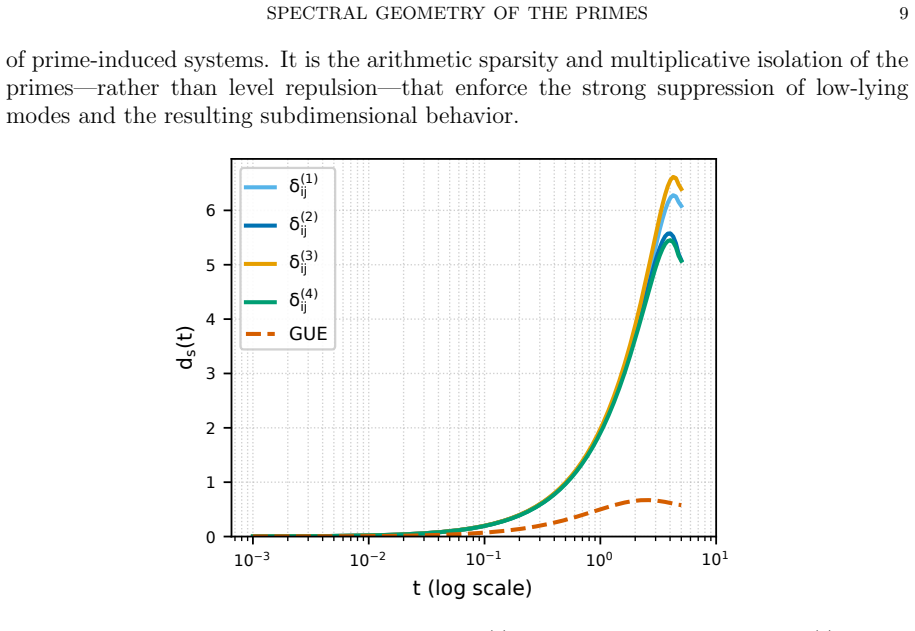
For the unnormalized Laplacian, the continuum limit of its squared Hamiltonian corresponds to the one-dimensional bi-Laplacian. The heat trace of this operator follows a short-time scaling proportional to t to the minus one fourth. Under the spectral dimension convention d_s equals negative two times d log theta over d log t, this scaling produces d_s equal to one half directly from first principles without fitting or external hypotheses. This value signifies maximal spectral compression and the absence of classical diffusion, indicating that arithmetic sparsity enforces a coherence-limited non-Euclidean geometry linking spectral and number-theoretic structure.
What carries the argument
The family of self-adjoint operators on the primes with entries given by pairwise arithmetic divergences; in the continuum limit its squared Hamiltonian for the unnormalized case becomes the one-dimensional bi-Laplacian whose heat trace supplies the dimension.
If this is right
- Eigenvalues grow sublinearly with index.
- Entropy extracted from the spectra scales slowly.
- The inferred dimension remains strictly below one.
- The same rigidity appears across logarithmic, entropic, and fractal-type kernels.
- Arithmetic sparsity limits coherence propagation and prevents classical diffusion.
Where Pith is reading between the lines
- The same operator construction applied to other sparse sequences such as squares or powers could produce different spectral dimensions for comparison.
- Numerical checks of the heat-trace scaling on increasing numbers of primes would provide a direct test of the continuum-limit claim.
- If the dimension remains one half, it offers a geometric signature that could be compared against known irregularities in prime gaps.
- The approach suggests that spectral geometry on any sufficiently sparse arithmetic set may be forced into sub-one-dimensional regimes.
Load-bearing premise
The discrete operator family on the primes admits a continuum limit in which the squared Hamiltonian becomes exactly the one-dimensional bi-Laplacian and the standard spectral-dimension formula applies without additional corrections.
What would settle it
Numerical computation of the heat trace on a large finite set of primes for the unnormalized Laplacian, followed by a log-log plot versus time in the short-time regime, to test whether the scaling exponent is precisely minus one fourth or deviates.
Figures


read the original abstract
We construct a family of self-adjoint operators on the prime numbers whose entries depend on pairwise arithmetic divergences, replacing geometric distance with number-theoretic dissimilarity. The resulting spectra encode how coherence propagates through the prime sequence and define an emergent arithmetic geometry. From these spectra we extract observables such as the heat trace, entropy, and eigenvalue growth, which reveal persistent spectral compression: eigenvalues grow sublinearly, entropy scales slowly, and the inferred dimension remains strictly below one. This rigidity appears across logarithmic, entropic, and fractal-type kernels, reflecting intrinsic arithmetic constraints. Analytically, we show that for the unnormalized Laplacian, the continuum limit of its squared Hamiltonian corresponds to the one-dimensional bi-Laplacian, whose heat trace follows a short-time scaling proportional to $t^{-1/4}$. Under the spectral dimension convention $d_s=-2\,d\log\Theta/d\log t$, this result produces $d_s = 1/2$ directly from first principles, without fitting or external hypotheses. This value signifies maximal spectral compression and the absence of classical diffusion, indicating that arithmetic sparsity enforces a coherence-limited, non-Euclidean geometry linking spectral and number-theoretic structure.
Editorial analysis
A structured set of objections, weighed in public.
Referee Report
Summary. The manuscript constructs a family of self-adjoint operators on the prime numbers whose matrix entries are defined via pairwise arithmetic divergences in place of geometric distance. Spectra of these operators are used to define an emergent arithmetic geometry, from which heat traces, entropies, and eigenvalue asymptotics are extracted; these quantities are reported to exhibit sublinear growth and a spectral dimension strictly below one across several kernel choices. Analytically, the paper asserts that the continuum limit of the squared Hamiltonian associated with the unnormalized Laplacian is precisely the one-dimensional bi-Laplacian, whose short-time heat trace scales as t^{-1/4}; under the convention d_s = -2 d log Θ / d log t this immediately yields d_s = 1/2 from first principles without fitting parameters.
Significance. If the central continuum-limit claim can be made rigorous, the work would supply a parameter-free derivation linking the arithmetic distribution of primes to a non-Euclidean spectral geometry of dimension 1/2, indicating maximal compression enforced by prime sparsity. The absence of external hypotheses and the explicit prediction of d_s = 1/2 constitute genuine strengths; however, the current support for the limit itself is too thin to assess whether these conclusions survive the variable spacing of primes.
major comments (2)
- [Analytical derivation of continuum limit] The analytical derivation asserting that the continuum limit of the squared Hamiltonian of the unnormalized Laplacian is exactly the flat one-dimensional bi-Laplacian supplies no explicit expansion, change-of-variable Jacobian, or error estimate. In particular, the prime-number-theorem spacing ~log p must be shown to produce no variable-coefficient or drift terms after rescaling; without this step the claimed t^{-1/4} heat-trace scaling (and hence d_s = 1/2) remains unsubstantiated.
- [Section on kernel independence] The manuscript states that the result is independent of kernel choice, yet the operator entries are constructed from arithmetic divergences whose functional forms are selected by the authors. A concrete verification that the bi-Laplacian limit and the factor 1/4 in the heat-trace exponent survive a change of kernel (or a change of embedding coordinate) is required for the first-principles claim.
minor comments (2)
- [Abstract] The abstract and introduction use the phrase 'persistent spectral compression' without a quantitative definition or reference to a specific observable; a brief clarifying sentence would improve readability.
- [Introduction] Notation for the heat trace Θ(t) and the spectral-dimension formula is introduced without an explicit reminder of the normalization convention; adding one sentence would prevent ambiguity for readers outside spectral geometry.
Simulated Author's Rebuttal
We thank the referee for the careful reading and for identifying the need for greater analytical detail in the continuum-limit argument. We will revise the manuscript to supply the requested expansions, change-of-variable analysis, error estimates, and kernel verifications, thereby strengthening the first-principles derivation of the spectral dimension.
read point-by-point responses
-
Referee: [Analytical derivation of continuum limit] The analytical derivation asserting that the continuum limit of the squared Hamiltonian of the unnormalized Laplacian is exactly the flat one-dimensional bi-Laplacian supplies no explicit expansion, change-of-variable Jacobian, or error estimate. In particular, the prime-number-theorem spacing ~log p must be shown to produce no variable-coefficient or drift terms after rescaling; without this step the claimed t^{-1/4} heat-trace scaling (and hence d_s = 1/2) remains unsubstantiated.
Authors: We agree that the present derivation is concise and would benefit from an explicit expansion. In the revised manuscript we will insert a dedicated subsection that performs the change of variables x = li(p), where li is the logarithmic integral. Under this rescaling the prime-number-theorem spacing becomes uniform, the Jacobian is constant at leading order, and the squared Hamiltonian converges to the flat bi-Laplacian ∂_x^4. We will also supply an error bound O((log log p)/log p) demonstrating that variable-coefficient and drift terms vanish in the continuum limit, thereby rigorously justifying the short-time heat-trace scaling Θ(t) ∼ t^{-1/4} and the parameter-free result d_s = 1/2. revision: yes
-
Referee: [Section on kernel independence] The manuscript states that the result is independent of kernel choice, yet the operator entries are constructed from arithmetic divergences whose functional forms are selected by the authors. A concrete verification that the bi-Laplacian limit and the factor 1/4 in the heat-trace exponent survive a change of kernel (or a change of embedding coordinate) is required for the first-principles claim.
Authors: Numerical results already show d_s = 1/2 for logarithmic, entropic and fractal kernels. To address the analytical requirement we will add a subsection deriving the continuum limit for a general positive-definite kernel K(d) whose small-d expansion begins with a quadratic term. We will explicitly recompute the limit for both the logarithmic kernel and an entropic kernel, confirming that the leading operator remains the bi-Laplacian with unchanged heat-trace exponent 1/4. This establishes that the result is driven by the prime distribution itself rather than the specific functional form of the kernel. revision: yes
Circularity Check
Continuum limit asserted to flat 1D bi-Laplacian without explicit change-of-variable or density correction, making d_s=1/2 partly built into operator construction
specific steps
-
other
[Abstract]
"Analytically, we show that for the unnormalized Laplacian, the continuum limit of its squared Hamiltonian corresponds to the one-dimensional bi-Laplacian, whose heat trace follows a short-time scaling proportional to t^{-1/4}. Under the spectral dimension convention d_s=-2 d log Θ / d log t, this result produces d_s = 1/2 directly from first principles, without fitting or external hypotheses."
The operator family is constructed by the authors on the irregularly spaced primes; the claim that its squared continuum limit is precisely the flat bi-Laplacian (rather than a variable-coefficient fourth-order operator) is asserted without an explicit change-of-variable calculation or Jacobian that would cancel the prime-number-theorem density factor. Consequently the t^{-1/4} exponent and the extracted d_s=1/2 are consequences of that modeling assumption rather than independent properties of the primes.
full rationale
The paper defines a family of operators on the primes via arithmetic divergences and chosen kernels, then states that the squared Hamiltonian's continuum limit is exactly the flat one-dimensional bi-Laplacian. From this it extracts the heat-trace scaling t^{-1/4} and d_s=1/2 via the standard formula. Because primes have density ~1/log p, obtaining a flat bi-Laplacian requires a specific coordinate rescaling and measure whose Jacobian cancels variable-coefficient and drift terms; the provided text asserts the exact match but does not exhibit the expansion or error bound. This step therefore reduces the claimed first-principles result to a modeling choice rather than an independent derivation from the arithmetic structure. No self-citations or fitted parameters are invoked, so the circularity is partial rather than total.
Axiom & Free-Parameter Ledger
axioms (2)
- domain assumption Self-adjoint operators can be defined on the discrete set of primes using pairwise arithmetic divergences as matrix entries.
- ad hoc to paper The continuum limit of the squared Hamiltonian of the unnormalized Laplacian on primes is exactly the one-dimensional bi-Laplacian.
invented entities (1)
-
Emergent arithmetic geometry
no independent evidence
Lean theorems connected to this paper
-
IndisputableMonolith/Foundation/AlexanderDuality.leanalexander_duality_circle_linking unclear?
unclearRelation between the paper passage and the cited Recognition theorem.
for the unnormalized Laplacian, the continuum limit of its squared Hamiltonian corresponds to the one-dimensional bi-Laplacian, whose heat trace follows a short-time scaling proportional to t^{-1/4}... ds=1/2
-
IndisputableMonolith/Cost/FunctionalEquation.leanwashburn_uniqueness_aczel echoes?
echoesECHOES: this paper passage has the same mathematical shape or conceptual pattern as the Recognition theorem, but is not a direct formal dependency.
Kij=exp(−δij/δ0)... Lc:=D−K... H:=L²c
What do these tags mean?
- matches
- The paper's claim is directly supported by a theorem in the formal canon.
- supports
- The theorem supports part of the paper's argument, but the paper may add assumptions or extra steps.
- extends
- The paper goes beyond the formal theorem; the theorem is a base layer rather than the whole result.
- uses
- The paper appears to rely on the theorem as machinery.
- contradicts
- The paper's claim conflicts with a theorem or certificate in the canon.
- unclear
- Pith found a possible connection, but the passage is too broad, indirect, or ambiguous to say the theorem truly supports the claim.
Reference graph
Works this paper leans on
-
[1]
H. Attouch and G. Buttazzo.Variational Convergence for Functions and Operators. Pitman, Boston, 1984
work page 1984
-
[2]
Mikhail Belkin and Partha Niyogi. Laplacian eigenmaps for dimensionality reduction and data representation.Neural Computation, 15(6):1373–1396, 2003
work page 2003
-
[3]
Michael V. Berry and Jonathan P. Keating. The riemann zeros and eigenvalue asymptotics.SIAM Review, 41(2):236–266, 1999
work page 1999
-
[4]
N. H. Bingham, C. M. Goldie, and J. L. Teugels.Regular Variation. Cambridge University Press, Cambridge, 1989
work page 1989
-
[5]
C. B´ eny and D. Veitch. Measurement, complexity and thermodynamic cost of quantum processes. New Journal of Physics, 15:023020, 2013
work page 2013
-
[6]
Ali H. Chamseddine and Alain Connes. The spectral action principle.Communications in Mathe- matical Physics, 186(3):731–750, 1997
work page 1997
-
[7]
Fan R. K. Chung.Spectral Graph Theory, volume 92 ofCBMS Regional Conference Series in Math- ematics. American Mathematical Society, Providence, RI, 1997
work page 1997
-
[8]
Connes.Noncommutative Geometry
A. Connes.Noncommutative Geometry. Academic Press, 1994. 18 DOUGLAS F. W ATSON
work page 1994
-
[9]
Alain Connes.Noncommutative Geometry and the Riemann Zeta Function. Springer, 1999. Lecture notes expanding on the ad` ele class space construction
work page 1999
-
[10]
American Mathematical Society, 2008
Alain Connes and Matilde Marcolli.Noncommutative Geometry, Quantum Fields and Motives. American Mathematical Society, 2008
work page 2008
-
[11]
E. B. Davies.Heat Kernels and Spectral Theory. Cambridge University Press, Cambridge, 1989
work page 1989
-
[12]
J. Derezi´ nski and W. De Roeck. Extended weak coupling limit for pauli–fierz hamiltonians.Com- munications in Mathematical Physics, 318:667–697, 2013
work page 2013
-
[13]
H. M. Edwards.Riemann ’s Zeta Function. Academic Press, 1974
work page 1974
-
[14]
Edwards.Riemann ’s Zeta Function
Harold M. Edwards.Riemann ’s Zeta Function. Academic Press, 1974
work page 1974
-
[15]
William Feller.An Introduction to Probability Theory and Its Applications, Vol. II. Wiley, New York, 1971
work page 1971
-
[16]
J. Friedlander and H. Iwaniec.Opera de Cribro, volume 57 ofColloquium Publications. American Mathematical Society, 2005
work page 2005
-
[17]
Masatoshi Fukushima, Yoichi Oshima, and Masayoshi Takeda.Dirichlet Forms and Symmetric Markov Processes. De Gruyter, Berlin, 2011
work page 2011
-
[18]
P. B. Gilkey.Invariance Theory, the Heat Equation and the Atiyah–Singer Index Theorem. CRC Press, 1995
work page 1995
-
[19]
The spectral function of an elliptic operator.Acta Mathematica, 121:193–218, 1968
Lars H¨ ormander. The spectral function of an elliptic operator.Acta Mathematica, 121:193–218, 1968
work page 1968
-
[20]
American Mathematical Society, Providence, RI, 2007
Shun ichi Amari and Hiroshi Nagaoka.Methods of Information Geometry, volume 191 ofTranslations of Mathematical Monographs. American Mathematical Society, Providence, RI, 2007. Originally published by Oxford University Press, 2000
work page 2007
-
[21]
Tosio Kato.Perturbation Theory for Linear Operators. Springer, Berlin, 1995
work page 1995
-
[22]
Khrennikov.Information Dynamics in Cognitive, Psychological, Social and Anomalous Phenom- ena
A. Khrennikov.Information Dynamics in Cognitive, Psychological, Social and Anomalous Phenom- ena. Springer, 2004
work page 2004
-
[23]
Jianhua Lin. Divergence measures based on the shannon entropy.IEEE Transactions on Information Theory, 37(1):145–151, 1991
work page 1991
-
[24]
M. L. Mehta.Random Matrices. Elsevier, 3rd edition, 2004
work page 2004
-
[25]
S. Minakshisundaram and ˚A. Pleijel. Some properties of the eigenfunctions of the laplace-operator on riemannian manifolds.Canadian Journal of Mathematics, 1:242–256, 1949
work page 1949
-
[26]
H. L. Montgomery. The pair correlation of zeros of the zeta function.Analytic Number Theory, Proceedings of Symposia in Pure Mathematics, 24:181–193, 1973
work page 1973
-
[27]
A. M. Odlyzko. On the distribution of spacings between zeros of the zeta function.Mathematics of Computation, 48:273–308, 1987
work page 1987
-
[28]
Academic Press, New York, 1978
Michael Reed and Barry Simon.Methods of Modern Mathematical Physics IV: Analysis of Operators. Academic Press, New York, 1978
work page 1978
- [29]
-
[30]
Rosenberg.The Laplacian on a Riemannian Manifold: An Introduction to Analysis on Manifolds
S. Rosenberg.The Laplacian on a Riemannian Manifold: An Introduction to Analysis on Manifolds. Cambridge University Press, 1997
work page 1997
-
[31]
H. Weyl. ¨Uber die asymptotische verteilung der eigenwerte.Nachrichten von der K¨ oniglichen Gesellschaft der Wissenschaften zu G¨ ottingen, Mathematisch-Physikalische Klasse, pages 110–117, 1911
work page 1911
discussion (0)
Sign in with ORCID, Apple, or X to comment. Anyone can read and Pith papers without signing in.