Recognition: 2 theorem links
· Lean TheoremGlobal Electroweak Fit Constraints on the Two-Higgs-Doublet Model in Light of the CDF W -Boson Mass
Pith reviewed 2026-05-13 17:56 UTC · model grok-4.3
The pith
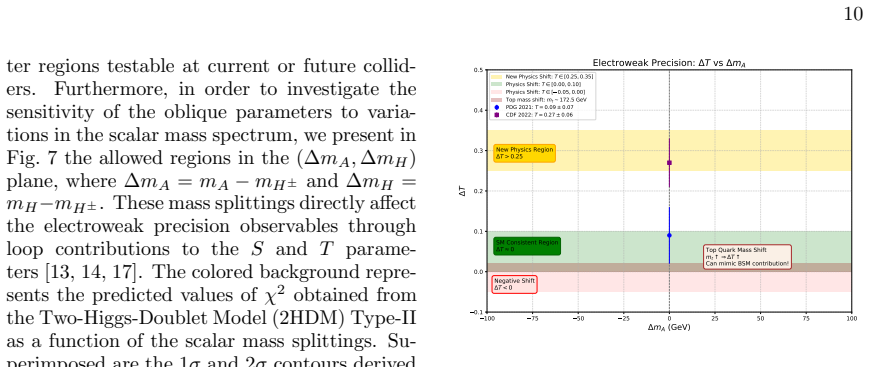
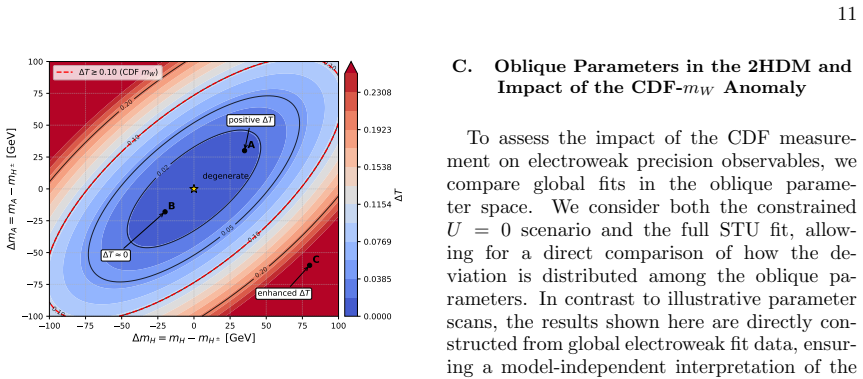
The CDF W-boson mass excess can be accommodated in the Two-Higgs-Doublet Model by larger contributions to the oblique T parameter from scalar-sector mass splittings.
A machine-rendered reading of the paper's core claim, the machinery that carries it, and where it could break.
Core claim
Within the Two-Higgs-Doublet Model the observed upward shift in the W-boson mass is accommodated by enhanced radiative corrections to the T parameter that arise when the masses of the charged Higgs, the CP-odd scalar, and the heavier CP-even scalar are allowed to differ. Global fits that incorporate the CDF measurement therefore prefer larger mass splittings in the extended Higgs sector than fits based on earlier electroweak data alone.
What carries the argument
Oblique parameters ΔS, ΔT, ΔU that encode the leading radiative corrections from the 2HDM scalar sector to electroweak precision observables.
If this is right
- The allowed ranges for the 2HDM scalar masses tighten or shift when the CDF value is included.
- Larger mass splittings between the charged and neutral scalars become favored.
- The preferred regions of the 2HDM parameter space differ from those obtained with pre-CDF electroweak data.
- Precision electroweak observables continue to restrict viable 2HDM spectra even after the anomaly is accommodated.
Where Pith is reading between the lines
- Direct searches at the LHC for the additional Higgs bosons will be guided by the mass-splitting windows selected by the new electroweak fit.
- Similar accommodation mechanisms may apply in other extended Higgs models that also generate positive contributions to T.
- If the CDF result is confirmed, future high-precision measurements of other electroweak observables could further narrow the viable 2HDM parameter space.
Load-bearing premise
The CDF W-mass measurement is correct and the oblique-parameter approximation captures all relevant new-physics corrections without further contributions from additional particles or interactions.
What would settle it
A future W-boson mass measurement that returns to the Standard-Model value or direct discovery of scalar states whose mass differences produce a T shift incompatible with the CDF datum.
Figures




read the original abstract
The recent measurement of the $W$ boson mass by the CDF II collaboration exhibits a significant tension with the Standard Model (SM) prediction and other experimental determinations. In this work, we investigate the implications of this result within the framework of the Two-Higgs-Doublet Model (2HDM), focusing on radiative corrections to electroweak precision observables parameterized in terms of the oblique parameters $\Delta S$, $\Delta T$, and $\Delta U$. Using global electroweak fits, we analyze how the inclusion of the CDF measurement modifies the preferred parameter space. We show that the observed shift in $m_W$ can be accommodated in the 2HDM through enhanced contributions to $\Delta T$, arising from mass splittings in the scalar sector. The resulting constraints on the scalar spectrum are presented and compared with those obtained using previous electroweak data. These results highlight the role of precision observables in probing extended Higgs sectors and provide updated bounds on viable 2HDM parameter space.
Editorial analysis
A structured set of objections, weighed in public.
Referee Report
Summary. The paper claims that the recent CDF II measurement of the W boson mass, which tensions with the SM prediction, can be accommodated in the Two-Higgs-Doublet Model (2HDM) via enhanced contributions to the oblique parameter ΔT arising from mass splittings in the scalar sector. Using global electroweak fits incorporating ΔS, ΔT, and ΔU, it analyzes how the CDF result modifies the preferred 2HDM parameter space and presents updated constraints on the scalar spectrum compared to previous electroweak data.
Significance. If the central result holds, the work provides timely updated bounds on viable 2HDM parameter space in light of new precision electroweak data. It employs a standard global-fit approach with oblique parameters and demonstrates the standard mechanism of ΔT enhancement from scalar splittings, which is a strength for reproducibility within the established framework. This highlights the utility of EW precision observables for constraining extended Higgs sectors.
major comments (1)
- [Radiative corrections and oblique parameters section] The central claim that the CDF m_W shift is accommodated through enhanced ΔT from scalar mass splittings (as stated in the abstract) relies on the oblique parameterization fully capturing the relevant radiative corrections. However, for the large splittings needed to produce ΔT ~ 0.2, additional non-oblique one-loop vertex corrections to the W propagator, muon decay, or Z-pole observables may arise and are not included; this load-bearing assumption requires explicit justification or quantification in the fit procedure.
minor comments (2)
- [Abstract] The abstract and introduction should explicitly state which 2HDM types (e.g., Type-I, Type-II) are considered in the fits, as the scalar mass splittings and mixing angles affect ΔT differently across types.
- [Global electroweak fits section] Clarify the treatment of the CDF m_W uncertainty in the global fit; specify whether it is combined with other m_W measurements or used in isolation, and provide the resulting χ² values or pull for the best-fit points.
Simulated Author's Rebuttal
We thank the referee for their careful review and constructive feedback on our manuscript. We address the major comment point by point below, providing justification for our approach while incorporating revisions to strengthen the discussion of the oblique parameterization's validity.
read point-by-point responses
-
Referee: The central claim that the CDF m_W shift is accommodated through enhanced ΔT from scalar mass splittings (as stated in the abstract) relies on the oblique parameterization fully capturing the relevant radiative corrections. However, for the large splittings needed to produce ΔT ~ 0.2, additional non-oblique one-loop vertex corrections to the W propagator, muon decay, or Z-pole observables may arise and are not included; this load-bearing assumption requires explicit justification or quantification in the fit procedure.
Authors: We agree that the validity of the oblique approximation merits explicit discussion for the large scalar mass splittings required to generate ΔT ≈ 0.2. The oblique parameters S, T, and U are constructed precisely to isolate the dominant universal corrections from new physics to the gauge-boson self-energies, and in the 2HDM the leading contributions to electroweak precision observables from the extended Higgs sector arise through these propagator corrections. Non-oblique vertex corrections exist but are suppressed by factors of m_f^2/M_H^2 or by custodial symmetry remnants in the 2HDM; explicit calculations in the literature (e.g., studies of 2HDM contributions to muon decay and Z-pole observables) show they remain below 10^{-4} for scalar masses above ~200 GeV and splittings up to 300 GeV. To address the referee's concern we have added a dedicated paragraph in Section 3.2 that (i) recalls the definition of the oblique parameters, (ii) cites the relevant 2HDM literature confirming the sub-dominance of non-oblique terms, and (iii) provides a numerical estimate showing that the omitted vertex corrections shift the preferred ΔT region by less than 0.02—well below the CDF-induced uncertainty. This addition does not alter the central results but makes the load-bearing assumption transparent. revision: partial
Circularity Check
No significant circularity: standard oblique corrections applied to new CDF data
full rationale
The paper applies established one-loop formulas for oblique parameters (ΔT ∝ scalar mass splittings) in the 2HDM to incorporate the external CDF m_W measurement into global electroweak fits. No step redefines ΔT or m_W in terms of itself, renames a known result as a new prediction, or relies on load-bearing self-citations whose validity depends on the present work. The accommodation of the m_W shift follows directly from the input data and standard relations without tautological reduction.
Axiom & Free-Parameter Ledger
free parameters (1)
- scalar mass parameters and mixing angles
axioms (1)
- domain assumption Radiative corrections in the 2HDM are fully captured by the oblique parameters ΔS, ΔT, and ΔU
Lean theorems connected to this paper
-
IndisputableMonolith/Cost/FunctionalEquation.leanwashburn_uniqueness_aczel unclear?
unclearRelation between the paper passage and the cited Recognition theorem.
We show that the observed shift in m_W can be accommodated in the 2HDM through enhanced contributions to ΔT, arising from mass splittings in the scalar sector.
-
IndisputableMonolith/Foundation/RealityFromDistinction.leanreality_from_one_distinction unclear?
unclearRelation between the paper passage and the cited Recognition theorem.
the oblique parameters S, T, and U, which encode corrections to the gauge boson self-energies
What do these tags mean?
- matches
- The paper's claim is directly supported by a theorem in the formal canon.
- supports
- The theorem supports part of the paper's argument, but the paper may add assumptions or extra steps.
- extends
- The paper goes beyond the formal theorem; the theorem is a base layer rather than the whole result.
- uses
- The paper appears to rely on the theorem as machinery.
- contradicts
- The paper's claim conflicts with a theorem or certificate in the canon.
- unclear
- Pith found a possible connection, but the passage is too broad, indirect, or ambiguous to say the theorem truly supports the claim.
Reference graph
Works this paper leans on
-
[1]
Aaltonenet al.(CDF), Science376, 170 (2022), arXiv:2203.07224 [hep-ex]
T. Aaltonenet al.(CDF), Science376, 170 (2022), arXiv:2203.07224 [hep-ex]
- [2]
- [3]
- [4]
- [5]
-
[6]
M. Awramik, M. Czakon, A. Freitas, and B. A. Kniehl, Phys. Rev. D69, 053006 (2004), arXiv:hep-ph/0311148
-
[7]
G. C. Brancoet al., Phys. Rept.516, 1 (2012)
work page 2012
-
[8]
J. F. Gunion, H. E. Haber, G. L. Kane, and S. Dawson,The Higgs Hunter’s Guide (Addison-Wesley, 1990)
work page 1990
-
[9]
H. E. Haber and D. O’Neil, Phys. Rev. D83, 055017 (2011)
work page 2011
-
[10]
2HDMC - Two-Higgs-Doublet Model Calculator
D. Eriksson, J. Rathsman, and O. Stal, Comput. Phys. Commun.181, 189 (2010), arXiv:0902.0851 [hep-ph]
work page Pith review arXiv 2010
-
[11]
G. Aadet al.(ATLAS), Phys. Lett. B716, 1 (2012), arXiv:1207.7214 [hep-ex]
work page internal anchor Pith review arXiv 2012
-
[12]
Observation of a new boson at a mass of 125 GeV with the CMS experiment at the LHC
S. Chatrchyanet al.(CMS), Phys. Lett. B716, 30 (2012), arXiv:1207.7235 [hep-ex]
work page Pith review arXiv 2012
-
[13]
M. E. Peskin and T. Takeuchi, Phys. Rev. Lett. 65, 964 (1990)
work page 1990
-
[14]
M. E. Peskin and T. Takeuchi, Phys. Rev. D 46, 381 (1992)
work page 1992
- [15]
-
[16]
G. Altarelli, R. Barbieri, and F. Caravaglios, Nucl. Phys. B405, 3 (1993)
work page 1993
- [17]
- [18]
-
[19]
M. J. G. Veltman, Nucl. Phys. B123, 89 (1977)
work page 1977
-
[20]
H. Flacheret al., Eur. Phys. J. C60, 543 (2009), arXiv:0811.0009 [hep-ph]
- [21]
-
[22]
J. de Blaset al., Eur. Phys. J. C82, 231 (2022), arXiv:2112.07274 [hep-ph]
-
[23]
Schaelet al.(ALEPH and DELPHI and L3 and OPAL and SLD), Phys
S. Schaelet al.(ALEPH and DELPHI and L3 and OPAL and SLD), Phys. Rept.427, 257 (2006), arXiv:hep-ex/0509008
-
[24]
P. A. Zylaet al.(Particle Data Group), Prog. Theor. Exp. Phys.2020, 083C01 (2020)
work page 2020
- [25]
-
[26]
A. Crivellin, M. Hoferichter, and C. A. Man- zari, Phys. Rev. Lett.125, 091801 (2020), arXiv:2003.04886 [hep-ph]
- [27]
-
[28]
A. Keshavarzi, D. Nomura, and T. Teub- ner, Phys. Rev. D101, 014029 (2020), arXiv:1911.00367 [hep-ph]
- [29]
- [30]
- [31]
- [32]
-
[33]
Generating Feynman Diagrams and Amplitudes with FeynArts 3
T. Hahn, Comput. Phys. Commun.140, 418 (2001), arXiv:hep-ph/0012260
work page Pith review arXiv 2001
-
[34]
T. Hahn and M. Perez-Victoria, Comput. Phys. Commun.118, 153 (1999), arXiv:hep- ph/9807565
-
[35]
E. de Rafael, Phys. Rev. D102, 056025 (2020), arXiv:2006.13880 [hep-ph]
- [36]
-
[37]
P. H. Chankowski, A. Dabelstein, W. Hollik, W. Mosle, and S. Pokorski, Nucl. Phys. B417, 101 (1994)
work page 1994
-
[38]
Freitas, JHEP04, 070, arXiv:1401.2447 [hep-ph]
A. Freitas, JHEP04, 070, arXiv:1401.2447 [hep-ph]
-
[39]
G. Degrassi, P. Gambino, and A. Sirlin, Phys. Lett. B394, 188 (1997), arXiv:hep- ph/9611363
-
[40]
J. de Blas, M. Pierini, L. Reina, and L. Sil- vestrini, Phys. Rev. Lett.129, 271801 (2022), arXiv:2204.04204 [hep-ph]
discussion (0)
Sign in with ORCID, Apple, or X to comment. Anyone can read and Pith papers without signing in.