Recognition: 1 theorem link
· Lean TheoremPrecise determination of electron-capture Q value of ¹¹³Sn decay related to electron neutrino mass measurements
Pith reviewed 2026-05-13 17:46 UTC · model grok-4.3
The pith
The ground-state to ground-state electron-capture Q value of 113Sn is 1039.25(19) keV, with an allowed transition at 9.60(20) keV showing enhanced endpoint sensitivity due to proximity to L-shell binding energies.
A machine-rendered reading of the paper's core claim, the machinery that carries it, and where it could break.
Core claim
The gs-to-gs Q value of 1039.25(19) keV was determined, and the allowed transition to the 1029.650(50) keV state has Q_EC^* = 9.60(20) keV with small energy differences from L1 and L2 shell bindings that enhance endpoint events; including subthreshold atomic states increases the EC rate near zero neutrino momentum by a factor of five.
Load-bearing premise
The self-consistent Dirac-Hartree-Fock-Slater method with exchange, overlap, shake-up and shake-off corrections, combined with the nuclear shell model, accurately predicts the spectral function and partial half-lives near the endpoint for this specific low-Q transition.
Figures


read the original abstract
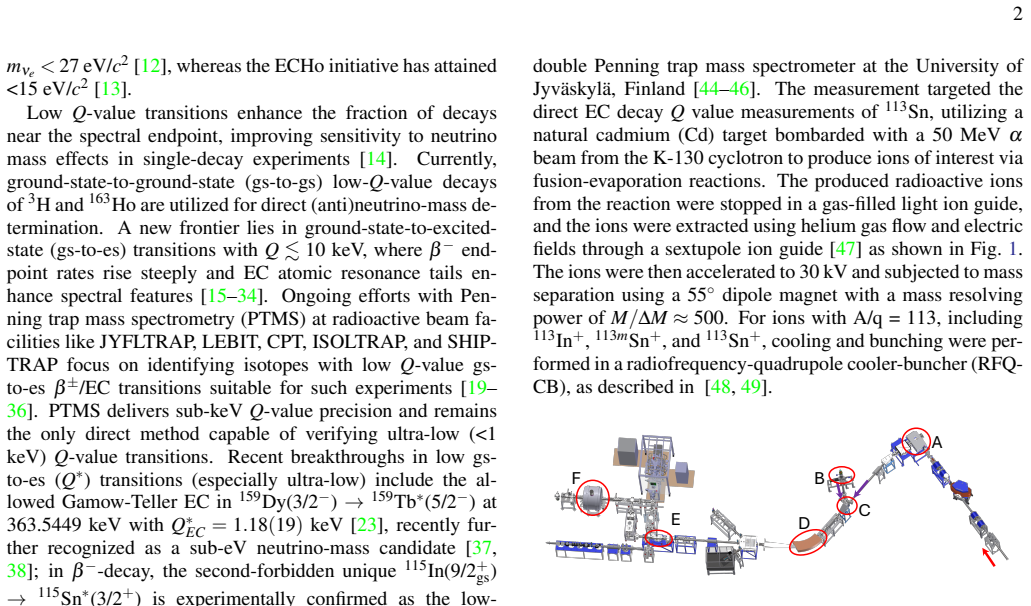
A high-precision measurement of the electron-capture (EC) decay $Q$ value for the ground-state-to-ground-state (gs-to-gs) transition of $^{113}$Sn to $^{113}$In has been performed using the JYFLTRAP double Penning trap mass spectrometer. Employing the phase-imaging ion-cyclotron-resonance technique, the isomeric state of $^{113}$Sn at 77.389(19) keV was resolved, and the cyclotron frequency ratio measured between the isomer $^{113m}$Sn and the daughter nucleus $^{113}$In. This yielded an isomer-to-ground-state $Q$ value of 1116.64(19) keV and gs-to-gs $Q$ value of 1039.25(19) keV. The atomic mass excess of $^{113}$Sn was determined as $-$88327.87(27) keV/c$^2$, in excellent agreement with the Atomic Mass Evaluation 2020 (AME2020) but with a sixfold precision improvement. Using nuclear energy-level data for $^{113}$In, we identified two low $Q$-value transitions of the ground state of $^{113}$Sn to excited states of $^{113}$In at 1024.280(50) keV ($Q_{EC}^* = 14.97(20)$ keV, second forbidden non-unique) and 1029.650(50) keV ($Q_{EC}^* = 9.60(20)$ keV, allowed). The allowed transition exhibits small energy differences ($\Delta_{L1} = 5.58(20)$ keV, $\Delta_{L2} = 5.87(20)$ keV) from L1 and L2 shell binding energies, enhancing endpoint events. Partial half-lives and energy-release spectra were calculated using the self-consistent Dirac-Hartree-Fock-Slater (DHFS) method (including exchange, overlap, shake-up, and shake-off corrections) together with the nuclear shell model, show enhanced endpoint sensitivity for the allowed transition to the state at 1029.650 keV. Including subthreshold atomic states in the spectral function enhances the EC rate near the zero-neutrino-momentum region by a factor of five, enabling new approaches for low $Q$-value EC reactions in neutrino-mass studies.
Editorial analysis
A structured set of objections, weighed in public.
Circularity Check
No significant circularity in the derivation chain
full rationale
The paper's central claim is a direct experimental determination of the gs-to-gs Q value of 1039.25(19) keV from the measured cyclotron frequency ratio between the resolved 113mSn isomer and 113In using JYFLTRAP phase-imaging ion-cyclotron-resonance. This does not reduce to any fitted parameter, self-referential equation, or ansatz within the paper. Nuclear level data for identifying the allowed transition at Q_EC^* = 9.60(20) keV are taken from external literature, and the DHFS spectral calculations (including exchange/overlap/shake corrections) are presented as an independent illustration of endpoint sensitivity rather than a prerequisite or load-bearing step for the measured Q value. The derivation chain is self-contained against external benchmarks with no circular reductions.
Axiom & Free-Parameter Ledger
axioms (2)
- domain assumption The phase-imaging ion-cyclotron-resonance technique in a Penning trap accurately determines cyclotron frequency ratios between parent and daughter ions.
- domain assumption The self-consistent Dirac-Hartree-Fock-Slater method including exchange, overlap, shake-up and shake-off corrections, together with the nuclear shell model, correctly describes the electron-capture spectral function for low-Q transitions.
Reference graph
Works this paper leans on
-
[1]
which is a rough two-to-three orders of magnitude longer than the computed ones but points to a spin-parity assignment J=1/2 +. The large discrepancy between the computed and experimental partial half-lives could be assigned to the inac- curacies of the adopted NSM Hamiltonian when applied to very weak EC transitions to highly excited states and the ex- p...
work page 2020
-
[2]
Y . Fukuda, T. Hayakawa, E. Ichihara, K. Inoue, K. Ishi- hara, H. Ishino, Y . Itow, T. Kajita, J. Kameda, S. Kasuga, K. Kobayashi, Y . Kobayashi, Y . Koshio, M. Miura, M. Naka- hata, S. Nakayama, A. Okada, K. Okumura, N. Sakurai, M. Sh- iozawa, Y . Suzuki, Y . Takeuchi, Y . Totsuka, S. Yamada, M. Earl, A. Habig, E. Kearns, M. D. Messier, K. Scholberg, J. ...
work page 1998
-
[3]
SNO Collaboration, Physical Review Letters89, 1 (2002), arXiv:0204008 [nucl-ex]
work page 2002
-
[4]
Planck Collaboration, Aghanim, N., Akrami, Y ., Ashdown, M., Aumont, J., Baccigalupi, C., Ballardini, M., Banday, A. J., Bar- reiro, R. B., Bartolo, N., Basak, S., Battye, R., Benabed, K., Bernard, J.-P., Bersanelli, M., Bielewicz, P., Bock, J. J., Bond, J. R., Borrill, J., Bouchet, F. R., Boulanger, F., Bucher, M., Buri- gana, C., Butler, R. C., Calabres...
work page 2020
-
[5]
A. Adame, J. Aguilar, S. Ahlen, S. Alam, D. Alexander, M. Alvarez, O. Alves, A. Anand, U. Andrade, E. Armen- gaud, S. Avila, A. Aviles, H. Awan, B. Bahr-Kalus, S. Bailey, C. Baltay, A. Bault, J. Behera, S. BenZvi, A. Bera, F. Beut- ler, D. Bianchi, C. Blake, R. Blum, S. Brieden, A. Brodzeller, D. Brooks, E. Buckley-Geer, E. Burtin, R. Calderon, R. Can- ni...
work page 2025
-
[6]
M. Gerbino and M. Lattanzi, Frontiers in Physics5(2018), 10.3389/fphy.2017.00070
-
[7]
E. Giusarma, M. Reyes, F. Villaescusa-Navarro, S. He, S. Ho, and C. Hahn, The Astrophysical Journal950, 70 (2023)
work page 2023
-
[8]
G. Drexlin, V . Hannen, S. Mertens, and C. Wein- heimer, Advances in High Energy Physics2013, 1 (2013), arXiv:1307.0101
- [9]
- [10]
-
[11]
KATRIN Collaboration et al., Science388, 180 (2025)
work page 2025
-
[12]
A. Ashtari Esfahani, S. Böser, N. Buzinsky, M. C. Carmona- Benitez, C. Claessens, L. de Viveiros, P. J. Doe, M. Fertl, J. A. Formaggio, J. K. Gaison, L. Gladstone, M. Grando, M. Guigue, J. Hartse, K. M. Heeger, X. Huyan, J. Johnston, A. M. Jones, K. Kazkaz, B. H. LaRoque, M. Li, A. Lindman, E. Machado, A. Marsteller, C. Matthé, R. Mohiuddin, B. Mon- real,...
work page 2023
-
[13]
B. K. Alpert, M. Balata, D. T. Becker, D. A. Bennett, M. Borgh- esi, P. Campana, E. Celasco, N. Cerboni, M. D. Gerone, R. Dressler, M. Faverzani, E. Ferri, J. Formicola, A. Giuliani, L. Gastaldo, F. Gatti, A. Fleischmann, C. Enss, D. Drung, M. Djamal, F. A. Danevich, J. S. Chung, S. Choudhury, S. Choi, J. S. Choe, M. K. Cheoun, N. Chanthima, C. R. Byeon, ...
-
[14]
Improved limit on the effective electron neutrino mass with the echo-1k exper- iment,
F. Adam, F. Ahrens, L. E. A. Perez, M. Balzer, A. Barth, D. Behrend-Uriarte, S. Berndt, K. Blaum, F. W. H. Böhm, M. Braß, L. Calza, K. Chrysalidis, M. Door, H. Dorrer, C. E. Düllmann, K. Eberhardt, S. Eliseev, C. Enss, P. Fil- ianin, A. Fleischmann, R. Gartmann, L. Gastaldo, M. Griedel, A. Göggelmann, R. Hammann, R. Hasse, M. W. Haverkort, S. Heinze, D. H...
- [15]
-
[16]
M. T. Mustonen and J. Suhonen, Journal of Physics G: Nuclear and Particle Physics37, 64008 (2010)
work page 2010
- [17]
-
[18]
M. Haaranen and J. Suhonen, The European Physical Journal A 49, 1 (2013)
work page 2013
- [19]
-
[20]
R. Sandler, G. Bollen, N. D. Gamage, A. Hamaker, C. Izzo, D. Puentes, M. Redshaw, R. Ringle, and I. Yandow, Physical Review C100, 1 (2019), arXiv:1906.03335
-
[21]
J. Karthein, D. Atanasov, K. Blaum, S. Eliseev, P. Filianin, D. Lunney, V . Manea, M. Mougeot, D. Neidherr, Y . Novikov, L. Schweikhard, A. Welker, F. Wienholtz, and K. Zuber, Hy- perfine Interactions240, 1 (2019), arXiv:1905.05510
-
[22]
A. De Roubin, J. Kostensalo, T. Eronen, L. Canete, R. P. De Groote, A. Jokinen, A. Kankainen, D. A. Nesterenko, I. D. Moore, S. Rinta-Antila, J. Suhonen, and M. Vilén, Physical Review Letters124, 1 (2020), arXiv:2002.08282
-
[23]
Z. Ge, T. Eronen, A. de Roubin, D. A. Nesterenko, M. Hukka- nen, O. Beliuskina, R. de Groote, S. Geldhof, W. Gins, A. Kankainen, A. Koszorús, J. Kotila, J. Kostensalo, I. D. Moore, A. Raggio, S. Rinta-Antila, J. Suhonen, V . Virtanen, A. P. Weaver, A. Zadvornaya, and A. Jokinen, Physical Review C103, 065502 (2021)
work page 2021
-
[24]
Z. Ge, T. Eronen, K. S. Tyrin, J. Kotila, J. Kostensalo, D. A. Nesterenko, O. Beliuskina, R. de Groote, A. de Roubin, S. Geldhof, W. Gins, M. Hukkanen, A. Jokinen, A. Kankainen, A. Koszorús, M. I. Krivoruchenko, S. Kujanpää, I. D. Moore, A. Raggio, S. Rinta-Antila, J. Suhonen, V . Virtanen, A. P. Weaver, and A. Zadvornaya, Phys. Rev. Lett.127, 272301 (2021)
work page 2021
-
[25]
Z. Ge, T. Eronen, A. de Roubin, K. Tyrin, L. Canete, S. Geld- hof, A. Jokinen, A. Kankainen, J. Kostensalo, J. Kotila, M. Krivoruchenko, I. Moore, D. Nesterenko, J. Suhonen, and M. Vilén, Physics Letters B832, 137226 (2022)
work page 2022
- [26]
-
[27]
Z. Ge, T. Eronen, A. de Roubin, J. Kostensalo, J. Suhonen, D. A. Nesterenko, O. Beliuskina, R. de Groote, C. Delafosse, S. Geldhof, W. Gins, M. Hukkanen, A. Jokinen, A. Kankainen, J. Kotila, A. Koszorús, I. D. Moore, A. Raggio, S. Rinta-Antila, V . Virtanen, A. P. Weaver, and A. Zadvornaya, Phys. Rev. C 106, 015502 (2022)
work page 2022
-
[28]
M. Ramalho, Z. Ge, T. Eronen, D. A. Nesterenko, J. Jaati- nen, A. Jokinen, A. Kankainen, J. Kostensalo, J. Kotila, M. I. 9 Krivoruchenko, J. Suhonen, K. S. Tyrin, and V . Virtanen, Phys. Rev. C106, 015501 (2022)
work page 2022
-
[29]
N. D. Gamage, R. Sandler, F. Buchinger, J. A. Clark, D. Ray, R. Orford, W. S. Porter, M. Redshaw, G. Savard, K. S. Sharma, and A. A. Valverde, Phys. Rev. C106, 045503 (2022)
work page 2022
-
[30]
D. K. Keblbeck, R. Bhandari, N. D. Gamage, M. Horana Gam- age, K. G. Leach, X. Mougeot, and M. Redshaw, Phys. Rev. C 107, 015504 (2023)
work page 2023
-
[31]
Z. Ge, T. Eronen, A. de Roubin, M. Ramalho, J. Kosten- salo, J. Kotila, J. Suhonen, D. A. Nesterenko, A. Kankainen, P. Ascher, O. Beliuskina, M. Flayol, M. Gerbaux, S. Grévy, M. Hukkanen, A. Husson, A. Jaries, A. Jokinen, I. D. Moore, P. Pirinen, J. Romero, M. Stryjczyk, V . Virtanen, and A. Zad- vornaya, Phys. Rev. C108, 045502 (2023)
work page 2023
-
[32]
A. Valverde, F. Kondev, B. Liu, D. Ray, M. Brodeur, D. Bur- dette, N. Callahan, A. Cannon, J. Clark, D. Hoff, R. Orford, W. Porter, G. Savard, K. Sharma, and L. Varriano, Physics Let- ters B858, 139037 (2024)
work page 2024
-
[33]
Z. Ge, T. Eronen, M. Ramalho, A. de Roubin, D. A. Nesterenko, A. Kankainen, O. Beliuskina, R. de Groote, S. Geldhof, W. Gins, M. Hukkanen, A. Jokinen, Á. Kos- zorús, J. Kotila, J. Kostensalo, I. D. Moore, P. Pirinen, A. Raggio, S. Rinta-Antila, V . A. Sevestrean, J. Suhonen, V . Virtanen, and A. Zadvornaya, Eur. Phys. J. A60(2024), https://doi.org/10.1140...
-
[34]
Z. Ge, T. Eronen, V . A. Sevestrean, O. Ni¸ tescu, S. Sto- ica, M. Ramalho, J. Suhonen, A. de Roubin, D. Nesterenko, A. Kankainen, P. Ascher, S. Ayet San Andres, O. Beliuskina, P. Delahaye, M. Flayol, M. Gerbaux, S. Grévy, M. Hukka- nen, A. Jaries, A. Jokinen, A. Husson, D. Kahl, J. Kostensalo, J. Kotila, I. Moore, S. Nikas, M. Stryjczyk, and V . Virtanen...
work page 2024
-
[35]
Z. Ge, T. Eronen, V . A. Sevestrean, M. Ramalho, O. Ni¸ tescu, S. Ghinescu, S. Stoica, J. Suhonen, A. de Roubin, D. Nesterenko, A. Kankainen, P. Ascher, S. A. S. Andres, O. Beliuskina, P. Delahaye, M. Flayol, M. Gerbaux, S. Grévy, M. Hukkanen, A. Jaries, A. Jokinen, A. Husson, D. Kahl, J. Kostensalo, J. Kotila, I. Moore, S. Nikas, J. Ruotsalainen, M. Stry...
work page 2025
-
[36]
D. A. Nesterenko, S. Eliseev, K. Blaum, M. Block, S. Chen- marev, A. Dörr, C. Droese, P. E. Filianin, M. Goncharov, E. Mi- naya Ramirez, Y . N. Novikov, L. Schweikhard, and V . V . Simon, Physical Review C - Nuclear Physics90, 042501(R) (2014)
work page 2014
-
[37]
S. Eliseev, K. Blaum, M. Block, S. Chenmarev, H. Dorrer, C. E. Düllmann, C. Enss, P. E. Filianin, L. Gastaldo, M. Goncharov, U. Köster, F. Lautenschläger, Y . N. Novikov, A. Rischka, R. X. Schüssler, L. Schweikhard, and A. Türler, Physical Review Letters115, 62501 (2015), arXiv:1604.04210
- [38]
- [39]
-
[40]
J. S. Wieslander, J. Suhonen, T. Eronen, M. Hult, V . V . Elo- maa, A. Jokinen, G. Marissens, M. Misiaszek, M. T. Mustonen, S. Rahaman, C. Weber, and J. Äystö, Physical Review Letters 103, 122501 (2009)
work page 2009
-
[41]
B. J. Mount, M. Redshaw, and E. G. Myers, Physical Review Letters103, 122502 (2009)
work page 2009
-
[42]
E. Andreotti, M. Hult, R. de Orduña, G. Marissens, J. S. E. Wieslander, and M. Misiaszek, Physical Review C84, 44605 (2011)
work page 2011
-
[43]
J. A. Formaggio, A. L. C. de Gouvêa, and R. H. Robertson, Physics Reports (2021), https://doi.org/10.1016/j.physrep.2021.02.002
-
[44]
V . A. Zheltonozhsky, A. M. Savrasov, N. V . Strilchuk, and V . I. Tretyak, Epl121(2018), 10.1209/0295-5075/121/12001
- [45]
-
[46]
I. D. Moore, T. Eronen, D. Gorelov, J. Hakala, A. Jokinen, A. Kankainen, V . S. Kolhinen, J. Koponen, H. Penttilä, I. Poh- jalainen, M. Reponen, J. Rissanen, A. Saastamoinen, S. Rinta- Antila, V . Sonnenschein, and J. Äystö, Nuclear Instruments and Methods in Physics Research, Section B: Beam Interac- tions with Materials and Atoms317, 208 (2013)
work page 2013
-
[47]
V . S. Kolhinen, T. Eronen, D. Gorelov, J. Hakala, A. Joki- nen, K. Jokiranta, A. Kankainen, M. Koikkalainen, J. Kopo- nen, H. Kulmala, M. Lantz, A. Mattera, I. D. Moore, H. Pent- tilä, T. Pikkarainen, I. Pohjlainen, M. Reponen, S. Rinta-Antila, J. Rissanen, C. Rodríguez Triguero, K. Rytkönen, A. Saasta- moinen, A. Solders, V . Sonnenschein, and J. Äystö,...
work page 2013
-
[48]
P. Karvonen, I. D. Moore, T. Sonoda, T. Kessler, H. Penttilä, K. Peräjärvi, P. Ronkanen, and J. Äystö, Nuclear Instruments and Methods in Physics Research, Section B: Beam Interactions with Materials and Atoms266, 4794 (2008)
work page 2008
-
[49]
A. Nieminen, J. Huikari, A. Jokinen, J. Äystö, P. Campbell, and E. C. Cochrane, Nuclear Instruments and Methods in Physics Research, Section A: Accelerators, Spectrometers, Detectors and Associated Equipment469, 244 (2001)
work page 2001
-
[50]
V . Virtanen, T. Eronen, A. Kankainen, O. Beliuskina, P. Camp- bell, R. Delaplanche, Z. Ge, R. de Groote, M. Hukkanen, A. Jaries, R. Kronholm, I. Moore, A. Raggio, A. de Roubin, J. Ruotsalainen, and M. Schuh, Nuclear Instruments and Methods in Physics Research Section A: Accelerators, Spec- trometers, Detectors and Associated Equipment1072, 170186 (2025)
work page 2025
- [51]
-
[52]
D. A. Nesterenko, T. Eronen, A. Kankainen, L. Canete, A. Joki- nen, I. D. Moore, H. Penttilä, S. Rinta-Antila, A. de Roubin, and M. Vilen, European Physical Journal A54, 0 (2018)
work page 2018
-
[53]
D. A. Nesterenko, T. Eronen, Z. Ge, A. Kankainen, and M. Vilen, Eur. Phys. J. A57, 302 (2021)
work page 2021
-
[54]
S. Eliseev, K. Blaum, M. Block, A. Dörr, C. Droese, T. Ero- nen, M. Goncharov, M. Höcker, J. Ketter, E. M. Ramirez, D. A. Nesterenko, Y . N. Novikov, and L. Schweikhard, Ap- plied Physics B: Lasers and Optics114, 107 (2014)
work page 2014
-
[55]
A. Kramida, Yu. Ralchenko, J. Reader, and and NIST ASD Team, NIST Atomic Spectra Database (ver. 5.8), [Online]. Available:https://physics.nist.gov/asd[2021, January 19]. National Institute of Standards and Technology, Gaithersburg, MD. (2020)
work page 2021
-
[56]
“National nuclear data center,” Available athttps://www. nndc.bnl.gov/(2020/4/7) (2021)
work page 2020
-
[57]
M. Wang, W. Huang, F. Kondev, G. Audi, and S. Naimi, Chi- nese Physics C45, 030003 (2021)
work page 2021
-
[58]
“X-ray data booklet,” Available athttps://xdb.lbl.gov (2021/05/01) (2021)
work page 2021
-
[59]
A. Kellerbauer, K. Blaum, G. Bollen, F. Herfurth, H. J. Kluge, M. Kuckein, E. Sauvan, C. Scheidenberger, and L. Schweikhard, European Physical Journal D22, 53 (2003)
work page 2003
-
[60]
C. Roux, K. Blaum, M. Block, C. Droese, S. Eliseev, M. Gon- charov, F. Herfurth, E. M. Ramirez, D. A. Nesterenko, Y . N. Novikov, and L. Schweikhard, The European Physical Journal D67, 1 (2013)
work page 2013
-
[61]
R. T. Birge, Physical Review40, 207 (1932). 10
work page 1932
- [62]
-
[63]
V . A. Sevestrean, O. Ni¸ tescu, S. Ghinescu, and S. Stoica, Phys. Rev. A108, 012810 (2023)
work page 2023
-
[64]
F. Salvat and J. M. Fernández-Varea, Computer Physics Com- munications240, 165 (2019)
work page 2019
-
[65]
B. Hahn, D. G. Ravenhall, and R. Hofstadter, Phys. Rev.101, 1131 (1956)
work page 1956
-
[66]
J. CAMPBELL and T. PAPP, Atomic Data and Nuclear Data Tables77, 1 (2001)
work page 2001
-
[67]
First calorimetric measurement of oi-line in the electron cap- ture spectrum of 163ho,
P. C. O. Ranitzsch, C. Hassel, M. Wegner, S. Kempf, A. Fleis- chmann, C. Enss, L. Gastaldo, A. Herlert, and K. Johnston, “First calorimetric measurement of oi-line in the electron cap- ture spectrum of 163ho,” (2014), arXiv:1409.0071 [physics.ins- det]
-
[68]
H. Behrens and W. Bühring,Electron Radial Wave Functions and Nuclear Beta-decay (International Series of Monographs on Physics)(Clarendon press, Oxford, 1982)
work page 1982
-
[69]
J. Suhonen,From Nucleons to Nucleus(Springer–Verlag Berlin Heidelberg, Springer, Gaithersburg MD, 20899, 2007)
work page 2007
-
[70]
J. T. Suhonen, Frontiers in Physics5(2017), 10.3389/fphy.2017.00055
-
[71]
W. Bambynek, H. Behrens, M. H. Chen, B. Crasemann, M. L. Fitzpatrick, K. W. D. Ledingham, H. Genz, M. Mutterer, and R. L. Intemann, Rev. Mod. Phys.49, 77 (1977)
work page 1977
-
[72]
Mougeot, Applied Radiation and Isotopes134, 225 (2018)
X. Mougeot, Applied Radiation and Isotopes134, 225 (2018)
work page 2018
discussion (0)
Sign in with ORCID, Apple, or X to comment. Anyone can read and Pith papers without signing in.