Recognition: 2 theorem links
· Lean TheoremFrom Wave Scattering to Bloch Bands: A Time-Domain Approach to Band Formation in Periodic Media
Pith reviewed 2026-05-13 17:34 UTC · model grok-4.3
The pith
Time-domain wave propagation through finite periodic layers reconstructs the Bloch dispersion relation of the infinite system.
A machine-rendered reading of the paper's core claim, the machinery that carries it, and where it could break.
Core claim
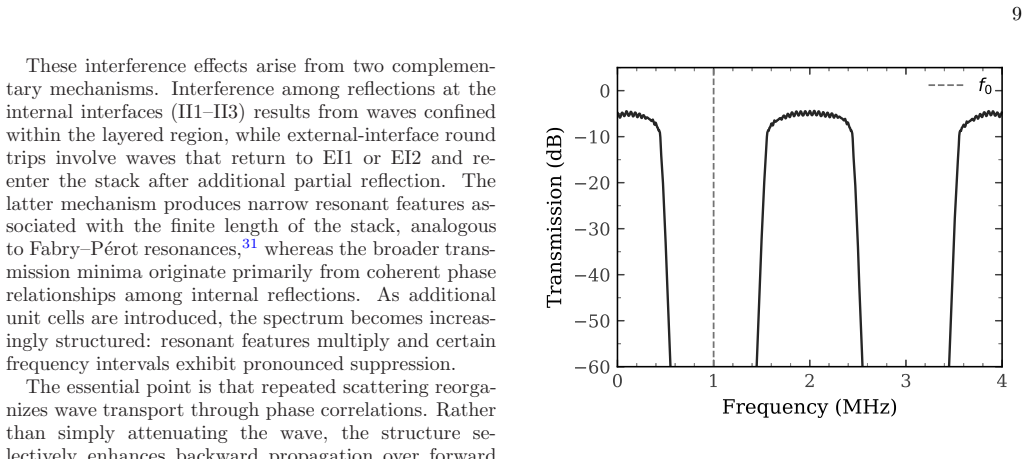
Band formation is recovered directly from the transmission spectrum of a finite periodic structure, where the frequency-dependent phase delay and attenuation encode the dispersion relation of the corresponding infinite lattice through the accumulated wavevector and the spatial decay inside gaps.
What carries the argument
Staggered-grid finite-difference time-domain propagation of elastic waves through a finite layered medium, followed by extraction of the Bloch wavevector from the frequency-dependent transmission phase and identification of gaps from spatial attenuation.
If this is right
- Band gaps appear as clear frequency intervals of strong spatial attenuation caused by destructive interference after many scattering events.
- Finite-size corrections, weak disorder, and point defects can be added inside the same simulation to observe how they shift or fill the ideal bands.
- Localized defect modes show up as sharp transmission peaks inside the gaps, directly linking scattering physics to mode confinement.
- The identical workflow applies to any linear wave equation, supplying a single numerical route from scattering to band diagrams across acoustics, electromagnetics, and elasticity.
Where Pith is reading between the lines
- The same finite-stack transmission data could be measured in a laboratory with ultrasonic pulses through stacked plates, providing an experimental test of the reconstruction.
- Once the dispersion is obtained this way, small changes in layer thicknesses or material contrast can be varied to map design rules for desired gap locations without ever invoking reciprocal-space methods.
- The approach supplies a concrete computational bridge that lets students move from time-domain intuition to reciprocal-space formalism rather than encountering the latter first.
Load-bearing premise
The transmission spectrum recorded in a finite-length stack faithfully reproduces the dispersion curve of the infinite periodic medium without large boundary or length-induced distortions.
What would settle it
Calculate the exact Bloch bands of the infinite layered medium with the standard transfer-matrix method and compare them with the dispersion extracted from the finite time-domain run; a mismatch larger than numerical error in band-edge locations or gap widths would falsify the reconstruction.
Figures






read the original abstract
Band formation in periodic media is a central topic in undergraduate solid-state physics, typically introduced through Bloch's theorem as an eigenvalue problem in reciprocal space for infinitely periodic systems. While mathematically elegant, this formulation can appear abstract: it assumes an idealized infinite lattice, shifts attention away from real-space wave dynamics, and presents band structures as static results rather than emergent consequences of wave propagation. Consequently, students often struggle to relate band gaps to familiar physical phenomena such as reflection, transmission, and interference, leading to a disconnect between formal band theory and observable wave behavior. We present a computational framework that addresses this gap by reconstructing band formation directly from time-domain wave propagation in finite periodic systems. Using a staggered-grid finite-difference time-domain scheme for elastic waves, a broadband excitation is propagated through a layered medium to obtain its transmission spectrum. From this, students extract the Bloch dispersion relation and observe spatial attenuation in band-gap regions, revealing the roles of multiple scattering and phase coherence. This approach provides a physically transparent pathway to band theory and enables exploration of finite-size effects, disorder, and defect-localized modes within a unified computational framework. Implemented through compact code and guided exercises, the method offers an accessible and versatile pedagogical tool, while also equipping students with transferable skills in numerical modeling of wave phenomena across disciplines.
Editorial analysis
A structured set of objections, weighed in public.
Referee Report
Summary. The paper claims to introduce a pedagogical computational framework that reconstructs Bloch band formation directly from time-domain elastic wave propagation in finite periodic layered media. Using a staggered-grid FDTD scheme, a broadband pulse is transmitted through a finite stack to obtain the transmission spectrum T(ω), from which the dispersion relation ω(k) is extracted; students are then shown spatial attenuation in gaps and finite-size effects, providing a real-space alternative to the conventional reciprocal-space Bloch eigenvalue problem.
Significance. If the extraction procedure is shown to recover the infinite-lattice dispersion with controlled error, the work could furnish a concrete, visually intuitive route from scattering and interference to band gaps that is currently missing from most undergraduate solid-state curricula. The emphasis on finite-N systems, disorder, and defect modes, together with compact code and guided exercises, would make the material immediately deployable across physics and engineering courses while also supplying transferable numerical skills.
major comments (2)
- [Abstract and §3] Abstract and §3 (extraction procedure): the central claim that the transmission spectrum of a finite-N stack directly yields the Bloch dispersion of the corresponding infinite lattice is not supported by any convergence test with N, any comparison against the exact transfer-matrix Bloch solution, or an explicit formula linking T(ω) to k(ω) that is proven to eliminate Fabry–Perot oscillations and interface reflections.
- [§4] §4 (numerical results): no error analysis or quantitative comparison to known analytical dispersion for a simple 1D bilayer is presented; without such benchmarks it is impossible to assess whether finite-size resonances distort the extracted bands at a level that would undermine the pedagogical goal.
minor comments (2)
- [Abstract] The abstract would be clearer if it stated the precise algorithm (phase accumulation, fitting, or attenuation mapping) used to convert the transmission spectrum into the dispersion curve.
- Figure captions should explicitly indicate the number of periods N used in each simulation so that readers can judge the scale of finite-size effects.
Simulated Author's Rebuttal
We thank the referee for the constructive and detailed report. The comments correctly identify the need for stronger validation of the extraction procedure and quantitative benchmarks. We have revised the manuscript to incorporate explicit convergence tests, comparisons with the transfer-matrix method, and error analysis, as described in the point-by-point responses below.
read point-by-point responses
-
Referee: [Abstract and §3] Abstract and §3 (extraction procedure): the central claim that the transmission spectrum of a finite-N stack directly yields the Bloch dispersion of the corresponding infinite lattice is not supported by any convergence test with N, any comparison against the exact transfer-matrix Bloch solution, or an explicit formula linking T(ω) to k(ω) that is proven to eliminate Fabry–Perot oscillations and interface reflections.
Authors: We accept the criticism that the original manuscript lacked explicit validation. In the revised version, §3 now contains a derivation of the relation between the transmission phase and the Bloch wavevector k(ω) for large but finite N, together with a windowing procedure that suppresses Fabry–Perot oscillations. We also add convergence plots of the extracted dispersion versus N, directly compared to the exact transfer-matrix Bloch solution for the same layered stack. These additions furnish the missing support for the central claim while preserving the pedagogical emphasis on finite systems. revision: yes
-
Referee: [§4] §4 (numerical results): no error analysis or quantitative comparison to known analytical dispersion for a simple 1D bilayer is presented; without such benchmarks it is impossible to assess whether finite-size resonances distort the extracted bands at a level that would undermine the pedagogical goal.
Authors: We agree that quantitative error analysis is required. The revised §4 now includes a direct comparison of the FDTD-extracted dispersion for a 1D bilayer against the analytical Bloch relation obtained from the transfer-matrix method. We report the frequency deviation (maximum and RMS) as a function of N and include figures showing convergence to the infinite-lattice limit. For N ≳ 20 the deviation in the pass bands falls below 1 %, confirming that finite-size effects do not undermine the pedagogical objectives. revision: yes
Circularity Check
No significant circularity; band extraction is forward simulation plus post-processing
full rationale
The paper's central step is a forward FDTD simulation of wave propagation through a finite periodic stack to obtain a transmission spectrum T(ω), followed by an extraction step that maps features of T(ω) (phase accumulation or attenuation) onto the Bloch dispersion ω(k). This is a data-driven reconstruction from an independent numerical experiment, not a self-definition, a fitted parameter renamed as prediction, or a load-bearing self-citation. No equations in the abstract or description reduce the output dispersion relation to the input ansatz by construction; the method remains falsifiable against transfer-matrix benchmarks or larger-N limits. The derivation chain is therefore self-contained.
Axiom & Free-Parameter Ledger
axioms (1)
- domain assumption Finite periodic systems exhibit transmission spectra that directly correspond to the band structure of infinite periodic media.
Lean theorems connected to this paper
-
IndisputableMonolith/Foundation/RealityFromDistinction.leanreality_from_one_distinction unclearUsing a staggered-grid finite-difference time-domain scheme for elastic waves, a broadband excitation is propagated through a layered medium to obtain its transmission spectrum. From this, students extract the Bloch dispersion relation
-
IndisputableMonolith/Cost/FunctionalEquation.leanwashburn_uniqueness_aczel unclearcos(k_B a) = D(ω) ... k''_B = (1/a) arcosh(|D(ω)|)
Reference graph
Works this paper leans on
-
[1]
does not explicitly reveal the dynamical mech- anism underlying wave propagation. A clearer physical picture emerges when the motion is expressed in terms of fields representing momentum transport and restor- ing forces. To make this structure explicit, it is conve- nient to recast the second-order equation into an equiva- lent first-order system. Introduci...
-
[2]
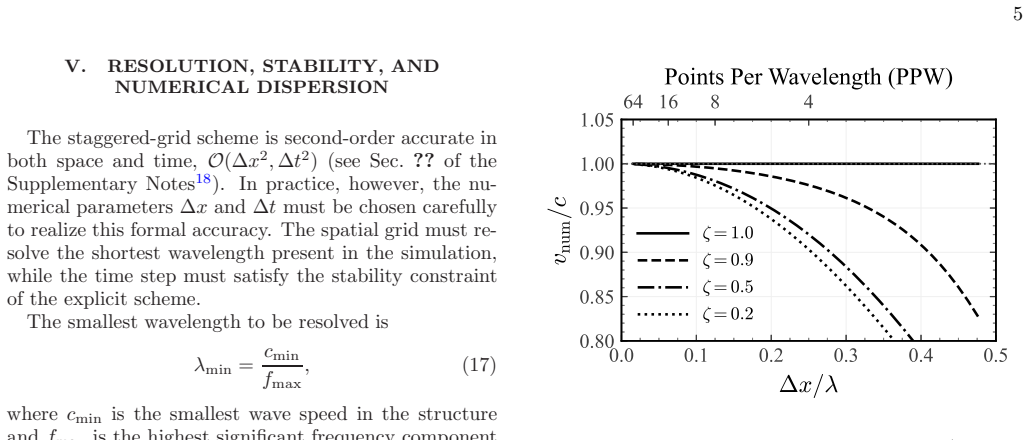
pro- vides the natural starting point for the numerical formu- lation developed in this work. In the following section, we construct a staggered-grid finite-difference scheme that respects this coupled structure and enables efficient sim- ulation of wave propagation in media with spatially vary- ing material properties. III. A STAGGERED-GRID FORMULATION FOR E...
-
[3]
42 − 0. 5 cos ( π (t − t0) t0 ) + 0. 08 cos ( 2π (t − t0) t0 ) , |t − t0| ≤ t0, 0, otherwise. (14) The sinc factor produces an approximately flat spec- trum up to fcut, while the Blackman window confines the pulse in time and suppresses spectral side lobes. In practice, the choice of excitation is guided by the desired spectral content: the Ricker wavelet p...
-
[4]
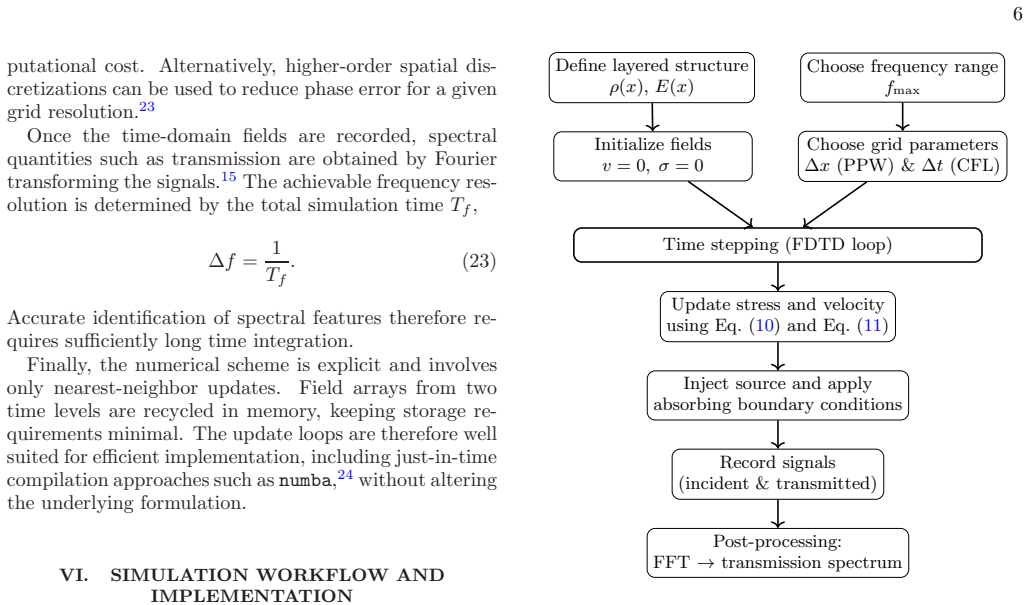
Start- ing from the definition of the layered structure and the choice of numerical parameters, the algorithm advances the coupled velocity and stress fields in time while in- jecting the source and applying absorbing boundaries at the edges of the computational domain. This sequence of steps mirrors the logical progression followed by stu- dents when imple...
work page 1960
-
[5]
and compare them with the nu- merical values obtained from the simulation. Examine how the larger impedance contrast modifies the partition of energy between reflected and transmitted waves. VIII. FROM REPEATED SCATTERING TO FREQUENCY-SELECTIVE TRANSMISSION Having established the scattering properties of a single impedance interface, we now examine how repe...
-
[6]
(36) When |D(ω )| ≤ 1, a real solution for kB exists and the frequency lies within a pass band
reduces to cos(kBa) = D(ω ). (36) When |D(ω )| ≤ 1, a real solution for kB exists and the frequency lies within a pass band. If instead |D(ω )|> 1, no real kB satisfies the equation. Taking the modulus of Eq. ( 36) and writing kB = ik′′ B, with cos( ix) = cosh( x), gives |cos(kBa)|= cosh(k′′ Ba) = |D(ω )|, (37) so that k′′ B = 1 a cosh− 1( |D(ω )| ) . (38)...
-
[7]
admits real solutions for kB, corresponding to propagating Bloch modes and a defi- nite phase advance kBa across each unit cell. In stop bands, where |D(ω )|> 1, the Bloch wavevector becomes complex, yielding the attenuation constant k′′ B given in Eq. ( 38). We now examine both manifestations directly within the time-domain simulation and compare them wit...
-
[8]
05%. The close agreement confirms that the spatial attenuation observed in the finite stack is governed by the same Bloch attenuation constant predicted for an in- finite periodic medium. In other words, the exponential decay measured directly in the time-domain simulation is not merely a numerical artifact of multiple reflections, but a manifestation of the ...
-
[9]
5 times the original layer width). Compute the trans- mission spectra and observe how the defect-mode fre- quency shifts as the defect geometry changes. XI. CONCLUSION We have presented a compact computational frame- work through which band formation in periodic media can be reconstructed directly from time-domain wave dy- namics in finite layered systems....
-
[10]
The present solver readily supports a variety of additional one-dimensional studies. Once imple- mented, students can modify layer thicknesses, ma- terial properties, or introduce defects to investigate band-gap tuning, localized defect modes, and the influence of impedance contrast on transmission in periodic layered media. 6,35–38
-
[11]
In the present context, it is ap- plied to the velocity and stress fields of elastody- namics
The staggered-grid update scheme follows the leapfrog finite-difference time-domain (FDTD) method originally introduced by Yee for electro- magnetic waves. In the present context, it is ap- plied to the velocity and stress fields of elastody- namics. This connection provides a natural path- way to extend the framework to electromagnetic wave simulations; a c...
-
[12]
Quantum mechanics of electrons in crystal lattices,
The one-dimensional model can also be extended to two dimensions. Such simulations enable explo- ration of richer phononic or photonic crystal phe- nomena, including directional band gaps, waveg- uiding, and defect cavities. 20,40,41 Since phononic crystals are an active area of research with applica- tions in vibration control and wave manipulation, the ...
work page 1931
discussion (0)
Sign in with ORCID, Apple, or X to comment. Anyone can read and Pith papers without signing in.