Recognition: no theorem link
Beyond f(φ)mathcal{G}: Gauss--Bonnet inflation with μ(φ,X)
Pith reviewed 2026-05-13 17:15 UTC · model grok-4.3
The pith
A phase-space coupling localizes the Gauss-Bonnet term to a finite window of e-folds during inflation.
A machine-rendered reading of the paper's core claim, the machinery that carries it, and where it could break.
Core claim
By introducing a trajectory-selective coupling μ(φ,X) that gates the Gauss-Bonnet sector in phase space, the higher-curvature contribution can be localized within a finite e-fold window while remaining negligible elsewhere, yielding viable backgrounds consistent with standard stability conditions and predictable pivot-scale observables.
What carries the argument
The trajectory-selective coupling μ(φ,X) that gates the Gauss-Bonnet sector according to the inflaton's position in phase space.
If this is right
- Viable inflationary solutions exist in which the Gauss-Bonnet contribution is active only inside a chosen finite e-fold interval.
- Ghost and gradient stability hold for both scalar and tensor perturbations over the full trajectory when the gate is properly chosen.
- Pivot-scale observables vary systematically with the overall Gauss-Bonnet strength and with the form of the kinetic gating.
- Controlled, localized higher-curvature imprints on CMB measurements become accessible without the term dominating the entire inflationary epoch.
Where Pith is reading between the lines
- The same gating idea could be applied to other higher-curvature corrections to achieve similar localization.
- Reheating dynamics might be altered because the higher-curvature term is absent during the final stages of inflation.
- The approach supplies a concrete way to test whether any observed deviation in the spectral index arises from a brief higher-curvature episode.
Load-bearing premise
A functional form for μ(φ,X) exists that localizes the Gauss-Bonnet term to a finite e-fold window while preserving ghost-free and gradient-stable conditions for all perturbations along the entire trajectory.
What would settle it
No choice of μ(φ,X) succeeds in confining the Gauss-Bonnet effect to a narrow window without producing a ghost or gradient instability in the scalar or tensor spectrum at some point during inflation.
Figures





read the original abstract
Gauss--Bonnet inflation typically affects the dynamics over an extended portion of the trajectory, making it difficult to isolate a controlled imprint at CMB scales. We consider a trajectory-selective coupling \(\mu(\phi,X)\) that gates the Gauss--Bonnet sector in phase space, enabling the higher-curvature contribution to be localized within a finite e-fold window while remaining negligible elsewhere. We identify stable inflationary solutions consistent with this localization and enforce standard ghost and gradient stability conditions for both scalar and tensor perturbations. For these viable backgrounds we compute pivot-scale observables and examine their dependence on the overall Gauss--Bonnet strength and on the kinetic gating. The framework offers a controlled route for realizing localized higher-curvature effects with predictable consequences for CMB-scale measurements.
Editorial analysis
A structured set of objections, weighed in public.
Referee Report
Summary. The paper introduces a trajectory-selective coupling μ(φ,X) that gates the Gauss-Bonnet term to localize its effects within a finite e-fold window during inflation, while remaining negligible elsewhere. It identifies stable inflationary backgrounds satisfying ghost-free and gradient stability conditions for scalar and tensor perturbations, computes pivot-scale observables, and examines their dependence on the GB coupling strength and kinetic gating parameters.
Significance. If the existence of a suitable μ(φ,X) that achieves localization without violating stability can be explicitly demonstrated, the work would provide a controlled extension beyond standard f(φ)G models, enabling targeted higher-curvature imprints at CMB scales with predictable observational consequences.
major comments (2)
- [Abstract] Abstract and §3 (presumed): The central claim that stable solutions exist with the required localization relies on the existence of a concrete functional form for μ(φ,X). The abstract states that such solutions are identified and stability conditions enforced, but without an explicit expression for μ(φ,X) or the associated stability matrices (e.g., no quadratic action coefficients or sound-speed expressions shown), it is impossible to verify that the gating term does not induce ghosts or imaginary sound speeds at the window boundaries. This is load-bearing for the viability claim.
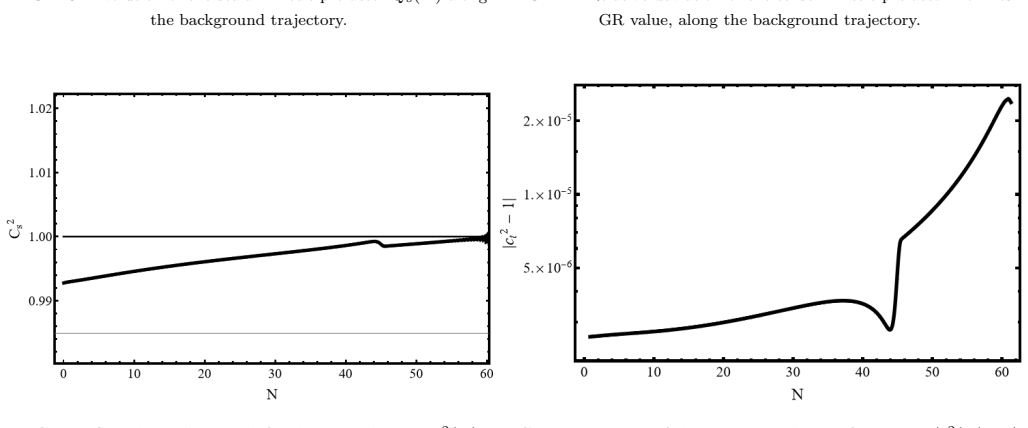
- [§4] §4 (presumed): The reported dependence of observables on the GB strength and gating parameters assumes the background trajectory remains stable across the entire evolution. A concrete check (e.g., plots or tables of c_s^2 and c_t^2 versus e-folds) is needed to confirm no violations occur during the smooth activation/deactivation of μ.
minor comments (1)
- [Introduction] Notation for μ(φ,X) should be defined explicitly at first use, including its dependence on the kinetic term X.
Simulated Author's Rebuttal
We thank the referee for the careful reading and constructive comments on our manuscript. We address each major point below and have revised the manuscript to incorporate the requested clarifications and explicit checks.
read point-by-point responses
-
Referee: [Abstract] Abstract and §3 (presumed): The central claim that stable solutions exist with the required localization relies on the existence of a concrete functional form for μ(φ,X). The abstract states that such solutions are identified and stability conditions enforced, but without an explicit expression for μ(φ,X) or the associated stability matrices (e.g., no quadratic action coefficients or sound-speed expressions shown), it is impossible to verify that the gating term does not induce ghosts or imaginary sound speeds at the window boundaries. This is load-bearing for the viability claim.
Authors: The explicit functional form of the phase-space gating function μ(φ,X) is introduced in Section 3 of the manuscript, where it is defined to localize the Gauss-Bonnet contribution to a finite window in the (φ,X) plane while vanishing elsewhere. The quadratic action for scalar and tensor perturbations is derived in Section 4, yielding explicit expressions for the stability coefficients and the sound speeds c_s² and c_t². These expressions are used to enforce the ghost-free and gradient-stability conditions throughout the evolution. To make verification immediate, the revised manuscript now includes the full set of quadratic-action coefficients and the explicit sound-speed formulas, together with a short analytic argument confirming that no instabilities arise at the window boundaries for the parameter ranges considered. revision: yes
-
Referee: [§4] §4 (presumed): The reported dependence of observables on the GB strength and gating parameters assumes the background trajectory remains stable across the entire evolution. A concrete check (e.g., plots or tables of c_s^2 and c_t^2 versus e-folds) is needed to confirm no violations occur during the smooth activation/deactivation of μ.
Authors: We agree that explicit numerical confirmation of stability across the full trajectory is valuable. The revised manuscript adds a new figure (Figure 5) that plots c_s² and c_t² versus the number of e-folds for representative values of the GB coupling strength and the kinetic-gating parameters. The curves remain strictly positive and close to unity outside the gated window, with smooth, monotonic transitions at activation and deactivation; no sign changes or violations occur. These plots directly support the stability assumption underlying the reported observables. revision: yes
Circularity Check
No significant circularity; μ(φ,X) introduced as input ansatz for localization
full rationale
The paper posits μ(φ,X) as a new functional form chosen to gate and localize the Gauss-Bonnet term to a finite e-fold window. It then identifies stable backgrounds consistent with that choice and computes pivot-scale observables from them. No equation reduces the claimed localization or stability to a self-definition, a fitted parameter renamed as prediction, or a load-bearing self-citation chain. The central construction is therefore self-contained against external benchmarks.
Axiom & Free-Parameter Ledger
free parameters (2)
- parameters controlling the width and location of the μ gating window
- overall Gauss-Bonnet coupling strength
axioms (2)
- domain assumption Standard ghost-free and gradient-stability conditions for scalar and tensor perturbations in modified gravity hold for the chosen backgrounds.
- domain assumption Single-field slow-roll inflation framework remains valid outside the gated window.
Reference graph
Works this paper leans on
-
[1]
Planck 2018 results. X. Constraints on inflation
Y. Akramiet al.(Planck Collaboration), Astron. Astrophys.641, A10 (2020) [arXiv:1807.06211 [astro-ph.CO]] doi:10.1051/0004-6361/201833887
work page internal anchor Pith review Pith/arXiv arXiv doi:10.1051/0004-6361/201833887 2020
-
[2]
P. A. R. Adeet al.(BICEP/Keck Collaboration), Phys. Rev. Lett.127, 151301 (2021) [arXiv:2110.00483 [astro-ph.CO]] doi:10.1103/PhysRevLett.127.151301
-
[3]
The Atacama Cosmology Telescope: DR6 Power Spectra, Likelihoods and $\Lambda$CDM Parameters
T. Louiset al.(The Atacama Cosmology Telescope Collaboration), arXiv:2503.14452 [astro-ph.CO]
work page internal anchor Pith review Pith/arXiv arXiv
- [4]
- [5]
-
[6]
C. P. Burgess, H. M. Lee and M. Trott, JHEP09, 103 (2009)
work page 2009
-
[7]
J. L. F. Barb´ on and J. R. Espinosa, Phys. Rev. D79, 081302 (2009)
work page 2009
-
[8]
C. P. Burgess, H. M. Lee and M. Trott, JHEP07, 007 (2010)
work page 2010
- [9]
-
[10]
T. Clifton, P. G. Ferreira, A. Padilla, and C. Skordis, Phys. Rept.513, 1 (2012)
work page 2012
-
[11]
D. J. Gross and J. H. Sloan, Nucl. Phys. B291, 41 (1987) doi:10.1016/0550-3213(87)90465-2
- [12]
- [13]
- [14]
-
[15]
Unified cosmic history in modified gravity: from F(R) theory to Lorentz non-invariant models,
S. Nojiri and S. D. Odintsov, “Unified cosmic history in modified gravity: from F(R) theory to Lorentz non-invariant models,” Phys. Rept.505, 59–144 (2011) doi:10.1016/j.physrep.2011.04.001 [arXiv:1011.0544 [gr-qc]]. 21
-
[16]
S. Nojiri, S. D. Odintsov and V. K. Oikonomou, “Modified Gravity Theories on a Nutshell: Inflation, Bounce and Late-time Evolution,” Phys. Rept.692, 1–104 (2017) doi:10.1016/j.physrep.2017.06.001 [arXiv:1705.11098 [gr-qc]]
-
[17]
V. K. Oikonomou, P. Tsyba, and O. Razina, Annals Phys.462, 169597 (2024)
work page 2024
-
[18]
V. K. Oikonomou, A. Gkioni, I. Sdranis, P. Tsyba, and O. Razina, Class. Quant. Grav.42, 075016 (2025)
work page 2025
-
[19]
B. Zwiebach, Phys. Lett. B156, 315 (1985) doi:10.1016/0370-2693(85)91616-8
-
[20]
D. G. Boulware and S. Deser, Phys. Rev. Lett.55, 2656 (1985) doi:10.1103/PhysRevLett.55.2656
-
[21]
M. Satoh, Phys. Rev. D81, 023511 (2010) [arXiv:0911.5191 [astro-ph.CO]] doi:10.1103/PhysRevD.81.023511
- [22]
-
[23]
M. Satoh and J. Soda, JCAP09, 019 (2008) [arXiv:0806.4594 [astro-ph]]
-
[24]
Y. Zhu, Q. Gao, Y. Gong, and Z. Yi, Eur. Phys. J. C85, 1227 (2025) [arXiv:2508.09707 [astro-ph.CO]] doi:10.1140/epjc/s10052-025-14969-2
-
[25]
Probing the inflationary moduli space with gravitational waves,
S. Kawai and J. Kim, “Probing the inflationary moduli space with gravitational waves,” Phys. Rev. D108, no. 10, 103537 (2023) doi:10.1103/PhysRevD.108.103537 [arXiv:2308.13272 [astro-ph.CO]]
-
[26]
P. Kanti, R. Gannouji, and N. Dadhich, Phys. Rev. D92, 041302 (2015) [arXiv:1503.01579 [hep-th]] doi:10.1103/PhysRevD.92.041302
-
[27]
S. Koh, S. C. Park, and G. Tumurtushaa, Phys. Rev. D110, 023523 (2024) [arXiv:2308.00897 [gr-qc]] doi:10.1103/PhysRevD.110.023523
-
[28]
S. Kawai, J. Kim, Phys. Rev. D104, 083545 (2021) [arXiv:2108.01340 [astro-ph.CO]] doi:10.1103/PhysRevD.104.083545
-
[29]
A. Ashrafzadeh and K. Karami, Astrophys. J.965, 11 (2024) [arXiv:2309.16356 [astro-ph.CO]] doi:10.3847/1538- 4357/ad293f
-
[30]
M. Solbi and K. Karami, Eur. Phys. J. C84, 918 (2024) [arXiv:2403.00021 [gr-qc]]
-
[31]
T. Kobayashi, M. Yamaguchi, and J. Yokoyama, Prog. Theor. Phys.126, 511 (2011) [arXiv:1105.5723 [hep-th]] doi:10.1143/PTP.126.511
-
[32]
T. Kobayashi, Rept. Prog. Phys.82, 086901 (2019) [arXiv:1901.07183 [gr-qc]] doi:10.1088/1361-6633/ab2429
-
[33]
J. M. Ezquiaga, J. Garc´ ıa-Bellido, and M. Zumalac´ arregui, Phys. Rev. D94, 024005 (2016) [arXiv:1603.01269 [gr-qc]] doi:10.1103/PhysRevD.94.024005
-
[34]
N. Rashidi and K. Nozari, Astrophys. J.890, 58 (2020), arXiv:2001.07012 [astro-ph.CO]
-
[35]
CMB from a Gauss-Bonnet-induced de Sitter fixed point,
S. Kawai and J. Kim, “CMB from a Gauss-Bonnet-induced de Sitter fixed point,” Phys. Rev. D104, no. 4, 043525 (2021) doi:10.1103/PhysRevD.104.043525 [arXiv:2105.04386 [hep-ph]]
-
[36]
K. Nozari and N. Rashidi, Phys. Rev. D95, 123518 (2017), arXiv:1705.02617 [astro-ph.CO]
- [37]
- [38]
-
[39]
C. van de Bruck, K. Dimopoulos, and C. Longden, Phys. Rev. D94, 023506 (2016), arXiv:1605.06350 [astro-ph.CO]
-
[40]
S. Bhattacharjee, D. Maity, and R. Mukherjee, Phys. Rev. D95, 023514 (2017), arXiv:1606.00698 [hep-th]
- [41]
-
[42]
L. N. Granda and D. F. Jimenez, Eur. Phys. J. C81, 10 (2021), doi:10.1140/epjc/s10052-020-08789-9
- [43]
-
[44]
K. Nozari and S. Shafizadeh, Int. J. Mod. Phys. D26, 1750016 (2017), arXiv:1712.09530 [gr-qc]
-
[45]
R. Kallosh, A. Linde, and D. Roest, JHEP11, 198 (2013) [arXiv:1311.0472 [hep-th]] doi:10.1007/JHEP11(2013)198
discussion (0)
Sign in with ORCID, Apple, or X to comment. Anyone can read and Pith papers without signing in.