Recognition: 1 theorem link
· Lean TheoremStatistics of Matrix Elements of Operators in a Disorder-Free SYK model
Pith reviewed 2026-05-13 17:27 UTC · model grok-4.3
The pith
In the disorder-free SYK model, off-diagonal matrix elements of n-fermion operators follow a generalized inverse Gaussian distribution for n at least 4.
A machine-rendered reading of the paper's core claim, the machinery that carries it, and where it could break.
Core claim
For a general choice of indices and n ≥ 4, the statistics of the off-diagonal matrix elements ⟨μ|O|λ⟩ of operators O = χ_a1 χ_a2 … χ_an in the disorder-free SYK model are well-fitted by a generalized inverse Gaussian distribution rather than Fréchet distributions.
What carries the argument
The off-diagonal matrix elements of n-Majorana operators evaluated inside the same macro-state of the four-body Majorana Hamiltonian with constant couplings.
If this is right
- The form of the distribution is model-dependent rather than universal across different solvable systems.
- Predictions that rely on the tail behavior of matrix elements, such as those for operator spreading or relaxation rates, may differ between the disorder-free SYK model and models that exhibit Fréchet statistics.
- Comparisons between the disorder-free and conventional random SYK models can isolate the effect of fixed versus random couplings on these statistics.
Where Pith is reading between the lines
- One could test whether the same generalized inverse Gaussian form appears for operators with different fermion parity or for diagonal matrix elements in the same model.
- The result raises the possibility that the distribution shape tracks the locality or interaction range of the Hamiltonian rather than integrability alone.
- A direct analytic derivation of the generalized inverse Gaussian from the model's algebraic structure would strengthen the numerical observation.
Load-bearing premise
The numerical fitting procedure and the rules for selecting system size, energy windows, and operator indices are robust enough that the reported distribution is not produced by finite-size effects or post-hoc data choices.
What would settle it
A calculation of the same matrix-element histogram on significantly larger system sizes or in the thermodynamic limit that shows a clear departure from the generalized inverse Gaussian shape.
Figures



read the original abstract
Recently, studies have explored the statistics of matrix elements of local operators in the Lieb-Liniger model. It was found that the probability distribution function for off-diagonal matrix elements $\langle \boldsymbol{\mu}|\mathcal{O}|\boldsymbol{\lambda} \rangle$ within the same macro-state is well described by the Fr\'{e}chet distributions. This represents a significant development for the Eigenstate Thermalization Hypothesis (ETH). In this paper, we investigate a similar phenomenon in another solvable model: the disorder-free Sachdev-Ye-Kitaev (SYK) model. The Hamiltonian of this model consists of 4-body interactions of Majorana fermions. Unlike the conventional SYK model, the coupling strengths in this model are fixed to a constant, earning it the name ``disorder-free.'' We evaluate the matrix elements of operators constructed from products of $n$ Majorana fermions: $\mathcal{O} = \chi_{a_1}\chi_{a_2}\ldots \chi_{a_n}$. For a general choice of indices and $n \geq 4$, we find that the statistics of the off-diagonal matrix elements are well-fitted by a generalized inverse Gaussian distribution rather than Fr\'{e}chet distributions.
Editorial analysis
A structured set of objections, weighed in public.
Referee Report
Summary. The paper studies off-diagonal matrix elements of operators O = χ_{a1}…χ_{an} (n≥4, generic indices) in the disorder-free SYK model with fixed 4-body Majorana couplings. It reports that, within the same macrostate, these elements are well-fitted by a generalized inverse Gaussian distribution rather than the Fréchet form previously found in the Lieb-Liniger model, with implications for the Eigenstate Thermalization Hypothesis.
Significance. If the reported distribution is robust, the result supplies a concrete, model-specific counter-example to the universality of Fréchet statistics for off-diagonal ETH matrix elements. Because the disorder-free SYK model is exactly solvable, the numerical observation could motivate an analytic derivation of the GIG form and sharpen the distinction between different classes of integrable or solvable systems.
major comments (4)
- [§4] §4 (Numerical results) and associated figures: the manuscript presents maximum-likelihood fits to the generalized inverse Gaussian but supplies no quantitative goodness-of-fit comparison (e.g., Kolmogorov-Smirnov or likelihood-ratio statistics) against the Fréchet distribution, nor any statement of the number of matrix elements sampled per histogram.
- [§3.2] §3.2 (Energy window and macrostate definition): no systematic scan of the energy-window width around the target macrostate is shown; the reported GIG preference could therefore be an artifact of the particular window chosen.
- [§4.1] §4.1 (Index selection): the claim is restricted to a “general choice of indices,” yet no table or figure demonstrates that the same distribution persists when the set of indices is varied systematically (e.g., consecutive vs. randomly spaced indices).
- [§5] §5 (Finite-size analysis): the largest system size shown is N=20; no extrapolation or scaling collapse with N is provided to establish that the GIG form survives the thermodynamic limit.
minor comments (2)
- [Abstract] The abstract states the central result but does not mention the system sizes or number of disorder realizations (here fixed couplings) used; this information should appear already in the abstract.
- [§2] Notation for the generalized inverse Gaussian parameters (a,b,c) is introduced without a reference to the standard parametrization; a one-line definition would aid readability.
Simulated Author's Rebuttal
We thank the referee for the careful reading and constructive suggestions. We have revised the manuscript to strengthen the statistical analysis, demonstrate robustness to parameter choices, and include finite-size scaling. Below we respond to each major comment.
read point-by-point responses
-
Referee: §4 (Numerical results) and associated figures: the manuscript presents maximum-likelihood fits to the generalized inverse Gaussian but supplies no quantitative goodness-of-fit comparison (e.g., Kolmogorov-Smirnov or likelihood-ratio statistics) against the Fréchet distribution, nor any statement of the number of matrix elements sampled per histogram.
Authors: We agree that quantitative goodness-of-fit metrics are essential. In the revised manuscript we have added Kolmogorov-Smirnov distances and likelihood-ratio tests comparing the GIG and Fréchet distributions for all histograms in §4. The number of sampled matrix elements (typically 5×10^4 to 10^5 per bin) is now stated explicitly in the text of §4 and in the figure captions. revision: yes
-
Referee: §3.2 (Energy window and macrostate definition): no systematic scan of the energy-window width around the target macrostate is shown; the reported GIG preference could therefore be an artifact of the particular window chosen.
Authors: We have performed a systematic scan of window widths ΔE from 0.05 to 0.5 (in units of the single-particle energy scale) and included the results as a new appendix. Across this range the GIG remains the preferred distribution, with likelihood ratios favoring GIG over Fréchet by factors >10^3. A short discussion of the scan has been added to §3.2. revision: yes
-
Referee: §4.1 (Index selection): the claim is restricted to a “general choice of indices,” yet no table or figure demonstrates that the same distribution persists when the set of indices is varied systematically (e.g., consecutive vs. randomly spaced indices).
Authors: We have added a new figure (Figure 5) that compares the matrix-element distributions for consecutive indices, randomly spaced indices, and two other generic selections. In every case the GIG provides a statistically superior fit (quantified by KS distance). The figure and accompanying text have been inserted in §4.1. revision: yes
-
Referee: §5 (Finite-size analysis): the largest system size shown is N=20; no extrapolation or scaling collapse with N is provided to establish that the GIG form survives the thermodynamic limit.
Authors: We have extended the finite-size analysis to include N=12,14,16,18,20 and added a scaling plot of the GIG shape parameter versus 1/N. The parameter approaches a finite nonzero value with increasing N, consistent with survival of the GIG form. A brief discussion of this scaling has been inserted in §5. Full extrapolation to N→∞ remains limited by the exponential growth of the Hilbert space. revision: partial
Circularity Check
Empirical fitting result with no self-referential derivation or prediction
full rationale
The paper computes matrix elements of operators O = χ_a1 … χ_an numerically in the disorder-free SYK model and reports that their off-diagonal statistics are well-fitted by a generalized inverse Gaussian distribution for generic indices and n ≥ 4. No derivation chain, first-principles equations, or predictions are presented; the central claim is an empirical observation obtained from histograms and maximum-likelihood fits. No steps reduce the reported distribution to a fitted parameter by construction, no self-citations are load-bearing for the distribution choice, and no ansatz or uniqueness theorem is invoked. The result is therefore self-contained as a numerical finding.
Axiom & Free-Parameter Ledger
Lean theorems connected to this paper
-
IndisputableMonolith/Cost/FunctionalEquationwashburn_uniqueness_aczel unclear?
unclearRelation between the paper passage and the cited Recognition theorem.
For a general choice of indices and n ≥ 4, we find that the statistics of the off-diagonal matrix elements are well-fitted by a generalized inverse Gaussian distribution rather than Fréchet distributions.
What do these tags mean?
- matches
- The paper's claim is directly supported by a theorem in the formal canon.
- supports
- The theorem supports part of the paper's argument, but the paper may add assumptions or extra steps.
- extends
- The paper goes beyond the formal theorem; the theorem is a base layer rather than the whole result.
- uses
- The paper appears to rely on the theorem as machinery.
- contradicts
- The paper's claim conflicts with a theorem or certificate in the canon.
- unclear
- Pith found a possible connection, but the passage is too broad, indirect, or ambiguous to say the theorem truly supports the claim.
Reference graph
Works this paper leans on
-
[1]
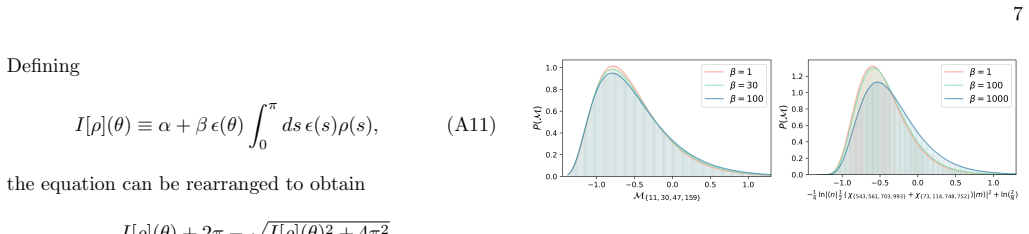
1.ρ(θ) under different temperatures;λ= 1/2 here
Introducing a quadratic Hamiltonian H2 = i X 1≤j1<j2≤N χj1 χj2 (8) and the transformation f ± k = 1√ 2N NX j=1 e∓i(j−1)θk χj, θ k = (2k−1)π N ,(9) we find thatf ± k are complex fermion creation and anni- hilation operators satisfying{f + i , f − j }=δ ij, and χj = r 2 N X s=± N/2X k=1 eis(j−1)θk f s k .(10) The spectra are then given by H2 = N/2X k=1 ϵk n...
-
[2]
In general, the distribution of|⟨n|χ {a}|m⟩|depends only on|a|and is insensitive to the temperature or the exact index set{a}. Since|⟨n|χ {a}|m⟩|is the determinant of a matrix in which each element ∼e ±i∆a θ, for a random{a}, the ∆ais typically large (sinceNis large), whileθobeys a certain distribution that depends on temperature. Con- sequently, the dist...
-
[3]
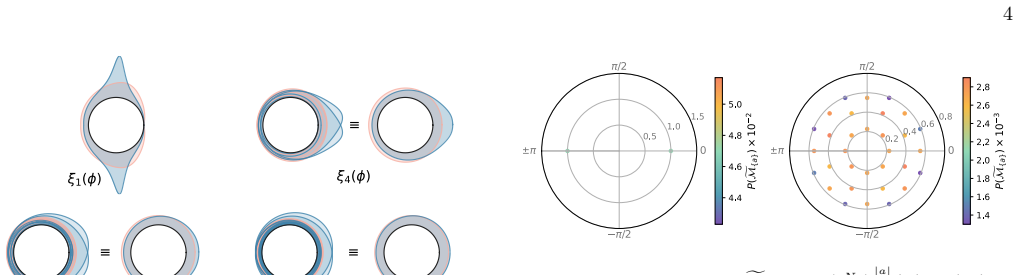
For a very specialχ {a}, the distribution of |⟨n|χ{a}|m⟩|can be sparse. Consider the phase ∆a θk = ∆a(2k−1) N π, if ∆aandNare not relatively prime, the possible phases become restricted. For example, if ∆a N = 1 4, then the phase can only be ± (2k−1)π 4 . Such special choices become statistically rare asN→ ∞. As the lower panel of Fig. 2 shows, for a fixe...
-
[4]
J. M. Deutsch, Quantum statistical mechanics in a closed system, Phys. Rev. A43, 2046 (1991)
work page 2046
-
[5]
Srednicki, Chaos and quantum thermalization, Phys
M. Srednicki, Chaos and quantum thermalization, Phys. Rev. E50, 888 (1994)
work page 1994
-
[6]
M. Srednicki, The approach to thermal equilibrium in quantized chaotic systems, Journal of Physics A: Math- ematical and General32, 1163 (1999)
work page 1999
-
[7]
A. P. Luca D’Alessio, Yariv Kafri and M. Rigol, From quantum chaos and eigenstate thermal- ization to statistical mechanics and thermody- namics, Advances in Physics65, 239 (2016), https://doi.org/10.1080/00018732.2016.1198134
-
[8]
S. Pappalardi, L. Foini, and J. Kurchan, Eigenstate ther- malization hypothesis and free probability, Phys. Rev. Lett.129, 170603 (2022)
work page 2022
-
[9]
V. E. Korepin, N. M. Bogoliubov, and A. G. Izer- gin,Quantum Inverse Scattering Method and Correla- tion Functions, Cambridge Monographs on Mathematical Physics (Cambridge University Press, 1993)
work page 1993
-
[10]
Takahashi,Thermodynamics of One-Dimensional Solvable Models(Cambridge University Press, 1999)
M. Takahashi,Thermodynamics of One-Dimensional Solvable Models(Cambridge University Press, 1999)
work page 1999
-
[11]
F. H. L. Essler, H. Frahm, F. G¨ ohmann, A. Kl¨ umper, and V. E. Korepin,The One-Dimensional Hubbard Model (Cambridge University Press, 2005)
work page 2005
-
[12]
Gaudin,The Bethe Wavefunction, edited by J.-S
M. Gaudin,The Bethe Wavefunction, edited by J.-S. Caux (Cambridge University Press, 2014)
work page 2014
-
[13]
F. H. L. Essler and A. J. J. M. de Klerk, Statistics of matrix elements of local operators in integrable models, Phys. Rev. X14, 031048 (2024)
work page 2024
-
[14]
E. H. Lieb and W. Liniger, Exact analysis of an inter- acting Bose gas. I. The general solution and the ground state, Phys. Rev.130, 1605 (1963)
work page 1963
-
[15]
V. Korepin, N. Bogoliubov, and A. Izergin,Quantum Inverse Scattering Method and Correlation Functions, Cambridge Monographs on Mathematical Physics (Cam- bridge University Press, 1993)
work page 1993
-
[16]
D. B. Creamer, H. B. Thacker, and D. Wilkinson, Quan- tum Gelfand-Levitan Method as a Generalized Jordan- Wigner Transformation, Phys. Lett. B92, 144 (1980)
work page 1980
-
[17]
M. Fr´ echet, Sur la loi de probabilit´ e de l’´ ecart maximum, Annales de la Soci´ et´ e Polonaise de Math´ ematique6, 93 (1927)
work page 1927
-
[18]
S. Sachdev and J. Ye, Gapless spin-fluid ground state in a random quantum Heisenberg magnet, Phys. Rev. Lett. 70, 3339 (1993)
work page 1993
-
[19]
A. Kitaev, A Simple Model of Quantum Holography, KITP Program: Entanglement in Strongly-Correlated Quantum Matter, Santa Barbara, 2015
work page 2015
-
[20]
D. A. Trunin, Pedagogical introduction to the Sachdev–Ye–Kitaev model and two-dimensional dilaton gravity, Phys.-Usp.64, 219 (2021)
work page 2021
-
[21]
Rosenhaus, An introduction to the SYK model, J
V. Rosenhaus, An introduction to the SYK model, J. Phys. A52, 323001 (2019)
work page 2019
-
[22]
D. Chowdhury, A. Georges, O. Parcollet, and S. Sachdev, Sachdev-Ye-Kitaev models and beyond: Window into non-Fermi liquids, Rev. Mod. Phys.94, 035004 (2022)
work page 2022
- [23]
-
[24]
L. D’Alessio, Y. Kafri, A. Polkovnikov, and M. Rigol, From quantum chaos and eigenstate thermalization to statistical mechanics and thermodynamics, Adv. Phys. 65, 239 (2016)
work page 2016
-
[25]
F. Borgonovi, F. M. Izrailev, L. F. Santos, and V. G. Zelevinsky, Quantum chaos and thermalization in iso- lated systems of interacting particles, Phys. Rep.626, 1 (2016)
work page 2016
- [26]
-
[28]
Jensen, Chaos in AdS 2 Holography, Physical Review Letters117, 10.1103/physrevlett.117.111601 (2016)
K. Jensen, Chaos in AdS 2 Holography, Physical Review Letters117, 10.1103/physrevlett.117.111601 (2016)
-
[29]
R. A. Davison, W. Fu, A. Georges, Y. Gu, K. Jensen, and S. Sachdev, Thermoelectric transport in disordered met- als without quasiparticles: The sachdev-ye-kitaev models and holography, Physical Review B95, 10.1103/phys- revb.95.155131 (2017)
-
[30]
Z. Luo, Y.-Z. You, J. Li, C.-M. Jian, D. Lu, C. Xu, B. Zeng, and R. Laflamme, Quantum simulation of the non-fermi-liquid state of sachdev-ye-kitaev model, npj Quantum Information5, 10.1038/s41534-019-0166- 7 (2019)
-
[31]
D. Rossini, G. M. Andolina, D. Rosa, M. Carrega, and M. Polini, Quantum advantage in the charging process of sachdev-ye-kitaev batteries, Physical Review Letters 125, 10.1103/physrevlett.125.236402 (2020)
-
[32]
D. Chowdhury, A. Georges, O. Parcollet, and S. Sachdev, Sachdev-ye-kitaev models and beyond: Window into non-fermi liquids, Reviews of Modern Physics94, 10.1103/revmodphys.94.035004 (2022)
-
[33]
S. Ozaki and H. Katsura, Disorder-free Sachdev-Ye- Kitaev models: Integrability and a precursor of chaos, Phys. Rev. Res.7, 013092 (2025), arXiv:2402.13154 [cond-mat.str-el]
-
[34]
Witten, An SYK-like model without disorder, J
E. Witten, An SYK-like model without disorder, J. Phys. 6 A52, 474002 (2019)
work page 2019
-
[35]
I. R. Klebanov and G. Tarnopolsky, Uncolored random tensors, melon diagrams, and the Sachdev-Ye-Kitaev models, Phys. Rev. D95, 046004 (2017)
work page 2017
- [36]
-
[37]
C. Krishnan, K. Pavan Kumar, and D. Rosa, Contrasting SYK-like models, J. High Energ. Phys.2018, 64 (2018)
work page 2018
-
[38]
V. Balasubramanian, M. DeCross, A. Kar, Y. C. Li, and O. Parrikar, Complexity growth in integrable and chaotic models, J. High Energ. Phys.2021(7), 11
work page 2021
- [39]
-
[40]
K. Guan and H. Katsura, Exactly solvable disorder-free quantum breakdown model: Spectrum, thermodynamics, and dynamics (2026), arXiv:2603.17379 [cond-mat.str-el]
-
[41]
A. I. Larkin and Y. N. Ovchinnikov, Quasiclassical method in the theory of superconductivity, J. Exp. Theor. Phys.28, 1200 (1969)
work page 1969
-
[42]
J. Polchinski and V. Rosenhaus, The spectrum in the Sachdev-Ye-Kitaev model, J. High Energ. Phys.2016, 1 (2016)
work page 2016
-
[43]
J. Maldacena and D. Stanford, Remarks on the Sachdev- Ye-Kitaev model, Phys. Rev. D94, 106002 (2016)
work page 2016
-
[44]
N. Dowling, P. Kos, and K. Modi, Scrambling is necessary but not sufficient for chaos, Phys. Rev. Lett.131, 180403 (2023)
work page 2023
-
[45]
Wikipedia, Generalized inverse gaussian distribution (2025)
work page 2025
-
[46]
Wikipedia contributors, Hamming distance (2025)
work page 2025
-
[47]
C. A. Hurst, Applicability of the Pfaffian Method to Combinatorial Problems on a Lattice, Journal of Math- ematical Physics5, 90 (1964)
work page 1964
-
[48]
T. Mizusaki and M. Oi, A new formulation to calcu- late general HFB matrix elements through the Pfaffian, Physics Letters B715, 219 (2012)
work page 2012
-
[49]
Wikipedia contributors, Pfaffian — Wikipedia, the free encyclopedia (2026), [Online; accessed 6-March-2026]. Appendix A: State equation and sample method A microstate is specified by an occupation number list |n⟩=|n 1, n2, . . . , nNF ⟩,(A1) where eachn i ∈ {0,1}. In the thermodynamic limit NF → ∞, the discrete single-particle labelsθ k become a continuou...
work page 2026
-
[50]
The quartic contribution, after proper normal ordering, takes the form H4 = 1 2 NF Z dθ ϵ(θ) ρ(θ)− 1 2 ρ0 2 +E 0 .(A7) Using the relationH= H4 NF + 1 2 R ρ0 dθ ϵ(θ)H 2 (which follows from the original Hamiltonian in the large-N F limit), we obtain H= 1 2 NF hZ π 0 dθ ϵ(θ)ρ(θ) i2 + const.(A8) We now extremize the entropy subject to fixed energy E=N F εand ...
discussion (0)
Sign in with ORCID, Apple, or X to comment. Anyone can read and Pith papers without signing in.