REVIEW 3 major objections 2 minor 27 references
Adaptive Cost-Efficient Evaluation for Reliable Patent Claim Generation
T0 review · 3 major / 2 minor · reviewed 2026-07-13 · grok-4.5
Pith's one-line read A two-stage entropy router validates patent claims cheaper than a 70B model while matching quality.
desk verdict Wrong manuscript in the cache: abstract is ACE patent validation; full text is HighFM EO foundation model—claims cannot be audited. read the letter →
The pith
A machine-rendered reading of the paper's core claim, the machinery that carries it, and where it could break.
The reading
What carries the argument
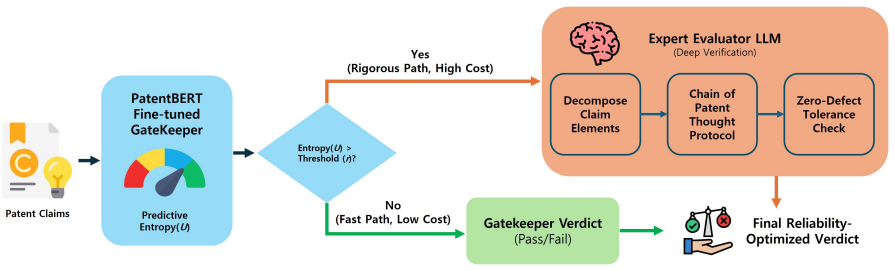
Adaptive Cost-efficient Evaluation (ACE): a fine-tuned encoder produces a K+1 distribution over legal error types; its predictive entropy is the routing threshold that decides whether a claim stays with the cheap stage or is escalated to schema-constrained Chain-of-Patent-Thought (CoPT) verification against 35 U.S.C. standards.
What would settle it
On a held-out set of real USPTO office-action rejections, measure whether the same entropy threshold still yields at least the reported competitive recall while cutting inference time by roughly 60 percent; if recall collapses or the time saving disappears, the routing claim fails.
Extended reading notes
Core claim
By treating patent errors as a categorical distribution rather than a binary validity score, predictive entropy becomes a reliable routing signal that sends only the structurally hard claims to expensive deep legal reasoning, so a two-stage cascade can outperform a supervised 70B LLM while reducing cost by 78 percent and transfer, without re-calibration, to real USPTO rejections.
Load-bearing premise
The predictive entropy of the error-type distribution cleanly separates claims that need only shallow checking from those that need deep legal reasoning, so one fixed threshold works both on the constructed dataset and on real USPTO rejections without re-tuning.
Editorial extensions
If this is right
- Million-claim patent portfolios can be screened at roughly one-fifth the LLM cost without sacrificing legal reliability.
- Schema-constrained legal reasoning (CoPT) alone already cuts per-claim latency by about 42 percent, so the same protocol can be reused outside the cascade.
- A single fixed entropy threshold that transfers to real USPTO data implies the error-type distribution captures stable structural difficulty rather than dataset artifacts.
- The ACE-40k annotations grounded in the Manual of Patent Examining Procedure become a reusable benchmark for future patent-validation models.
Reading between the lines
- The same categorical-error-plus-entropy routing pattern could apply to other high-stakes legal or regulatory documents (contracts, compliance filings) where error types have unequal reasoning cost.
- If the encoder’s error-type predictions are already informative, they could be surfaced to examiners as diagnostic labels rather than used only for routing.
- Scaling the first-stage encoder or adding more error categories might shrink the fraction of claims that ever reach the expensive second stage still further.
Editorial analysis
A structured set of objections, weighed in public.
Referee Report
Summary. The submission under review is titled and abstracted as Adaptive Cost-Efficient Evaluation (ACE) for patent claim validation: a two-stage cascade in which a fine-tuned encoder produces a K+1 distribution over legal error types, predictive entropy routes hard claims to a schema-constrained Chain-of-Patent-Thought (CoPT) LLM stage, and the system is evaluated on a claimed ACE-40k MPEP-grounded set plus real USPTO rejections (headline results: beat a supervised 70B LLM, 78% cost cut, 42% CoPT latency cut, 60% time cut with transfer without re-calibration). The body of the manuscript supplied for review is not that paper. It is instead HighFM, a SatMAE-style foundation-model study on MSG/SEVIRI geostationary imagery for cloud masking and active fire detection, with its own datasets, architecture, and EO benchmarks. None of ACE’s methods, datasets, legal taxonomy, routing threshold, CoPT protocol, or reported numbers appear in the full text.
Significance. If the ACE abstract claims were supported by a matching manuscript—entropy routing that separates shallow vs. deep legal errors, a transferable fixed threshold on real USPTO rejections, and large cost reductions while matching or beating a supervised 70B model—the work would be a useful systems contribution for low-tolerance patent NLP at scale. That significance cannot be assessed here: the load-bearing objects (ACE-40k, CoPT schema, K+1 entropy router, USPTO transfer experiment) are absent from the provided full text, so no credit can be given for proofs, code, or falsifiable results of ACE.
major comments (3)
- Title/abstract vs. full text identity failure: the abstract and paper_id describe ACE (patent claim validation, K+1 legal-error entropy routing, CoPT, ACE-40k, USPTO transfer). The full manuscript is HighFM (SEVIRI/MSG masked autoencoding, cloud and fire segmentation, Mediterranean 2014–2024 splits). Central ACE claims therefore have zero support in the body and cannot be audited for baselines, splits, thresholds, or error bars.
- Load-bearing ACE results (surpass supervised 70B; 78% cost reduction on ACE-40k; 42% CoPT latency reduction; 60% inference-time cut on USPTO rejections without re-calibration) are stated only in the abstract. No corresponding sections, tables, equations, or experiments exist in the supplied manuscript, so the strongest claim is unverifiable.
- The abstract’s core technical assumption—that predictive entropy of a K+1 legal-error distribution is a reliable fixed-threshold routing signal that transfers from ACE-40k to real USPTO rejections—cannot be stress-tested: architecture, loss, threshold selection, calibration, and transfer protocol are not present in the full text.
minor comments (2)
- Even as a standalone HighFM manuscript, the body is incomplete relative to a full journal article (e.g., quantitative tables referenced in the narrative are missing or truncated in the supplied text; Figure 3 qualitative discussion is present without the corresponding metric tables).
- arXiv line in the body (2604.04306) does not match the paper_id under review (2604.04295), reinforcing the content-identity problem rather than a minor metadata typo.
Circularity Check
No derivation-level circularity in the supplied manuscript (HighFM); only a minor non-load-bearing self-citation for temporal encodings.
-
self citation load bearing
[§3.2 Pretraining with Adapted SatMAE (temporal encoding paragraph)]
"In this work, we build upon the original SatMAE implementation, incorporating architectural adaptations proposed by [Girtsou et al., 2024] to better align with the characteristics of our data and the requirements of our work. A key modification concerns the treatment of temporal information. ... We adopt the same strategy, as our focus on real-time monitoring demands higher temporal resolution."
The paper’s listed contribution of an ‘adapted SatMAE with enhanced temporal encoding’ is justified by citing Girtsou et al. 2024, whose author list overlaps the present paper. This is ordinary self-citation of a prior design choice, not a uniqueness theorem or a prediction forced by a fitted identity; the empirical gains still depend on independent held-out evaluation. Flagged only as minor, non-load-bearing self-citation.
full rationale
The full text provided is HighFM (SEVIRI/MSG foundation-model pretraining via adapted SatMAE, then fine-tuning on cloud and fire segmentation), not the ACE patent-claim abstract. Within HighFM there is no first-principles derivation, uniqueness theorem, or fitted identity presented as a prediction: performance claims rest on held-out temporal splits (pretrain 2014–2018 / eval 2019; fine-tune 2020–2021 / val 2022 / test 2023–2024) and external baselines. The only mild circularity-adjacent pattern is adoption of fine-grained temporal encodings from Girtsou et al. 2024 (overlapping authors). That citation is a design choice, not a load-bearing uniqueness or forced prediction of the reported IoU/accuracy gains. ACE’s entropy-routing / CoPT / ACE-40k / 78% cost claims cannot be checked for circularity because they do not appear in the manuscript body; absence of support is a content-identity failure, not equation-level circularity. Score 1 reflects one minor self-citation only.
Assumptions & free parameters
free parameters (2)
- entropy routing threshold
- K (number of legal error types)
assumptions (4)
- domain assumption Patent validity errors form a categorical structure of structurally distinct types that require different reasoning depths.
- ad hoc to paper Predictive entropy of the encoder’s error-type distribution is a sufficient routing signal for cost–accuracy trade-offs.
- ad hoc to paper Schema-constrained Chain-of-Patent-Thought mapping to 35 U.S.C. standards yields legally grounded verdicts and reduces latency ~42%.
- domain assumption ACE-40k annotations are MPEP-grounded and suitable for training/evaluating claim validity models.
invented entities (3)
-
ACE (Adaptive Cost-efficient Evaluation) two-stage framework
-
Chain-of-Patent-Thought (CoPT) protocol
-
ACE-40k dataset
Cite this review
Pith. "Pith review of Adaptive Cost-Efficient Evaluation for Reliable Patent Claim Generation." pith.science (2026). https://pith.science/paper/ZDIRMS4B
@misc{pith2026260404295,
  author       = {Pith},
  title        = {Pith review of: Adaptive Cost-Efficient Evaluation for Reliable Patent Claim Generation},
  year         = {2026},
  howpublished = {\url{https://pith.science/paper/ZDIRMS4B}},
  note         = {Machine review of arXiv:2604.04295}
}
read the original abstract
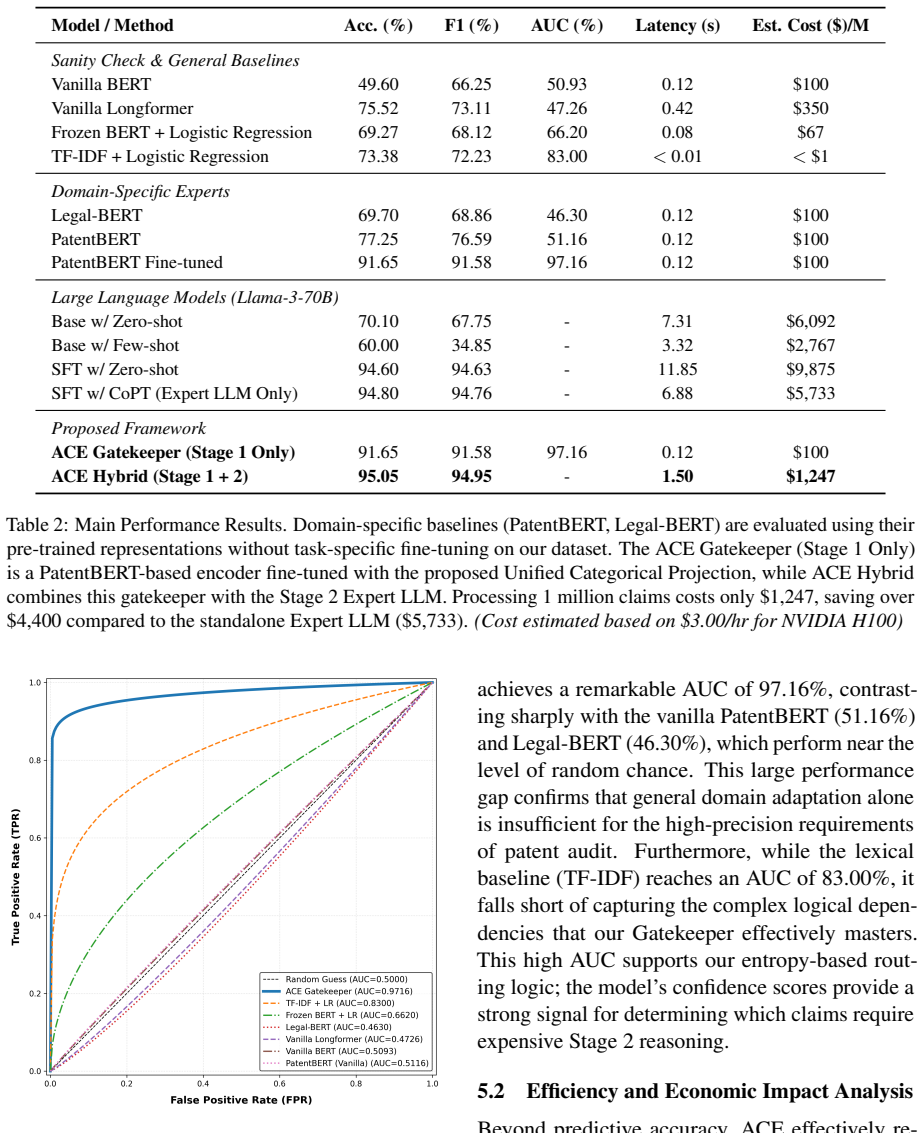
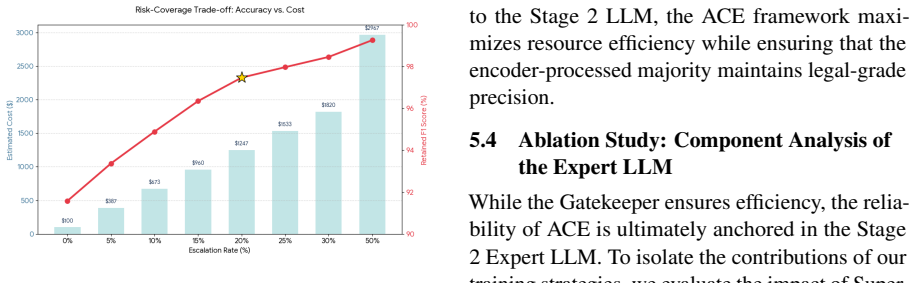
Automated patent claim validation demands low error tolerance. However, existing approaches face a rigidity-resource dilemma: lightweight encoders cannot track long-range legal dependencies, while exhaustive LLM verification incurs 4-5X higher overhead at million-claim scale. A naive confidence-based cascade cannot resolve this because binary validity scores fail to distinguish structurally distinct error types which require different reasoning depths. We propose a two-stage framework: Adaptive Cost-efficient Evaluation (ACE), which exploits the categorical structure of patent errors for uncertainty-aware routing. In the first stage, a fine-tuned encoder projects claims into a K+1 distribution over legal error types, whose predictive entropy serves as the routing signal. Claims exceeding an entropy threshold are escalated to the second stage, where an expert LLM executes a schema-constrained Chain-of-Patent-Thought (CoPT) protocol to map claim elements against 35 U.S.C. standards whose schema constraint reduces per-claim latency by 42% while producing legally grounded verdicts. We further present a 40,000-claim dataset ACE-40k with MPEP-grounded annotations, where ACE surpasses competitive baselines including a supervised 70B-parameter LLM while reducing costs by 78%. On real USPTO rejection data, the routing mechanism transfers without re-calibration, reducing inference time by 60% while maintaining competitive recall.
Figures

Figures from the paper (2 more)
Reference graph
Works this paper leans on
-
[1]
Foundational models defining a new era in vision: A survey and outlook,
[Awaiset al., 2023 ] Muhammad Awais, Muzammal Naseer, Salman Khan, Rao Muhammad Anwer, Hisham Cholakkal, Mubarak Shah, Ming-Hsuan Yang, and Fahad Shahbaz Khan. Foundational models defining a new era in vision: A survey and outlook,
2023
-
[2]
Fomo: Multi-modal, multi-scale and multi-task remote sensing foundation models for forest monitoring,
[Bountoset al., 2025 ] Nikolaos Ioannis Bountos, Arthur Ouaknine, Ioannis Papoutsis, and David Rolnick. Fomo: Multi-modal, multi-scale and multi-task remote sensing foundation models for forest monitoring,
2025
-
[3]
[Chabrillatet al., 2024 ] Sabine Chabrillat, Stefan Foerster, Karl Segl, Alice Beamish, Maximilian Brell, Saeed Asadzadeh, Robert Milewski, Kevin J. Ward, Arne Brosin- sky, Karin Koch, Daniel Scheffler, St ´ephane Guillaso, Alexander Kokhanovsky, Sigrid Roessner, Luis Guan- ter, Hermann Kaufmann, Nicole Pinnel, Emilio Carmona, Thomas Storch, Tobias Hank, ...
2024
-
[4]
Lobell, and Stefano Ermon
[Conget al., 2022 ] Yezhen Cong, Samar Khanna, Chenlin Meng, Patrick Liu, Erik Rozi, Yutong He, Marshall Burke, David B. Lobell, and Stefano Ermon. Satmae: Pre-training transformers for temporal and multi-spectral satellite im- agery. InAdvances in Neural Information Processing Sys- tems (NeurIPS),
2022
-
[5]
[Copernicus Atmosphere Monitoring Service, 2021] Copernicus Atmosphere Monitoring Service
arXiv:2207.08051. [Copernicus Atmosphere Monitoring Service, 2021] Copernicus Atmosphere Monitoring Service. CAMS Global Atmospheric Composition Forecasts. https://ads.atmosphere.copernicus.eu/,
arXiv 2021
-
[6]
Copernicus Atmosphere Monitoring Service (CAMS) Atmosphere Data Store. DOI: 10.24381/04a0b097. Accessed on 14-Jul-2025. [Diaoet al., 2025 ] Wenhui Diao, Haichen Yu, Kaiyue Kang, Tong Ling, Di Liu, Yingchao Feng, Hanbo Bi, Libo Ren, Xuexue Li, Yongqiang Mao, and Xian Sun. Ringmo- aerial: An aerial remote sensing foundation model with affine transformation ...
-
[7]
An image is worth 16x16 words: Trans- formers for image recognition at scale
[Dosovitskiyet al., 2021 ] Alexey Dosovitskiy, Lucas Beyer, Alexander Kolesnikov, Dirk Weissenborn, Xiaohua Zhai, Thomas Unterthiner, Mostafa Dehghani, Matthias Min- derer, Georg Heigold, Sylvain Gelly, Jakob Uszkoreit, and Neil Houlsby. An image is worth 16x16 words: Trans- formers for image recognition at scale. In9th International Conference on Learnin...
2021
-
[8]
Emmanuel Johnson, and Anna Jungbluth
[Girtsouet al., 2024 ] Stella Girtsou, Emiliano Diaz Salas- Porras, Lilli Freischem, Joppe Massant, Kyriaki-Margarita Bintsi, Giuseppe Castiglione, William Jones, Michael Eisinger, J. Emmanuel Johnson, and Anna Jungbluth. 3d cloud reconstruction through geospatially-aware masked autoencoders. InNeurIPS 2024 Workshop on Machine Learning and the Physical Sciences,
2024
Show all 27 references
-
[9]
[Heet al., 2021 ] Kaiming He, Xinlei Chen, Saining Xie, Yanghao Li, Piotr Doll´ar, and Ross Girshick
Poster. [Heet al., 2021 ] Kaiming He, Xinlei Chen, Saining Xie, Yanghao Li, Piotr Doll´ar, and Ross Girshick. Masked au- toencoders are scalable vision learners,
2021
-
[10]
When re- mote sensing meets foundation model: A survey and be- yond.Remote Sensing, 17(2):179,
[Huoet al., 2025 ] Chenyu Huo, Ke Chen, Shu Zhang, Zhenyu Wang, Hongyuan Yan, Jianbing Shen, Yong Hong, Guojin Qi, Hong Fang, and Zongming Wang. When re- mote sensing meets foundation model: A survey and be- yond.Remote Sensing, 17(2):179,
2025
-
[11]
Lobell, and Stefano Ermon
[Khannaet al., 2024 ] Samar Khanna, Patrick Liu, Linqi Zhou, Chenlin Meng, Robin Rombach, Marshall Burke, David B. Lobell, and Stefano Ermon. Diffusionsat: A generative foundation model for satellite imagery. InThe Twelfth International Conference on Learning Represen- tations,
2024
-
[12]
Remote sensing techniques for forest fire disaster management: The firehub operational platform
[Kontoeset al., 2016 ] Christos Kontoes, Ioannis Papout- sis, Theodoros Herekakis, Eleni Ieronymidi, and Irene Keramitsoglou. Remote sensing techniques for forest fire disaster management: The firehub operational platform. In Integrating Scale in Remote Sensing and GIS, pages 157–
2016
-
[13]
Zimmer- Dauphinee, Jordan M
[Luet al., 2025 ] Siqi Lu, Junlin Guo, James R. Zimmer- Dauphinee, Jordan M. Nieusma, Xiao Wang, Parker van- Valkenburgh, Steven A. Wernke, and Yuankai Huo. Vision foundation models in remote sensing: A survey.IEEE Geoscience and Remote Sensing Magazine, pages 2–27,
2025
-
[14]
Gpt-4 technical report,
[OpenAI, 2024] OpenAI. Gpt-4 technical report,
2024
-
[15]
Learning transferable visual models from natural language supervi- sion,
[Radfordet al., 2021 ] Alec Radford, Jong Wook Kim, Chris Hallacy, Aditya Ramesh, Gabriel Goh, Sandhini Agar- wal, Girish Sastry, Amanda Askell, Pamela Mishkin, Jack Clark, Gretchen Krueger, and Ilya Sutskever. Learning transferable visual models from natural language supervi- sion,
2021
-
[16]
Reed, Ritwik Gupta, Shufan Li, Sarah Brockman, Christopher Funk, Brian Clipp, Kurt Keutzer, Salvatore Candido, Matt Uyttendaele, and Trevor Darrell
[Reedet al., 2023 ] Colorado J. Reed, Ritwik Gupta, Shufan Li, Sarah Brockman, Christopher Funk, Brian Clipp, Kurt Keutzer, Salvatore Candido, Matt Uyttendaele, and Trevor Darrell. Scale-mae: A scale-aware masked autoencoder for multiscale geospatial representation learning,
2023
-
[17]
U-net: Convolutional networks for biomedical image segmentation
[Ronnebergeret al., 2015 ] Olaf Ronneberger, Philipp Fis- cher, and Thomas Brox. U-net: Convolutional networks for biomedical image segmentation. InMedical Image Computing and Computer-Assisted Intervention - MICCAI 2015 - 18th International Conference Munich, Germany, October...
2015
-
[18]
Sen12ms – a curated dataset of georeferenced multi-spectral sentinel-1/2 imagery for deep learning and data fusion,
[Schmittet al., 2019 ] Michael Schmitt, Lloyd Haydn Hughes, Chunping Qiu, and Xiao Xiang Zhu. Sen12ms – a curated dataset of georeferenced multi-spectral sentinel-1/2 imagery for deep learning and data fusion,
2019
-
[19]
Spradlin, Jordan A
[Spradlinet al., 2024 ] Caleb S. Spradlin, Jordan A. Caraballo-Vega, Jian Li, Mark L. Carroll, Jie Gong, and Paul M. Montesano. Satvision-toa: A geospatial foundation model for coarse-resolution all-sky remote sensing imagery,
2024
-
[20]
Bigearthnet: A large- scale benchmark archive for remote sensing image under- standing
[Sumbulet al., 2019 ] Gencer Sumbul, Marcela Charfuelan, Begum Demir, and V olker Markl. Bigearthnet: A large- scale benchmark archive for remote sensing image under- standing. InIGARSS 2019 - 2019 IEEE International Geo- science and Remote Sensing Symposium. IEEE, July
2019
-
[21]
Prithvi- eo-2.0: A versatile multi-temporal foundation model for earth observation applications,
[Szwarcmanet al., 2025 ] Daniela Szwarcman, Sujit Roy, Paolo Fraccaro, Thorsteinn El ´ı G´ıslason, Benedikt Blu- menstiel, Rinki Ghosal, Pedro Henrique de Oliveira, Joao Lucas de Sousa Almeida, Rocco Sedona, Yanghui Kang, Srija Chakraborty, Sizhe Wang, Carlos Gomes, Ankur Kuma...
2025
-
[22]
Crs- diff: Controllable remote sensing image generation with diffusion model,
[Tanget al., 2024 ] Datao Tang, Xiangyong Cao, Xingsong Hou, Zhongyuan Jiang, Junmin Liu, and Deyu Meng. Crs- diff: Controllable remote sensing image generation with diffusion model,
2024
-
[23]
Swimdiff: Scene-wide matching contrastive learning with diffusion constraint for remote sensing image,
[Tianet al., 2024 ] Jiayuan Tian, Jie Lei, Jiaqing Zhang, Weiying Xie, and Yunsong Li. Swimdiff: Scene-wide matching contrastive learning with diffusion constraint for remote sensing image,
2024
-
[24]
Panop- ticon: Advancing any-sensor foundation models for earth observation
[Waldmannet al., 2025 ] Leonard Waldmann, Ando Shah, Yi Wang, Nils Lehmann, Adam Stewart, Zhitong Xiong, Xiao Xiang Zhu, Stefan Bauer, and John Chuang. Panop- ticon: Advancing any-sensor foundation models for earth observation. InProceedings of the Computer Vision and Pattern ...
2025
-
[25]
Feature guided masked autoencoder for self-supervised learning in remote sensing,
[Wanget al., 2023 ] Yi Wang, Hugo Hern ´andez Hern ´andez, Conrad M Albrecht, and Xiao Xiang Zhu. Feature guided masked autoencoder for self-supervised learning in remote sensing,
2023
-
[26]
Stewart, Thomas Dujardin, Nikolaos Ioannis Bountos, Angelos Zavras, Franziska Gerken, Ioannis Pa- poutsis, Laura Leal-Taix´e, and Xiao Xiang Zhu
[Wanget al., 2025 ] Yi Wang, Zhitong Xiong, Chenying Liu, Adam J. Stewart, Thomas Dujardin, Nikolaos Ioannis Bountos, Angelos Zavras, Franziska Gerken, Ioannis Pa- poutsis, Laura Leal-Taix´e, and Xiao Xiang Zhu. Towards a unified copernicus foundation model for earth vision,
2025
-
[27]
One for all: Toward unified foundation models for earth vision, 2024
[Xionget al., 2024 ] Zhitong Xiong, Yi Wang, Fahong Zhang, and Xiao Xiang Zhu. One for all: Toward unified foundation models for earth vision, 2024
2024
Reviewed July 13, 2026 · model on record in the stance chip above.
Discussion (0). Sign in to comment.