Recognition: 2 theorem links
· Lean TheoremMeasurement-enhanced entanglement in a monitored superconducting chain
Pith reviewed 2026-05-10 20:27 UTC · model grok-4.3
The pith
Measurements enhance steady-state entanglement in a monitored superconducting chain by suppressing pairing correlations.
A machine-rendered reading of the paper's core claim, the machinery that carries it, and where it could break.
Core claim
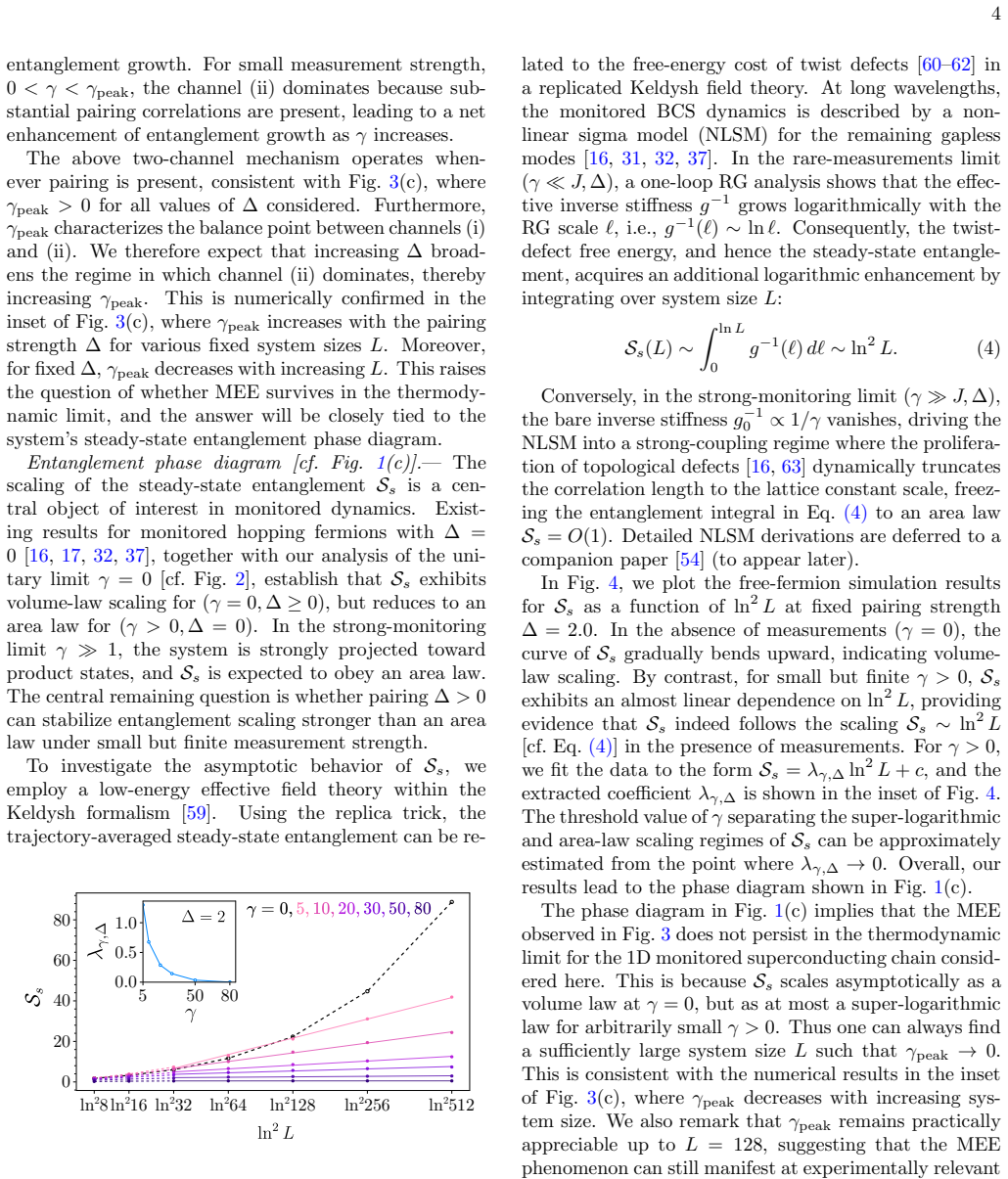
For Delta greater than zero, the steady-state entanglement Ss increases with gamma over a finite interval from zero to gamma peak. This occurs because stronger measurements suppress pairing correlations, which would otherwise suppress entanglement growth. Using a nonlinear sigma-model calculation and free-fermion simulations, the authors provide evidence that for Delta greater than zero and small but finite gamma, the steady-state entanglement scales as Ss proportional to ln squared L. This implies that measurement-enhanced entanglement does not persist in the thermodynamic limit.
What carries the argument
The competition between pairing correlations that suppress entanglement and continuous on-site measurements that suppress those pairing correlations in the monitored BCS chain.
If this is right
- Entanglement grows with measurement rate over a window of gamma values when pairing is present.
- The entanglement reaches a maximum at a finite peak measurement rate before declining.
- The ln squared L scaling shows the enhancement stays sub-extensive even at the optimal rate.
- The same competition between pairing and measurement suppression may govern other monitored interacting systems.
Where Pith is reading between the lines
- The result could motivate protocols that use moderate monitoring to tune entanglement in experimental superconducting devices.
- If the mechanism holds for discrete rather than continuous measurements, it would broaden the range of applicable setups.
- The sub-extensive scaling suggests that thermodynamic-limit entanglement remains limited even when the enhancement is active.
Load-bearing premise
The free-fermion simulations, quasiparticle analysis, and nonlinear sigma-model calculation together correctly capture the steady-state entanglement scaling and the competition between pairing and measurements in the continuous-monitoring limit.
What would settle it
A simulation or experiment in which steady-state entanglement decreases monotonically with increasing measurement rate gamma for positive Delta, or in which the scaling deviates from ln squared L at small gamma.
Figures


read the original abstract
A common view in monitored quantum dynamics is that local measurements suppress entanglement growth. We show that this intuition can fail in a one-dimensional spinful fermionic chain governed by a BCS Hamiltonian with pairing strength $\Delta$ and subject to continuous, on-site, spin-resolved charge measurements at rate $\gamma$. Using free-fermion simulations and quasiparticle analysis, we show that pairing suppresses entanglement growth, while measurements suppress pairing. Their competition yields measurement-enhanced entanglement: for $\Delta>0$, the steady-state entanglement $S_s$ increases with $\gamma$ over a finite interval $0<\gamma<\gamma_{\rm peak}$. This occurs because stronger measurements suppress pairing correlations, which would otherwise suppress entanglement growth. Using a nonlinear sigma-model calculation and free-fermion simulations, we provide evidence that for $\Delta>0$ and small but finite $\gamma$, the steady-state entanglement scales as $S_s\sim \ln^2 L$. This implies that, in this setting, measurement-enhanced entanglement does not persist in the thermodynamic limit.
Editorial analysis
A structured set of objections, weighed in public.
Referee Report
Summary. The manuscript studies a one-dimensional spinful fermionic chain with BCS pairing strength Δ subject to continuous on-site spin-resolved charge measurements at rate γ. It claims that measurements can enhance steady-state entanglement Ss for Δ>0 by suppressing pairing correlations that would otherwise limit entanglement growth, leading to an increase in Ss with γ over the interval 0<γ<γ_peak. Free-fermion trajectory simulations and quasiparticle analysis support this competition, while a nonlinear sigma-model calculation combined with simulations provides evidence that Ss scales as ln²L for small but finite γ and Δ>0, implying the enhancement vanishes in the thermodynamic limit.
Significance. If the central claims hold, the work provides a concrete counterexample to the prevailing intuition that local measurements generically suppress entanglement in monitored quantum systems. The mechanism—measurement-induced suppression of pairing—offers a tunable route to enhanced entanglement in open fermionic chains and suggests testable predictions for superconducting qubit platforms. The multi-pronged methodology (free-fermion numerics, quasiparticle picture, and field theory) is a strength, as is the explicit scaling prediction Ss∼ln²L that could be falsified by larger-scale simulations or experiments.
major comments (2)
- [Nonlinear sigma-model calculation] Nonlinear sigma-model section: the mapping from the stochastic, non-Hermitian monitored trajectories to the effective replica or Keldysh action is not shown to preserve the Goldstone-mode structure without additional measurement-induced mass terms or decoherence that would cut off the ln²L scaling. Standard derivations assume equilibrium or purely unitary dynamics; the continuous-monitoring limit requires explicit justification that no such cutoff arises.
- [Quasiparticle analysis and simulations] Quasiparticle analysis and free-fermion simulations: the claim that pairing suppression acts as a simple reduction in effective Δ (without altering the diffusive or localized character of monitored modes) is load-bearing for both the γ-enhancement and the ln²L scaling, yet the manuscript does not provide a direct comparison of the quasiparticle dispersion or localization length extracted from simulations versus the assumed effective-Δ model.
minor comments (2)
- [Numerical methods] The definition of the steady-state entanglement Ss and the extraction of γ_peak should be stated explicitly with the precise averaging procedure over trajectories.
- [Figures] Figure captions and axis labels for the entanglement scaling plots should include the range of system sizes L used and the number of trajectories averaged.
Simulated Author's Rebuttal
We thank the referee for their careful reading of the manuscript, positive assessment of its significance, and constructive comments. We address each major point below and have revised the manuscript to incorporate additional justifications and comparisons.
read point-by-point responses
-
Referee: [Nonlinear sigma-model calculation] Nonlinear sigma-model section: the mapping from the stochastic, non-Hermitian monitored trajectories to the effective replica or Keldysh action is not shown to preserve the Goldstone-mode structure without additional measurement-induced mass terms or decoherence that would cut off the ln²L scaling. Standard derivations assume equilibrium or purely unitary dynamics; the continuous-monitoring limit requires explicit justification that no such cutoff arises.
Authors: We thank the referee for highlighting the need for a more explicit justification of the mapping in the monitored case. While our original derivation followed the standard replica/Keldysh approach for continuously monitored systems, we agree that the absence of additional mass terms for the Goldstone modes requires clearer demonstration. In the revised manuscript we have added an expanded derivation (new Appendix C) starting from the stochastic Schrödinger equation in the continuous-monitoring limit. We show that the measurement-induced terms enter as imaginary contributions to the action that renormalize the diffusion constant but do not generate a relevant mass for the Goldstone modes at the scales relevant to the ln²L scaling. This is consistent with the numerical results, which continue to exhibit the predicted scaling for small but finite γ. revision: yes
-
Referee: [Quasiparticle analysis and simulations] Quasiparticle analysis and free-fermion simulations: the claim that pairing suppression acts as a simple reduction in effective Δ (without altering the diffusive or localized character of monitored modes) is load-bearing for both the γ-enhancement and the ln²L scaling, yet the manuscript does not provide a direct comparison of the quasiparticle dispersion or localization length extracted from simulations versus the assumed effective-Δ model.
Authors: The referee correctly identifies that a direct comparison would strengthen the load-bearing assumption. Although the manuscript already demonstrates consistency between the effective-Δ quasiparticle picture and the observed entanglement scaling, we have now extracted the single-particle dispersion and localization lengths directly from the free-fermion trajectory data for several values of γ. These quantities are compared to the predictions of the reduced-Δ model in a new figure (Fig. 5) and accompanying discussion in Section IV. The comparison confirms that, for γ < γ_peak, the primary effect is a reduction in the pairing gap while the diffusive character of the modes remains essentially unchanged, supporting the validity of the approximation used for both the enhancement and the scaling analysis. revision: yes
Circularity Check
No significant circularity detected in derivation chain
full rationale
The paper derives its claims on measurement-enhanced entanglement and Ss ~ ln²L scaling through free-fermion trajectory simulations, quasiparticle analysis, and an adapted nonlinear sigma-model calculation. These elements are presented as independent inputs: numerical data provides direct evidence for the competition between pairing suppression and entanglement growth, while the sigma-model supplies the scaling form without reducing to a parameter fit or self-referential definition within the paper's equations. No load-bearing step equates a prediction to its own input by construction, and external frameworks are invoked without self-citation chains that would force the result. The overall derivation remains self-contained against the provided benchmarks.
Axiom & Free-Parameter Ledger
Lean theorems connected to this paper
-
IndisputableMonolith/Cost/FunctionalEquation.lean (J-uniqueness, Aczél classification)washburn_uniqueness_aczel unclear?
unclearRelation between the paper passage and the cited Recognition theorem.
Using a nonlinear sigma-model calculation and free-fermion simulations, we provide evidence that for Δ>0 and small but finite γ, the steady-state entanglement scales as Ss(L)∼ln²L
-
IndisputableMonolith/Foundation/RealityFromDistinction.leanreality_from_one_distinction unclear?
unclearRelation between the paper passage and the cited Recognition theorem.
GGE predicts a volume-law scaling Ss(L)=cΔ·L with cΔ=2∫dk/2π F(1/2+Δ/2Ek)
What do these tags mean?
- matches
- The paper's claim is directly supported by a theorem in the formal canon.
- supports
- The theorem supports part of the paper's argument, but the paper may add assumptions or extra steps.
- extends
- The paper goes beyond the formal theorem; the theorem is a base layer rather than the whole result.
- uses
- The paper appears to rely on the theorem as machinery.
- contradicts
- The paper's claim conflicts with a theorem or certificate in the canon.
- unclear
- Pith found a possible connection, but the passage is too broad, indirect, or ambiguous to say the theorem truly supports the claim.
Reference graph
Works this paper leans on
-
[1]
C.-M. Jian, B. Bauer, A. Keselman, and A. W. W. Lud- wig, Criticality and entanglement in nonunitary quantum circuits and tensor networks of noninteracting fermions, Phys. Rev. B106, 134206 (2022)
2022
- [2]
-
[3]
S. Choi, Y. Bao, X.-L. Qi, and E. Altman, Quantum er- ror correction in scrambling dynamics and measurement- induced phase transition, Phys. Rev. Lett.125, 030505 (2020)
2020
-
[4]
Agrawal, A
U. Agrawal, A. Zabalo, K. Chen, J. H. Wilson, A. C. Potter, J. H. Pixley, S. Gopalakrishnan, and R. Vasseur, Entanglement and charge-sharpening transitions in u(1) symmetric monitored quantum circuits, Phys. Rev. X12, 041002 (2022)
2022
-
[5]
Y. Bao, S. Choi, and E. Altman, Theory of the phase transition in random unitary circuits with measurements, Phys. Rev. B101, 104301 (2020)
2020
-
[6]
Jian, Y.-Z
C.-M. Jian, Y.-Z. You, R. Vasseur, and A. W. W. Ludwig, Measurement-induced criticality in random quantum cir- cuits, Phys. Rev. B101, 104302 (2020)
2020
-
[7]
Y. Li, X. Chen, and M. P. A. Fisher, Measurement- driven entanglement transition in hybrid quantum cir- cuits, Phys. Rev. B100, 134306 (2019)
2019
-
[8]
M. J. Gullans and D. A. Huse, Dynamical purifica- tion phase transition induced by quantum measurements, Phys. Rev. X10, 041020 (2020)
2020
-
[9]
M. J. Gullans and D. A. Huse, Scalable probes of measurement-induced criticality, Phys. Rev. Lett.125, 070606 (2020)
2020
-
[10]
Iaconis, A
J. Iaconis, A. Lucas, and X. Chen, Measurement-induced phase transitions in quantum automaton circuits, Phys. Rev. B102, 224311 (2020)
2020
-
[11]
Lavasani, Y
A. Lavasani, Y. Alavirad, and M. Barkeshli, Measurement-induced topological entanglement transi- tions in symmetric random quantum circuits, Nature Physics17, 342 (2021)
2021
-
[12]
Sang and T
S. Sang and T. H. Hsieh, Measurement-protected quan- tum phases, Phys. Rev. Res.3, 023200 (2021)
2021
-
[13]
Nahum, S
A. Nahum, S. Roy, B. Skinner, and J. Ruhman, Mea- surement and entanglement phase transitions in all-to- all quantum circuits, on quantum trees, and in landau- ginsburg theory, PRX Quantum2, 010352 (2021)
2021
-
[14]
Block, Y
M. Block, Y. Bao, S. Choi, E. Altman, and N. Y. Yao, Measurement-induced transition in long-range in- teracting quantum circuits, Phys. Rev. Lett.128, 010604 (2022)
2022
- [15]
-
[16]
M. Fava, L. Piroli, D. Bernard, and A. Nahum, Monitored fermions with conservedu(1) charge, Phys. Rev. Res.6, 043246 (2024)
2024
-
[17]
Coppola, E
M. Coppola, E. Tirrito, D. Karevski, and M. Collura, Growth of entanglement entropy under local projective measurements, Phys. Rev. B105, 094303 (2022)
2022
-
[18]
Skinner, J
B. Skinner, J. Ruhman, and A. Nahum, Measurement- induced phase transitions in the dynamics of entangle- ment, Phys. Rev. X9, 031009 (2019)
2019
-
[19]
Szyniszewski, A
M. Szyniszewski, A. Romito, and H. Schomerus, Entan- glement transition from variable-strength weak measure- ments, Phys. Rev. B100, 064204 (2019)
2019
-
[20]
Travaglino, C
R. Travaglino, C. Rylands, and P. Calabrese, Quench dy- namics of entanglement entropy under projective charge measurements: the free fermion case, Journal of Statis- tical Mechanics: Theory and Experiment2025, 123101 (2025)
2025
- [21]
-
[22]
A. Chan, R. M. Nandkishore, M. Pretko, and G. Smith, Unitary-projective entanglement dynamics, Phys. Rev. B 99, 224307 (2019)
2019
-
[23]
X. Cao, A. Tilloy, and A. D. Luca, Entanglement in a fermion chain under continuous monitoring, SciPost Phys.7, 024 (2019)
2019
-
[24]
Ladewig, S
B. Ladewig, S. Diehl, and M. Buchhold, Monitored open fermion dynamics: Exploring the interplay of measure- ment, decoherence, and free hamiltonian evolution, Phys. Rev. Res.4, 033001 (2022)
2022
-
[25]
Carollo and V
F. Carollo and V. Alba, Entangled multiplets and spread- 6 ing of quantum correlations in a continuously monitored tight-binding chain, Phys. Rev. B106, L220304 (2022)
2022
-
[26]
L´ oio, A
H. L´ oio, A. De Luca, J. De Nardis, and X. Turkeshi, Purification timescales in monitored fermions, Phys. Rev. B108, L020306 (2023)
2023
-
[27]
Turkeshi, L
X. Turkeshi, L. Piroli, and M. Schir´ o, Enhanced entangle- ment negativity in boundary-driven monitored fermionic chains, Phys. Rev. B106, 024304 (2022)
2022
-
[28]
Turkeshi, M
X. Turkeshi, M. Dalmonte, R. Fazio, and M. Schir´ o, En- tanglement transitions from stochastic resetting of non- hermitian quasiparticles, Phys. Rev. B105, L241114 (2022)
2022
-
[29]
Van Regemortel, Z.-P
M. Van Regemortel, Z.-P. Cian, A. Seif, H. Dehghani, and M. Hafezi, Entanglement entropy scaling transition under competing monitoring protocols, Phys. Rev. Lett. 126, 123604 (2021)
2021
-
[30]
Kells, D
G. Kells, D. Meidan, and A. Romito, Topological tran- sitions in weakly monitored free fermions, SciPost Phys. 14, 031 (2023)
2023
-
[31]
Poboiko, I
I. Poboiko, I. V. Gornyi, and A. D. Mirlin, Measurement- induced phase transition for free fermions above one di- mension, Phys. Rev. Lett.132, 110403 (2024)
2024
-
[32]
Poboiko, P
I. Poboiko, P. P¨ opperl, I. V. Gornyi, and A. D. Mirlin, Theory of free fermions under random projective mea- surements, Phys. Rev. X13, 041046 (2023)
2023
-
[33]
M. Fava, L. Piroli, T. Swann, D. Bernard, and A. Nahum, Nonlinear sigma models for monitored dynamics of free fermions, Phys. Rev. X13, 041045 (2023)
2023
-
[34]
G.-Y. Zhu, N. Tantivasadakarn, and S. Trebst, Struc- tured volume-law entanglement in an interacting, moni- tored majorana spin liquid, Phys. Rev. Res.6, L042063 (2024)
2024
-
[35]
Oshima, K
H. Oshima, K. Mochizuki, R. Hamazaki, and Y. Fuji, Topology and spectrum in measurement-induced phase transitions, Phys. Rev. Lett.134, 240401 (2025)
2025
-
[36]
Nahum and B
A. Nahum and B. Skinner, Entanglement and dynamics of diffusion-annihilation processes with majorana defects, Phys. Rev. Res.2, 023288 (2020)
2020
-
[37]
Poboiko, P
I. Poboiko, P. P¨ opperl, I. V. Gornyi, and A. D. Mirlin, Measurement-induced transitions for interacting fermions, Phys. Rev. B111, 024204 (2025)
2025
-
[38]
Goto and I
S. Goto and I. Danshita, Measurement-induced transi- tions of the entanglement scaling law in ultracold gases with controllable dissipation, Phys. Rev. A102, 033316 (2020)
2020
-
[39]
Fuji and Y
Y. Fuji and Y. Ashida, Measurement-induced quantum criticality under continuous monitoring, Phys. Rev. B 102, 054302 (2020)
2020
-
[40]
E. V. H. Doggen, Y. Gefen, I. V. Gornyi, A. D. Mirlin, and D. G. Polyakov, Generalized quantum measurements with matrix product states: Entanglement phase transi- tion and clusterization, Phys. Rev. Res.4, 023146 (2022)
2022
-
[41]
E. V. H. Doggen, Y. Gefen, I. V. Gornyi, A. D. Mirlin, and D. G. Polyakov, Evolution of many-body systems under ancilla quantum measurements, Phys. Rev. B107, 214203 (2023)
2023
- [42]
-
[43]
Tang and W
Q. Tang and W. Zhu, Measurement-induced phase transi- tion: A case study in the nonintegrable model by density- matrix renormalization group calculations, Phys. Rev. Res.2, 013022 (2020)
2020
-
[44]
B. Pokharel, H. Pan, K. Aziz, L. C. G. Govia, S. Gane- shan, T. Iadecola, J. H. Wilson, B. A. Jones, A. Desh- pande, J. H. Pixley, and M. Takita, Order from chaos with adaptive circuits on quantum hardware (2025), arXiv:2509.18259 [quant-ph]
-
[45]
Szyniszewski, O
M. Szyniszewski, O. Lunt, and A. Pal, Disordered moni- tored free fermions, Phys. Rev. B108, 165126 (2023)
2023
-
[46]
S.-K. Jian, C. Liu, X. Chen, B. Swingle, and P. Zhang, Measurement-induced phase transition in the monitored sachdev-ye-kitaev model, Phys. Rev. Lett.127, 140601 (2021)
2021
-
[47]
Altland, M
A. Altland, M. Buchhold, S. Diehl, and T. Micklitz, Dy- namics of measured many-body quantum chaotic sys- tems, Phys. Rev. Res.4, L022066 (2022)
2022
-
[48]
C. Noel, P. Niroula, D. Zhu, A. Risinger, L. Egan, D. Biswas, M. Cetina, A. V. Gorshkov, M. J. Gullans, D. A. Huse, and C. Monroe, Measurement-induced quan- tum phases realized in a trapped-ion quantum computer, Nature Physics18, 760 (2022)
2022
-
[49]
J. M. Koh, S.-N. Sun, M. Motta, and A. J. Minnich, Measurement-induced entanglement phase transition on a superconducting quantum processor with mid-circuit readout, Nature Physics19, 1314–1319 (2023)
2023
- [50]
-
[51]
J. C. Hoke, M. Ippoliti, E. Rosenberg, D. Abanin, R. Acharya, T. I. Andersen, M. Ansmann, F. Arute, K. Arya, A. Asfaw, J. Atalaya, J. C. Bardin, A. Bengts- son, G. Bortoli, A. Bourassa, J. Bovaird, L. Brill, M. Broughton, B. B. Buckley, D. A. Buell, T. Burger, B. Burkett, N. Bushnell, Z. Chen, B. Chiaro, D. Chik, J. Cogan, R. Collins, P. Conner, W. Courtn...
2023
-
[52]
Mart´in-V´ azquez, T
G. Mart´in-V´ azquez, T. Tolppanen, and M. Silveri, Phase transitions induced by standard and feedback mea- surements in transmon arrays, Phys. Rev. B109, 214308 (2024)
2024
-
[53]
M. A. Nielsen and I. L. Chuang,Quantum computation and quantum information(Cambridge University Press, 2000)
2000
-
[54]
Guo and Z.-Y
R. Guo and Z.-Y. Wei, in preparation
-
[55]
See Supplemental Material at [URL will be inserted by publisher] for more details
-
[56]
Bardeen, L
J. Bardeen, L. N. Cooper, and J. R. Schrieffer, Theory of superconductivity, Phys. Rev.108, 1175 (1957)
1957
-
[57]
N. N. Bogoljubov, On a new method in the theory of superconductivity, Il Nuovo Cimento (1955-1965)7, 794 (1958)
1955
-
[58]
Chang and D
J.-J. Chang and D. J. Scalapino, Kinetic-equation ap- proach to nonequilibrium superconductivity, Phys. Rev. B15, 2651 (1977)
1977
-
[59]
A. Kamenev and A. Levchenko, Keldysh technique and non-linearσ-model: basic principles and ap- plications, Advances in Physics58, 197 (2009), https://doi.org/10.1080/00018730902850504
-
[60]
J. L. Cardy, O. A. Castro-Alvaredo, and B. Doyon, Form factors of branch-point twist fields in quantum integrable models and entanglement entropy, Journal of Statistical Physics130, 129–168 (2007)
2007
-
[61]
Calabrese and J
P. Calabrese and J. Cardy, Entanglement entropy and quantum field theory, Journal of Statistical Mechanics: Theory and Experiment2004, P06002 (2004)
2004
-
[62]
Calabrese and J
P. Calabrese and J. Cardy, Entanglement entropy and conformal field theory, Journal of Physics A: Mathemat- ical and Theoretical42, 504005 (2009)
2009
-
[63]
Fu and C
L. Fu and C. L. Kane, Topology, delocalization via av- erage symmetry and the symplectic anderson transition, Phys. Rev. Lett.109, 246605 (2012)
2012
-
[64]
Morral-Yepes, A
R. Morral-Yepes, A. Smith, S. Sondhi, and F. Pollmann, Entanglement transitions in unitary circuit games, PRX Quantum5, 010309 (2024)
2024
-
[65]
Disentangling strategies and entanglement transitions in unitary circuit games with matchgates
R. Morral-Yepes, M. Langer, A. Gammon-Smith, B. Kraus, and F. Pollmann, Disentangling strategies and entanglement transitions in unitary circuit games with matchgates (2026), arXiv:2507.05055 [quant-ph]. Supplementary Materials for: Measurement-enhanced entanglement in a monitored superconducting chain Rui-Jing Guo (郭睿婧), 1 Ji-Yao Chen,1,∗ and Zhi-Yuan We...
work page internal anchor Pith review Pith/arXiv arXiv 2026
-
[66]
Simulating Monitored Dynamics Starting from the N´ eel Product State 1
-
[67]
Quasiparticle description of unmonitored BCS dynamics 4 A
Evolution starting from vacuum state 3 S2. Quasiparticle description of unmonitored BCS dynamics 4 A. Steady-state pairing correlations 4
-
[68]
GGE prediction of onsite pairing correlations 5
-
[69]
Entanglement Entropy 7 C
GGE prediction of nearest-neighbor pairing correlations 6 B. Entanglement Entropy 7 C. Entanglement Saturation Time 8 References 9 S1. GAUSSIAN ST A TE SIMULA TION OF MONITORED BCS DYNAMICS
-
[70]
The operatorc † l,σ creates a fermion at site l∈ {1,
Simulating Monitored Dynamics Starting from the N´ eel Product State We consider a one-dimensional chain of spinful fermions withLsites. The operatorc † l,σ creates a fermion at site l∈ {1, . . . , L}with spinσ∈ {↑,↓}. The system is characterized by fermionic creation and annihilation operators that obey the canonical anticommutation relations (CAR):{c † ...
-
[71]
S1 we also consider the same monitored BCS dynamics starting from the vacuum state,|ψ vac(0)⟩=|0,
Evolution starting from vacuum state Besides the initial N´ eel state studied in the main text, in Fig. S1 we also consider the same monitored BCS dynamics starting from the vacuum state,|ψ vac(0)⟩=|0, . . . ,0⟩. Similar to Fig. 3(b,c) in the main text, we again observe the same measurement-enhanced entanglement phenomenon, showing that it is not specific...
-
[72]
Numerical Results Using exact Gaussian-state numerics, we extract the amplitude of the steady-state pairing correlations from the covariance matrix|Γ 21|[cf. Eq. (S5)], whose elements are given by|Γ 21|ij =|⟨c i↓cj↑⟩|. The results, shown in Fig. S2, are obtained for pairing amplitude ∆ = 1 and system sizeL= 32. For the unmonitored dynamics (γ= 0) [cf. Fig...
-
[73]
GGE prediction of onsite pairing correlations After quenching from the initial N´ eel state [cf. Eq. (S2)], the system relaxes to a steady state described by a GGE rather than undergoing conventional thermalization. Since the post-quench Hamiltonian is fully diagonalized in the Bogoliubov quasiparticle basis [cf. Eq. (S19)], the commutator of any generic ...
-
[74]
GGE prediction of nearest-neighbor pairing correlations In contrast to the vanishing on-site pairing implied byχ k = 0 [cf. Eq. (S25)] , we now evaluate the nearest-neighbor pairing correlation⟨c j,↓cj+1,↑⟩s in the steady state. The real-space nearest-neighbor pairing correlation is reconstructed via the Fourier expansion: ⟨cj,↓cj+1,↑⟩s = 1 L X k,q eikj e...
2022
discussion (0)
Sign in with ORCID, Apple, or X to comment. Anyone can read and Pith papers without signing in.