Recognition: 2 theorem links
· Lean TheoremCoarse Screening
Pith reviewed 2026-05-10 20:02 UTC · model grok-4.3
The pith
The optimal signal for investigating a buyer before pricing is always coarse, using at most three outcomes no matter how many types exist.
A machine-rendered reading of the paper's core claim, the machinery that carries it, and where it could break.
Core claim
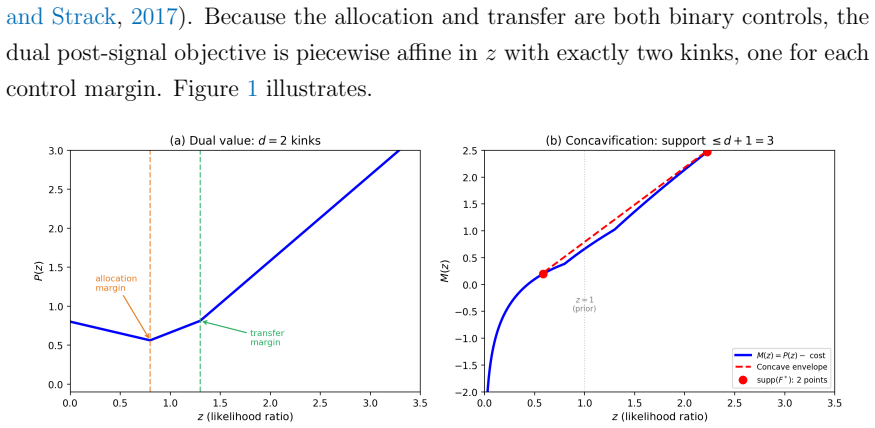
The seller designs both an information structure and a mechanism to maximize expected profit minus information cost. The central discovery is that an optimal information structure exists with at most three signal realizations for each buyer. This ternary bound equals the effective policy dimension, which counts the independent post-signal choices plus one. Screening involves the allocation decision and the pricing decision, and limited liability ensures these cannot be collapsed into one.
What carries the argument
The effective policy dimension, equal to the number of independent decisions the seller makes after receiving the signal plus one.
Load-bearing premise
The seller cannot impose arbitrarily large penalties on the buyer due to limited liability.
What would settle it
Solve the optimal signal for a continuous buyer type space under a quadratic information cost and check whether any optimal signal uses four or more realizations.
Figures





read the original abstract
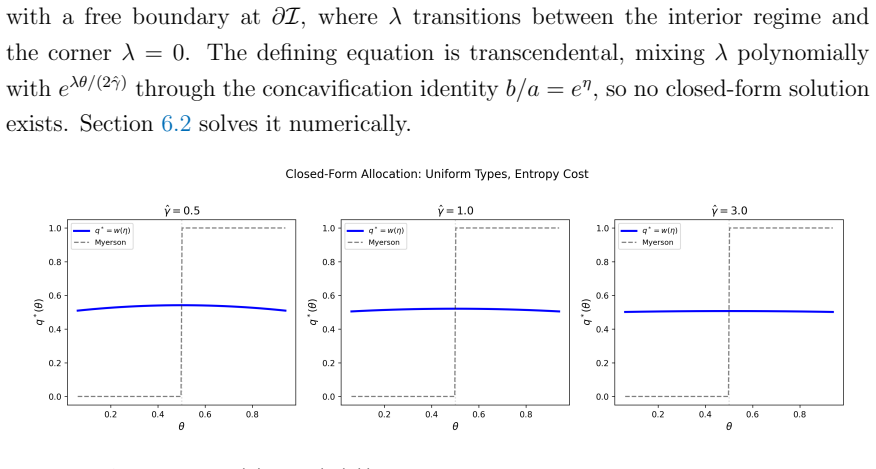
A seller investigates a buyer before setting prices, balancing the cost of acquiring information against the gain from tailoring the contract to the buyer's private type. The optimal signal is coarse: no matter how rich the type space, the seller never needs more than three outcomes per buyer. The bound equals the number of independent post-signal decisions plus one, a quantity we call the effective policy dimension. Screening involves two decisions, whether to allocate and what to charge, giving the ternary bound. Limited liability is the source: without it, the price is pinned by the envelope, only the allocation decision remains, and signals are binary as in monitoring. The Myerson exclusion rule is an artifact of not investigating. With investigation, every marginal buyer trades with positive probability, governed by a universal function that connects information design to rational inattention. The bound holds for any strictly convex information cost.
Editorial analysis
A structured set of objections, weighed in public.
Referee Report
Summary. The paper analyzes a seller who acquires costly information about a buyer's private type before offering a contract, balancing information costs against gains from tailoring. It claims that the optimal signal is always coarse, requiring at most three outcomes per buyer for arbitrary type spaces. This ternary bound equals the effective policy dimension, defined as the number of independent post-signal decisions plus one; here, limited liability makes allocation and pricing independent, yielding dimension 2. The bound holds for any strictly convex information cost. Dropping limited liability reduces the problem to a single allocation decision and recovers binary signals. With investigation, the Myerson exclusion rule disappears and every marginal buyer trades with positive probability governed by a universal function linking information design to rational inattention.
Significance. If the dimensionality bound and its dependence on limited liability are established rigorously, the paper offers a sharp, portable result on the complexity of optimal signals in mechanism design with endogenous information. The effective-policy-dimension concept and the universal marginal-trading function provide a clean bridge between information design and rational inattention, while reframing the exclusion rule as an artifact of zero investigation. These contributions could shape subsequent work on coarse contracts and costly screening.
major comments (2)
- The central claim that the bound is exactly three outcomes rests on counting two independent decisions (allocation and pricing) under limited liability. The manuscript should explicitly derive why these decisions remain independent after the signal is realized and why no third decision (e.g., participation or type-dependent outside option) enters the count; a counter-example with a type-dependent participation constraint would falsify the dimension argument.
- The statement that the bound holds for arbitrary (possibly continuous) type spaces requires a precise statement of the information-cost functional and the topology on signals. If the proof relies on finite-type approximations, the passage to the continuum limit must be shown to preserve the three-outcome property; otherwise the result is limited to finite types.
minor comments (3)
- Define the effective policy dimension formally in the main text (rather than only in the abstract) and state its value for the baseline model before invoking it in the ternary-bound theorem.
- The universal function governing marginal-buyer trading probabilities should be stated explicitly (e.g., as an equation relating the posterior belief to the information cost) so that readers can verify its independence from the type distribution.
- Add a short discussion of how the result relates to the existing literature on rational inattention in mechanism design (e.g., references to Sims, Caplin-Dean, or Matějka-McKay) to clarify the incremental contribution.
Simulated Author's Rebuttal
We thank the referee for the constructive and detailed report. We address the two major comments point by point below, indicating the revisions we will undertake to clarify the arguments.
read point-by-point responses
-
Referee: The central claim that the bound is exactly three outcomes rests on counting two independent decisions (allocation and pricing) under limited liability. The manuscript should explicitly derive why these decisions remain independent after the signal is realized and why no third decision (e.g., participation or type-dependent outside option) enters the count; a counter-example with a type-dependent participation constraint would falsify the dimension argument.
Authors: We agree that the independence of the two decisions requires a more explicit derivation in the text. In the revision we will add a dedicated paragraph immediately after the definition of effective policy dimension that solves the seller's post-signal problem explicitly: under limited liability the seller chooses an allocation probability q and a scalar price p for each realized signal, subject to the buyer's interim incentive and participation constraints. Because limited liability normalizes the outside option to zero independently of type, the participation constraint does not introduce an additional free decision variable; it is either slack or determines a boundary condition already embedded in the two-dimensional choice. We will also insert a remark stating that the result is specific to type-independent outside options and that a type-dependent participation constraint would indeed raise the dimension, but lies outside the maintained limited-liability environment of the model. revision: yes
-
Referee: The statement that the bound holds for arbitrary (possibly continuous) type spaces requires a precise statement of the information-cost functional and the topology on signals. If the proof relies on finite-type approximations, the passage to the continuum limit must be shown to preserve the three-outcome property; otherwise the result is limited to finite types.
Authors: The proof is formulated directly on general type spaces by treating the information cost as a strictly convex functional on the space of probability measures over the type space. We will revise the manuscript to state this functional and the weak topology explicitly in the model section and to note that the dimensionality argument bounding the number of signal outcomes relies only on the linear independence of the gradients of the two post-signal decisions, not on any finite-type approximation. Consequently the three-outcome bound carries over to continuous type spaces without additional limiting arguments. A short clarifying paragraph will be added to the main text. revision: yes
Circularity Check
No significant circularity; derivation follows from model primitives
full rationale
The central claim derives the ternary bound on signal outcomes from the effective policy dimension, which equals the number of independent post-signal decisions (allocation plus pricing) plus one under limited liability. This is a direct counting argument from the contract structure and convex information costs, without any reduction of a prediction to a fitted input, self-referential definition, or load-bearing self-citation. When limited liability is removed the bound collapses to binary signals as stated, confirming the logic is driven by the primitives rather than by construction. The paper presents this as holding for arbitrary type spaces and any strictly convex cost, with no internal equations or steps that equate outputs to inputs by fiat.
Axiom & Free-Parameter Ledger
axioms (2)
- domain assumption Information cost is strictly convex
- domain assumption Limited liability constraint on transfers
invented entities (1)
-
effective policy dimension
no independent evidence
Lean theorems connected to this paper
-
IndisputableMonolith/Cost/FunctionalEquation.leanwashburn_uniqueness_aczel echoesThe bound equals the number of independent post-signal decisions plus one... Screening involves two decisions, whether to allocate and what to charge, giving the ternary bound.
-
IndisputableMonolith/Foundation/BranchSelection.leanbranch_selection echoesM j,Λ is piecewise strictly concave with at most two kinks. Every optimal experiment ... is supported on at most three likelihood-ratio realizations.
Reference graph
Works this paper leans on
-
[1]
Bardhi, A. (2024). Attributes: Selective learning and influence. Econometrica, 92(2):311--353
2024
-
[2]
Ben-Porath, E., Dekel, E., and Lipman, B. L. (2014). Optimal allocation with costly verification. American Economic Review, 104(12):3779--3813
2014
-
[3]
Bergemann, D., Brooks, B., and Morris, S. (2015). The limits of price discrimination. American Economic Review, 105(3):921--957
2015
-
[4]
and Pesendorfer, M
Bergemann, D. and Pesendorfer, M. (2007). Information structures in optimal auctions. Journal of Economic Theory, 137(1):580--609
2007
-
[5]
and V\"alim\"aki, J
Bergemann, D. and V\"alim\"aki, J. (2002). Information acquisition and efficient mechanism design. Econometrica, 70(3):1007--1033
2002
-
[6]
Blackwell, D. (1953). Equivalent comparisons of experiments. The Annals of Mathematical Statistics, 24(2):265--272
1953
-
[7]
and Strack, P
Candogan, O. and Strack, P. (2023). Optimal disclosure of information to privately informed agents. Theoretical Economics, 18(3):1225--1269
2023
-
[8]
and Kolotilin, A
Dworczak, P. and Kolotilin, A. (2024). The persuasion duality. Theoretical Economics, 19(4):1701--1755
2024
-
[9]
and Martini, G
Dworczak, P. and Martini, G. (2019). The simple economics of optimal persuasion. Journal of Political Economy, 127(5):1993--2048
2019
-
[10]
Di Tillio, A., Ottaviani, M., and S rensen, P. N. (2021). Strategic sample selection. Econometrica, 89(2):911--953
2021
-
[11]
and Kleiner, A
Erlanson, A. and Kleiner, A. (2020). Costly verification in collective decisions. Review of Economic Studies, 87(5):2094--2125
2020
-
[12]
Frick, M., Iijima, R., and Ishii, Y. (2026). Multidimensional screening with precise seller information. Econometrica, 94(1):35--70
2026
-
[13]
and Szentes, B
Georgiadis, G. and Szentes, B. (2020). Optimal monitoring design. Econometrica, 88(5):2075--2107
2020
-
[14]
Heumann, T. (2020). Information design and sequential screening with ex post participation constraint. Theoretical Economics, 15(1):319--359
2020
-
[15]
Holmstr\"om, B. (1979). Moral hazard and observability. Bell Journal of Economics, 10(1):74--91
1979
-
[16]
and Gentzkow, M
Kamenica, E. and Gentzkow, M. (2011). Bayesian persuasion. American Economic Review, 101(6):2590--2615
2011
-
[17]
Kleiner, A., Moldovanu, B., and Strack, P. (2021). Extreme points and majorization: Economic applications. Econometrica, 89(4):1557--1593
2021
-
[18]
and Zapechelnyuk, A
Kolotilin, A. and Zapechelnyuk, A. (2025). Persuasion meets delegation. Econometrica, 93(1):195--228
2025
-
[19]
and Martimort, D
Laffont, J.-J. and Martimort, D. (2002). The Theory of Incentives: The Principal-Agent Model. Princeton University Press
2002
-
[20]
Luenberger, D. G. (1969). Optimization by Vector Space Methods. Wiley
1969
- [21]
-
[22]
and McKay, A
Mat e jka, F. and McKay, A. (2015). Rational inattention to discrete choices: A new foundation for the multinomial logit model. American Economic Review, 105(1):272--298
2015
-
[23]
and Segal, I
Milgrom, P. and Segal, I. (2002). Envelope theorems for arbitrary choice sets. Econometrica, 70(2):583--601
2002
-
[24]
and Strack, P
Morris, S. and Strack, P. (2017). The Wald problem and the equivalence of sequential sampling and static information costs. Working Paper
2017
-
[25]
Myerson, R. B. (1981). Optimal auction design. Mathematics of Operations Research, 6(1):58--73
1981
-
[26]
and Szentes, B
Roesler, A.-K. and Szentes, B. (2017). Buyer-optimal learning and monopoly pricing. American Economic Review, 107(7):2072--2080
2017
-
[27]
Sion, M. (1958). On general minimax theorems. Pacific Journal of Mathematics, 8(1):171--176
1958
-
[28]
Townsend, R. M. (1979). Optimal contracts and competitive markets with costly state verification. Journal of Economic Theory, 21(2):265--293
1979
discussion (0)
Sign in with ORCID, Apple, or X to comment. Anyone can read and Pith papers without signing in.