Recognition: 2 theorem links
· Lean TheoremInformation-Geometric Perspective on the Hubble Tension: Eigenmode Rotation and Curvature Suppression in wCDM
Pith reviewed 2026-05-10 20:03 UTC · model grok-4.3
The pith
The Hubble tension in wCDM arises from a reconfiguration of the datasets' constraint manifold rather than from new physical agreement.
A machine-rendered reading of the paper's core claim, the machinery that carries it, and where it could break.
Core claim
Within the local Gaussian approximation the quadratic tension factorizes into the squared shift between parameter estimates and the combined directional curvature from the Fisher matrices of the datasets. For Planck, DESI DR2 and SH0ES data in wCDM the leading Planck Fisher eigenvalue drops to roughly 2.7 percent of its Lambda-CDM value with only modest rotation of the acoustic eigenmode. The resulting softening of acoustic rigidity is countered by new curvature injected by the late-time data, which limits the possible reduction in tension.
What carries the argument
The shift-curvature decomposition that splits quadratic tension into a squared displacement term and a directional Fisher curvature term.
If this is right
- The leading curvature of the cosmic microwave background constraint is suppressed when the dark energy equation of state is allowed to vary.
- Late-time data impose additional stiffness that closes off routes to full tension resolution.
- Inferred tension values reflect the geometry of the constraint manifold rather than direct physical reconciliation.
- The method provides a rapid diagnostic for tensions that avoids full likelihood reanalysis.
Where Pith is reading between the lines
- The same decomposition could diagnose whether other cosmological tensions arise from similar manifold reconfigurations.
- Increasing the precision of late-time measurements would further stiffen the manifold and reduce opportunities for tension relief through parameter extensions.
- Applying the factorization to non-Gaussian cases would test its range of applicability beyond the local approximation.
Load-bearing premise
The local Gaussian approximation accurately factorizes the quadratic tension into a squared shift term and a combined directional curvature term contributed by the datasets.
What would settle it
A calculation of the full tension in wCDM that does not match the sum of the squared shift and the curvature contribution from the reported eigenvalues and rotations would falsify the factorization.
Figures


read the original abstract
The Hubble tension is shaped not only by shifts between early- and late-time parameter estimates, but also by the stiffness of the constraints that define them. In this work, we analyze this geometric structure in the wCDM model by separating the discrepancy into two components: a parameter displacement and a directional Fisher curvature. Within the local Gaussian approximation, the quadratic tension along a given direction factorizes into the squared shift and the combined directional curvature contributed by the datasets. Applying this framework to Planck, DESI DR2, and SH0ES, we show that extending \LambdaCDM to wCDM primarily reshapes the Fisher geometry of the CMB constraint rather than opening a genuinely new route to concordance. Allowing the dark-energy equation-of-state parameter w to vary suppresses the leading Planck Fisher eigenvalue to only \sim 2.7 % of its \LambdaCDM value, while producing only a modest rotation of the dominant acoustic-scale eigenmode. The net effect is a strong softening of the effective acoustic rigidity. At the same time, high-precision late-time data, especially from DESI DR2, inject substantial curvature along the expansion-rate direction. This added stiffness acts as a geometric wall, closing off phantom-like escape routes and sharply limiting tension relief within the extended parameter space. Our results indicate that changes in the inferred H_0 tension under model extension are best understood as a reconfiguration of the constraint manifold rather than as evidence for new physical agreement. The shift-curvature decomposition thus offers a simple, fast, and physically transparent way to diagnose cosmological tensions.
Editorial analysis
A structured set of objections, weighed in public.
Referee Report
Summary. The paper claims that the Hubble tension in wCDM is best understood geometrically as a reconfiguration of the constraint manifold rather than new physical agreement. Using Fisher matrices from Planck, DESI DR2, and SH0ES, it factorizes quadratic tension along directions into a squared shift term plus combined directional curvature. Extending to wCDM suppresses the leading Planck eigenmode to ~2.7% of its ΛCDM value with modest rotation of the acoustic-scale mode, while late-time data adds substantial curvature along the expansion-rate direction, acting as a geometric wall that limits tension relief.
Significance. If the local Gaussian approximation and factorization remain valid under strong eigenmode suppression, the shift-curvature decomposition offers a fast, transparent diagnostic for how model extensions reshape tensions without achieving concordance. This could aid interpretation of future datasets by distinguishing weakened constraints from genuine physical resolutions, and the approach is computationally lightweight compared to full MCMC explorations.
major comments (2)
- [Abstract] Abstract and results section: the central claim that wCDM reconfigures the manifold (via ~97% suppression of the leading Planck Fisher eigenvalue) rests on the local Gaussian approximation for tension factorization. No validation is shown that this quadratic form remains accurate once the acoustic-scale curvature is reduced to 2.7% of its ΛCDM value; residual non-Gaussianity, prior volume, or higher-order likelihood curvature could then dominate the budget. A concrete test (e.g., comparison of the quadratic approximation against full likelihood evaluations along the suppressed eigenmode) is needed to support the factorization.
- [Abstract] The directional curvatures and eigenmodes are constructed directly from Fisher matrices fitted to the same Planck, DESI DR2, and SH0ES datasets whose tension is being diagnosed. This makes the geometric quantities downstream of the parameter fits rather than independent external benchmarks, raising a correctness risk for the reconfiguration interpretation. The manuscript should test the claim on mock data generated from a fiducial model with known tension to confirm the decomposition is not an artifact of the fitting procedure.
minor comments (1)
- [Abstract] The abstract mentions application to Planck, DESI DR2, and SH0ES but provides no error bars, data exclusion criteria, or verification that the Gaussian approximation holds for these posteriors; these details should be added for reproducibility.
Simulated Author's Rebuttal
We thank the referee for their insightful and constructive comments, which have prompted us to strengthen the validation of our geometric framework. We address each major comment in detail below, outlining the specific revisions we will implement to address the concerns raised.
read point-by-point responses
-
Referee: [Abstract] Abstract and results section: the central claim that wCDM reconfigures the manifold (via ~97% suppression of the leading Planck Fisher eigenvalue) rests on the local Gaussian approximation for tension factorization. No validation is shown that this quadratic form remains accurate once the acoustic-scale curvature is reduced to 2.7% of its ΛCDM value; residual non-Gaussianity, prior volume, or higher-order likelihood curvature could then dominate the budget. A concrete test (e.g., comparison of the quadratic approximation against full likelihood evaluations along the suppressed eigenmode) is needed to support the factorization.
Authors: We agree that the validity of the local Gaussian approximation under strong eigenmode suppression requires explicit verification, as higher-order effects could become relevant. In the revised manuscript, we will add a new subsection (likely in Section 3 or 4) that performs a direct numerical test: we will evaluate the full Planck likelihood (or posterior samples) along the direction of the suppressed leading eigenmode and compare the resulting tension measure to the quadratic factorization. This will quantify any deviations due to non-Gaussianity or prior effects and report the fractional error in the decomposition. We anticipate the approximation remains accurate for the relevant parameter displacements, but the test will provide the necessary evidence to support our claims. revision: yes
-
Referee: [Abstract] The directional curvatures and eigenmodes are constructed directly from Fisher matrices fitted to the same Planck, DESI DR2, and SH0ES datasets whose tension is being diagnosed. This makes the geometric quantities downstream of the parameter fits rather than independent external benchmarks, raising a correctness risk for the reconfiguration interpretation. The manuscript should test the claim on mock data generated from a fiducial model with known tension to confirm the decomposition is not an artifact of the fitting procedure.
Authors: The referee raises a valid point about potential circularity in deriving the geometric quantities from the same data used to measure the tension. To address this, the revised manuscript will include a dedicated validation using mock datasets. We will generate simulated Planck, DESI-like, and SH0ES-like data from a fiducial wCDM cosmology with a controlled input tension (e.g., by imposing a deliberate H0 shift in the early-time mock while holding late-time mocks fixed to a different value). Applying our Fisher decomposition to these mocks will confirm that the shift-curvature factorization recovers the known geometric reconfiguration without fitting artifacts. This test will be presented as a methodological robustness check, while the main results continue to focus on the real datasets. revision: yes
Circularity Check
No significant circularity; factorization follows from standard Gaussian likelihood
full rationale
The paper applies the local Gaussian approximation to decompose quadratic tension into a squared parameter shift term and a directional curvature term constructed from the Fisher matrices of Planck, DESI DR2, and SH0ES. This decomposition is a direct algebraic consequence of the quadratic expansion of the log-likelihood and does not reduce any claimed result to its inputs by construction; the shifts and curvatures remain independently determined by the external datasets. The central interpretive claim—that wCDM extension reconfigures the constraint manifold rather than producing physical concordance—follows from comparing these computed quantities across models and is not a tautological renaming or self-referential prediction. No load-bearing self-citations, uniqueness theorems, or ansatze imported from prior author work are present, and the analysis relies on standard information-geometry tools benchmarked against the same public data releases used in conventional tension studies. The derivation chain is therefore self-contained.
Axiom & Free-Parameter Ledger
axioms (2)
- domain assumption Local Gaussian approximation for the posterior distributions of cosmological parameters
- standard math Fisher information matrix supplies a valid local quadratic approximation to the log-likelihood surface
Lean theorems connected to this paper
-
IndisputableMonolith/Foundation/AbsoluteFloorClosure.leanreality_from_one_distinction unclear?
unclearRelation between the paper passage and the cited Recognition theorem.
Within the local Gaussian approximation, the quadratic tension along a given direction factorizes into the squared shift and the combined directional curvature contributed by the datasets.
-
IndisputableMonolith/Cost/FunctionalEquation.leanwashburn_uniqueness_aczel unclear?
unclearRelation between the paper passage and the cited Recognition theorem.
Allowing the dark-energy equation-of-state parameter w to vary suppresses the leading Planck Fisher eigenvalue to only ∼2.7% of its ΛCDM value
What do these tags mean?
- matches
- The paper's claim is directly supported by a theorem in the formal canon.
- supports
- The theorem supports part of the paper's argument, but the paper may add assumptions or extra steps.
- extends
- The paper goes beyond the formal theorem; the theorem is a base layer rather than the whole result.
- uses
- The paper appears to rely on the theorem as machinery.
- contradicts
- The paper's claim conflicts with a theorem or certificate in the canon.
- unclear
- Pith found a possible connection, but the passage is too broad, indirect, or ambiguous to say the theorem truly supports the claim.
Forward citations
Cited by 1 Pith paper
-
From Scalar $H_0$ to $E(z)$: A Reformulation of the Hubble Tension
Re-expressing the Hubble tension via posterior-implied E(z) histories yields moderate mismatches (S_hist of 1.65 and 2.55) that correspond to only 1.1-2.1 sigma equivalents, below the usual 4.9 sigma scalar-H0 discrepancy.
Reference graph
Works this paper leans on
-
[1]
Consequently, the SH0ES Fisher tensor projects almost entirely onto the pure expansion-rate axis
Fisher–geometric interpretation BecauseD L ∝H −1 0 at low redshift, variations inH 0 (or equivalently lnH 0) simply rescale predicted luminosity distances without requiring correlated shifts in other cosmological parameters. Consequently, the SH0ES Fisher tensor projects almost entirely onto the pure expansion-rate axis. In the (Ωm0,lnH 0, w) basis, the d...
-
[2]
Numerical construction of the SH0ES Fisher tensor The SH0ES Fisher matrix is constructed directly from the Pantheon+SH0ES likelihood using the publicly released distance-modulus data vector and covariance matrix. Unlike the Planck and DESI Fisher tensors, which are reconstructed from posterior covariances of MCMC chains, the SH0ES Fisher tensor is evaluat...
-
[3]
In the rdFREE configuration, DESI contributes no curvature along the expansion-rate axis (Sec
Structural role in rdFREE and rdFIX The invariance ofκ S under the rdFREE/rdFIX transformation highlights the structural distinction of SH0ES within the combined Fisher geometry. In the rdFREE configuration, DESI contributes no curvature along the expansion-rate axis (Sec. VI B), and the effective stiffness is supplied entirely by Planck and SH0ES. The ex...
2018
-
[4]
In the lnH 0 repre- sentation, the curvature saturates rapidly, reaching unity by the first mode in rdFIX and by the second mode in rdFREE
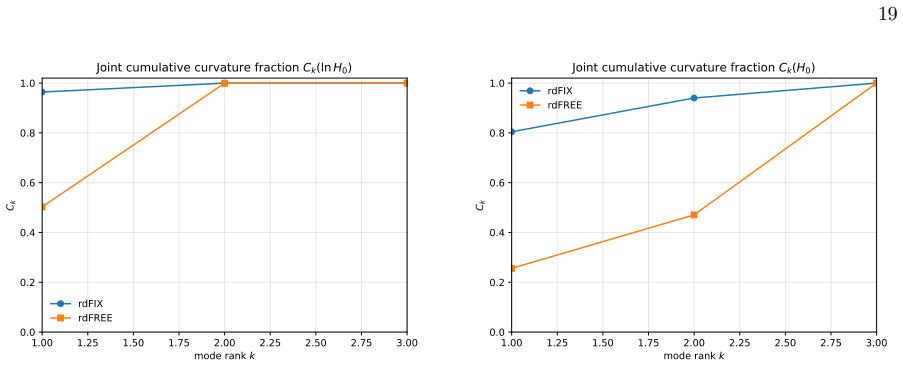
Low-dimensional curvature structure Figure 6 shows the cumulative curvature fractionC k of the joint Fisher tensor. In the lnH 0 repre- sentation, the curvature saturates rapidly, reaching unity by the first mode in rdFIX and by the second mode in rdFREE. In the linearH 0 basis, the curvature is distributed over a slightly larger set of leading modes, app...
-
[5]
In the rdFREE configuration, DESI contributes identically zero curvature along the pure expansion-rate axis, and the joint curvature reduces toκ rdFREE joint =κ P +κ S
Redistribution of stiffness Within this anisotropic Fisher geometry, the treatment of the sound horizon controls how stiffness is redistributed among probes. In the rdFREE configuration, DESI contributes identically zero curvature along the pure expansion-rate axis, and the joint curvature reduces toκ rdFREE joint =κ P +κ S. Numerically, the stiffness par...
-
[6]
Geometric origin of the tension The essential insight is geometric. The Hubble tension is not merely a discrepancy between two central values ofH 0; it is the projection of a physical displacement onto a highly anisotropic Fisher metric whose stiffness is concentrated in a single eigenmode. Sound-horizon calibration determines whether that stiff- ness is ...
-
[7]
Connection to observational constraints This geometric structure is reflected in current cosmological parameter constraints. Although allowing the dark energy equation of state to vary slightly shifts the preferred expansion rate, the combined DESI+CMB+Pantheon+ constraints in thewCDM model yield [17] H0 = 67.97±0.57 km s −1 Mpc−1.(72) This value remains ...
-
[8]
Product of three Gaussian likelihoods Before forming the Gaussian product, all probes are first expressed in a common parameter basis θthrough the appropriate Jacobian transformations, as described in Sec. VI. Only after this basis unification do we construct the Gaussian product. 25 Consider three Gaussian likelihoods for a common parameter vectorθ, LP(θ...
-
[9]
Explicit expansion of the exponent Using the symmetry ofF i we obtain (θ−θ i)T Fi(θ−θ i) =θ T Fiθ−2θ T Fiθi +θ T i Fiθi.(A7) Summing over the three probes yields Q3(θ) =θ T (FP +F S +F D)θ−2θ T (FPθP +F SθS +F DθD) +θ T P FPθP +θ T S FSθS +θ T DFDθD.(A8)
-
[10]
Completing the square Define A3 =F P +F S +F D, b 3 =F PθP +F SθS +F DθD.(A9) Then Q3(θ) =θ T A3θ−2θ T b3 +c 3.(A10) Completing the square yields Q3(θ) = (θ−µ 3)T A3(θ−µ 3) + (c3 −µ T 3 A3µ3) (A11) with µ3 =A −1 3 b3.(A12) Thus, the joint likelihood becomes Gaussian with Fjoint =F P +F S +F D,(A13) and θjoint = (FP +F S +F D)−1(FPθP +F SθS +F DθD).(A14)
-
[11]
Early–late regrouping Combining the two late-time probes first, FL =F S +F D, θ L = (FS +F D)−1(FSθS +F DθD).(A15) Combining this block with the early probe gives Fjoint =F P +F L,(A16) which reproduces the full three-probe result. 26
-
[12]
Early–late quadratic tension The statistical tension between the early-Universe block (Planck) and the late-Universe block (SH0ES + DESI) is quantified by the residual of the combined quadratic forms evaluated at the joint minimum, θjoint. Defining the individual penalties asQ P(θ) = (θ−θ P)T FP(θ−θ P) andQ L(θ) = (θ−θ L)T FL(θ−θ L), the exact tension sta...
2018
-
[13]
A. Sandage and G. A. Tammann, Astrophys. J.196, 313-328 (1975) doi:10.1086/153413
-
[14]
de Vaucouleurs, Nature299, no.5881, 303-307 (1982) doi:10.1038/299303a0 27 TABLE V
G. de Vaucouleurs, Nature299, no.5881, 303-307 (1982) doi:10.1038/299303a0 27 TABLE V. Numerical configuration of the Fisher reconstructions. Only SH0ES employs finite-difference deriva- tives, while Planck and DESI use posterior covariance inversion. Planck 2018 (base w) DESI DR2 (D M /rd, DH /rd) SH0ES Input data MCMC chains (plikHM TT lowl lowE) BAO ve...
-
[15]
W. L. Freedmanet al.[HST], Astrophys. J.553, 47-72 (2001) doi:10.1086/320638 [arXiv:astro-ph/0012376 [astro-ph]]
-
[16]
A. Sandage, G. A. Tammann, A. Saha, B. Reindl, F. D. Macchetto and N. Panagia, Astrophys. J.653, 843-860 (2006) doi:10.1086/508853 [arXiv:astro-ph/0603647 [astro-ph]]
-
[17]
L. Verde, P. Protopapas and R. Jimenez, Phys. Dark Univ.2, 166-175 (2013) doi:10.1016/j.dark.2013.09.002 [arXiv:1306.6766 [astro-ph.CO]]
-
[18]
G. Efstathiou, Mon. Not. Roy. Astron. Soc.440, no.2, 1138-1152 (2014) doi:10.1093/mnras/stu278 [arXiv:1311.3461 [astro-ph.CO]]
-
[19]
J. L. Bernal, L. Verde and A. G. Riess, JCAP10, 019 (2016) doi:10.1088/1475-7516/2016/10/019 [arXiv:1607.05617 [astro-ph.CO]]
-
[20]
L. Knox and M. Millea, Phys. Rev. D101, no.4, 043533 (2020) doi:10.1103/PhysRevD.101.043533 [arXiv:1908.03663 [astro-ph.CO]]
-
[21]
P. A. R. Adeet al.[Planck], Astron. Astrophys.594, A13 (2016) doi:10.1051/0004-6361/201525830 [arXiv:1502.01589 [astro-ph.CO]]
-
[22]
Planck 2018 results. VI. Cosmological parameters
N. Aghanimet al.[Planck], Astron. Astrophys.641, A6 (2020) [erratum: Astron. Astrophys.652, C4 (2021)] doi:10.1051/0004-6361/201833910 [arXiv:1807.06209 [astro-ph.CO]]
work page internal anchor Pith review Pith/arXiv arXiv doi:10.1051/0004-6361/201833910 2020
-
[23]
A. G. Riess, L. Macri, S. Casertano, H. Lampeitl, H. C. Ferguson, A. V. Filippenko, S. W. Jha, W. Li and R. Chornock, Astrophys. J.730, 119 (2011) [erratum: Astrophys. J.732, 129 (2011)] doi:10.1088/0004- 637X/732/2/129 [arXiv:1103.2976 [astro-ph.CO]]
-
[24]
A. G. Riess, L. M. Macri, S. L. Hoffmann, D. Scolnic, S. Casertano, A. V. Filippenko, B. E. Tucker, M. J. Reid, D. O. Jones and J. M. Silverman,et al.Astrophys. J.826, no.1, 56 (2016) doi:10.3847/0004-637X/826/1/56 [arXiv:1604.01424 [astro-ph.CO]]
-
[25]
A. G. Riess, S. Casertano, W. Yuan, L. M. Macri and D. Scolnic, Astrophys. J.876, no.1, 85 (2019) doi:10.3847/1538-4357/ab1422 [arXiv:1903.07603 [astro-ph.CO]]
-
[26]
W. L. Freedman, B. F. Madore, D. Hatt, T. J. Hoyt, I. S. Jang, R. L. Beaton, C. R. Burns, M. G. Lee, A. J. Monson and J. R. Neeley,et al.Astrophys. J.882, 34 (2019) doi:10.3847/1538-4357/ab2f73 [arXiv:1907.05922 [astro-ph.CO]]
-
[27]
A. G. Riess, S. Casertano, W. Yuan, J. B. Bowers, L. Macri, J. C. Zinn and D. Scolnic, Astrophys. J. Lett. 908, no.1, L6 (2021) doi:10.3847/2041-8213/abdbaf [arXiv:2012.08534 [astro-ph.CO]]
-
[28]
A. G. Riess, W. Yuan, L. M. Macri, D. Scolnic, D. Brout, S. Casertano, D. O. Jones, Y. Murakami, L. Breuval and T. G. Brink,et al.Astrophys. J. Lett.934, no.1, L7 (2022) doi:10.3847/2041-8213/ac5c5b [arXiv:2112.04510 [astro-ph.CO]]
-
[29]
M. Abdul Karimet al.[DESI], Phys. Rev. D112, no.8, 083515 (2025) doi:10.1103/tr6y-kpc6 [arXiv:2503.14738 [astro-ph.CO]]
-
[30]
W. Lin and M. Ishak, Phys. Rev. D96, no.2, 023532 (2017) doi:10.1103/PhysRevD.96.023532 [arXiv:1705.05303 [astro-ph.CO]]
-
[31]
M. Raveri and W. Hu, Phys. Rev. D99, no.4, 043506 (2019) doi:10.1103/PhysRevD.99.043506 [arXiv:1806.04649 [astro-ph.CO]]
-
[32]
Bayes in the sky: Bayesian inference and model selection in cosmology
R. Trotta, Contemp. Phys.49, 71-104 (2008) doi:10.1080/00107510802066753 [arXiv:0803.4089 [astro-ph]]
-
[33]
S. Seehars, A. Amara, A. Refregier, A. Paranjape and J. Akeret, Phys. Rev. D90, no.2, 023533 (2014) doi:10.1103/PhysRevD.90.023533 [arXiv:1402.3593 [astro-ph.CO]]
-
[34]
W. Handley and P. Lemos, Phys. Rev. D100, no.4, 043504 (2019) doi:10.1103/PhysRevD.100.043504 [arXiv:1902.04029 [astro-ph.CO]]
- [35]
-
[36]
A. N. Ormondroyd, W. J. Handley, M. P. Hobson, A. N. Lasenby and D. Yallup, [arXiv:2509.13220 [astro- ph.CO]]
work page internal anchor Pith review Pith/arXiv arXiv
-
[37]
D. D. Y. Ong, D. Yallup and W. Handley, [arXiv:2511.10631 [astro-ph.CO]]
work page internal anchor Pith review arXiv
-
[38]
M. Tegmark, A. Taylor and A. Heavens, Astrophys. J.480, 22 (1997) doi:10.1086/303939 [arXiv:astro- ph/9603021 [astro-ph]]
-
[39]
Report of the Dark Energy Task Force
A. Albrecht, G. Bernstein, R. Cahn, W. L. Freedman, J. Hewitt, W. Hu, J. Huth, M. Kamionkowski, E. W. Kolb and L. Knox,et al.[arXiv:astro-ph/0609591 [astro-ph]]
-
[40]
M. Raveri, Phys. Rev. D93, no.4, 043522 (2016) doi:10.1103/PhysRevD.93.043522 [arXiv:1510.00688 [astro- ph.CO]]
-
[41]
G. E. Addison, Y. Huang, D. J. Watts, C. L. Bennett, M. Halpern, G. Hinshaw and J. L. Weiland, Astrophys. J.818, no.2, 132 (2016) doi:10.3847/0004-637X/818/2/132 [arXiv:1511.00055 [astro-ph.CO]]
-
[42]
Classical and Quantum Gravity , keywords =
E. Di Valentino, O. Mena, S. Pan, L. Visinelli, W. Yang, A. Melchiorri, D. F. Mota, A. G. Riess and J. Silk, Class. Quant. Grav.38, no.15, 153001 (2021) doi:10.1088/1361-6382/ac086d [arXiv:2103.01183 [astro- ph.CO]]
-
[43]
W. Hu and N. Sugiyama, Astrophys. J.471, 542-570 (1996) doi:10.1086/177989 [arXiv:astro-ph/9510117 [astro-ph]]
-
[44]
W. Hu and M. J. White, Phys. Rev. D56, 596-615 (1997) doi:10.1103/PhysRevD.56.596 [arXiv:astro- ph/9702170 [astro-ph]]
-
[45]
G. Efstathiou and J. R. Bond, Mon. Not. Roy. Astron. Soc.304, 75-97 (1999) doi:10.1046/j.1365- 8711.1999.02274.x [arXiv:astro-ph/9807103 [astro-ph]]
-
[46]
D. J. Eisenstein, W. Hu and M. Tegmark, Astrophys. J.518, 2-23 (1999) doi:10.1086/307261 [arXiv:astro- ph/9807130 [astro-ph]]
-
[47]
D. Huterer and M. S. Turner, Phys. Rev. D60, 081301 (1999) doi:10.1103/PhysRevD.60.081301 [arXiv:astro- ph/9808133 [astro-ph]]
-
[48]
I. Maor, R. Brustein and P. J. Steinhardt, Phys. Rev. Lett.86, 6 (2001) [erratum: Phys. Rev. Lett.87, 049901 (2001)] doi:10.1103/PhysRevLett.86.6 [arXiv:astro-ph/0007297 [astro-ph]]
-
[49]
P. Astier, Phys. Lett. B500, 8-15 (2001) doi:10.1016/S0370-2693(01)00072-7 [arXiv:astro-ph/0008306 [astro- ph]]
-
[50]
D. Huterer and M. S. Turner, Phys. Rev. D64, 123527 (2001) doi:10.1103/PhysRevD.64.123527 [arXiv:astro- ph/0012510 [astro-ph]]
-
[51]
D. Huterer and A. Cooray, Phys. Rev. D71, 023506 (2005) doi:10.1103/PhysRevD.71.023506 [arXiv:astro- ph/0404062 [astro-ph]]
-
[52]
E. V. Linder, Phys. Rev. D72, 043529 (2005) doi:10.1103/PhysRevD.72.043529 [arXiv:astro-ph/0507263 [astro-ph]]
-
[53]
Y. Wang and M. Tegmark, Phys. Rev. D71, 103513 (2005) doi:10.1103/PhysRevD.71.103513 [arXiv:astro- ph/0501351 [astro-ph]]
-
[54]
L. Amendola, M. Kunz and D. Sapone, JCAP04, 013 (2008) doi:10.1088/1475-7516/2008/04/013 [arXiv:0704.2421 [astro-ph]]
-
[55]
S. Lee, Phys. Lett. B874, 140237 (2026) doi:10.1016/j.physletb.2026.140237 [arXiv:2512.14747 [astro- ph.CO]]
-
[56]
B. A. Bassett, P. S. Corasaniti and M. Kunz, Astrophys. J. Lett.617, L1-L4 (2004) doi:10.1086/427023 [arXiv:astro-ph/0407364 [astro-ph]]
-
[57]
M. Cortˆ es and A. R. Liddle, Mon. Not. Roy. Astron. Soc.531, no.1, L52-L56 (2024) doi:10.1093/mnrasl/slae030 [arXiv:2309.03286 [astro-ph.CO]]
-
[58]
M. Cortˆ es and A. R. Liddle, JCAP12, 007 (2024) doi:10.1088/1475-7516/2024/12/007 [arXiv:2404.08056 [astro-ph.CO]]
-
[59]
M. Cortˆ es and A. R. Liddle, Mon. Not. Roy. Astron. Soc.544, L121-L125 (2025) doi:10.1093/mnrasl/slaf108 [arXiv:2504.15336 [astro-ph.CO]]
-
[60]
D. J. Eisenstein and W. Hu, Astrophys. J.496, 605 (1998) doi:10.1086/305424 [arXiv:astro-ph/9709112 [astro-ph]]
-
[61]
´E. Aubourget al.[BOSS], Phys. Rev. D92, no.12, 123516 (2015) doi:10.1103/PhysRevD.92.123516 [arXiv:1411.1074 [astro-ph.CO]]
-
[62]
S. Brieden, H. Gil-Mar´ ın and L. Verde, JCAP04, 023 (2023) doi:10.1088/1475-7516/2023/04/023 [arXiv:2212.04522 [astro-ph.CO]]
-
[63]
S. Lee, Mon. Not. Roy. Astron. Soc.544, no.4, 3388-3393 (2025) doi:10.1093/mnras/staf1890 [arXiv:2506.16022 [astro-ph.CO]]
- [64]
-
[65]
S. Lee, Eur. Phys. J. C86, no.2, 191 (2026) doi:10.1140/epjc/s10052-026-15431-7 [arXiv:2506.18230 [astro- ph.CO]]
-
[66]
S. Lee, [arXiv:2511.16703 [astro-ph.CO]]
- [67]
- [68]
discussion (0)
Sign in with ORCID, Apple, or X to comment. Anyone can read and Pith papers without signing in.