Recognition: no theorem link
Lattice studies of chimera baryons in Sp(4) gauge theory
Pith reviewed 2026-05-10 19:50 UTC · model grok-4.3
The pith
Lattice calculations determine the low-lying spectrum of chimera baryons in an Sp(4) gauge theory for composite Higgs models.
A machine-rendered reading of the paper's core claim, the machinery that carries it, and where it could break.
Core claim
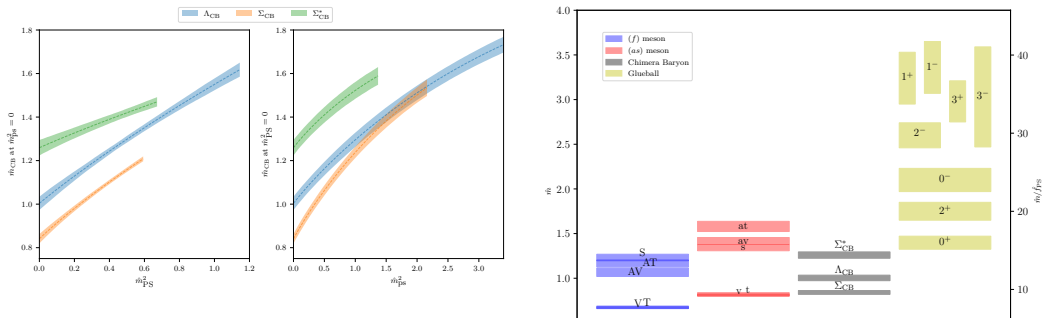
In a specific Sp(4) realization of composite Higgs models, non-perturbative lattice computations give the low-lying chimera baryon spectrum in the quenched approximation after taking the continuum and massless-fermion limits, while dynamical-fermion runs measure the spectrum and matrix elements directly through a newly developed spectral density analysis for several choices of lattice spacing and volume.
What carries the argument
Non-perturbative lattice gauge simulations with spectral density analysis applied to fermion bound states built from fundamental and antisymmetric representations.
Load-bearing premise
The quenched approximation supplies a reliable qualitative picture of the spectrum that survives the inclusion of dynamical fermions, and the chosen Sp(4) theory with the given representations forms a viable composite Higgs model with top partial compositeness.
What would settle it
Observation that the chimera baryon masses extracted on finer lattices or with dynamical fermions remain far above the scale needed to generate the top-quark mass would falsify the model's ability to explain the top mass via partial compositeness.
Figures


read the original abstract
We study chimera baryons, fermion bound states composed of two (hyper)quarks transforming in the fundamental and one in the antisymmetric representation of a non-Abelian gauge group. While in QCD they coincide with ordinary baryons, in composite Higgs models (CHMs) with top partial compositeness, spin-1/2 chimera baryons serve as partners of the top quark and are responsible for its large mass. We perform non-perturbative lattice calculations of the low-lying spectrum of the chimera baryons, in a specific realization of CHMs based on a Sp(4) gauge theory. In the quenched approximation, we present the numerical results in the continuum and massless limits. Then, for dynamical fermions, we measure the spectrum and matrix elements by employing a newly developed spectral density analysis for several choices of the lattice parameters.
Editorial analysis
A structured set of objections, weighed in public.
Referee Report
Summary. The manuscript reports non-perturbative lattice calculations of the low-lying spectrum of chimera baryons (bound states of two fundamental and one antisymmetric fermions) in Sp(4) gauge theory, motivated by composite Higgs models with top partial compositeness. Quenched results are presented after continuum and massless extrapolations; dynamical results for spectrum and matrix elements are obtained via a newly developed spectral density analysis at several lattice parameters.
Significance. If the central claims hold, the work supplies valuable non-perturbative benchmarks for chimera baryon masses and matrix elements in a concrete CHM realization, which can guide model building and phenomenology. Strengths include the quenched continuum/massless extrapolations and the technical development of the spectral density method for dynamical mixed-representation fermions; these constitute concrete advances in lattice techniques for beyond-Standard-Model applications.
major comments (2)
- [dynamical fermions section] Section presenting dynamical results: the central claim that the quenched spectrum 'remains qualitatively valid' once dynamical fermions are included is load-bearing but unsupported by a direct quantitative comparison at matched bare parameters or by reweighting estimates of the mixed-representation determinant effects. The manuscript shows dynamical results for a few parameter sets but does not demonstrate that the quenched extrapolations lie within a controlled distance of the dynamical spectrum.
- [quenched results section] Quenched extrapolation section: while continuum and massless limits are reported, the full error budget (including systematic uncertainties from the choice of fitting ansätze and the impact of the quenched approximation on the effective potential) is not presented in sufficient detail to substantiate the reliability of the quenched results as a first estimate.
minor comments (2)
- [introduction] Notation for the two fermion representations should be defined explicitly at first use and used consistently throughout to avoid ambiguity in the description of chimera states.
- [figures] Figure captions for the spectrum plots should include the specific lattice parameters (beta, masses) and the number of configurations used, to improve reproducibility.
Simulated Author's Rebuttal
We thank the referee for the careful reading of our manuscript and the constructive comments. We address the two major points below, outlining how we will strengthen the presentation while remaining faithful to the scope and results of the current study.
read point-by-point responses
-
Referee: Section presenting dynamical results: the central claim that the quenched spectrum 'remains qualitatively valid' once dynamical fermions are included is load-bearing but unsupported by a direct quantitative comparison at matched bare parameters or by reweighting estimates of the mixed-representation determinant effects. The manuscript shows dynamical results for a few parameter sets but does not demonstrate that the quenched extrapolations lie within a controlled distance of the dynamical spectrum.
Authors: We agree that a direct, quantitative comparison at matched parameters would provide stronger support. The dynamical results are presented for a limited set of ensembles primarily to establish the viability of the spectral-density method for mixed-representation fermions. The qualitative statement is based on the observed similarity in state ordering and rough mass ratios between the dynamical data and the quenched extrapolations at comparable bare parameters. In the revised manuscript we will add an explicit side-by-side comparison of the dynamical masses with quenched values interpolated to similar lattice spacings and fermion masses, together with a brief discussion of the expected magnitude of mixed-representation determinant effects inferred from the simulated mass values. A full reweighting analysis lies beyond the computational scope of the present exploratory work and will be noted as such. revision: partial
-
Referee: Quenched extrapolation section: while continuum and massless limits are reported, the full error budget (including systematic uncertainties from the choice of fitting ansätze and the impact of the quenched approximation on the effective potential) is not presented in sufficient detail to substantiate the reliability of the quenched results as a first estimate.
Authors: We acknowledge that the error budget can be presented more transparently. The revised manuscript will include an expanded discussion of systematic uncertainties, covering variations in the functional forms adopted for the continuum and chiral extrapolations as well as a qualitative assessment of quenching effects (e.g., by reference to partially-quenched comparisons and related literature). A dedicated table summarizing statistical and systematic contributions to the final extrapolated masses will be added. revision: yes
Circularity Check
No circularity in lattice spectrum computations
full rationale
The paper reports direct numerical results from Monte Carlo lattice simulations of chimera baryon spectra in Sp(4) gauge theory, both in the quenched approximation (with continuum and massless extrapolations) and with dynamical fermions via spectral density analysis. These are empirical outputs from gauge-field ensembles and correlation-function measurements, not analytical derivations or predictions that reduce to their inputs by construction. No self-definitional relations, fitted parameters renamed as predictions, or load-bearing self-citations appear in the central claims. The quenched-dynamical comparison is presented as an independent numerical check rather than a tautological step.
Axiom & Free-Parameter Ledger
free parameters (2)
- lattice spacing a
- bare fermion masses
axioms (2)
- domain assumption Quenched approximation captures the essential non-perturbative physics of the chimera baryon spectrum
- domain assumption Sp(4) with fundamental plus antisymmetric fermions realizes a viable CHM with top partial compositeness
Reference graph
Works this paper leans on
-
[1]
’t Hooft, Nucl
G. ’t Hooft, Nucl. Phys. B72, 461 (1974)
1974
-
[2]
Witten, Nucl
E. Witten, Nucl. Phys. B160, 57-115 (1979)
1979
-
[3]
Corrigan and P
E. Corrigan and P. Ramond, Phys. Lett. B87, 73-74 (1979)
1979
-
[4]
E. Bennettet al., Phys. Rev. D109, no.9, 094512 (2024). [arXiv:2311.14663 [hep-lat]]
-
[5]
Lovelace, Nucl
C. Lovelace, Nucl. Phys. B201, 333-340 (1982)
1982
-
[6]
A. Cherman, T. D. Cohen and R. F. Lebed, Phys. Rev. D 80, 036002 (2009). [arXiv:0906.2400 [hep-ph]]
-
[7]
G. Panico and A. Wulzer, Lect. Notes Phys.913, pp.1-316 (2016) Springer. [arXiv:1506.01961 [hep-ph]]
-
[8]
G. Ferretti and D. Karateev, JHEP03, 077 (2014). [arXiv:1312.5330 [hep-ph]]
-
[9]
J. Barnard, T. Gherghetta and T. S. Ray, JHEP02, 002 (2014). [arXiv:1311.6562 [hep-ph]]
-
[10]
E. Bennettet al.[TELOS], Phys. Rev. D112, no.7, 074515 (2025). [arXiv:2506.19804 [hep-lat]]
-
[11]
E. Bennettet al., Phys. Rev. D106, no.1, 014501 (2022). [arXiv:2202.05516 [hep-lat]]
-
[12]
On the extraction of spectral densities from lattice correlators
M. Hansen, A. Lupo and N. Tantalo, Phys. Rev. D99, no.9, 094508 (2019). [arXiv:1903.06476 [hep-lat]]
work page Pith review arXiv 2019
-
[13]
E. Bennettet al., Phys. Rev. D106, no.9, 094503 (2022) [arXiv:2205.09364 [hep-lat]]
-
[14]
Bennettet al., Universe9, no.5, 236 (2023) [arXiv:2304.01070 [hep-lat]]
E. Bennettet al., Universe9, no.5, 236 (2023) [arXiv:2304.01070 [hep-lat]]
-
[15]
E. Bennettet al., Phys. Rev. D109, no.9, 094517 (2024) [arXiv:2312.08465 [hep-lat]]
-
[16]
L. Del Debbio, A. Patella and C. Pica, Phys. Rev. D81, 094503 (2010) [arXiv:0805.2058 [hep-lat]]
-
[17]
Bennettet al.,JHEP03(2018), 185 [arXiv:1712.04220 [hep-lat]]
E. Bennett,et al., JHEP03, 185 (2018). [arXiv:1712.04220 [hep-lat]]
-
[18]
E. Bennettet al., Phys. Rev. D101, no.7, 074516 (2020). [arXiv:1912.06505 [hep-lat]]
-
[19]
E. Bennettet al., Phys. Rev. D103, no.5, 054509 (2021). [arXiv:2010.15781 [hep-lat]]
-
[20]
Grid: A next generation data parallel C++ QCD library,
P. Boyle, G. Cossu, A. Yamaguchi and A. Portelli, PoS LA TTICE2015, 023 (2016). [arXiv:1512.03487 [hep-lat]]
-
[21]
E. Bennettet al., Phys. Rev. D108, no.9, 094508 (2023). [arXiv:2306.11649 [hep-lat]]
-
[22]
E. Bennettet al., Phys. Rev. D110, no.7, 074509 (2024). [arXiv:2405.01388 [hep-lat]]
-
[23]
E. Bennettet al., Phys. Rev. D109, no.3, 034504 (2024) [arXiv:2304.07191 [hep-lat]]
-
[24]
E. Bennettet al., Phys. Rev. D110, no.7, 074504 (2024) [arXiv:2405.05765 [hep-lat]]
-
[25]
Bennettet al., 10.5281/zenodo.10929539 (2024)
E. Bennettet al., 10.5281/zenodo.10929539 (2024)
-
[26]
Forzanoet al., 10.5281/zenodo.15804889 (2025)
N. Forzanoet al., 10.5281/zenodo.15804889 (2025)
-
[27]
Forzanoet al., 10.5281/zenodo.15804848 (2025)
N. Forzanoet al., 10.5281/zenodo.15804848 (2025)
-
[28]
Bennett,The TELOS Collaboration Approach to Reproducibility and Open Science,2504.01876
E. Bennett, [arXiv:2504.01876 [hep-lat]]. 4
discussion (0)
Sign in with ORCID, Apple, or X to comment. Anyone can read and Pith papers without signing in.