Recognition: 2 theorem links
· Lean TheoremEfficient direct quantum state tomography using fan-out couplings
Pith reviewed 2026-05-10 20:12 UTC · model grok-4.3
The pith
A fan-out coupling to one meter qubit enables direct quantum state tomography at constant circuit depth independent of system size.
A machine-rendered reading of the paper's core claim, the machinery that carries it, and where it could break.
Core claim
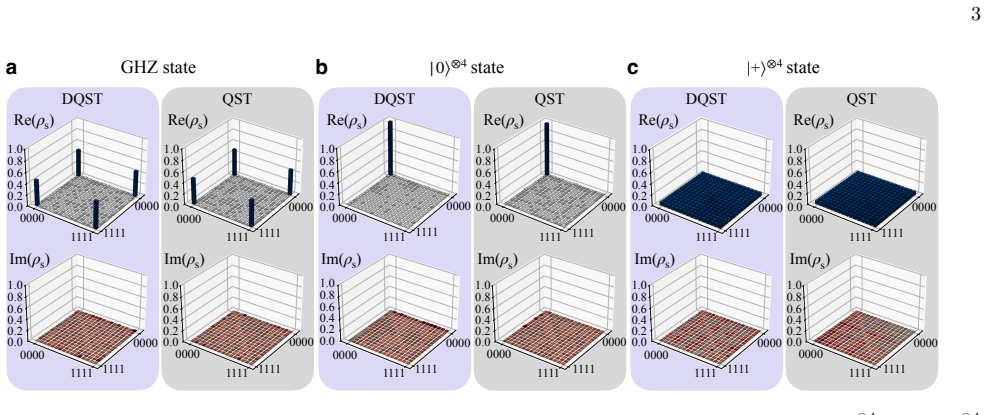
We introduce a direct quantum state tomography scheme combining strong-measurement estimation with a fan-out coupling architecture. It enables mutually commuting interactions between system qubits and a single meter qubit, thereby achieving constant circuit depth, independent of system size. Notably, the involutory fan-out coupling reduces to the identity under repetition, enabling straightforward noise scaling for quantum error mitigation. We experimentally validate the scheme on a superconducting quantum processor via the IBM Quantum Platform, demonstrating four-qubit state reconstruction and single-circuit GHZ-state fidelity estimation up to 20 qubits with error mitigation.
What carries the argument
The involutory fan-out coupling architecture, which supplies mutually commuting interactions from many system qubits to one meter qubit and returns exactly to the identity after two applications.
Load-bearing premise
The fan-out coupling remains perfectly involutory and all interactions stay mutually commuting under real hardware noise and control imperfections without introducing non-commuting errors.
What would settle it
An experiment on systems beyond 20 qubits in which the effective depth grows with qubit number or repeated applications deviate from identity scaling would falsify the constant-depth and noise-mitigation claims.
Figures


read the original abstract
Characterizing quantum states is essential for validating quantum devices, yet conventional quantum state tomography becomes prohibitively expensive as system size grows. Direct tomography offers a distinct route by enabling selective access to individual complex density-matrix elements, with a particular advantage for sparse target states and some verification tasks. Here we introduce a direct quantum state tomography scheme combining strong-measurement estimation with a fan-out coupling architecture. It enables mutually commuting interactions between system qubits and a single meter qubit, thereby achieving constant circuit depth, independent of system size. Notably, the involutory fan-out coupling reduces to the identity under repetition, enabling straightforward noise scaling for quantum error mitigation. We experimentally validate the scheme on a superconducting quantum processor via the IBM Quantum Platform, demonstrating four-qubit state reconstruction and single-circuit GHZ-state fidelity estimation up to 20 qubits with error mitigation. Consistent results with standard tomography and improved efficiency establish our scheme as a promising approach to reconstructing full quantum states and scalable verification tasks.
Editorial analysis
A structured set of objections, weighed in public.
Referee Report
Summary. The manuscript introduces a direct quantum state tomography scheme that combines strong-measurement estimation with a fan-out coupling architecture between system qubits and a single meter qubit. This enables mutually commuting interactions, yielding constant circuit depth independent of system size. The involutory property of the fan-out coupling (reducing to the identity upon repetition) is used to enable straightforward noise scaling for quantum error mitigation. Experimental validation on IBM superconducting hardware demonstrates 4-qubit state reconstruction consistent with standard tomography and single-circuit GHZ-state fidelity estimation up to 20 qubits with error mitigation, claiming improved efficiency.
Significance. If the constant-depth scaling and noise-mitigation assumptions hold under realistic conditions, the approach could meaningfully advance scalable state characterization for large quantum systems, offering advantages for sparse states and verification tasks where conventional tomography scales poorly. The experimental demonstrations on real hardware provide practical grounding, though the headline efficiency gains depend on the robustness of the architectural claims.
major comments (2)
- [Fan-out coupling and noise mitigation section] Fan-out coupling and noise mitigation section (abstract and methods): The central claim that the involutory fan-out coupling reduces exactly to the identity under repetition, enabling straightforward noise scaling for QEM, is load-bearing for the 20-qubit GHZ fidelity results. The manuscript provides no analysis, simulation, or bounds on how control errors, residual ZZ interactions, or decoherence on superconducting hardware deviate from U² = I, which could turn the two-copy operation into a non-identity channel and undermine the extrapolation argument.
- [Experimental validation section] Experimental validation section: The reported 4-qubit reconstruction consistency with standard tomography and 20-qubit GHZ results lack full circuit diagrams, explicit error-bar details, and data exclusion criteria. This prevents full auditing of whether the constant-depth property was achieved in practice and whether the noise-scaling QEM delivered the claimed improvement.
minor comments (2)
- [Abstract] The term 'strong-measurement estimation' appears in the abstract without a concise definition or reference in the main text; adding this would improve accessibility.
- [Figures] Figure captions should explicitly distinguish mitigated versus unmitigated data and note the circuit depth for each method to better support the constant-depth claim.
Simulated Author's Rebuttal
We thank the referee for their constructive and detailed comments, which help clarify key aspects of our work. We address each major comment point by point below and indicate the corresponding revisions.
read point-by-point responses
-
Referee: [Fan-out coupling and noise mitigation section] Fan-out coupling and noise mitigation section (abstract and methods): The central claim that the involutory fan-out coupling reduces exactly to the identity under repetition, enabling straightforward noise scaling for QEM, is load-bearing for the 20-qubit GHZ fidelity results. The manuscript provides no analysis, simulation, or bounds on how control errors, residual ZZ interactions, or decoherence on superconducting hardware deviate from U² = I, which could turn the two-copy operation into a non-identity channel and undermine the extrapolation argument.
Authors: We agree that a quantitative assessment of deviations from the ideal involutory property (U² = I) under realistic superconducting hardware noise is essential to support the noise-scaling QEM for the 20-qubit results. Although the fan-out coupling is exactly involutory in the ideal case, we will add a dedicated analysis subsection in the revised manuscript. This will include numerical simulations based on IBM hardware noise models (incorporating control errors, residual ZZ couplings, and decoherence) to provide bounds on the deviation from identity and evaluate its effect on the extrapolation procedure. revision: yes
-
Referee: [Experimental validation section] Experimental validation section: The reported 4-qubit reconstruction consistency with standard tomography and 20-qubit GHZ results lack full circuit diagrams, explicit error-bar details, and data exclusion criteria. This prevents full auditing of whether the constant-depth property was achieved in practice and whether the noise-scaling QEM delivered the claimed improvement.
Authors: We concur that full transparency in the experimental section requires additional documentation. In the revised manuscript, we will include complete circuit diagrams for the 4-qubit direct tomography and the 20-qubit GHZ fidelity estimation circuits, confirming the constant-depth implementation. We will also add explicit error-bar calculations based on finite-shot statistics, along with a clear statement of any data exclusion criteria applied during post-processing. These changes will enable independent verification of the results and the QEM improvement. revision: yes
Circularity Check
No significant circularity in the derivation chain
full rationale
The paper proposes a direct quantum state tomography scheme based on a fan-out coupling architecture between system qubits and a meter qubit. The constant-depth claim follows directly from the stated mutual commutativity of interactions, and the noise-scaling QEM follows from the involutory (U² = I) property of the coupling; both are design features of the architecture rather than quantities derived from data or prior results. Experimental validation on IBM hardware (4-qubit tomography and 20-qubit GHZ fidelity) is compared against standard tomography, providing external benchmarks. No equations reduce by construction to fitted inputs, no uniqueness theorems are imported via self-citation, and no ansatz is smuggled in. The scheme is self-contained against external benchmarks.
Axiom & Free-Parameter Ledger
axioms (2)
- domain assumption The fan-out coupling operator is involutory (U squared equals identity), allowing exact cancellation upon repetition for noise scaling.
- domain assumption All system-meter interactions commute, permitting simultaneous execution in constant depth.
Lean theorems connected to this paper
-
IndisputableMonolith/Cost/FunctionalEquation.leanJcost properties (reciprocity J(x)=J(1/x)) echoes?
echoesECHOES: this paper passage has the same mathematical shape or conceptual pattern as the Recognition theorem, but is not a direct formal dependency.
involutory fan-out coupling reduces to the identity under repetition, enabling straightforward noise scaling
-
IndisputableMonolith/Foundation/AlexanderDuality.leanalexander_duality_circle_linking (D=3 forcing) unclear?
unclearRelation between the paper passage and the cited Recognition theorem.
mutually commuting interactions... constant circuit depth, independent of system size
What do these tags mean?
- matches
- The paper's claim is directly supported by a theorem in the formal canon.
- supports
- The theorem supports part of the paper's argument, but the paper may add assumptions or extra steps.
- extends
- The paper goes beyond the formal theorem; the theorem is a base layer rather than the whole result.
- uses
- The paper appears to rely on the theorem as machinery.
- contradicts
- The paper's claim conflicts with a theorem or certificate in the canon.
- unclear
- Pith found a possible connection, but the passage is too broad, indirect, or ambiguous to say the theorem truly supports the claim.
Reference graph
Works this paper leans on
-
[1]
Hashim, A.et al.Practical introduction to benchmark- ing and characterization of quantum computers.PRX Quantum6, 030202 (2025)
2025
-
[2]
& Becker, S
Aditi, K. & Becker, S. Rigorous maximum-likelihood estimation for quantum states.Phys. Rev. A112, 052436 (2025)
2025
-
[3]
Patel, A., Gaikwad, A., Huang, T., Kockum, A. F. & Abad, T. Selective and efficient quantum state tomog- raphy for multiqubit systems.Phys. Rev. Research8, 013339 (2026)
2026
- [4]
-
[5]
T., Becker, S
Gross, D., Liu, Y.-K., Flammia, S. T., Becker, S. & Eis- ert, J. Quantum state tomography via compressed sens- ing.Phys. Rev. Lett.105, 150401 (2010)
2010
-
[6]
T., Gross, D., Liu, Y.-K
Flammia, S. T., Gross, D., Liu, Y.-K. & Eisert, J. Quan- tum tomography via compressed sensing: error bounds, sample complexity and efficient estimators.New J. Phys. 14, 095022 (2012)
2012
-
[7]
Cramer, M.et al.Efficient quantum state tomography. Nat. Commun.1, 149 (2010)
2010
-
[8]
& Houlsby, N
Husz´ ar, F. & Houlsby, N. M. T. Adaptive bayesian quan- tum tomography.Phys. Rev. A85, 052120 (2012)
2012
-
[9]
H.et al.Adaptive quantum state tomography improves accuracy quadratically.Phys
Mahler, D. H.et al.Adaptive quantum state tomography improves accuracy quadratically.Phys. Rev. Lett.111, 183601 (2013). 6
2013
-
[10]
Kim, Y.et al.Universal compressive characterization of quantum dynamics.Phys. Rev. Lett.124, 210401 (2020)
2020
-
[11]
Phys.14, 447–450 (2018)
Torlai, G.et al.Neural-network quantum state tomog- raphy.Nat. Phys.14, 447–450 (2018)
2018
-
[12]
Quek, Y., Fort, S. & Ng, H. K. Adaptive quantum state tomography with neural networks.npj Quantum Info.7, 105 (2021)
2021
-
[13]
S.et al.Benchmarking quantum tomography completeness and fidelity with machine learning.New J
Teo, Y. S.et al.Benchmarking quantum tomography completeness and fidelity with machine learning.New J. Phys.23, 103021 (2021)
2021
-
[14]
Cha, P.et al.Attention-based quantum tomography. Mach. Learn.: Sci. Technol.3, 01LT01 (2021)
2021
-
[15]
& Arunachalam, S
Anshu, A. & Arunachalam, S. A survey on the complex- ity of learning quantum states.Nat. Rev. Phys.6, 59–69 (2024)
2024
-
[16]
Flammia, S. T. & Liu, Y.-K. Direct fidelity estimation from few pauli measurements.Phys. Rev. Lett.106, 230501 (2011)
2011
-
[17]
Park, G., Chang, J., Kim, Y., Teo, Y. S. & Jeong, H. Sample- and hardware-efficient fidelity estimation by stripping phase-dominated magic.arXiv:2602.09710
work page internal anchor Pith review Pith/arXiv arXiv
-
[18]
& Preskill, J
Huang, H.-Y., Kueng, R. & Preskill, J. Predicting many properties of a quantum system from very few measure- ments.Nat. Phys.16, 1050–1057 (2020)
2020
-
[19]
& Soleimanifar, M
Huang, H.-Y., Preskill, J. & Soleimanifar, M. Certifying almost all quantum states with few single-qubit measure- ments.Nat. Phys.21, 1834–1841 (2025)
2025
-
[20]
Park, G., Teo, Y. S. & Jeong, H. Resource-efficient shadow tomography using equatorial stabilizer measure- ments.Phys. Rev. Research7, 033097 (2025)
2025
-
[21]
Commun.9, 192 (2018)
Kim, Y.et al.Direct quantum process tomography via measuring sequential weak values of incompatible observ- ables.Nat. Commun.9, 192 (2018)
2018
-
[22]
& T´ oth, G
G¨ uhne, O. & T´ oth, G. Entanglement detection.Phys. Rep.474, 1–75 (2009)
2009
-
[23]
& Seevinck, M
G¨ uhne, O. & Seevinck, M. Separability criteria for genuine multiparticle entanglement.New J. Phys.12, 053002 (2010)
2010
-
[24]
& Plenio, M
Streltsov, A., Adesso, G. & Plenio, M. B. Colloquium: Quantum coherence as a resource.Rev. Mod. Phys.89, 041003 (2017)
2017
-
[25]
Quantum Comput.5, 1–44 (2024)
Lubinski, T.et al.Optimization applications as quan- tum performance benchmarks.ACM Trans. Quantum Comput.5, 1–44 (2024)
2024
-
[26]
S., Sutherland, B., Patel, A., Stewart, C
Lundeen, J. S., Sutherland, B., Patel, A., Stewart, C. & Bamber, C. Direct measurement of the quantum wave- function.Nature474, 188–191 (2011)
2011
-
[27]
Kocsis, S.et al.Observing the average trajectories of single photons in a two-slit interferometer.Science332, 1170–1173 (2011)
2011
-
[28]
7, 13 (2021)
Kim, Y.et al.Observing the quantum cheshire cat effect with noninvasive weak measurement.npj Quantum Info. 7, 13 (2021)
2021
-
[29]
Malik, M.et al.Direct measurement of a 27-dimensional orbital-angular-momentum state vector.Nat. Commun. 5, 3115 (2014)
2014
-
[30]
Zhou, Y.et al.Direct tomography of high-dimensional density matrices for general quantum states of photons. Phys. Rev. Lett.127, 040402 (2021)
2021
-
[31]
M., Jordan, A
Dressel, J., Malik, M., Miatto, F. M., Jordan, A. N. & Boyd, R. W. Colloquium: Understanding quantum weak values: Basics and applications.Rev. Mod. Phys.86, 307–316 (2014)
2014
-
[32]
Lundeen, J. S. & Bamber, C. Procedure for direct mea- surement of general quantum states using weak measure- ment.Phys. Rev. Lett.108, 070402 (2012)
2012
-
[33]
S.et al.Direct measurement of the den- sity matrix of a quantum system.Phys
Thekkadath, G. S.et al.Direct measurement of the den- sity matrix of a quantum system.Phys. Rev. Lett.117, 120401 (2016)
2016
-
[34]
& Dequal, D
Vallone, G. & Dequal, D. Strong measurements give a better direct measurement of the quantum wave function. Phys. Rev. Lett.116, 040502 (2016)
2016
-
[35]
Zhang, C.-R.et al.Direct measurement of the two- dimensional spatial quantum wave function via strong measurements.Phys. Rev. A101, 012119 (2020)
2020
-
[36]
& Vallone, G
Calderaro, L., Foletto, G., Dequal, D., Villoresi, P. & Vallone, G. Direct reconstruction of the quantum density matrix by strong measurements.Phys. Rev. Lett.121, 230501 (2018)
2018
-
[37]
Pan, W.-W.et al.Direct measurement of a nonlocal entangled quantum state.Phys. Rev. Lett.123, 150402 (2019)
2019
-
[38]
& Song, W
Zou, P., Zhang, Z.-M. & Song, W. Direct measurement of general quantum states using strong measurement.Phys. Rev. A91, 052109 (2015)
2015
-
[39]
Phys.18, 783–788 (2022)
Kim, Y.et al.High-fidelity three-qubit i toffoli gate for fixed-frequency superconducting qubits.Nat. Phys.18, 783–788 (2022)
2022
-
[40]
B.et al.Programmable heisenberg interac- tions between floquet qubits.Nat
Nguyen, L. B.et al.Programmable heisenberg interac- tions between floquet qubits.Nat. Phys.20, 240–246 (2024)
2024
-
[41]
& ˇSpalek, R
Høyer, P. & ˇSpalek, R. Quantum fan-out is powerful. Theory Comput.1, 81–103 (2005)
2005
-
[42]
Lu, Y.et al.Global entangling gates on arbitrary ion qubits.Nature572, 363–367 (2019)
2019
-
[43]
Y.et al.Implementing a fast unbounded quan- tum fanout gate using power-law interactions.Phys
Guo, A. Y.et al.Implementing a fast unbounded quan- tum fanout gate using power-law interactions.Phys. Rev. Research4, L042016 (2022)
2022
-
[44]
& Woerner, S
B¨ aumer, E. & Woerner, S. Measurement-based long- range entangling gates in constant depth.Phys. Rev. Research7, 023120 (2025)
2025
-
[45]
Song, Y.et al.Constant-depth fan-out with real-time feedforward on a superconducting quantum processor. Phys. Rev. Appl.24, 024068 (2025)
2025
-
[46]
Hashim, A.et al.Efficient generation of multi-partite entanglement between non-local superconducting qubits using classical feedback.APL Quantum2, 046108 (2025)
2025
-
[47]
& Gambetta, J
Temme, K., Bravyi, S. & Gambetta, J. M. Error mitiga- tion for short-depth quantum circuits.Phys. Rev. Lett. 119, 180509 (2017)
2017
-
[48]
Kandala, A.et al.Error mitigation extends the compu- tational reach of a noisy quantum processor.Nature567, 491–495 (2019)
2019
-
[49]
& Zeng, W
Giurgica-Tiron, T., Hindy, Y., LaRose, R., Mari, A. & Zeng, W. J. Digital zero noise extrapolation for quantum error mitigation. In2020 IEEE International Conference on Quantum Computing and Engineering (QCE), 306– 316 (IEEE, 2020)
2020
-
[50]
Henao, I., Santos, J. P. & Uzdin, R. Adaptive quantum error mitigation using pulse-based inverse evolutions.npj Quantum Info.9, 120 (2023)
2023
-
[51]
https://quantum.cloud.ibm.com/
IBM Quantum (2025). https://quantum.cloud.ibm.com/
2025
-
[52]
James, D. F. V., Kwiat, P. G., Munro, W. J. & White, A. G. Measurement of qubits.Phys. Rev. A64, 052312 (2001)
2001
-
[53]
& Uno, S
Yang, B., Raymond, R. & Uno, S. Efficient quantum readout-error mitigation for sparse measurement out- comes of near-term quantum devices.Phys. Rev. A106, 7 012423 (2022)
2022
-
[54]
Big cats: Entanglement in 120 qubits and beyond.arXiv preprint arXiv:2510.09520, 2025
Javadi-Abhari, A., Martiel, S., Seif, A., Takita, M. & Wei, K. X. Big cats: entanglement in 120 qubits and beyond.arXiv:2510.09520
-
[55]
& Pan, J.-W
G¨ uhne, O., Lu, C.-Y., Gao, W.-B. & Pan, J.-W. Toolbox for entanglement detection and fidelity estimation.Phys. Rev. A76, 030305 (2007)
2007
-
[56]
X.et al.Verifying multipartite entangled Greenberger–Horne–Zeilinger states via multiple quan- tum coherences.Phys
Wei, K. X.et al.Verifying multipartite entangled Greenberger–Horne–Zeilinger states via multiple quan- tum coherences.Phys. Rev. A101, 032343 (2020)
2020
-
[57]
Wallman, J. J. & Emerson, J. Noise tailoring for scalable quantum computation via randomized compiling.Phys. Rev. A94, 052325 (2016)
2016
-
[58]
Hashim, A.et al.Randomized compiling for scalable quantum computing on a noisy superconducting quan- tum processor.Phys. Rev. X11, 041039 (2021)
2021
-
[59]
Quek, Y., Stilck Fran¸ ca, D., Khatri, S., Meyer, J. J. & Eisert, J. Exponentially tighter bounds on limitations of quantum error mitigation.Nat. Phys.20, 1648–1658 (2024)
2024
-
[60]
1-fold,” “3-fold,
Hoeffding, W. Probability inequalities for sums of bounded random variables.J. Am. Stat. Assoc.58, 13– 30 (1963). Acknowledgments The authors thank Jiwon Yune and Eunsung Kim for their thoughtful discussions. This work was partly sup- ported by National Research Foundation of Korea (NRF) grant funded by the Korea government (MSIT) (RS- 2024-00353348, RS-2...
1963
discussion (0)
Sign in with ORCID, Apple, or X to comment. Anyone can read and Pith papers without signing in.