Recognition: 3 theorem links
· Lean TheoremA Demon that remembers: An agential approach towards quantum thermodynamics of temporal correlations
Pith reviewed 2026-05-10 20:04 UTC · model grok-4.3
The pith
A classical agent with memory extracts more thermodynamic work from quantum temporal correlations than non-adaptive strategies allow.
A machine-rendered reading of the paper's core claim, the machinery that carries it, and where it could break.
Core claim
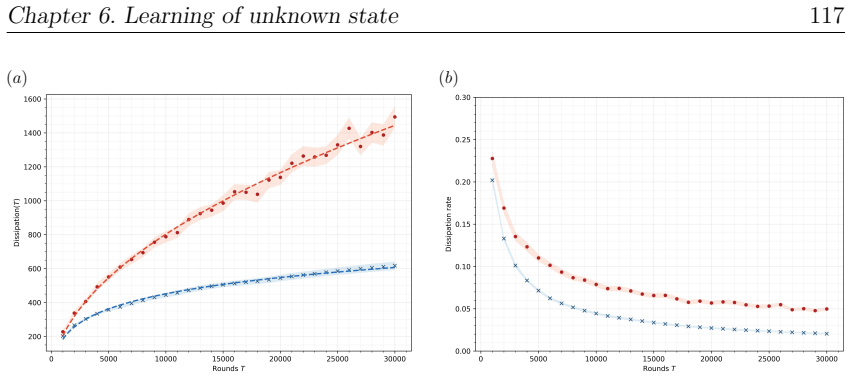
By modeling a classical agent that remembers past observations and adapts its future actions, the work shows that ρ*-ideal protocols let adaptive strategies surpass non-adaptive bounds; this is formalized by the Time-Ordered Free Energy bound, which quantifies a gap linked to adaptive ordered discord and is complemented by a reinforcement-learning procedure that simultaneously learns an unknown i.i.d. quantum state and extracts work with only polylogarithmic total dissipation.
What carries the argument
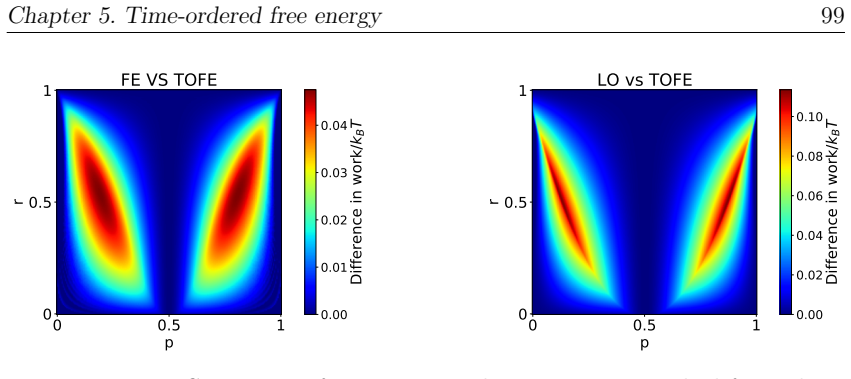
The Time-Ordered Free Energy (TOFE), a novel upper bound on work obtainable from causal, adaptive operations that accounts for memory effects and reveals the thermodynamic cost of adaptive ordered discord.
If this is right
- Adaptive memory-using strategies can achieve higher work yields than memoryless ones in any system whose correlations are time-ordered.
- The thermodynamic gap quantified by the Time-Ordered Free Energy sets a concrete performance ceiling for causal agents.
- Reinforcement-learning agents can learn and extract work from unknown quantum sources without first performing full tomography.
- The framework separates the cost of inference from the cost of extraction, allowing quantitative comparison of different adaptive policies.
Where Pith is reading between the lines
- Extending the agent to possess limited quantum memory could close or widen the identified thermodynamic gap, depending on how the extra coherence interacts with the TOFE bound.
- The same decision-theoretic structure may apply to other tasks such as cooling or state preparation, not only work extraction.
- Testing the polylogarithmic scaling on near-term quantum hardware would require only repeated single-shot measurements and classical feedback, providing a low-overhead benchmark.
- If the TOFE bound proves tight, it supplies a practical design rule for scheduling adaptive measurements in quantum thermodynamic engines.
Load-bearing premise
The assumption that a classical agent without quantum memory can realize ρ*-ideal adaptive protocols without incurring thermodynamic costs outside those already captured by the Time-Ordered Free Energy bound.
What would settle it
An experiment or simulation in which an adaptive classical agent extracts strictly more work from a known quantum state with temporal correlations than the non-adaptive bound permits, or in which a reinforcement-learning agent achieves cumulative dissipation scaling as polylog N for an unknown i.i.d. source.
Figures










read the original abstract
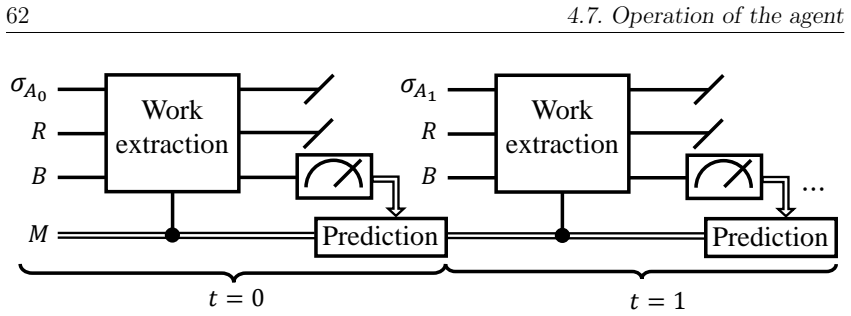
This thesis develops a decision-theoretic framework for extracting thermodynamic work from temporal correlations in quantum systems. We model a classical agent -- lacking quantum memory -- performing adaptive work extraction through continuous inference and decision-making under uncertainty. By introducing $\rho^*$-ideal protocols, we demonstrate that exploiting memory effects allows adaptive strategies to surpass non-adaptive bounds. We formalize this via the Time-Ordered Free Energy (TOFE), a novel upper bound for causal, adaptive operations that reveals a thermodynamic gap linked to adaptive ordered discord. Additionally, we tackle work extraction from unknown sources using reinforcement learning. By adapting multi-armed bandit algorithms, we show an agent can simultaneously learn an unknown i.i.d. quantum state and extract work, achieving polylogarithmic cumulative dissipation that significantly outperforms standard tomography. Overall, this work lays the foundation for predictive and learning-based quantum thermodynamics.
Editorial analysis
A structured set of objections, weighed in public.
Referee Report
Summary. The manuscript develops a decision-theoretic framework for thermodynamic work extraction from temporal correlations in quantum systems by a strictly classical agent lacking quantum memory. It introduces ρ*-ideal protocols to show that adaptive strategies exploiting memory effects can surpass non-adaptive bounds, formalized via the novel Time-Ordered Free Energy (TOFE) upper bound that quantifies a thermodynamic gap tied to adaptive ordered discord. It further applies reinforcement learning (adapted multi-armed bandit algorithms) to simultaneously learn an unknown i.i.d. quantum state and extract work, claiming polylogarithmic cumulative dissipation that outperforms standard tomography.
Significance. If the derivations are sound and the key modeling assumptions hold, this work could meaningfully connect quantum thermodynamics with decision theory and online learning, providing new bounds for adaptive causal operations and efficient protocols for unknown sources. The TOFE construction and RL performance claims, if independently grounded, would represent a concrete advance in handling temporal correlations without requiring quantum memory.
major comments (3)
- [Framework for ρ*-ideal protocols (near abstract and main derivation)] The central modeling assumption that ρ*-ideal protocols can be realized by a strictly classical, memoryless agent without incurring additional thermodynamic costs (e.g., measurement back-action or control overhead from continuous inference) not captured by TOFE is load-bearing for both the claimed advantage over non-adaptive bounds and the RL result. This requires explicit justification or an auxiliary bound in the section introducing ρ*-ideal protocols.
- [TOFE definition and proof] Derivation of the Time-Ordered Free Energy (TOFE) as an upper bound for causal adaptive operations: it must be shown whether TOFE is independently derived from the decision-theoretic axioms or reduces to a quantity fitted to the protocol class, as the latter would undermine the claimed thermodynamic gap linked to adaptive ordered discord.
- [Reinforcement learning application] The reinforcement learning result claiming polylogarithmic cumulative dissipation outperforming tomography: the protocol details, including how the agent handles quantum measurements on the unknown state and the precise error analysis or regret bound, need to be expanded to verify the scaling and the comparison.
minor comments (2)
- Ensure consistent notation for TOFE, ρ*, and related quantities across the manuscript and figures.
- Add explicit statements on the scope of the classical-agent assumption and any implicit costs in the protocol implementation.
Simulated Author's Rebuttal
We thank the referee for their constructive and detailed report. Their comments identify key areas where additional justification and expansion will strengthen the manuscript. We address each major comment below and commit to the indicated revisions.
read point-by-point responses
-
Referee: [Framework for ρ*-ideal protocols (near abstract and main derivation)] The central modeling assumption that ρ*-ideal protocols can be realized by a strictly classical, memoryless agent without incurring additional thermodynamic costs (e.g., measurement back-action or control overhead from continuous inference) not captured by TOFE is load-bearing for both the claimed advantage over non-adaptive bounds and the RL result. This requires explicit justification or an auxiliary bound in the section introducing ρ*-ideal protocols.
Authors: We agree that the implementation of ρ*-ideal protocols by a strictly classical agent requires explicit justification to rule out unaccounted costs. In the revised manuscript we will add a dedicated subsection following the definition of ρ*-ideal protocols. This subsection will (i) specify that the agent maintains only classical memory of measurement outcomes, (ii) model inference as a classical Bayesian update whose thermodynamic cost is already subsumed in the TOFE accounting of temporal correlations, and (iii) supply an auxiliary inequality showing that any residual control overhead is bounded by a term that vanishes in the thermodynamic limit, thereby preserving the claimed advantage. revision: yes
-
Referee: [TOFE definition and proof] Derivation of the Time-Ordered Free Energy (TOFE) as an upper bound for causal adaptive operations: it must be shown whether TOFE is independently derived from the decision-theoretic axioms or reduces to a quantity fitted to the protocol class, as the latter would undermine the claimed thermodynamic gap linked to adaptive ordered discord.
Authors: TOFE is obtained directly from the decision-theoretic axioms of causal adaptive operations (ordered information processing and the second law applied to time-ordered channels). It is not fitted to any particular protocol class; the gap quantified by adaptive ordered discord emerges as a consequence of the derivation. We will revise the TOFE section to present the derivation in explicit axiomatic steps, beginning from the causal decision axioms, proceeding through the definition of time-ordered extractable work, and arriving at the TOFE bound, thereby making the independence of the construction transparent. revision: yes
-
Referee: [Reinforcement learning application] The reinforcement learning result claiming polylogarithmic cumulative dissipation outperforming tomography: the protocol details, including how the agent handles quantum measurements on the unknown state and the precise error analysis or regret bound, need to be expanded to verify the scaling and the comparison.
Authors: We will substantially expand the reinforcement-learning section. The revised text will describe the adapted multi-armed-bandit protocol in full: the classical agent maintains a posterior over the unknown i.i.d. state, selects the next measurement basis to maximize expected work minus information gain, performs a projective measurement, and updates its belief with the classical outcome. We will include the complete regret analysis, deriving the polylogarithmic bound on cumulative dissipation and contrasting it with the linear sample complexity of full tomography. These additions will allow independent verification of the scaling claim. revision: yes
Circularity Check
No significant circularity detected; claims rest on independent formalization
full rationale
The paper introduces ρ*-ideal protocols and defines TOFE as a novel upper bound for causal adaptive operations, linking a thermodynamic gap to adaptive ordered discord. It further applies multi-armed bandit RL to achieve polylogarithmic dissipation on unknown i.i.d. states, outperforming tomography. No equations, self-citations, or derivations are shown that reduce TOFE, the adaptive advantage, or the RL bound to fitted inputs or prior self-referential results by construction. The modeling assumptions (classical memoryless agent, realizability of ρ*-ideal protocols) are explicit and external to the derivation chain itself. The work therefore remains self-contained against the stated non-adaptive benchmarks.
Axiom & Free-Parameter Ledger
axioms (2)
- domain assumption Quantum systems possess exploitable temporal correlations that affect thermodynamic work extraction
- domain assumption A classical agent can perform continuous inference and adaptive decisions without quantum memory
invented entities (2)
-
ρ*-ideal protocols
no independent evidence
-
Time-Ordered Free Energy (TOFE)
no independent evidence
Lean theorems connected to this paper
-
IndisputableMonolith/Cost/FunctionalEquation.leanwashburn_uniqueness_aczel unclear?
unclearRelation between the paper passage and the cited Recognition theorem.
We introduce a family of ρ*-ideal protocols … Time-Ordered Free Energy (TOFE) … adaptive ordered discord … multi-armed bandit algorithms … polylogarithmic cumulative dissipation
-
IndisputableMonolith/Foundation/ArithmeticFromLogic.leanphi_golden_ratio echoes?
echoesECHOES: this paper passage has the same mathematical shape or conceptual pattern as the Recognition theorem, but is not a direct formal dependency.
2-1 golden-mean process … perturbed-coin process
-
IndisputableMonolith/Foundation/BranchSelection.leanbranch_selection unclear?
unclearRelation between the paper passage and the cited Recognition theorem.
dynamic programming … backward induction … search space … optimality of DP
What do these tags mean?
- matches
- The paper's claim is directly supported by a theorem in the formal canon.
- supports
- The theorem supports part of the paper's argument, but the paper may add assumptions or extra steps.
- extends
- The paper goes beyond the formal theorem; the theorem is a base layer rather than the whole result.
- uses
- The paper appears to rely on the theorem as machinery.
- contradicts
- The paper's claim conflicts with a theorem or certificate in the canon.
- unclear
- Pith found a possible connection, but the passage is too broad, indirect, or ambiguous to say the theorem truly supports the claim.
Reference graph
Works this paper leans on
-
[1]
Identifying functional thermodynamics in autonomous maxwellian ratchets.New Journal of Physics, 18(2):023049, 2016
Alexander B Boyd, Dibyendu Mandal, and James P Crutchfield. Identifying functional thermodynamics in autonomous maxwellian ratchets.New Journal of Physics, 18(2):023049, 2016
2016
-
[2]
Optical quan- tum memory.Nature photonics, 3(12):706–714, 2009
Alexander I Lvovsky, Barry C Sanders, and Wolfgang Tittel. Optical quan- tum memory.Nature photonics, 3(12):706–714, 2009
2009
-
[3]
Quantum mem- ories: emerging applications and recent advances.Journal of modern optics, 63(20):2005–2028, 2016
Khabat Heshami, Duncan G England, Peter C Humphreys, Philip J Bustard, Victor M Acosta, Joshua Nunn, and Benjamin J Sussman. Quantum mem- ories: emerging applications and recent advances.Journal of modern optics, 63(20):2005–2028, 2016
2005
-
[4]
Thermodynamics and an introduction to thermostatistics
Herbert B Callen. Thermodynamics and an introduction to thermostatistics. John Wiley& Sons, 2, 1980
1980
-
[5]
Oup Oxford, 2010
Stephen J Blundell and Katherine M Blundell.Concepts in thermal physics. Oup Oxford, 2010
2010
-
[6]
Oxford University Press, 2021
James P Sethna.Statistical mechanics: entropy, order parameters, and com- plexity, volume 14. Oxford University Press, 2021
2021
-
[7]
Courier Corporation, 2012
James Clerk Maxwell.Theory of heat. Courier Corporation, 2012
2012
-
[8]
¨Uber die entropieverminderung in einem thermodynamischen system bei eingriffen intelligenter wesen.Zeitschrift f¨ ur Physik, 53(11):840– 856, 1929
Leo Szilard. ¨Uber die entropieverminderung in einem thermodynamischen system bei eingriffen intelligenter wesen.Zeitschrift f¨ ur Physik, 53(11):840– 856, 1929
1929
-
[9]
Irreversibility and heat generation in the computing process
Rolf Landauer. Irreversibility and heat generation in the computing process. IBM journal of research and development, 5(3):183–191, 1961
1961
-
[10]
The thermodynamics of computation—a review.Inter- national Journal of Theoretical Physics, 21:905–940, 1982
Charles H Bennett. The thermodynamics of computation—a review.Inter- national Journal of Theoretical Physics, 21:905–940, 1982
1982
-
[11]
Thermodynamic cost of computation, algorithmic com- plexity and the information metric.Nature, 341(6238):119–124, 1989
Wojciech H Zurek. Thermodynamic cost of computation, algorithmic com- plexity and the information metric.Nature, 341(6238):119–124, 1989
1989
-
[12]
Col- loquium: Non-markovian dynamics in open quantum systems.Reviews of Modern Physics, 88(2):021002, 2016
Heinz-Peter Breuer, Elsi-Mari Laine, Jyrki Piilo, and Bassano Vacchini. Col- loquium: Non-markovian dynamics in open quantum systems.Reviews of Modern Physics, 88(2):021002, 2016. 127 128BIBLIOGRAPHY
2016
-
[13]
Mem- ory effects in quantum dynamics modelled by quantum renewal processes
Nina Megier, Manuel Ponzi, Andrea Smirne, and Bassano Vacchini. Mem- ory effects in quantum dynamics modelled by quantum renewal processes. Entropy, 23(7):905, 2021
2021
-
[14]
Memory correc- tions to markovian langevin dynamics.Entropy, 26(5):425, 2024
Mateusz Wi´ sniewski, Jerzy Luczka, and Jakub Spiechowicz. Memory correc- tions to markovian langevin dynamics.Entropy, 26(5):425, 2024
2024
-
[15]
Leveraging environmental correlations: The thermodynamics of requisite variety.Journal of Statistical Physics, 167:1555–1585, 2017
Alexander B Boyd, Dibyendu Mandal, and James P Crutchfield. Leveraging environmental correlations: The thermodynamics of requisite variety.Journal of Statistical Physics, 167:1555–1585, 2017
2017
-
[16]
Infor- mation processing second law for an information ratchet with finite tape
Lianjie He, Andri Pradana, Jian Wei Cheong, and Lock Yue Chew. Infor- mation processing second law for an information ratchet with finite tape. Physical Review E, 105(5):054131, 2022
2022
-
[17]
The proper formula for relative entropy and its asymptotics in quantum probability.Communications in mathematical physics, 143:99–114, 1991
Fumio Hiai and D´ enes Petz. The proper formula for relative entropy and its asymptotics in quantum probability.Communications in mathematical physics, 143:99–114, 1991
1991
-
[18]
Discriminating states: The quantum chernoff bound.Physical review letters, 98(16):160501, 2007
Koenraad MR Audenaert, John Calsamiglia, Ram´ on Munoz-Tapia, Emilio Bagan, Ll Masanes, Antonio Acin, and Frank Verstraete. Discriminating states: The quantum chernoff bound.Physical review letters, 98(16):160501, 2007
2007
-
[20]
Learning pure quantum states (almost) without regret
Josep Lumbreras, Mikhail Terekhov, and Marco Tomamichel. Learning pure quantum states (almost) without regret.arXiv preprint arXiv:2406.18370, 2024
-
[21]
Cambridge university press, 2010
Michael A Nielsen and Isaac L Chuang.Quantum computation and quantum information. Cambridge university press, 2010
2010
-
[22]
Cambridge university press, 2013
Mark M Wilde.Quantum information theory. Cambridge university press, 2013
2013
-
[23]
Positive functions on c*-algebras.Proceedings of the American Mathematical Society, 6(2):211–216, 1955
W Forrest Stinespring. Positive functions on c*-algebras.Proceedings of the American Mathematical Society, 6(2):211–216, 1955
1955
-
[24]
Quantum discord: a measure of the quantumness of correlations.Physical review letters, 88(1):017901, 2001
Harold Ollivier and Wojciech H Zurek. Quantum discord: a measure of the quantumness of correlations.Physical review letters, 88(1):017901, 2001
2001
-
[25]
Classical, quantum and total correla- tions.Journal of physics A: mathematical and general, 34(35):6899, 2001
Leah Henderson and Vlatko Vedral. Classical, quantum and total correla- tions.Journal of physics A: mathematical and general, 34(35):6899, 2001. BIBLIOGRAPHY129
2001
-
[26]
Quantum discord, local operations, and maxwell’s demons.Physical Review A—Atomic, Molecular, and Optical Physics, 81(6):062103, 2010
Aharon Brodutch and Daniel R Terno. Quantum discord, local operations, and maxwell’s demons.Physical Review A—Atomic, Molecular, and Optical Physics, 81(6):062103, 2010
2010
-
[27]
Necessary and suffi- cient condition for nonzero quantum discord.Physical review letters, 105 (19):190502, 2010
Borivoje Daki´ c, Vlatko Vedral, and ˇCaslav Brukner. Necessary and suffi- cient condition for nonzero quantum discord.Physical review letters, 105 (19):190502, 2010
2010
-
[28]
The classical-quantum boundary for correlations:¡? format?¿ discord and related measures.Reviews of Modern Physics, 84(4):1655–1707, 2012
Kavan Modi, Aharon Brodutch, Hugo Cable, Tomasz Paterek, and Vlatko Vedral. The classical-quantum boundary for correlations:¡? format?¿ discord and related measures.Reviews of Modern Physics, 84(4):1655–1707, 2012
2012
-
[29]
Quantum discord and maxwell’s demons.Physical Review A, 67(1):012320, 2003
Wojciech Hubert Zurek. Quantum discord and maxwell’s demons.Physical Review A, 67(1):012320, 2003
2003
-
[30]
Passive states and kms states for general quantum systems.Communications in Mathematical Physics, 58: 273–290, 1978
Wies law Pusz and Stanis law L Woronowicz. Passive states and kms states for general quantum systems.Communications in Mathematical Physics, 58: 273–290, 1978
1978
-
[31]
Maximal work extraction from finite quantum systems.Europhysics Letters, 67(4): 565, 2004
Armen E Allahverdyan, Roger Balian, and Th M Nieuwenhuizen. Maximal work extraction from finite quantum systems.Europhysics Letters, 67(4): 565, 2004
2004
-
[32]
Fundamental limitations for quantum and nanoscale thermodynamics.Nature communications, 4(1):2059, 2013
Micha l Horodecki and Jonathan Oppenheim. Fundamental limitations for quantum and nanoscale thermodynamics.Nature communications, 4(1):2059, 2013
2059
-
[33]
Truly work-like work extraction via a single-shot analysis
Johan ˚Aberg. Truly work-like work extraction via a single-shot analysis. Nature communications, 4(1):1925, 2013
1925
-
[34]
The second laws of quantum thermodynamics.Proceed- ings of the National Academy of Sciences, 112(11):3275–3279, 2015
Fernando Brandao, Micha l Horodecki, Nelly Ng, Jonathan Oppenheim, and Stephanie Wehner. The second laws of quantum thermodynamics.Proceed- ings of the National Academy of Sciences, 112(11):3275–3279, 2015
2015
-
[35]
Thermodynamic cost of reliability and low temperatures: Tightening lan- dauer’s principle and the second law.International Journal of Theoretical Physics, 39:2717–2753, 2000
Dominik Janzing, Pawel Wocjan, Robert Zeier, Rubino Geiss, and Th Beth. Thermodynamic cost of reliability and low temperatures: Tightening lan- dauer’s principle and the second law.International Journal of Theoretical Physics, 39:2717–2753, 2000
2000
-
[36]
Resource theory of quantum states out of thermal equilibrium.Physical review letters, 111(25):250404, 2013
Fernando GSL Brandao, Micha l Horodecki, Jonathan Oppenheim, Joseph M Renes, and Robert W Spekkens. Resource theory of quantum states out of thermal equilibrium.Physical review letters, 111(25):250404, 2013
2013
-
[37]
Quantum coherence, time-translation symmetry, and thermodynamics.Phys- ical review X, 5(2):021001, 2015
Matteo Lostaglio, Kamil Korzekwa, David Jennings, and Terry Rudolph. Quantum coherence, time-translation symmetry, and thermodynamics.Phys- ical review X, 5(2):021001, 2015
2015
-
[38]
The extraction of work from quantum coherence.New Journal of Physics, 18(2):023045, 2016
Kamil Korzekwa, Matteo Lostaglio, Jonathan Oppenheim, and David Jen- nings. The extraction of work from quantum coherence.New Journal of Physics, 18(2):023045, 2016. 130BIBLIOGRAPHY
2016
-
[39]
The minimal work cost of information processing.Nature communications, 6(1):7669, 2015
Philippe Faist, Fr´ ed´ eric Dupuis, Jonathan Oppenheim, and Renato Renner. The minimal work cost of information processing.Nature communications, 6(1):7669, 2015
2015
-
[40]
The resource theory of informational nonequi- librium in thermodynamics.Physics Reports, 583:1–58, 2015
Gilad Gour, Markus P M¨ uller, Varun Narasimhachar, Robert W Spekkens, and Nicole Yunger Halpern. The resource theory of informational nonequi- librium in thermodynamics.Physics Reports, 583:1–58, 2015
2015
-
[41]
A fully quantum asymptotic equipartition property.IEEE Transactions on information the- ory, 55(12):5840–5847, 2009
Marco Tomamichel, Roger Colbeck, and Renato Renner. A fully quantum asymptotic equipartition property.IEEE Transactions on information the- ory, 55(12):5840–5847, 2009
2009
-
[42]
Kaito Watanabe and Ryuji Takagi. Black box work extraction and com- posite hypothesis testing.Physical Review Letters, 133(25):250401, 2024. doi: 10.1103/PhysRevLett.133.250401. URLhttps://doi.org/10.1103/ PhysRevLett.133.250401
-
[43]
Universal work extraction in quantum thermodynamics.arXiv preprint arXiv:2504.12373, 2025
Kaito Watanabe and Ryuji Takagi. Universal work extraction in quantum thermodynamics.arXiv preprint arXiv:2504.12373, 2025
-
[44]
Extractable work from correlations.Physical Review X, 5(4):041011, 2015
Mart´ ı Perarnau-Llobet, Karen V Hovhannisyan, Marcus Huber, Paul Skrzypczyk, Nicolas Brunner, and Antonio Ac´ ın. Extractable work from correlations.Physical Review X, 5(4):041011, 2015
2015
-
[45]
Entanglement boost for extractable work from ensembles of quantum batteries.Physical Review E—Statistical, Non- linear, and Soft Matter Physics, 87(4):042123, 2013
Robert Alicki and Mark Fannes. Entanglement boost for extractable work from ensembles of quantum batteries.Physical Review E—Statistical, Non- linear, and Soft Matter Physics, 87(4):042123, 2013
2013
-
[46]
Quantum sequential hypothesis testing.Physical review letters, 126(18):180502, 2021
Esteban Mart´ ınez Vargas, Christoph Hirche, Gael Sent´ ıs, Michalis Skotinio- tis, Marta Carrizo, Ramon Mu˜ noz-Tapia, and John Calsamiglia. Quantum sequential hypothesis testing.Physical review letters, 126(18):180502, 2021
2021
-
[47]
John Wiley & Sons, 1999
Thomas M Cover.Elements of information theory. John Wiley & Sons, 1999
1999
-
[48]
A tutorial on hidden markov models and selected applications in speech recognition.Proceedings of the IEEE, 77(2):257–286, 1989
Lawrence R Rabiner. A tutorial on hidden markov models and selected applications in speech recognition.Proceedings of the IEEE, 77(2):257–286, 1989
1989
-
[49]
Computational mechan- ics: Pattern and prediction, structure and simplicity.Journal of statistical physics, 104:817–879, 2001
Cosma Rohilla Shalizi and James P Crutchfield. Computational mechan- ics: Pattern and prediction, structure and simplicity.Journal of statistical physics, 104:817–879, 2001
2001
-
[50]
Spectral simplicity of apparent complexity
Paul M Riechers and James P Crutchfield. Spectral simplicity of apparent complexity. i. the nondiagonalizable metadynamics of prediction.Chaos: An Interdisciplinary Journal of Nonlinear Science, 28(3), 2018
2018
-
[51]
Shannon entropy rate of hidden markov processes.Journal of Statistical Physics, 183(2):32, 2021
Alexandra M Jurgens and James P Crutchfield. Shannon entropy rate of hidden markov processes.Journal of Statistical Physics, 183(2):32, 2021. BIBLIOGRAPHY131
2021
-
[52]
Introduction to automata theory, languages, and computation.Acm Sigact News, 32(1):60– 65, 2001
John E Hopcroft, Rajeev Motwani, and Jeffrey D Ullman. Introduction to automata theory, languages, and computation.Acm Sigact News, 32(1):60– 65, 2001
2001
-
[53]
Finite-state con- trollers based on mealy machines for centralized and decentralized pomdps
Christopher Amato, Blai Bonet, and Shlomo Zilberstein. Finite-state con- trollers based on mealy machines for centralized and decentralized pomdps. InProceedings of the AAAI Conference on Artificial Intelligence, volume 24, pages 1052–1058, 2010
2010
-
[54]
Inferring statistical complexity.Phys- ical review letters, 63(2):105, 1989
James P Crutchfield and Karl Young. Inferring statistical complexity.Phys- ical review letters, 63(2):105, 1989
1989
-
[55]
Time’s barbed arrow: Irreversibility, crypticity, and stored information.Physical review letters, 103(9):094101, 2009
James P Crutchfield, Christopher J Ellison, and John R Mahoney. Time’s barbed arrow: Irreversibility, crypticity, and stored information.Physical review letters, 103(9):094101, 2009
2009
-
[56]
James P Crutchfield, Christopher J Ellison, Ryan G James, and John R Ma- honey. Synchronization and control in intrinsic and designed computation: An information-theoretic analysis of competing models of stochastic com- putation.Chaos: An Interdisciplinary Journal of Nonlinear Science, 20(3), 2010
2010
-
[57]
Prediction, retrodiction, and the amount of information stored in the present.Journal of Statistical Physics, 136(6):1005–1034, 2009
Christopher J Ellison, John R Mahoney, and James P Crutchfield. Prediction, retrodiction, and the amount of information stored in the present.Journal of Statistical Physics, 136(6):1005–1034, 2009
2009
-
[58]
Ariadna E Venegas-Li, Alexandra M Jurgens, and James P Crutchfield. Measurement-induced randomness and structure in controlled qubit pro- cesses.Physical Review E, 102(4):040102, 2020. doi: 10.1103/PhysRevE. 102.040102. URLhttps://doi.org/10.1103/PhysRevE.102.040102
-
[59]
Optimality and complexity in measured quantum-state stochastic processes.Journal of Statistical Physics, 190(6):106, 2023
Ariadna Venegas-Li and James P Crutchfield. Optimality and complexity in measured quantum-state stochastic processes.Journal of Statistical Physics, 190(6):106, 2023
2023
-
[60]
Impossibility of achieving Landauer’s bound for almost every quantum state.Phys
Paul M Riechers and Mile Gu. Impossibility of achieving Landauer’s bound for almost every quantum state.Phys. Rev. A, 104:012214, Jul 2021. doi: 10. 1103/PhysRevA.104.012214. URLhttps://link.aps.org/doi/10.1103/ PhysRevA.104.012214
2021
-
[61]
Dominik ˇSafr´ anek, Dario Rosa, and Felix C. Binder. Work extraction from unknown quantum sources.Phys. Rev. Lett., 130:210401, May 2023. doi: 10.1103/PhysRevLett.130.210401. URLhttps://link.aps.org/doi/10. 1103/PhysRevLett.130.210401
-
[62]
Ther- modynamics of information.Nature physics, 11(2):131–139, 2015
Juan MR Parrondo, Jordan M Horowitz, and Takahiro Sagawa. Ther- modynamics of information.Nature physics, 11(2):131–139, 2015. doi: 10.1038/nphys3230. URLhttps://doi.org/10.1038/nphys3230. 132BIBLIOGRAPHY
-
[63]
Second law of thermodynamics for batteries with vacuum state.Quantum, 5:408, 2021
Patryk Lipka-Bartosik, Pawe l Mazurek, and Micha l Horodecki. Second law of thermodynamics for batteries with vacuum state.Quantum, 5:408, 2021
2021
-
[64]
Johan ˚Aberg. Catalytic coherence.Phys. Rev. Lett., 113:150402, Oct 2014. doi: 10.1103/PhysRevLett.113.150402. URLhttps://link.aps.org/doi/ 10.1103/PhysRevLett.113.150402
-
[65]
An improved landauer principle with finite- size corrections.New Journal of Physics, 16(10):103011, 2014
David Reeb and Michael M Wolf. An improved landauer principle with finite- size corrections.New Journal of Physics, 16(10):103011, 2014
2014
-
[66]
Implications of non-markovian quantum dynamics for the landauer bound.New Journal of Physics, 18(12):123018, 2016
Marco Pezzutto, Mauro Paternostro, and Yasser Omar. Implications of non-markovian quantum dynamics for the landauer bound.New Journal of Physics, 18(12):123018, 2016
2016
-
[67]
Initial-state dependence of thermodynamic dissipation for any quantum process.Physical Review E, 103(4):042145,
Paul M Riechers and Mile Gu. Initial-state dependence of thermodynamic dissipation for any quantum process.Physical Review E, 103(4):042145,
-
[68]
doi: 10.1103/PhysRevE.103.042145. URLhttps://doi.org/10. 1103/PhysRevE.103.042145
-
[70]
Finite-time quantum landauer principle and quantum coherence.Phys
Tan Van Vu and Keiji Saito. Finite-time quantum landauer principle and quantum coherence.Phys. Rev. Lett., 128:010602, Jan 2022. doi: 10.1103/PhysRevLett.128.010602. URLhttps://link.aps.org/doi/10. 1103/PhysRevLett.128.010602
-
[71]
Landauer versus nernst: What is the true cost of cooling a quantum system?PRX Quantum, 4(1):010332, 2023
Philip Taranto, Faraj Bakhshinezhad, Andreas Bluhm, Ralph Silva, Nicolai Friis, Maximilian PE Lock, Giuseppe Vitagliano, Felix C Binder, Tiago De- barba, Emanuel Schwarzhans, et al. Landauer versus nernst: What is the true cost of cooling a quantum system?PRX Quantum, 4(1):010332, 2023
2023
-
[72]
Strang.Calculus
G. Strang.Calculus. Wellesley-Cambridge Press, 2019. ISBN 9780980232752. URLhttps://www.cambridge.org/us/universitypress/subjects/ mathematics/real-and-complex-analysis/calculus-3rd-edition-1
2019
-
[73]
Quantifying coherence.Physical review letters, 113(14):140401, 2014
Tillmann Baumgratz, Marcus Cramer, and Martin B Plenio. Quantifying coherence.Physical review letters, 113(14):140401, 2014
2014
-
[74]
Mischa P. Woods and Micha l Horodecki. Autonomous quantum devices: When are they realizable without additional thermodynamic costs?Phys. Rev. X, 13:011016, Feb 2023. doi: 10.1103/PhysRevX.13.011016. URL https://link.aps.org/doi/10.1103/PhysRevX.13.011016
-
[75]
Unified view of quantum and classical correlations.Phys
Kavan Modi, Tomasz Paterek, Wonmin Son, Vlatko Vedral, and Mark Williamson. Unified view of quantum and classical correlations.Phys. Rev. Lett., 104:080501, Feb 2010. doi: 10.1103/PhysRevLett.104.080501. URL https://link.aps.org/doi/10.1103/PhysRevLett.104.080501. BIBLIOGRAPHY133
-
[76]
Work extraction and thermodynamics for individual quantum systems.Nature communica- tions, 5, 2014
Paul Skrzypczyk, Anthony J Short, and Sandu Popescu. Work extraction and thermodynamics for individual quantum systems.Nature communica- tions, 5, 2014. doi: 10.1038/ncomms5185. URLhttps://doi.org/10.1038/ ncomms5185
-
[77]
Quantum and information thermodynamics: A unifying framework based on repeated interactions.Phys
Philipp Strasberg, Gernot Schaller, Tobias Brandes, and Massimiliano Es- posito. Quantum and information thermodynamics: A unifying framework based on repeated interactions.Phys. Rev. X, 7:021003, Apr 2017. doi: 10.1103/PhysRevX.7.021003. URLhttps://link.aps.org/doi/10.1103/ PhysRevX.7.021003
-
[78]
Dibyendu Mandal and Christopher Jarzynski. Work and information pro- cessing in a solvable model of Maxwell’s demon.Proceedings of the Na- tional Academy of Sciences, 109(29):11641–11645, 2012. doi: 10.1073/pnas. 1204263109. URLhttps://doi.org/10.1073/pnas.1204263109
-
[79]
Boyd, Dibyendu Mandal, and James P
Alexander B. Boyd, Dibyendu Mandal, and James P. Crutchfield. Correlation-powered information engines and the thermodynamics of self- correction.Phys. Rev. E, 95:012152, Jan 2017. doi: 10.1103/PhysRevE.95. 012152. URLhttps://link.aps.org/doi/10.1103/PhysRevE.95.012152
-
[80]
Transient dissipation and structural costs of physical information trans- duction.Physical review letters, 118(22):220602, 2017
Alexander B Boyd, Dibyendu Mandal, Paul M Riechers, and James P Crutch- field. Transient dissipation and structural costs of physical information trans- duction.Physical review letters, 118(22):220602, 2017
2017
-
[81]
Measurement of quantum mechanical operators.Physical Review, 120(2):622, 1960
Huzihiro Araki and Mutsuo M Yanase. Measurement of quantum mechanical operators.Physical Review, 120(2):622, 1960
1960
-
[82]
Pomdp inference and robust solution via deep reinforcement learning: An application to railway optimal maintenance.Machine Learning, 113(10):7967–7995, 2024
Giacomo Arcieri, Cyprien Hoelzl, Oliver Schwery, Daniel Straub, Konstanti- nos G Papakonstantinou, and Eleni Chatzi. Pomdp inference and robust solution via deep reinforcement learning: An application to railway optimal maintenance.Machine Learning, 113(10):7967–7995, 2024
2024
discussion (0)
Sign in with ORCID, Apple, or X to comment. Anyone can read and Pith papers without signing in.