Recognition: no theorem link
Continuous thermochemical sources of AlF molecules
Pith reviewed 2026-05-10 19:38 UTC · model grok-4.3
The pith
A compact oven using thermochemical reaction produces continuous high-brightness AlF molecular beams.
A machine-rendered reading of the paper's core claim, the machinery that carries it, and where it could break.
Core claim
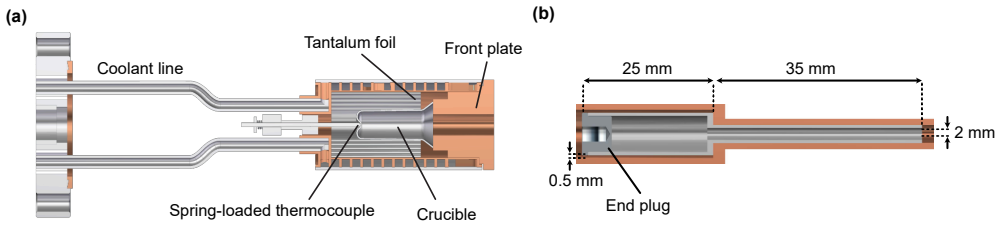
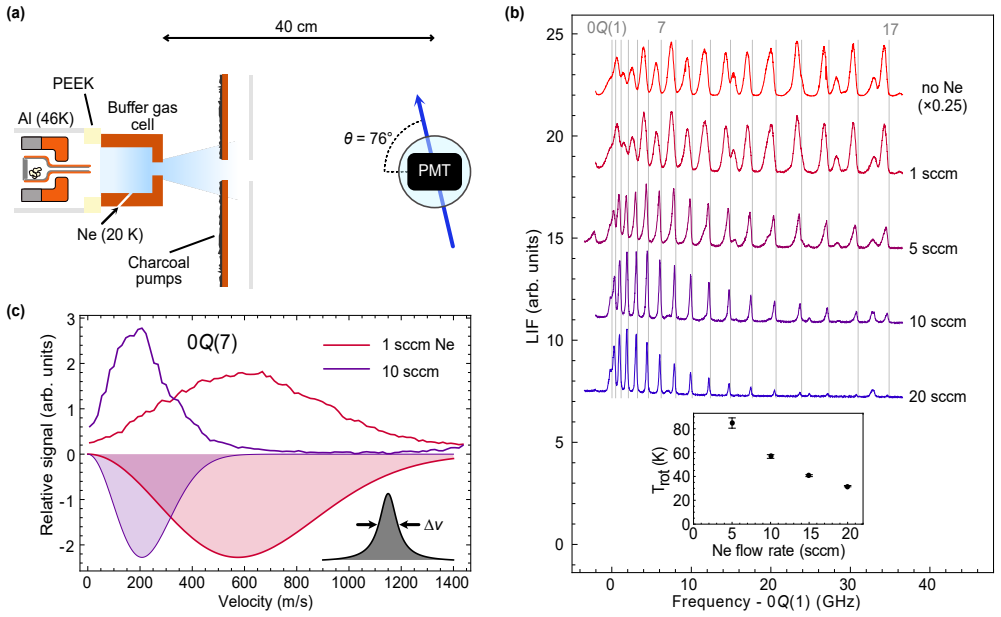
The central discovery is that a thermochemical reaction between sublimated aluminum trifluoride and aluminum metal enables continuous sources of AlF. A compact oven achieves total far-field brightness of 5×10^{15} molecules per steradian per second just below aluminum's melting point. Delivering flux into a cryogenic Ne buffer gas cell lowers rotational temperature to around 30 K and velocity to 200 ms^{-1}. AlF can also be produced in a dispenser package, and the vapour thermalises after wall collisions, potentially enabling direct MOT loading.
What carries the argument
The thermochemical reaction between aluminum trifluoride and aluminum metal that continuously generates AlF in a molecular beam oven.
If this is right
- The continuous oven output exceeds the peak brightness of jet-cooled ablation-based supersonic AlF sources for the v=0, J=7 level.
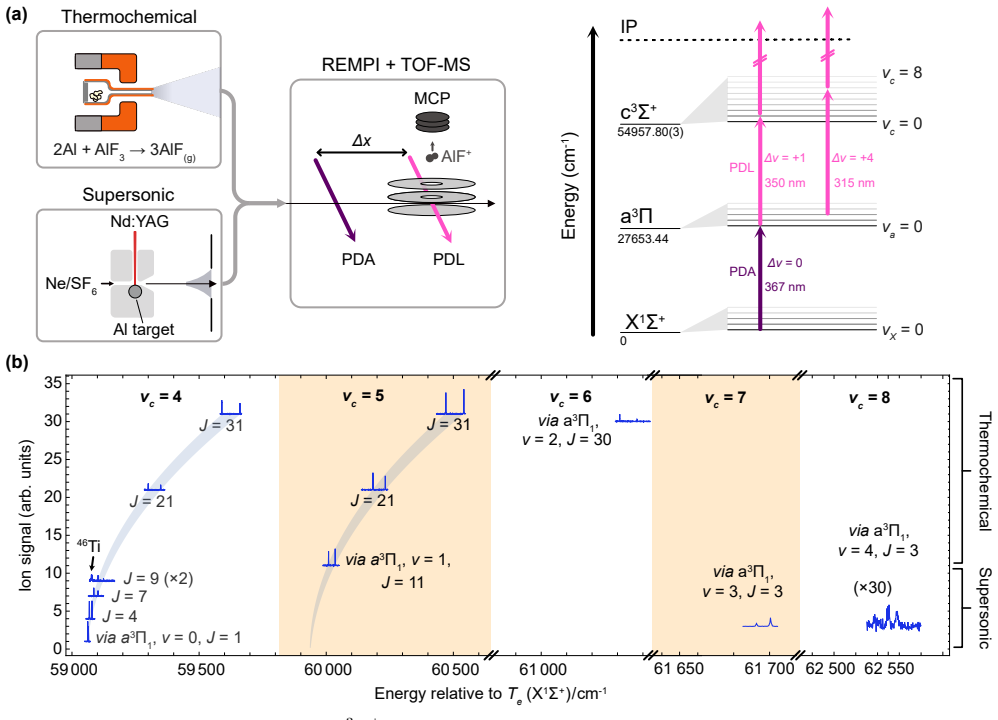
- High signal-to-noise ratios are obtained in pulsed laser ionisation spectroscopy experiments using the oven.
- Buffer gas cooling reduces rotational temperature and forward velocity, improving conditions for laser cooling and trapping.
- Simple dispenser production and wall thermalization enable transient AlF vapour for direct molecular magneto-optical trap loading.
Where Pith is reading between the lines
- This continuous source could reduce the need for pulsed ablation in AlF experiments, allowing longer integration times.
- Combining thermochemical production with buffer gas cells might achieve higher molecular phase space densities for trapping.
- Wall thermalization suggests that AlF could be used in room-temperature vapour cell experiments after initial production.
Load-bearing premise
The thermochemical reaction produces AlF efficiently and continuously without reactant depletion or contaminant introduction that would degrade beam quality over time.
What would settle it
A significant decrease in beam brightness or increase in contaminants over hours of operation would indicate that the continuous production claim does not hold.
Figures



read the original abstract
The AlF molecule, currently subject to laser cooling and trapping efforts, has the advantage that it can be efficiently produced in a thermochemical reaction between sublimated aluminum trifluoride and aluminum metal. Here we present a series of experiments with continuous molecular beam sources of AlF, utilising this reaction. We demonstrate a compact AlF molecular beam oven whose total far-field brightness is $5\times 10^{15}$ molecules per steradian per second at 923~K, just below the melting temperature of aluminum metal. The continuous output from the oven begins to exceed the peak brightness of a jet-cooled, ablation-based supersonic AlF source for the $v=0$, $J=7$ level, and we obtain an excellent signal-to-noise ratio with the oven in pulsed laser ionisation spectroscopy experiments. By delivering flux from the oven into a cryogenic Ne buffer gas cell, we lower the rotational temperature of the beam to around 30~K and reduce its most probable forward velocity from 600~ms$^{-1}$ to 200~ms$^{-1}$. In addition, we demonstrate that AlF can be made in a simple dispenser package, and observe that molecules thermalise to the laboratory temperature after colliding with vacuum chamber walls of the experiment. The resulting transient AlF vapour may enable direct loading of a molecular magneto-optical trap.
Editorial analysis
A structured set of objections, weighed in public.
Referee Report
Summary. The paper reports experiments on continuous thermochemical production of AlF molecules via reaction of sublimated AlF3 with Al metal. It describes a compact oven source with measured far-field brightness of 5×10^{15} molecules sr^{-1} s^{-1} at 923 K, shows that this exceeds the peak brightness of a pulsed ablation source for the v=0, J=7 level, demonstrates delivery into a cryogenic Ne buffer-gas cell to achieve ~30 K rotational temperature and 200 m s^{-1} forward velocity, and presents a simple dispenser source in which AlF thermalizes to lab temperature after wall collisions, with potential for direct MOT loading.
Significance. If the continuous operation and beam quality are robustly verified, the work supplies a stable, high-brightness alternative to ablation-based sources for AlF, which is currently targeted for laser cooling. The reported brightness, buffer-gas cooling results, and dispenser concept could improve signal-to-noise in spectroscopy and open routes to steady-state molecular trapping experiments.
major comments (2)
- [oven performance and results sections] The central claim of a 'continuous' source (title, abstract, and oven-performance section) rests on the thermochemical reaction producing steady flux without rapid depletion, passivation, or contamination. However, the manuscript provides no quantitative data on integrated mass loss versus total delivered molecules, no multi-hour stability traces of the ionization signal, and no residual-gas analysis or impurity spectroscopy to bound contaminant levels. This leaves the continuous descriptor as an extrapolation from short-term operation rather than a demonstrated property.
- [results on brightness comparison] The brightness comparison to the ablation-based supersonic source (abstract and results) states that the oven exceeds peak brightness for v=0, J=7, but lacks explicit details on normalization (e.g., how the far-field brightness is integrated, what fraction of the beam is in that level, and error bars on both measurements). This comparison is load-bearing for the claimed advantage over existing sources.
minor comments (2)
- [abstract] The abstract states specific numerical outcomes (brightness, temperature, velocity) without accompanying uncertainties or references to the relevant figures/tables; adding these would improve clarity.
- [throughout] Notation for units (e.g., 'ms^{-1}' instead of 'm s^{-1}') and temperature reporting (923 K vs. 'around 30 K') should be standardized for consistency.
Simulated Author's Rebuttal
We thank the referee for their careful reading and constructive comments. We address the major points below, acknowledging where the manuscript can be strengthened with additional clarification or data discussion.
read point-by-point responses
-
Referee: [oven performance and results sections] The central claim of a 'continuous' source (title, abstract, and oven-performance section) rests on the thermochemical reaction producing steady flux without rapid depletion, passivation, or contamination. However, the manuscript provides no quantitative data on integrated mass loss versus total delivered molecules, no multi-hour stability traces of the ionization signal, and no residual-gas analysis or impurity spectroscopy to bound contaminant levels. This leaves the continuous descriptor as an extrapolation from short-term operation rather than a demonstrated property.
Authors: We agree that quantitative long-term stability data would strengthen the continuous-operation claim. The thermochemical reaction between sublimated AlF3 and Al metal is inherently suited to steady production without rapid passivation or depletion under the reported conditions, and our short-term ionization signals remained stable over the duration of individual runs (typically several hours) with no observable drop in flux. However, the manuscript does not include integrated mass-loss measurements, multi-hour traces, or dedicated impurity analysis. We will revise the oven-performance section to add an estimate of operational lifetime based on the loaded material quantities and measured flux, include any available short-term stability records, and note the clean AlF spectral features observed without obvious contaminant lines. Full multi-hour traces would require additional dedicated experiments. revision: partial
-
Referee: [results on brightness comparison] The brightness comparison to the ablation-based supersonic source (abstract and results) states that the oven exceeds peak brightness for v=0, J=7, but lacks explicit details on normalization (e.g., how the far-field brightness is integrated, what fraction of the beam is in that level, and error bars on both measurements). This comparison is load-bearing for the claimed advantage over existing sources.
Authors: We thank the referee for highlighting the need for clearer normalization details. The far-field brightness of 5×10^{15} molecules sr^{-1} s^{-1} was obtained by calibrating the integrated ion signal from a pulsed laser ionization scheme against the known collection solid angle and detector efficiency. For the v=0, J=7 comparison, the population fraction was calculated from the measured rotational temperature using the Boltzmann distribution at the oven temperature of 923 K. We will add an explicit paragraph in the results section describing the integration over the far-field solid angle, the exact Boltzmann fraction for J=7, the calibration procedure, and error bars derived from signal fluctuations and repeated measurements on both sources. revision: yes
Circularity Check
No circularity: purely experimental report with direct measurements
full rationale
The manuscript presents experimental construction and characterization of an AlF molecular beam oven based on thermochemical reaction between AlF3 and Al metal. All quantitative claims (brightness of 5e15 sr^-1 s^-1, rotational temperature ~30 K, velocity reduction to 200 m/s) are direct observations from the apparatus, with no equations, fitted parameters, predictions, or derivations that could reduce to inputs by construction. No self-citations are invoked to justify uniqueness or load-bearing steps, and the work contains no mathematical modeling chain. This is a standard experimental methods paper whose results stand on measured data rather than any internal derivation.
Axiom & Free-Parameter Ledger
Reference graph
Works this paper leans on
-
[1]
J. E. Padilla-Castillo, J. Cai, P. Agarwal, P. Kukreja, R. Thomas, B. G. Sartakov, S. Truppe, G. Meijer, and S. C. Wright. Magneto-optical trapping of aluminum monofluoride.Phys. Rev. Lett., 135:243401, 2025. doi:10.1103/ksnd-9fyf
-
[2]
P. Gross, C. Hayman, and D. L. Levi. The heats of formation of metal halides. aluminium fluoride.Trans. Faraday Soc., 50:477–480, 1954. doi:10.1039/TF9545000477
-
[3]
N. Walter, M. Doppelbauer, S. Schaller, X. Liu, R. Thomas, S. Wright, B. G. Sartakov, and G. Meijer. Triplet Rydberg states of aluminum monofluoride.The Journal of Physical Chemistry A, 128(14):2752–2762, 2024. doi:10.1021/acs.jpca.4c00611
-
[4]
N. R. Behera, A. K. Kanakati, S. Barik, S. Dutta, and G. Aravind. Photoelectron spectroscopy of metastable AlF− negative ion.The Journal of Chemical Physics, 163(2):024322, 2025. doi:10.1063/5.0278243
-
[5]
S. Truppe, S. Marx, S. Kray, M. Doppelbauer, S. Hofs¨ ass, H. C. Schewe, N. Walter, J. P´ erez-R´ ıos, B. G. Sartakov, and G. Meijer. Spectroscopic characterization of aluminum monofluoride with relevance to laser cooling and trapping.Phys. Rev. A, 100:052513, 2019. doi:10.1103/PhysRevA.100.052513
-
[6]
J. J. Gilijamse, S. Hoekstra, S. A. Meek, M. Mets¨ al¨ a, S. Y. T. van de Meerakker, G. Meijer, and G. C. Groenenboom. The radiative lifetime of metastable CO (a 3Π, v= 0).The Journal of Chemical Physics, 127 (22):221102, 2007. doi:10.1063/1.2813888
-
[7]
N. Walter, M. Doppelbauer, S. Marx, J. Seifert, X. Liu, J. P´ erez-R´ ıos, B. G. Sartakov, S. Truppe, and G. Meijer. Spectroscopic characterization of thea 3Π state of aluminum monofluoride.The Journal of Chemical Physics, 156(12):124306, 2022. doi:10.1063/5.0082601
-
[8]
J. F. Barry, D. J. McCarron, E. B. Norrgard, M. H. Steinecker, and D. DeMille. Magneto-optical trapping of a diatomic molecule.Nature, 512(7514):286–289, 2014. doi:10.1038/nature13634
-
[9]
S. Truppe, H. J. Williams, M. Hambach, L. Caldwell, N. J. Fitch, E. A. Hinds, B. E. Sauer, and M. R. Tarbutt. Molecules cooled below the Doppler limit.Nature Physics, 13(12):1173–1176, 2017. doi:10.1038/nphys4241. 13
-
[10]
L. Anderegg, B. L. Augenbraun, E. Chae, B. Hemmerling, N. R. Hutzler, A. Ravi, A. Collopy, J. Ye, W. Ket- terle, and J. M. Doyle. Radio Frequency Magneto-Optical Trapping of CaF with High Density.Physical Review Letters, 119(10):103201, 2017. doi:10.1103/PhysRevLett.119.103201
-
[11]
A. L. Collopy, S. Ding, Y. Wu, I. A. Finneran, L. Anderegg, B. L. Augenbraun, J. M. Doyle, and J. Ye. 3D Magneto-Optical Trap of Yttrium Monoxide.Physical Review Letters, 121(21):213201, 2018. doi:10.1103/PhysRevLett.121.213201
-
[12]
N. B. Vilas, C. Hallas, L. Anderegg, P. Robichaud, A. Winnicki, D. Mitra, and J. M. Doyle. Magneto-optical trapping and sub-Doppler cooling of a polyatomic molecule.Nature, 606(7912):70–74, 2022. doi:10.1038/s41586- 022-04620-5
-
[13]
Z. Zeng, S. Deng, S. Yang, and B. Yan. Three-Dimensional Magneto-Optical Trapping of Barium Monofluoride. Physical Review Letters, 133(14):143404, 2024. doi:10.1103/PhysRevLett.133.143404
-
[14]
Z. D. Lasner, A. Frenett, H. Sawaoka, L. Anderegg, B. Augenbraun, H. Lampson, M. Li, A. Lunstad, J. Mango, A. Nasir, T. Ono, T. Sakamoto, and J. M. Doyle. Magneto-Optical Trapping of a Heavy Polyatomic Molecule for Precision Measurement.Physical Review Letters, 134(8):083401, 2025. doi:10.1103/PhysRevLett.134.083401
-
[15]
N. R. Hutzler, H. I. Lu, and J. M. Doyle. The buffer gas beam: An intense, cold, and slow source for atoms and molecules.Chemical Reviews, 112(9):4803–4827, 2012. doi:10.1021/cr200362u. PMID: 22571401
-
[16]
W. D. Phillips and H. Metcalf. Laser deceleration of an atomic beam.Phys. Rev. Lett., 48:596–599, 1982. doi:10.1103/PhysRevLett.48.596
-
[17]
H. C. Ko, M. A. Greenbaum, J. A. Blauer, and M. Farber. The enthalpy of formation and entropy of Aluminum (I) Fluoride (g).The Journal of Physical Chemistry, 69(7):2311–2316, 1965. doi:10.1021/j100891a030
-
[18]
W. P. Witt and R. F. Barrow. The heat of sublimation of aluminium trifluoride and the heat of formation of aluminium monofluoride.Trans. Faraday Soc., 55:730–735, 1959. doi:10.1039/TF9595500730
-
[19]
C. B. Alcock, V. P. Itkin, and M. K. Horrigan. Vapour pressure equations for the metallic elements: 298–2500 K.Canadian Metallurgical Quarterly, 1984. doi:https://doi.org/10.1179/cmq.1984.23.3.309
-
[20]
A. K. Shukla, S. Banik, R. S. Dhaka, C. Biswas, S. R. Barman, and H. Haak. Versatile UHV compatible Knudsen type effusion cell.Review of Scientific Instruments, 75(11):4467–4470, 2004. doi:10.1063/1.1793892
-
[21]
R. H. Jones, D. R. Olander, and V. R. Kruger. Molecular-beam sources fabricated from multichannel ar- rays. I. Angular distributions and peaking factors.Journal of Applied Physics, 40(11):4641–4649, 1969. doi:10.1063/1.1657245
-
[22]
D. R. Olander and V. Kruger. Molecular beam sources fabricated from multichannel arrays. III. The exit density problem.Journal of Applied Physics, 41(7):2769–2776, 1970. doi:10.1063/1.1659313
-
[23]
J. J. Hudson, B. E. Sauer, M. R. Tarbutt, and E. A. Hinds. Measurement of the electron electric dipole moment using YbF molecules.Phys. Rev. Lett., 89:023003, 2002. doi:10.1103/PhysRevLett.89.023003
-
[24]
G. D. Blue, J. W. Green, R. G. Bautista, and J. L. Margrave. The sublimation pressure of calcium (II) fluoride and the dissociation energy of calcium (I) fluoride.The Journal of Physical Chemistry, 67(4):877–882, 1963. doi:10.1021/j100798a039
-
[25]
L. B. Knight, W. C. Easley, W. Weltner, and M. Wilson. Hyperfine interaction and chemical bonding in MgF, CaF, SrF, and BaF molecules.The Journal of Chemical Physics, 54(1):322–329, 1971. doi:10.1063/1.1674610
-
[26]
S. Hofs¨ ass, M. Doppelbauer, S. C. Wright, S. Kray, B. G. Sartakov, J. P´ erez-R´ ıos, G. Meijer, and S. Truppe. Optical cycling of AlF molecules.New Journal of Physics, 23(7):075001, 2021. doi:10.1088/1367-2630/ac06e5
-
[27]
R. F. Barrow, I. Kopp, and C. Malmberg. The electronic spectrum of gaseous AlF.Physica Scripta, 10(1-2): 86, 1974. doi:10.1088/0031-8949/10/1-2/008
-
[28]
K. Zhang, B. Guo, V. Braun, M. Dulick, and P. Bernath. Infrared emission spectroscopy of BF and AlF. Journal of Molecular Spectroscopy, 170(1):82–93, 1995. doi:https://doi.org/10.1006/jmsp.1995.1058. 14
-
[29]
Walter, J
N. Walter, J. Seifert, S. Truppe, H. C. Schewe, B. G. Sartakov, and G. Meijer. Spectroscopic characterization of singlet–triplet doorway states of aluminum monofluoride.The Journal of Chemical Physics, 156(18):184301,
-
[30]
doi:10.1063/5.0088288
-
[31]
J. K. G. Watson. Rounding errors in the reporting of least-squares parameters.Journal of Molecular Spec- troscopy, 66(3):500–502, 1977. doi:https://doi.org/10.1016/0022-2852(77)90308-3
-
[32]
H. L. D. Ityaksov and W. Ubachs. Deep-UV Rayleigh scattering of N 2, CH4 and SF6.Molecular Physics, 106 (21-23):2471–2479, 2008. doi:10.1080/00268970802570334
-
[33]
M. Doppelbauer, N. Walter, S. Hofs¨ ass, S. Marx, H. C. Schewe, S. Kray, J. P´ erez-R´ ıos, B. G. Sartakov, S. Truppe, and G. Meijer. Characterisation of theb 3Σ+, v= 0 state and its interaction with theA 1Π state in aluminium monofluoride.Molecular Physics, 119(1-2):e1810351, 2021. doi:10.1080/00268976.2020.1810351
-
[34]
N. Wells and I. C. Lane. Electronic states and spin-forbidden cooling transitions of AlH and AlF.Phys. Chem. Chem. Phys., 13:19018–19025, 2011. doi:10.1039/C1CP21313J
-
[35]
W. Huntington, J. Glick, M. Borysow, and D. J. Heinzen. Intense continuous cold-atom source.Phys. Rev. A, 107:013302, 2023. doi:10.1103/PhysRevA.107.013302
-
[36]
D. Patterson, J. Rasmussen, and J. M. Doyle. Intense atomic and molecular beams via neon buffer-gas cooling. New Journal of Physics, 11(5):055018, 2009. doi:10.1088/1367-2630/11/5/055018
-
[37]
D. Patterson and J. M. Doyle. A slow, continuous beam of cold benzonitrile.Phys. Chem. Chem. Phys., 17: 5372–5375, 2015. doi:10.1039/C4CP03818E
-
[38]
V. Singh, A. K. Samanta, N. Roth, D. Gusa, T. Ossenbr¨ uggen, I. Rubinsky, D. A. Horke, and J. K¨ upper. Optimized cell geometry for buffer-gas-cooled molecular-beam sources.Phys. Rev. A, 97:032704, 2018. doi:10.1103/PhysRevA.97.032704
-
[39]
J. P. Porterfield, L. Satterthwaite, S. Eibenberger, D. Patterson, and M. C. McCarthy. High sensitivity microwave spectroscopy in a cryogenic buffer gas cell.Review of Scientific Instruments, 90(5):053104, 2019. doi:10.1063/1.5091773
-
[40]
V. D. Sarno, R. Aiello, M. D. Rosa, I. Ricciardi, S. Mosca, G. Notariale, P. D. Natale, L. Santamaria, and P. Maddaloni. Lamb-dip spectroscopy of buffer-gas-cooled molecules.Optica, 6(4):436–441, 2019. doi:10.1364/OPTICA.6.000436
-
[41]
L. D. van Buuren, C. Sommer, M. Motsch, S. Pohle, M. Schenk, J. Bayerl, P. W. H. Pinkse, and G. Rempe. Electrostatic extraction of cold molecules from a cryogenic reservoir.Phys. Rev. Lett., 102:033001, 2009. doi:10.1103/PhysRevLett.102.033001
-
[42]
J. C. Shaw and D. J. McCarron. Bright, continuous beams of cold free radicals.Phys. Rev. A, 102:041302,
-
[43]
doi:10.1103/PhysRevA.102.041302
-
[44]
S. C. Wright, M. Doppelbauer, S. Hofs¨ ass, H. Christian Schewe, B. Sartakov, G. Meijer, and S. Truppe. Cryogenic buffer gas beams of AlF, CaF, MgF, YbF, Al, Ca, Yb and NO – a comparison.Molecular Physics, 121(17-18):e2146541, 2023. doi:10.1080/00268976.2022.2146541
-
[45]
C. Wieman, G. Flowers, and S. Gilbert. Inexpensive laser cooling and trapping experiment for undergraduate laboratories.American Journal of Physics, 63(4):317–330, 1995. doi:10.1119/1.18072
-
[46]
J. Fortagh, A. Grossmann, T. W. H¨ ansch, and C. Zimmermann. Fast loading of a magneto-optical trap from a pulsed thermal source.Journal of Applied Physics, 84(12):6499–6501, 1998. doi:10.1063/1.369018
-
[47]
M. F. Tu, J. J. Ho, C. C. Hsieh, and Y. C. Chen. Intense SrF radical beam for molecular cooling experiments. Review of Scientific Instruments, 80(11):113111, 2009. doi:10.1063/1.3262631
-
[48]
R. J. Ackermann, E. G. Rauh, and R. J. Thorn. Thermodynamic properties of gaseous Yttrium Monoxide. Correlation of bonding in group III transition-metal monoxides.The Journal of Chemical Physics, 40(3): 883–889, 1964. doi:10.1063/1.1725221. 15
-
[49]
H. G. Hedderich, M. Dulick, and P. F. Bernath. High resolution emission spectroscopy of AlCl at 20µm.The Journal of Chemical Physics, 99(11):8363–8370, 1993. doi:10.1063/1.465611
-
[50]
B. Brunetti, V. Piacente, and P. Scardala. Torsion vapor pressures and sublimation enthalpies of alu- minum trifluoride and aluminum trichloride.Journal of Chemical & Engineering Data, 54(3):940–944, 2009. doi:10.1021/je8007167
-
[51]
L. R. Hunter, S. K. Peck, A. S. Greenspon, S. S. Alam, and D. DeMille. Prospects for laser cooling TlF.Phys. Rev. A, 85:012511, 2012. doi:10.1103/PhysRevA.85.012511
-
[52]
E. B. Norrgard, E. R. Edwards, D. J. McCarron, M. H. Steinecker, D. DeMille, S. S. Alam, S. K. Peck, N. S. Wadia, and L. R. Hunter. Hyperfine structure of theB 3Π1 state and predictions of optical cycling behavior in theX→Btransition of TlF.Phys. Rev. A, 95:062506, 2017. doi:10.1103/PhysRevA.95.062506
-
[53]
T. Junglen, T. Rieger, S. A. Rangwala, P. W. H. Pinkse, and G. Rempe. Slow ammonia molecules in an electrostatic quadrupole guide.The European Physical Journal D - Atomic, Molecular, Optical and Plasma Physics, 31(2):365–373, 2004. doi:10.1140/epjd/e2004-00130-3
-
[54]
Y. B. Ovchinnikov. A Zeeman slower based on magnetic dipoles.Optics Communications, 276(2):261–267,
-
[55]
doi:https://doi.org/10.1016/j.optcom.2007.04.048
-
[56]
G. Reinaudi, C. B. Osborn, K. Bega, and T. Zelevinsky. Dynamically configurable and optimizable Zeeman slower using permanent magnets and servomotors.J. Opt. Soc. Am. B, 29(4):729–733, 2012. doi:10.1364/JOSAB.29.000729. 16
discussion (0)
Sign in with ORCID, Apple, or X to comment. Anyone can read and Pith papers without signing in.