Recognition: 2 theorem links
· Lean TheoremOptical Appearance and Ringdown of Black Holes in a Kalb Ramond Field Coupled to Perfect Fluid Dark Matter
Pith reviewed 2026-05-10 19:42 UTC · model grok-4.3
The pith
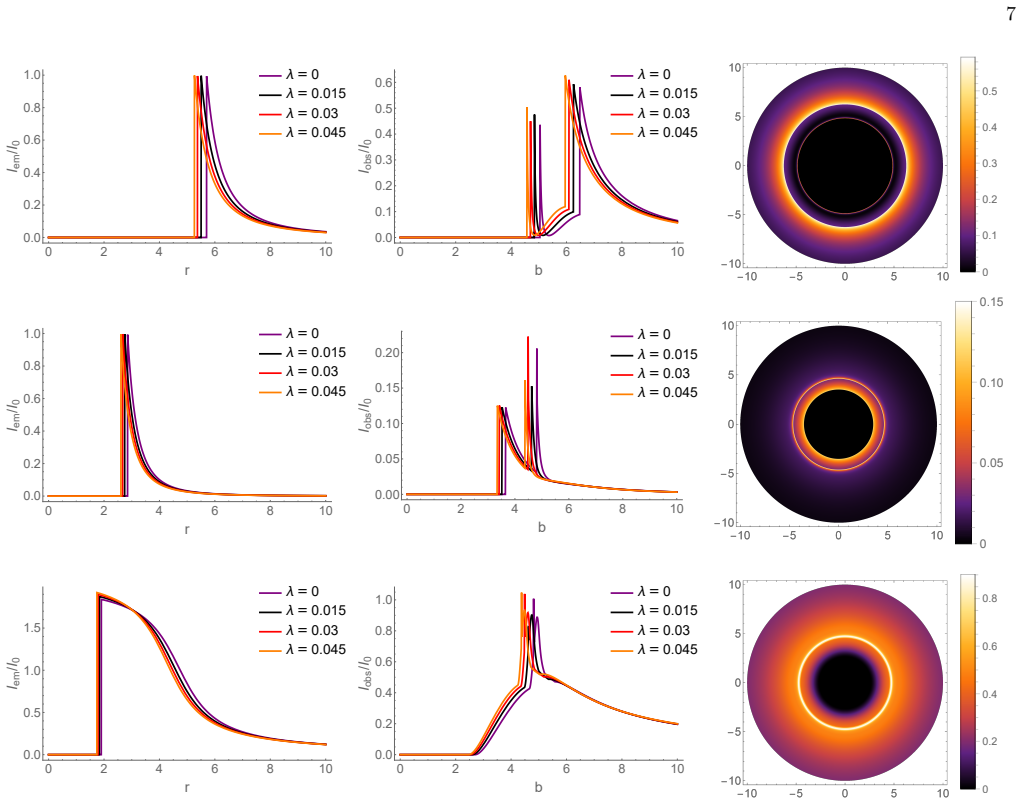
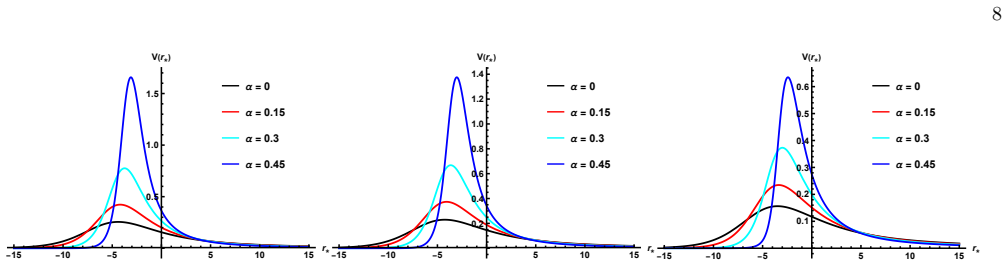
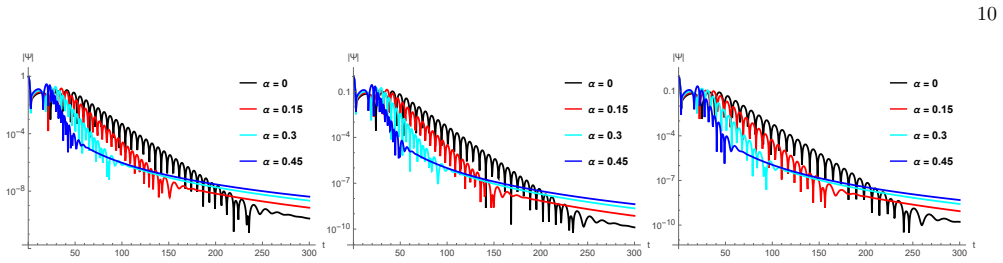
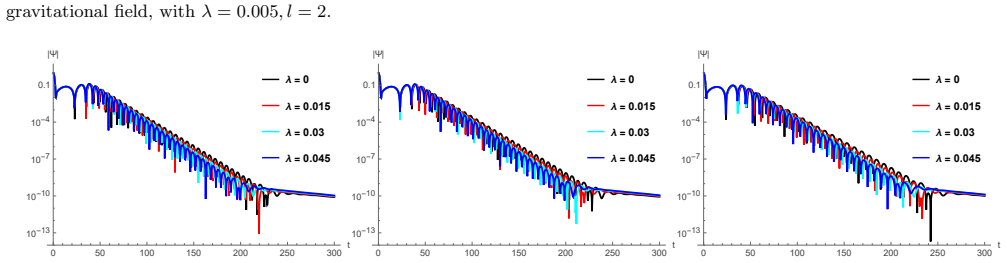
The Lorentz-violating parameter and the dark matter parameter change the optical appearance and ringdown of the black hole.
A machine-rendered reading of the paper's core claim, the machinery that carries it, and where it could break.
Core claim
In this model the metric is modified by the Kalb-Ramond Lorentz-violating parameter α and the perfect fluid dark matter parameter λ, which in turn control the location of the photon sphere and the shape of the effective potential for perturbations, leading to altered photon trajectories for the optical appearance and modified quasinormal mode spectra for scalar, electromagnetic, and gravitational perturbations that agree with geodesic properties in the eikonal limit.
What carries the argument
The exact solution for the static spherically symmetric metric with the coupled Kalb-Ramond field and perfect fluid dark matter, whose radial functions depend on α and λ and enter the geodesic equation and the wave equations for perturbations.
If this is right
- The black hole shadow radius varies with α and λ, leading to observable differences in the photon ring.
- Quasinormal mode frequencies and damping rates change, affecting the ringdown signal in gravitational waves.
- The agreement in the eikonal limit between quasinormal modes and null geodesics holds for this spacetime.
- These dependencies provide a way to place observational bounds on Lorentz violation and dark matter density.
Where Pith is reading between the lines
- Re-examination of existing Event Horizon Telescope data on M87* and Sgr A* could look for the specific dependence on these parameters.
- The model suggests that Lorentz-violating effects might leave detectable imprints even when dark matter is present, which could be tested in other strong-field scenarios.
- Extending the analysis to rotating black holes would test whether the effects persist in more realistic astrophysical settings.
Load-bearing premise
The spacetime is assumed to be static and spherically symmetric with a specific coupling between the Kalb-Ramond field and perfect fluid dark matter that yields an exact solution whose metric functions are used throughout the analysis.
What would settle it
An observation of the black hole shadow or a gravitational wave ringdown signal whose properties lie outside the range spanned by varying the model parameters α and λ would falsify the claim that these parameters control the appearance and dynamics in the way described.
Figures



read the original abstract
This paper investigates the optical and dynamical properties of a static spherically symmetric black hole in the presence of a Kalb--Ramond (KR) field coupled to perfect fluid dark matter (PFDM). We analyze the effects of the Lorentz-violating parameter $\alpha$ and the dark matter parameter $\lambda$ on photon trajectories and their observational signatures in the strong-gravity regime. Furthermore, we study the quasinormal mode spectrum under scalar, electromagnetic, and gravitational perturbations, examining how the model parameters influence the characteristic oscillation frequencies and damping rates. In particular, the interplay between the effective potential structure and perturbative dynamics is clarified, and it is found that, within the validity of the eikonal approximation, the quasinormal modes of the black hole considered here exhibit good agreement with the properties of null geodesics. Our results show that the model parameters significantly affect both the optical appearance of the black hole and the dynamical features of the ringdown phase, providing potential observational constraints on Lorentz-violating effects and dark matter environments in strong-field regimes.
Editorial analysis
A structured set of objections, weighed in public.
Referee Report
Summary. The paper investigates the optical appearance (photon trajectories, effective potentials, and shadows) and ringdown (quasinormal modes for scalar, electromagnetic, and gravitational perturbations) of a static spherically symmetric black hole sourced by a Kalb-Ramond field coupled to perfect fluid dark matter. It studies the dependence on the Lorentz-violating parameter α and the dark matter parameter λ, finding that both parameters alter shadow radii and QNM frequencies/damping times, while eikonal QNMs agree with null geodesic properties, potentially allowing observational constraints on these effects.
Significance. If the underlying metric is confirmed to solve the coupled field equations, the results provide concrete predictions for how Lorentz violation and dark matter environments modify strong-field observables. The multi-perturbation QNM analysis and explicit eikonal check are strengths that facilitate direct comparison with EHT shadow data and gravitational-wave ringdown signals, offering a pathway to constrain the model parameters observationally.
major comments (2)
- [Section II] Section II: The metric functions are asserted to be an exact solution arising from the KR field coupled to PFDM, but the explicit forms of the energy-momentum tensors T^{KR}_{μν} and T^{PFDM}_{μν} and the verification that the given metric satisfies G_{μν} = 8π(T^{KR} + T^{PFDM}) are not displayed. This verification is load-bearing for the central claims, as all photon-sphere calculations (§III), shadow radii, and QNM spectra (§IV) are derived from these functions.
- [§4.2] §4.2: The claim of good agreement between eikonal QNMs and null geodesics is stated without quantitative support such as a table of relative differences in real and imaginary parts for representative values of α and λ, or error estimates. This makes the strength of the agreement difficult to assess and weakens the link to geodesic properties.
minor comments (3)
- [Figure 2] Figure 2: The shadow contour plots lack explicit labels for the specific α and λ values used in each panel, reducing reproducibility.
- [References] References: Several recent works on Kalb-Ramond gravity and perfect fluid dark matter black holes are absent; adding them would strengthen the contextual placement of the results.
- [§3.1] §3.1: The effective potential for null geodesics is introduced without a brief reminder of its explicit form in terms of the metric components f(r) and h(r); including Eq. (12) or equivalent would improve clarity.
Simulated Author's Rebuttal
We thank the referee for their careful reading of our manuscript and for providing constructive feedback. We address each of the major comments in detail below.
read point-by-point responses
-
Referee: [Section II] Section II: The metric functions are asserted to be an exact solution arising from the KR field coupled to PFDM, but the explicit forms of the energy-momentum tensors T^{KR}_{μν} and T^{PFDM}_{μν} and the verification that the given metric satisfies G_{μν} = 8π(T^{KR} + T^{PFDM}) are not displayed. This verification is load-bearing for the central claims, as all photon-sphere calculations (§III), shadow radii, and QNM spectra (§IV) are derived from these functions.
Authors: We agree that the explicit verification of the field equations is important for the robustness of our results. In the revised manuscript, we will include the explicit expressions for the energy-momentum tensors T^{KR}_{μν} and T^{PFDM}_{μν} in Section II, along with the direct verification that the given metric satisfies the Einstein equations G_{μν} = 8π(T^{KR} + T^{PFDM}). revision: yes
-
Referee: [§4.2] §4.2: The claim of good agreement between eikonal QNMs and null geodesics is stated without quantitative support such as a table of relative differences in real and imaginary parts for representative values of α and λ, or error estimates. This makes the strength of the agreement difficult to assess and weakens the link to geodesic properties.
Authors: We thank the referee for this observation. To strengthen the claim, we will add a table in §4.2 that provides quantitative comparisons, including the real and imaginary parts of the eikonal QNMs and the corresponding null geodesic frequencies for several representative values of α and λ, along with the relative differences and error estimates. revision: yes
Circularity Check
No significant circularity; standard metric-to-observable computation
full rationale
The paper derives an exact static spherically symmetric metric from the Einstein equations with Kalb-Ramond and perfect-fluid dark-matter sources (parameters α and λ enter via the coupling ansatz). All subsequent results—photon-sphere radii, shadow sizes, effective potentials, and quasinormal frequencies/damping rates—are obtained by direct substitution of those metric functions into the geodesic or perturbation equations. This is the ordinary GR workflow and does not reduce any reported quantity to a re-expression or fit of the input parameters. No self-citation is invoked to justify the metric itself, no uniqueness theorem is smuggled in, and no “prediction” is statistically forced by construction. The central claim that α and λ affect optical appearance and ringdown therefore remains an independent consequence of the solved spacetime.
Axiom & Free-Parameter Ledger
free parameters (2)
- alpha
- lambda
axioms (2)
- domain assumption Existence of a static spherically symmetric exact solution for the KR field coupled to PFDM
- standard math Linear perturbation theory is valid for scalar, electromagnetic, and gravitational modes
Lean theorems connected to this paper
-
IndisputableMonolith/Foundation/RealityFromDistinction.leanreality_from_one_distinction unclearthe metric function expressed as: f(r) = 1/(1-α) - 2M/r + λ/r ln(r/|λ|)
-
IndisputableMonolith/Cost/FunctionalEquation.leanwashburn_uniqueness_aczel unclearRμν − 1/2 gμν R = TKRμν + TPFDMμν
Reference graph
Works this paper leans on
-
[1]
B. P. Abbottet al.[LIGO Scientific and Virgo], Phys. Rev. Lett.116(2016) no.6, 061102 doi:10.1103/PhysRevLett.116.061102 [arXiv:1602.03837 [gr-qc]]
-
[2]
E. Berti, V. Cardoso and A. O. Starinets, Class. Quant. Grav.26(2009), 163001 doi:10.1088/0264- 9381/26/16/163001 [arXiv:0905.2975 [gr-qc]]
-
[3]
K. D. Kokkotas and B. G. Schmidt, Living Rev. Rel. 2(1999), 2 doi:10.12942/lrr-1999-2 [arXiv:gr-qc/9909058 [gr-qc]]
-
[4]
R. A. Konoplya and A. Zhidenko, Rev. Mod. Phys. 83(2011), 793-836 doi:10.1103/RevModPhys.83.793 [arXiv:1102.4014 [gr-qc]]
-
[5]
A. Ribes Metidieri, B. Bonga and B. Krish- nan, Phys. Rev. D111(2025) no.10, 104075 doi:10.1103/PhysRevD.111.104075 [arXiv:2501.08964 [gr-qc]]
-
[6]
K. Akiyamaet al.[Event Horizon Telescope], Astro- phys. J. Lett.875, no.1, L4 (2019) doi:10.3847/2041- 8213/ab0e85 [arXiv:1906.11241 [astro-ph.GA]]
-
[7]
M. D. Johnson, A. Lupsasca, A. Strominger, G. N. Wong, S. Hadar, D. Kapec, R. Narayan, A. Chael, C. F. Gam- mie and P. Galison,et al.Sci. Adv.6(2020) no.12, eaaz1310 doi:10.1126/sciadv.aaz1310 [arXiv:1907.04329 [astro-ph.IM]]
-
[8]
H. Falcke, F. Melia and E. Agol, Astrophys. J. Lett.528 (2000), L13 doi:10.1086/312423 [arXiv:astro-ph/9912263 [astro-ph]]
-
[9]
J. P. Luminet, Astron. Astrophys.75(1979), 228-235
1979
-
[10]
I. Urso, F. H. Vincent, M. Wielgus, T. Paumard and G. Perrin, Astron. Astrophys.700(2025), A193 doi:10.1051/0004-6361/202554919 [arXiv:2506.13482 [astro-ph.HE]]
-
[11]
T. Desire, A. C´ ardenas-Avenda˜ no and A. Chael, As- trophys. J.980(2025) no.2, 262 doi:10.3847/1538- 4357/adac4d [arXiv:2411.17884 [astro-ph.HE]]
-
[12]
2022, NewAR, 95, 101659, doi: 10.1016/j.newar.2022.101659
L. Perivolaropoulos and F. Skara, New Astron. Rev.95(2022), 101659 doi:10.1016/j.newar.2022.101659 [arXiv:2105.05208 [astro-ph.CO]]
-
[13]
P. G. S. Fernandes and V. Cardoso, Phys. Rev. Lett.135(2025) no.21, 211403 doi:10.1103/9shv-5d21 [arXiv:2507.04389 [gr-qc]]
-
[14]
R. Narayan and J. E. McClintock, New Astron. Rev.51(2008), 733-751 doi:10.1016/j.newar.2008.03.002 [arXiv:0803.0322 [astro-ph]]
-
[15]
G. Bertone, D. Hooper and J. Silk, Phys. Rept. 405(2005), 279-390 doi:10.1016/j.physrep.2004.08.031 [arXiv:hep-ph/0404175 [hep-ph]]
-
[16]
The strong coupling constant: state of the art and the decade ahead,
L. Roszkowski, E. M. Sessolo and S. Trojanowski, Rept. Prog. Phys.81(2018) no.6, 066201 doi:10.1088/1361- 6633/aab913 [arXiv:1707.06277 [hep-ph]]. 13
-
[17]
Planck 2018 results. VI. Cosmological parameters
N. Aghanimet al.[Planck], Astron. Astrophys.641 (2020), A6 [erratum: Astron. Astrophys.652(2021), C4] doi:10.1051/0004-6361/201833910 [arXiv:1807.06209 [astro-ph.CO]]
work page internal anchor Pith review Pith/arXiv arXiv doi:10.1051/0004-6361/201833910 2020
-
[18]
V. C. Rubin and W. K. Ford, Jr., Astrophys. J.159 (1970), 379-403 doi:10.1086/150317
-
[19]
P. J. E. Peebles, Astrophys. J. Lett.263(1982), L1-L5 doi:10.1086/183911
-
[20]
G. R. Blumenthal, S. M. Faber, J. R. Primack and M. J. Rees, Nature311(1984), 517-525 doi:10.1038/311517a0
-
[21]
V. Irˇ siˇ c, M. Viel, M. G. Haehnelt, J. S. Bolton, S. Cristiani, G. Cupani, T. S. Kim, V. D’Odorico, S. L´ opez and S. Ellison,et al.Phys. Rev. D96 (2017) no.2, 023522 doi:10.1103/PhysRevD.96.023522 [arXiv:1702.01764 [astro-ph.CO]]
-
[22]
A. D. Ludlow, S. Bose, R. E. Angulo, L. Wang, W. A. Hellwing, J. F. Navarro, S. Cole and C. S. Frenk, Mon. Not. Roy. Astron. Soc.460(2016) no.2, 1214-1232 doi:10.1093/mnras/stw1046 [arXiv:1601.02624 [astro-ph.CO]]
-
[23]
J. F. Navarro, C. S. Frenk and S. D. M. White, Astrophys. J.490(1997), 493-508 doi:10.1086/304888 [arXiv:astro-ph/9611107 [astro-ph]]
-
[24]
S. Bharadwaj and S. Kar, Phys. Rev. D68(2003), 023516 doi:10.1103/PhysRevD.68.023516 [arXiv:astro- ph/0304504 [astro-ph]]
-
[25]
C. M. Will, Living Rev. Rel.17(2014), 4 doi:10.12942/lrr-2014-4 [arXiv:1403.7377 [gr-qc]]
-
[26]
T. Damour and G. Esposito-Farese, Phys. Rev. Lett.70 (1993), 2220-2223 doi:10.1103/PhysRevLett.70.2220
-
[27]
T. P. Sotiriou and V. Faraoni, Phys. Rev. Lett. 108(2012), 081103 doi:10.1103/PhysRevLett.108.081103 [arXiv:1109.6324 [gr-qc]]
-
[28]
C. A. R. Herdeiro and E. Radu, Phys. Rev. Lett. 112(2014), 221101 doi:10.1103/PhysRevLett.112.221101 [arXiv:1403.2757 [gr-qc]]
-
[29]
T. P. Sotiriou and V. Faraoni, Rev. Mod. Phys. 82(2010), 451-497 doi:10.1103/RevModPhys.82.451 [arXiv:0805.1726 [gr-qc]]
-
[30]
D. G. Boulware and S. Deser, Phys. Rev. Lett.55(1985), 2656 doi:10.1103/PhysRevLett.55.2656
-
[31]
Z. Lyu, N. Jiang and K. Yagi, Phys. Rev. D105 (2022) no.6, 064001 [erratum: Phys. Rev. D106 (2022) no.6, 069901; erratum: Phys. Rev. D106 (2022) no.6, 069901] doi:10.1103/PhysRevD.105.064001 [arXiv:2201.02543 [gr-qc]]
-
[32]
A. B. Balakin and A. E. Zayats, Phys. Lett. B 644(2007), 294-298 doi:10.1016/j.physletb.2006.12.002 [arXiv:gr-qc/0612019 [gr-qc]]
-
[33]
A. B. Balakin, J. P. S. Lemos and A. E. Za- yats, Phys. Rev. D93(2016) no.2, 024008 doi:10.1103/PhysRevD.93.024008 [arXiv:1512.02653 [gr-qc]]
-
[34]
B. C. L¨ utf¨ uo˘ glu, Eur. Phys. J. C85(2025) no.6, 630 doi:10.1140/epjc/s10052-025-14380-x [arXiv:2504.18482 [gr-qc]]
-
[35]
F. Y. Liu, Y. F. Mai, W. Y. Wu and Y. Xie, Phys. Lett. B 795(2019), 475-481 doi:10.1016/j.physletb.2019.06.052
-
[36]
S. Hod, Phys. Rev. D112(2025) no.10, 104029 doi:10.1103/6xy7-948n
-
[37]
M. Kalb and P. Ramond, Phys. Rev. D9(1974), 2273- 2284 doi:10.1103/PhysRevD.9.2273
-
[38]
E. Sucu and ˙I. Sakall, Phys. Rev. D111(2025) no.6, 064049 doi:10.1103/PhysRevD.111.064049
-
[39]
R. Kumar, S. G. Ghosh and A. Wang, Phys. Rev. D101 (2020) no.10, 104001 doi:10.1103/PhysRevD.101.104001 [arXiv:2001.00460 [gr-qc]]
-
[40]
M. Mangut, H. G¨ ursel and ˙I. Sakallı, Chin. Phys. C 49(2025) no.6, 065106 doi:10.1088/1674-1137/adbacf [arXiv:2504.02108 [gr-qc]]
-
[41]
Z. Q. Duan, J. Y. Zhao and K. Yang, Eur. Phys. J. C 84(2024) no.8, 798 doi:10.1140/epjc/s10052-024-13188-5 [arXiv:2310.13555 [gr-qc]]
-
[42]
Y. Shi and A. A. Ara´ ujo Filho, JHEP08(2025), 028 doi:10.1007/JHEP08(2025)028 [arXiv:2504.15373 [gr- qc]]
-
[44]
A. A. Ara´ ujo Filho, N. Heidari and I. P. Lobo, JCAP 09(2025), 076 doi:10.1088/1475-7516/2025/09/076 [arXiv:2507.17390 [gr-qc]]
-
[45]
A. A. Ara´ ujo Filho, JCAP04(2025), 076 doi:10.1088/1475-7516/2025/04/076 [arXiv:2411.06841 [gr-qc]]
-
[46]
A. Ditta, F. Javed, A. Bouzenada, G. Mustafa, A. Mah- mood, F. Atamurotov and V. Khamidov, JHEAp45 (2025), 62-74 doi:10.1016/j.jheap.2024.11.010
-
[47]
S. K. Jha, JCAP09(2025), 069 doi:10.1088/1475- 7516/2025/09/069 [arXiv:2506.21911 [gr-qc]]
-
[48]
B. Shodikulov, M. Mirov, F. Atamurotov, S. G. Ghosh and A. Abdujabbarov, Phys. Dark Univ.50(2025), 102096 doi:10.1016/j.dark.2025.102096
-
[49]
B. Rahmatov, I. Egamberdiev, S. Murodov, J. Ray- imbaev, I. Ibragimov, E. Davletov and S. Dju- manov, Phys. Dark Univ.50(2025), 102152 doi:10.1016/j.dark.2025.102152
-
[50]
S. Jumaniyozov, S. Murodov, J. Rayimbaev, I. Ibrag- imov, B. Madaminov, S. Urinbaev and A. Abdu- jabbarov, Eur. Phys. J. C85(2025) no.7, 797 doi:10.1140/epjc/s10052-025-14522-1
-
[51]
S. E. Gralla, D. E. Holz and R. M. Wald, Phys. Rev. D100(2019) no.2, 024018 doi:10.1103/PhysRevD.100.024018 [arXiv:1906.00873 [astro-ph.HE]]
-
[52]
R. A. Konoplya, Phys. Rev. D68(2003), 024018 doi:10.1103/PhysRevD.68.024018 [arXiv:gr-qc/0303052 [gr-qc]]
-
[53]
E. Abdalla, R. A. Konoplya and C. Molina, Phys. Rev. D72(2005), 084006 doi:10.1103/PhysRevD.72.084006 [arXiv:hep-th/0507100 [hep-th]]
-
[54]
V. Cardoso, A. S. Miranda, E. Berti, H. Witek and V. T. Zanchin, Phys. Rev. D79(2009) no.6, 064016 doi:10.1103/PhysRevD.79.064016 [arXiv:0812.1806 [hep- th]]
-
[55]
I. Z. Stefanov, S. S. Yazadjiev and G. G. Gy- ulchev, Phys. Rev. Lett.104(2010), 251103 doi:10.1103/PhysRevLett.104.251103 [arXiv:1003.1609 [gr-qc]]
-
[56]
R. A. Konoplya and Z. Stuchl´ ık, Phys. Lett. B 771(2017), 597-602 doi:10.1016/j.physletb.2017.06.015 [arXiv:1705.05928 [gr-qc]]
-
[57]
R. A. Konoplya, Phys. Lett. B838(2023), 137674 doi:10.1016/j.physletb.2023.137674 [arXiv:2210.08373 [gr-qc]]
discussion (0)
Sign in with ORCID, Apple, or X to comment. Anyone can read and Pith papers without signing in.