Recognition: 2 theorem links
· Lean TheoremGravitational waves production during preheating within GB gravity with monomial coupling
Pith reviewed 2026-05-10 19:25 UTC · model grok-4.3
The pith
In a Gauss-Bonnet gravity model with monomial potential and coupling, the energy density of gravitational waves produced during preheating is consistent with Planck constraints when expressed as a function of the scalar spectral index.
A machine-rendered reading of the paper's core claim, the machinery that carries it, and where it could break.
Core claim
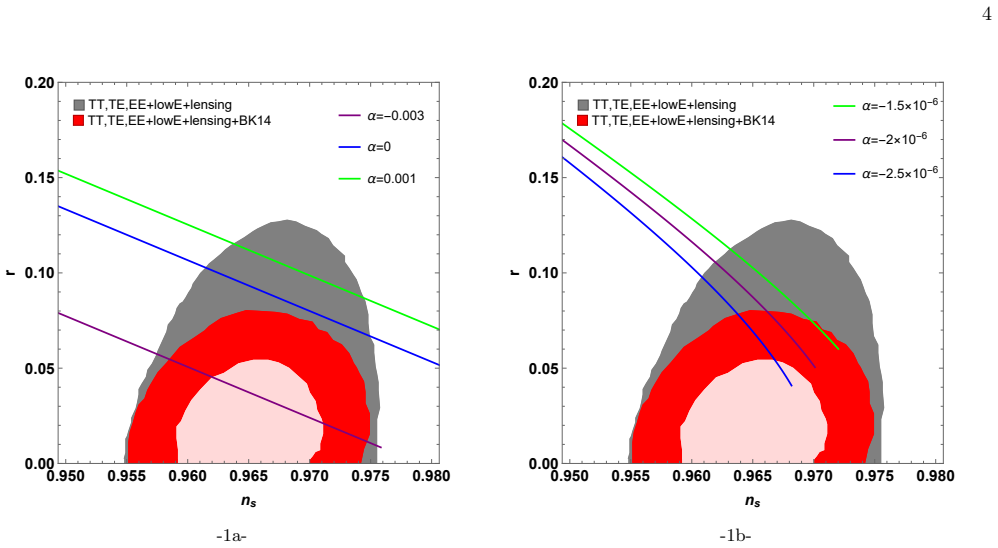
In this Gauss-Bonnet gravity model with power-law potential and monomial coupling, the generation of gravitational waves during preheating produces a present-day energy density that, when written in terms of the scalar spectral index, satisfies the Planck constraints for the choice of dimensionless Gauss-Bonnet coupling parameter α ≡ 4V0ξ0/3 = −1.5×10^{-6}, effective equation of state parameter ω = 1/6, and preheating efficiency parameter δ = 10^5.
What carries the argument
The link established between preheating duration, reheating phase, and inflationary parameters, which allows the gravitational-wave energy density to be expressed directly as a function of the scalar spectral index.
If this is right
- The present-day gravitational-wave energy density becomes a direct function of the scalar spectral index.
- This function yields values consistent with Planck data for the selected values of the coupling parameter α, the equation of state ω, and the efficiency δ.
- Preheating in the model thus offers a testable prediction tied to inflation observables.
- The specific parameter choices ensure the gravitational waves do not exceed observational limits.
Where Pith is reading between the lines
- If confirmed, measurements of the spectral index could be used to infer properties of the preheating stage in this class of models.
- The framework could be applied to other forms of the potential and coupling to explore different gravitational wave signals.
- Future detectors sensitive to stochastic backgrounds might test the amplitude predicted for these parameters.
Load-bearing premise
The assumed link between preheating duration, reheating phase, and inflationary parameters is accurate and free of large uncertainties, and the specific numerical choices for α, ω, and δ are physically justified rather than selected solely to produce consistency with Planck data.
What would settle it
A measurement of the scalar spectral index together with the present-day gravitational wave energy density that falls outside the specific relation predicted for α = −1.5×10^{-6}, ω = 1/6, and δ = 10^5 would show the consistency does not hold.
Figures


read the original abstract
In this paper, we investigate the production of gravitational waves during the preheating era. To achieve this purpose, we consider Gauss-Bonnet inflation model with Power{\textendash}law potential, $V(\phi)= V_0 \phi^n$, and monomial Gauss-Bonnet coupling function, $\xi(\phi)= \xi_0 \phi^n$. We examine our model by comparing our findings with the current observational data. After that, we study the preheating stage by adopting an approach in which we establish a link between preheating duration, reheating phase and inflationary parameters. This step allows us to benefit from observational constraints imposed on inflation. Furthermore, we examine the production of gravitational waves during preheating epoch connecting the energy density to the preheating duration, $N_{pre}$, and then with the spectral index $n_s$. The generation of gravitational waves during preheating can satisfy observational constraints. In particular, the predicted present-day gravitational-wave energy density, expressed as a function of the scalar spectral index, is consistent with the Planck constraints for the choice of a dimensionless Gauss-Bonnet coupling parameter $\alpha \equiv 4V_{0}\xi_{0}/3 = -1.5\times 10^{-6}$, an effective equation of state parameter $\omega = 1/6$, and a preheating efficiency parameter $\delta = 10^{5}$.
Editorial analysis
A structured set of objections, weighed in public.
Circularity Check
GW 'prediction' Ω_GW,0(n_s) lies inside Planck bounds only after fixing α=-1.5e-6, ω=1/6, δ=10^5 and assuming an un-derived N_pre-to-n_s map
specific steps
-
fitted input called prediction
[Abstract]
"the predicted present-day gravitational-wave energy density, expressed as a function of the scalar spectral index, is consistent with the Planck constraints for the choice of a dimensionless Gauss-Bonnet coupling parameter α ≡ 4V0ξ0/3 = −1.5×10⁻⁶, an effective equation of state parameter ω = 1/6, and a preheating efficiency parameter δ = 10^5"
The central claim is that the derived Ω_GW,0(n_s) satisfies constraints. This holds only after the three parameters are fixed to the quoted numbers; the functional dependence on n_s is obtained by substituting the chosen ω and δ into the GW formula and the N_pre–n_s relation, so the consistency is a direct consequence of the input selection rather than a model prediction.
full rationale
The paper links preheating duration N_pre to inflationary observables via an effective equation-of-state ω during reheating, inserts an efficiency δ into the GW production formula, and then expresses the present-day energy density as a function of n_s. The abstract explicitly states that consistency with Planck constraints holds for the specific numerical choices α ≡ 4V0ξ0/3 = -1.5×10^{-6}, ω = 1/6, and δ = 10^5. These values are not derived from the GB monomial dynamics or shown to be attractor values; they are selected so that the resulting curve falls inside the observational window. Consequently the reported 'prediction' is statistically forced by the input choices rather than an independent output of the model equations.
Axiom & Free-Parameter Ledger
free parameters (3)
- alpha =
-1.5e-6
- omega =
1/6
- delta =
10^5
axioms (2)
- domain assumption Standard assumptions of inflationary cosmology and preheating dynamics hold inside the Gauss-Bonnet framework.
- domain assumption Monomial forms for both the potential and the Gauss-Bonnet coupling are appropriate for the model.
Lean theorems connected to this paper
-
IndisputableMonolith/Cost/FunctionalEquation.leanwashburn_uniqueness_aczel unclear?
unclearRelation between the paper passage and the cited Recognition theorem.
the predicted present-day gravitational-wave energy density... is consistent with the Planck constraints for the choice of a dimensionless Gauss-Bonnet coupling parameter α ≡ 4V0ξ0/3 = −1.5×10^{-6}, an effective equation of state parameter ω = 1/6, and a preheating efficiency parameter δ = 10^5
-
IndisputableMonolith/Foundation/Constants.leanreality_from_one_distinction unclear?
unclearRelation between the paper passage and the cited Recognition theorem.
N_pre = [60.0085 − (1/4)ln(30λ_end/(δ g_re π²)) − ...] − (1−3ω)/4 N_re
What do these tags mean?
- matches
- The paper's claim is directly supported by a theorem in the formal canon.
- supports
- The theorem supports part of the paper's argument, but the paper may add assumptions or extra steps.
- extends
- The paper goes beyond the formal theorem; the theorem is a base layer rather than the whole result.
- uses
- The paper appears to rely on the theorem as machinery.
- contradicts
- The paper's claim conflicts with a theorem or certificate in the canon.
- unclear
- Pith found a possible connection, but the passage is too broad, indirect, or ambiguous to say the theorem truly supports the claim.
Reference graph
Works this paper leans on
-
[1]
A New Type of Isotropic Cosmological Models Without Singularity,
A. A. Starobinsky, “A New Type of Isotropic Cosmological Models Without Singularity,” Phys. Lett. B91, 99-102 (1980)
1980
-
[2]
The Inflationary Universe: A Possible Solution to the Horizon and Flatness Problems,
A. H. Guth, “The Inflationary Universe: A Possible Solution to the Horizon and Flatness Problems,” Phys. Rev. D23, 347-356 (1981)
1981
-
[3]
A New Inflationary Universe Scenario: A Possible Solution of the Horizon, Flatness, Homogeneity, Isotropy and Primordial Monopole Problems,
A. D. Linde, “A New Inflationary Universe Scenario: A Possible Solution of the Horizon, Flatness, Homogeneity, Isotropy and Primordial Monopole Problems,” Phys. Lett. B108, 389-393 (1982)
1982
-
[4]
Cosmology for Grand Unified Theories with Radiatively Induced Symmetry Breaking,
A. Albrecht and P. J. Steinhardt, “Cosmology for Grand Unified Theories with Radiatively Induced Symmetry Breaking,” Phys. Rev. Lett.48, 1220-1223 (1982)
1982
-
[5]
Chaotic Inflation,
A. D. Linde, “Chaotic Inflation,” Phys. Lett. B129, 177-181 (1983)
1983
-
[6]
Dynamics of the Universe and Spontaneous Symmetry Breaking,
D. Kazanas, “Dynamics of the Universe and Spontaneous Symmetry Breaking,” Astrophys. J. Lett.241, L59-L63 (1980)
1980
-
[7]
Induced gravity effect on inflationary parameters in a holographic cosmology,
A. Bargach, F. Bargach, A. Errahmani and T. Ouali, “Induced gravity effect on inflationary parameters in a holographic cosmology,” Int. J. Mod. Phys. D29, no.02, 2050010 (2020) [hep-th/1904.06282]
-
[8]
Non-minimal Higgs inflation within holographic cosmology,
A. Bargach, F. Bargach, M. Bouhmadi-L´ opez and T. Ouali, “Non-minimal Higgs inflation within holographic cosmology,” Phys. Rev. D102, 123540 (2020) [gr-qc/2012.04342]
-
[9]
Higgs inflation model with non-minimal coupling in hybrid Palatini 10 approach,
B. Asfour, A. Bargach, A. Errahmani and T. Ouali, “Higgs inflation model with non-minimal coupling in hybrid Palatini 10 approach,” Chin. Phys. C48, no.4, 045104 (2024) [gr-qc/2209.11541]
-
[10]
Constraints on tachyon inflationary models with an AdS/CFT correspondence,
Z. Bouabdallaoui, A. Errahmani, M. Bouhmadi-Lopez and T. Ouali, “Constraints on tachyon inflationary models with an AdS/CFT correspondence,” Phys. Rev. D94, no.12, 123508 (2016) [hep-th/1610.01963]
-
[11]
Scalar warm inflation in holographic cosmology,
Z. Bouabdallaoui, A. Errahmani, M. Bouhmadi-L´ opez and T. Ouali, “Scalar warm inflation in holographic cosmology,” Phys. Rev. D105, no.4, 043513 (2022) [hep-th/2203.05047]
-
[12]
Particle Production in the New Inflationary Cosmology,
L. F. Abbott, E. Farhi and M. B. Wise, “Particle Production in the New Inflationary Cosmology,” Phys. Lett. B117, 29 (1982)
1982
-
[13]
Baryon Asymmetry in Inflationary Universe,
A. D. Dolgov and A. D. Linde, “Baryon Asymmetry in Inflationary Universe,” Phys. Lett. B116, 329 (1982)
1982
-
[14]
Reheating an Inflationary Universe,
A. Albrecht, P. J. Steinhardt, M. S. Turner and F. Wilczek, “Reheating an Inflationary Universe,” Phys. Rev. Lett.48, 1437 (1982)
1982
-
[15]
Particle Production During Out-of-equilibrium Phase Transitions,
J. H. Traschen and R. H. Brandenberger, “Particle Production During Out-of-equilibrium Phase Transitions,” Phys. Rev. D42, 2491-2504 (1990)
1990
-
[16]
Y. Shtanov, J. H. Traschen and R. H. Brandenberger, “Universe reheating after inflation,” Phys. Rev. D51, 5438-5455 (1995) [hep-ph/9407247]
-
[17]
L. Kofman, A. D. Linde and A. A. Starobinsky, “Reheating after inflation,” Phys. Rev. Lett.73, 3195-3198 (1994) [hep- th/9405187]
-
[18]
Nonperturbative Dynamics Of Reheating After Inflation: A Review
M. A. Amin, M. P. Hertzberg, D. I. Kaiser and J. Karouby, “Nonperturbative Dynamics Of Reheating After Inflation: A Review,” Int. J. Mod. Phys. D24, 1530003 (2014) [hep-ph/1410.3808]
work page Pith review arXiv 2014
-
[19]
Constraints on the reheating phase after Higgs inflation in the hybrid metric-Palatini approach,
B. Asfour, A. Bargach, Y. Ladghami, A. Errahmani and T. Ouali, “Constraints on the reheating phase after Higgs inflation in the hybrid metric-Palatini approach,” Phys. Lett. B853, 138679 (2024) [gr-qc/2404.15535]
-
[20]
Reheating constraints for an induced gravity model with a holographic description,
F. Bargach, A. Bargach, B. Asfour, A. Oukouiss and T. Ouali, “Reheating constraints for an induced gravity model with a holographic description,” Phys. Dark Univ.50, 102080 (2025)
2025
- [21]
-
[22]
Structure of resonance in preheating after inflation,
P. B. Greene, L. Kofman, A. D. Linde and A. A. Starobinsky, “Structure of resonance in preheating after inflation,” Phys. Rev. D56, 6175-6192 (1997) [hep-ph/9705347]
-
[23]
ON PARTICLE CREATION BY A TIME DEPENDENT SCALAR FIELD,
A. D. Dolgov and D. P. Kirilova, “ON PARTICLE CREATION BY A TIME DEPENDENT SCALAR FIELD,” Sov. J. Nucl. Phys.51, 172-177 (1990) JINR-E2-89-321
1990
-
[24]
Planck 2018 results. X. Constraints on inflation
Y. Akramiet al.[Planck], “Planck 2018 results. X. Constraints on inflation,” Astron. Astrophys.641, A10 (2020) [astro- ph.CO/1807.06211]
work page internal anchor Pith review arXiv 2018
-
[25]
Reheating constraints to inflationary models,
L. Dai, M. Kamionkowski and J. Wang, “Reheating constraints to inflationary models,” Phys. Rev. Lett.113, 041302 (2014) [astro-ph.CO/1404.6704]
-
[27]
S. Y. Khlebnikov and I. I. Tkachev, “Relic gravitational waves produced after preheating,” Phys. Rev. D56, 653-660 (1997) [hep-ph/9701423]
-
[28]
Preheating in the Standard Model with the Higgs-Inflaton coupled to gravity,
J. Garcia-Bellido, D. G. Figueroa and J. Rubio, “Preheating in the Standard Model with the Higgs-Inflaton coupled to gravity,” Phys. Rev. D79, 063531 (2009) [hep-ph/0812.4624]
-
[29]
Preheating after Higgs Inflation: Self-Resonance and Gauge boson production,
E. I. Sfakianakis and J. van de Vis, “Preheating after Higgs Inflation: Self-Resonance and Gauge boson production,” Phys. Rev. D99, no.8, 083519 (2019) [hep-ph/1810.01304]
-
[30]
Preheating after multifield in- flation with nonminimal couplings, III: Dynamical spacetime results,
M. P. DeCross, D. I. Kaiser, A. Prabhu, C. Prescod-Weinstein and E. I. Sfakianakis, “Preheating after multifield in- flation with nonminimal couplings, III: Dynamical spacetime results,” Phys. Rev. D97, no.2, 023528 (2018) [astro- ph.CO/1610.08916]
-
[31]
Preheating after multifield inflation with nonminimal couplings, II: Resonance Structure,
M. P. DeCross, D. I. Kaiser, A. Prabhu, C. Prescod-Weinstein and E. I. Sfakianakis, “Preheating after multifield inflation with nonminimal couplings, II: Resonance Structure,” Phys. Rev. D97, no.2, 023527 (2018) [astro-ph.CO/1610.08868]
-
[32]
Violent Preheating in Inflation with Nonminimal Coupling,
Y. Ema, R. Jinno, K. Mukaida and K. Nakayama, “Violent Preheating in Inflation with Nonminimal Coupling,” JCAP 02, 045 (2017) [hep-ph/1609.05209]
-
[33]
Combined Preheating on the lattice with applications to Higgs inflation,
J. Repond and J. Rubio, “Combined Preheating on the lattice with applications to Higgs inflation,” JCAP07, 043 (2016) [astro-ph.CO/1604.08238]
-
[34]
M. P. DeCross, D. I. Kaiser, A. Prabhu, C. Prescod-Weinstein and E. I. Sfakianakis, “Preheating after Multifield Inflation with Nonminimal Couplings, I: Covariant Formalism and Attractor Behavior,” Phys. Rev. D97, no.2, 023526 (2018) [astro-ph.CO/1510.08553]
-
[35]
Tachyonic instability and dynamics of spontaneous symmetry breaking,
G. N. Felder, L. Kofman and A. D. Linde, “Tachyonic instability and dynamics of spontaneous symmetry breaking,” Phys. Rev. D64, 123517 (2001) [hep-th/0106179]
-
[36]
Dynamics of symmetry breaking and tachyonic preheating,
G. N. Felder, J. Garcia-Bellido, P. B. Greene, L. Kofman, A. D. Linde and I. Tkachev, “Dynamics of symmetry breaking and tachyonic preheating,” Phys. Rev. Lett.87, 011601 (2001) [hep-ph/0012142]
-
[37]
Preheating in Palatini Higgs inflation,
J. Rubio and E. S. Tomberg, “Preheating in Palatini Higgs inflation,” JCAP04, 021 (2019) [hep-ph/1902.10148]
-
[38]
Preheating in Palatini Higgs inflation on the lattice,
F. Dux, A. Florio, J. Klari´ c, A. Shkerin and I. Timiryasov, “Preheating in Palatini Higgs inflation on the lattice,” JCAP 09, 015 (2022) [hep-ph/2203.13286]
-
[39]
Primordial black holes and gravitational waves in teleparallel Gravity,
K. El Bourakadi, B. Asfour, Z. Sakhi, Z. M. Bennai and T. Ouali, “Primordial black holes and gravitational waves in teleparallel Gravity,” Eur. Phys. J. C82, no.9, 792 (2022) [gr-qc/2209.08585]
-
[40]
V. K. Oikonomou, “Flat energy spectrum of primordial gravitational waves versus peaks and the NANOGrav 2023 obser- vation,” Phys. Rev. D108, no.4, 043516 (2023) [astro-ph.CO/2306.17351]
-
[41]
V. K. Oikonomou, “Implications of a scalar field interacting with the dark matter fluid on primordial gravitational waves,” 11 Phys. Rev. D110, no.2, 023535 (2024) [gr-qc/2406.09604]
-
[42]
Gravitational waves from preheating in Gauss–Bonnet inflation,
K. El Bourakadi, M. Ferricha-Alami, H. Filali, Z. Sakhi and M. Bennai, “Gravitational waves from preheating in Gauss–Bonnet inflation,” Eur. Phys. J. C81, no.12, 1144 (2021) [gr-qc/2209.08581]
-
[43]
Preheating constraints inα-attractor inflation and gravitational waves pro- duction,
K. El Bourakadi, Z. Sakhi and M. Bennai, “Preheating constraints inα-attractor inflation and gravitational waves pro- duction,” Int. J. Mod. Phys. A37, no.17, 2250117 (2022) [gr-qc/2209.09241]
-
[44]
N. Aggarwal, O. D. Aguiar, A. Bauswein, G. Cella, S. Clesse, A. M. Cruise, V. Domcke, D. G. Figueroa, A. Geraci and M. Goryachev,et al.“Challenges and opportunities of gravitational-wave searches at MHz to GHz frequencies,” Living Rev. Rel.24, no.1, 4 (2021) [gr-qc/2011.12414]
-
[45]
G. Franciolini, A. Maharana and F. Muia, “Hunt for light primordial black hole dark matter with ultrahigh-frequency gravitational waves,” Phys. Rev. D106, no.10, 103520 (2022) [astro-ph.CO/2205.02153]
-
[46]
Slow-roll Inflation with the Gauss-Bonnet and Chern-Simons Corrections,
M. Satoh, “Slow-roll Inflation with the Gauss-Bonnet and Chern-Simons Corrections,” JCAP11, 024 (2010) [astro- ph.CO/1008.2724]
-
[47]
Slow-roll inflation with a Gauss-Bonnet correction,
Z. K. Guo and D. J. Schwarz, “Slow-roll inflation with a Gauss-Bonnet correction,” Phys. Rev. D81, 123520 (2010) [hep-th/1001.1897]
-
[48]
Inflation coupled to a Gauss-Bonnet term,
P. X. Jiang, J. W. Hu and Z. K. Guo, “Inflation coupled to a Gauss-Bonnet term,” Phys. Rev. D88, 123508 (2013) [hep-th/1310.5579]
-
[49]
Anomalies, Topological Invariants and the Gauss-Bonnet Theorem in Super- gravity,
P. K. Townsend and P. van Nieuwenhuizen, “Anomalies, Topological Invariants and the Gauss-Bonnet Theorem in Super- gravity,” Phys. Rev. D19, 3592 (1979)
1979
-
[50]
String Generated Gravity Models,
D. G. Boulware and S. Deser, “String Generated Gravity Models,” Phys. Rev. Lett.55, 2656 (1985)
1985
-
[51]
Observational constraints on slow-roll inflation coupled to a Gauss-Bonnet term,
S. Koh, B. H. Lee, W. Lee and G. Tumurtushaa, “Observational constraints on slow-roll inflation coupled to a Gauss-Bonnet term,” Phys. Rev. D90, no.6, 063527 (2014) [gr-qc/1404.6096]
-
[52]
Reconstruction of the Scalar Field Potential in Inflationary Models with a Gauss-Bonnet term,
S. Koh, B. H. Lee and G. Tumurtushaa, “Reconstruction of the Scalar Field Potential in Inflationary Models with a Gauss-Bonnet term,” Phys. Rev. D95, no.12, 123509 (2017) [gr-qc/1610.04360]
-
[53]
S. Koh, B. H. Lee and G. Tumurtushaa, “Constraints on the reheating parameters after Gauss-Bonnet inflation from primordial gravitational waves,” Phys. Rev. D98, no.10, 103511 (2018) [astro-ph.CO/1807.04424]
-
[54]
Cosmology and fundamental physics with the Euclid satellite,
L. Amendola, S. Appleby, A. Avgoustidis, D. Bacon, T. Baker, M. Baldi, N. Bartolo, A. Blanchard, C. Bonvin and S. Borgani,et al.“Cosmology and fundamental physics with the Euclid satellite,” Living Rev. Rel.21, no.1, 2 (2018) [astro-ph.CO/1606.00180]
- [55]
-
[56]
Gravitational waves from gauge preheating,
P. Adshead, J. T. Giblin and Z. J. Weiner, “Gravitational waves from gauge preheating,” Phys. Rev. D98, no.4, 043525 (2018) [astro-ph.CO/1805.04550]
-
[57]
Production of gravitational waves during preheating inα-attractor inflation,
J. Li, H. Yu and P. Wu, “Production of gravitational waves during preheating inα-attractor inflation,” Phys. Rev. D102, no.8, 083522 (2020)
2020
-
[58]
C. W. Misner, K. S. Thorne and J. A. Wheeler,Gravitation, San Francisco: W. H. Freeman, 1973
1973
discussion (0)
Sign in with ORCID, Apple, or X to comment. Anyone can read and Pith papers without signing in.