Recognition: 2 theorem links
· Lean TheoremPrecision QCD with the Electron-Ion Collider
Pith reviewed 2026-05-10 18:51 UTC · model grok-4.3
The pith
A five-week program identifies five key priorities for precision QCD at the Electron-Ion Collider.
A machine-rendered reading of the paper's core claim, the machinery that carries it, and where it could break.
Core claim
The program identified five principal areas for advancing precision QCD at the EIC: higher-order perturbative-QCD calculations and techniques; nuclear structure and tomography; comparisons of phenomenological and lattice determinations of parton distribution functions; identification of signature observables for saturated gluons; and assessment of the importance of AI techniques for EIC studies and detector development.
What carries the argument
The five-week collaborative program that collects and synthesizes input from roughly seventy experts to prioritize research directions for the Electron-Ion Collider.
If this is right
- Higher-order perturbative calculations will be required to match the expected precision of EIC measurements.
- Direct comparisons between lattice and phenomenological parton distributions will reduce systematic uncertainties in nuclear structure studies.
- Dedicated observables will be needed to isolate gluon saturation effects in high-density nuclear environments.
- AI methods will be integrated into both theoretical modeling and real-time detector calibration for the EIC.
- Tomographic reconstruction techniques will map the three-dimensional partonic structure of nucleons inside nuclei.
Where Pith is reading between the lines
- These priorities are likely to influence which theory calculations and experimental analyses receive the earliest funding and computing resources.
- Closer coupling between lattice QCD and EIC phenomenology may resolve existing discrepancies in parton distribution functions.
- The explicit inclusion of AI assessment signals an expectation that machine-learning tools will become standard in nuclear-physics data interpretation.
- Community-wide workshops of this type could serve as a model for planning other large-scale facilities.
Load-bearing premise
That the topics selected during the program discussions are in fact the most important open questions whose resolution will determine the scientific reach of the Electron-Ion Collider.
What would settle it
If the first years of EIC data reveal that one of the five listed topics, such as signatures of gluon saturation, produces no distinctive signals within the collider's kinematic reach, the prioritization recorded in the summary would be called into question.
Figures















read the original abstract
This document summarizes the discussions at the program "Precision QCD with the Electron Ion Collider", held from May to June 2025 at the Institute for Nuclear Theory (INT) at the University of Washington. The program was co-sponsored by the INT and by the Center for Frontiers in Nuclear Science (CFNS, Stony Brook University). Over its five-week duration it brought together about 70 theorists, experimentalists and computer scientists all interested in the physics program at the future Electron Ion Collider in preparation at Brookhaven National Laboratory. Key topics at the program were: higher-order perturbative-QCD calculations and techniques; nuclear structure and tomography; comparisons of phenomenological and lattice determinations of parton distribution functions; identification of signature observables for saturated gluons; assessment of the importance of AI techniques for EIC studies and detector development.
Editorial analysis
A structured set of objections, weighed in public.
Referee Report
Summary. The manuscript summarizes the discussions at the five-week INT program 'Precision QCD with the Electron-Ion Collider' held May-June 2025 at the University of Washington. Co-sponsored by INT and CFNS, it involved ~70 theorists, experimentalists, and computer scientists. The text lists five key topics: higher-order perturbative-QCD calculations and techniques; nuclear structure and tomography; comparisons of phenomenological and lattice determinations of parton distribution functions; identification of signature observables for saturated gluons; and assessment of AI techniques for EIC studies and detector development.
Significance. If the listed topics accurately reflect the program, the summary provides a concise archival record of community priorities for the EIC QCD program, correctly spanning perturbative methods, nuclear effects, lattice QCD, gluon saturation, and computational tools. A strength is its factual, claim-free description of the event scope without unsupported assertions or data. As a purely descriptive workshop note rather than a research article with derivations or results, its significance is modest and primarily documentary.
minor comments (2)
- The manuscript text is essentially identical to the abstract and provides only a high-level list of topics without any elaboration on specific discussions, conclusions, or outcomes from the program.
- No references, links to talks, or further reading are included; adding such pointers would improve utility for readers interested in the listed topics.
Simulated Author's Rebuttal
We thank the referee for their review of our manuscript summarizing the INT program 'Precision QCD with the Electron-Ion Collider'. The referee's assessment correctly identifies the document as a factual, claim-free archival record of the workshop discussions and key topics. We appreciate the recommendation for minor revision.
- The referee recommends minor revision, but the major comments section is empty and no specific changes or issues are identified in the report.
Circularity Check
No circularity: purely descriptive workshop summary with no derivations or predictions
full rationale
The document is a factual summary of discussions at an INT program on Precision QCD with the EIC. It lists key topics covered but advances no new physics claims, equations, predictions, or fitted quantities. There is no derivation chain, self-citation load-bearing argument, or any step that reduces to its own inputs by construction. The content is limited to reporting what was discussed, making circularity analysis inapplicable.
Axiom & Free-Parameter Ledger
Lean theorems connected to this paper
-
IndisputableMonolith/Foundation/RealityFromDistinction.leanreality_from_one_distinction unclear?
unclearRelation between the paper passage and the cited Recognition theorem.
Key topics at the program were: higher-order perturbative-QCD calculations and techniques; nuclear structure and tomography; comparisons of phenomenological and lattice determinations of parton distribution functions; identification of signature observables for saturated gluons; assessment of the importance of AI techniques for EIC studies and detector development.
-
IndisputableMonolith/Cost/FunctionalEquation.leanwashburn_uniqueness_aczel unclear?
unclearRelation between the paper passage and the cited Recognition theorem.
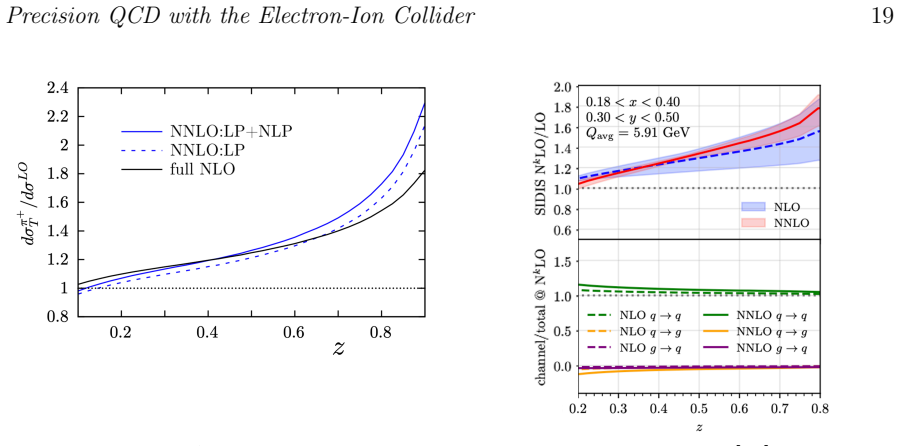
The NNLL double-soft results were used in [30] to derive approximations to the full NNLO corrections...
What do these tags mean?
- matches
- The paper's claim is directly supported by a theorem in the formal canon.
- supports
- The theorem supports part of the paper's argument, but the paper may add assumptions or extra steps.
- extends
- The paper goes beyond the formal theorem; the theorem is a base layer rather than the whole result.
- uses
- The paper appears to rely on the theorem as machinery.
- contradicts
- The paper's claim conflicts with a theorem or certificate in the canon.
- unclear
- Pith found a possible connection, but the passage is too broad, indirect, or ambiguous to say the theorem truly supports the claim.
Forward citations
Cited by 2 Pith papers
-
AI-assisted modeling and Bayesian inference of unpolarized quark transverse momentum distributions from Drell-Yan data
An AI-assisted Bayesian framework extracts TMD PDFs from global Drell-Yan data using surrogate models for scalable MCMC sampling.
-
On the Two $R$-Factors in the Small-$x$ Shockwave Formalism
Replacing the rapidity argument of the dipole amplitude with ln min{1/|x|, 1/|ξ|} and refining initial conditions for non-linear evolution can eliminate two R-factors in small-x shockwave calculations.
Reference graph
Works this paper leans on
-
[1]
Study of the fundamental structure of matter with an electron-ion collider
Abhay Deshpande, Richard Milner, Raju Venugopalan, and Werner Vogelsang. Study of the fundamental structure of matter with an electron-ion collider. Ann. Rev. Nucl. Part. Sci., 55:165–228, 2005
2005
-
[2]
Daniel Boer et al. Gluons and the quark sea at high energies: Distributions, polarization, tomography. INT report INT-PUB-11-034. arXiv:1108.1713
-
[3]
Accardi et al
A. Accardi et al. Electron Ion Collider: The Next QCD Frontier: Understanding the glue that binds us all. Eur. Phys. J. A, 52(9):268, 2016
2016
-
[4]
Abdul Khalek et al
R. Abdul Khalek et al. Science Requirements and Detector Concepts for the Electron-Ion Collider: EIC Yellow Report. Nucl. Phys. A, 1026:122447, 2022
2022
-
[5]
Abdul Khalek et al., in2022 Snowmass Summer Study(2022),2203.13199
R. Abdul Khalek et al. Snowmass 2021 White Paper: Electron Ion Collider for High Energy Physics. arXiv:2203.13199
-
[6]
Raktim Abir et al. The case for an EIC Theory Alliance: Theoretical Challenges of the EIC. arXiv:2305.14572
-
[7]
J. A. M. Vermaseren, A. Vogt, and S. Moch. The Third-order QCD corrections to deep-inelastic scattering by photon exchange. Nucl. Phys. B, 724:3–182, 2005
2005
-
[8]
Ablinger, A
J. Ablinger, A. Behring, J. Bl¨ umlein, A. De Freitas, A. von Manteuffel, C. Schneider, and K. Sch¨ onwald. The three-loop single-mass heavy-flavor corrections to the structure functions F2(x, Q2) andg 1(x, Q2). 9 2025
2025
-
[9]
Falcioni, F
G. Falcioni, F. Herzog, S. Moch, and A. Vogt. Four-loop splitting functions in QCD – The quark-quark case. Phys. Lett. B, 842:137944, 2023
2023
-
[10]
Falcioni, F
G. Falcioni, F. Herzog, S. Moch, and A. Vogt. Four-loop splitting functions in QCD – The gluon-to-quark case. Phys. Lett. B, 846:138215, 2023
2023
-
[11]
Falcioni, F
G. Falcioni, F. Herzog, S. Moch, A. Pelloni, and A. Vogt. Four-loop splitting functions in QCD – The quark-to-gluon case. Phys. Lett. B, 856:138906, 2024
2024
-
[12]
Falcioni, F
G. Falcioni, F. Herzog, S. Moch, A. Pelloni, and A. Vogt. Four-loop splitting functions in QCD – the gluon-gluon case –. Phys. Lett. B, 860:139194, 2025
2025
-
[13]
Gehrmann, A
T. Gehrmann, A. von Manteuffel, V. Sotnikov, and T.-Z. Yang. CompleteN 2 f contributions to four-loop pure-singlet splitting functions. JHEP, 01:029, 2024
2024
-
[14]
Gehrmann, A
T. Gehrmann, A. von Manteuffel, V. Sotnikov, and T.-Z. Yang. The NfCF3 contribution to the non-singlet splitting function at four-loop order. Phys. Lett. B, 849:138427, 2024
2024
-
[15]
E. B. Zijlstra and W. L. van Neerven. Order-α 2 s corrections to the polarized structure function g1(x, Q2). Nucl. Phys. B, 417:61–100, 1994. [Erratum: Nucl.Phys.B 426, 245 (1994), Erratum: Nucl.Phys.B 773, 105–106 (2007), Erratum: Nucl.Phys.B 501, 599–599 (1997)]
1994
-
[16]
S. Moch, J. A. M. Vermaseren, and A. Vogt. The Three-Loop Splitting Functions in QCD: The Helicity-Dependent Case. Nucl. Phys. B, 889:351–400, 2014
2014
-
[17]
Bl¨ umlein, P
J. Bl¨ umlein, P. Marquard, C. Schneider, and K. Sch¨ onwald. The three-loop unpolarized and polarized non-singlet anomalous dimensions from off shell operator matrix elements. Nucl. Phys. B, 971:115542, 2021
2021
-
[18]
Bl¨ umlein, P
J. Bl¨ umlein, P. Marquard, C. Schneider, and K. Sch¨ onwald. The massless three-loop Wilson coefficients for the deep-inelastic structure functions F 2, FL, xF3 and g1. JHEP, 11:156, 2022
2022
-
[19]
Ravindran
Saurav Goyal, Sven-Olaf Moch, Vaibhav Pathak, Narayan Rana, and V. Ravindran. Next-to- Next-to-Leading Order QCD Corrections to Semi-Inclusive Deep-Inelastic Scattering. Phys. Rev. Lett., 132(25):251902, 2024
2024
-
[20]
Semi-Inclusive Deep-Inelastic Scattering at Next-to-Next-to-Leading Order in QCD
Leonardo Bonino, Thomas Gehrmann, and Giovanni Stagnitto. Semi-Inclusive Deep-Inelastic Scattering at Next-to-Next-to-Leading Order in QCD. Phys. Rev. Lett., 132(25):251901, 2024
2024
-
[21]
Lee, Sven-Olaf Moch, Vaibhav Pathak, Narayan Rana, and V
Saurav Goyal, Roman N. Lee, Sven-Olaf Moch, Vaibhav Pathak, Narayan Rana, and V. Ravindran. Next-to-Next-to-Leading Order QCD Corrections to Polarized Semi-Inclusive Deep-Inelastic Scattering. Phys. Rev. Lett., 133:211905, 2024
2024
-
[22]
Precision QCD with the Electron-Ion Collider124 Polarized Semi-Inclusive Deep-Inelastic Scattering at Next-to-Next-to-Leading Order in QCD
Leonardo Bonino, Thomas Gehrmann, Markus L¨ ochner, Kay Sch¨ onwald, and Giovanni Stagnitto. Precision QCD with the Electron-Ion Collider124 Polarized Semi-Inclusive Deep-Inelastic Scattering at Next-to-Next-to-Leading Order in QCD. Phys. Rev. Lett., 133(21):211904, 2024
2024
-
[23]
Neutral and charged current semi-inclusive deep-inelastic scattering at NNLO QCD
Leonardo Bonino, Thomas Gehrmann, Markus L¨ ochner, Kay Sch¨ onwald, and Giovanni Stagnitto. Neutral and charged current semi-inclusive deep-inelastic scattering at NNLO QCD. JHEP, 10:016, 2025
2025
-
[24]
Polarized Neutral and Charged Current Semi-Inclusive Deep-Inelastic Scattering at NNLO in QCD
Leonardo Bonino, Thomas Gehrmann, Markus L¨ ochner, Kay Sch¨ onwald, and Giovanni Stagnitto. Polarized Neutral and Charged Current Semi-Inclusive Deep-Inelastic Scattering at NNLO in QCD. 9 2025
2025
-
[25]
Lee, Sven-Olaf Moch, Vaibhav Pathak, and V
Saurav Goyal, Roman N. Lee, Sven-Olaf Moch, Vaibhav Pathak, and V. Ravindran. NNLO QCD⊗QED corrections to unpolarized and polarized SIDIS. arXiv:2510.18872
-
[26]
Single-valued representation of unpolarized and polarized semi-inclusive deep inelastic scattering at next-to-next-to-leading order
Juliane Haug and Fabian Wunder. Single-valued representation of unpolarized and polarized semi-inclusive deep inelastic scattering at next-to-next-to-leading order. Phys. Rev. D, 112(11):114036, 2025
2025
-
[27]
Soft gluon resummation for the fragmentation of light and heavy quarks at large x
Matteo Cacciari and Stefano Catani. Soft gluon resummation for the fragmentation of light and heavy quarks at large x. Nucl. Phys. B, 617:253–290, 2001
2001
-
[28]
Anderle, Felix Ringer, and Werner Vogelsang
Daniele P. Anderle, Felix Ringer, and Werner Vogelsang. QCD resummation for semi-inclusive hadron production processes. Phys. Rev. D, 87(3):034014, 2013
2013
-
[29]
Anderle, Felix Ringer, and Werner Vogelsang
Daniele P. Anderle, Felix Ringer, and Werner Vogelsang. Threshold resummation for polarized (semi-)inclusive deep inelastic scattering. Phys. Rev. D, 87:094021, 2013
2013
-
[30]
Approximate NNLO QCD corrections to semi-inclusive DIS
Maurizio Abele, Daniel de Florian, and Werner Vogelsang. Approximate NNLO QCD corrections to semi-inclusive DIS. Phys. Rev. D, 104(9):094046, 2021
2021
-
[31]
Threshold resummation at NLL3 accuracy and approximate N3LO corrections to semi-inclusive DIS
Maurizio Abele, Daniel de Florian, and Werner Vogelsang. Threshold resummation at NLL3 accuracy and approximate N3LO corrections to semi-inclusive DIS. Phys. Rev. D, 106(1):014015, 2022
2022
-
[32]
Next-to-Next-to-Leading Order Global Analysis of Polarized Parton Distribution Functions
Ignacio Borsa, Marco Stratmann, Werner Vogelsang, Daniel de Florian, and Rodolfo Sassot. Next-to-Next-to-Leading Order Global Analysis of Polarized Parton Distribution Functions. Phys. Rev. Lett., 133(15):151901, 2024
2024
-
[33]
Valerio Bertone, Amedeo Chiefa, and Emanuele R. Nocera. Helicity-dependent parton distribution functions at next-to-next-to-leading order accuracy from inclusive and semi- inclusive deep-inelastic scattering data. Phys. Lett. B, 865:139497, 2025
2025
-
[34]
Ravindran
Saurav Goyal, Sven-Olaf Moch, Vaibhav Pathak, Narayan Rana, and V. Ravindran. Soft and virtual corrections to semi-inclusive DIS up to four loops in QCD. Phys. Rev. D, 113(3):034004, 2026
2026
-
[35]
Catani and M
S. Catani and M. H. Seymour. A General algorithm for calculating jet cross-sections in NLO QCD. Nucl. Phys. B, 485:291–419, 1997. [Erratum: Nucl.Phys.B 510, 503–504 (1998)]
1997
-
[36]
Frixione, Z
S. Frixione, Z. Kunszt, and A. Signer. Three jet cross-sections to next-to-leading order. Nucl. Phys. B, 467:399–442, 1996
1996
-
[37]
A new method for real radiation at NNLO
Charalampos Anastasiou, Kirill Melnikov, and Frank Petriello. A new method for real radiation at NNLO. Phys. Rev. D, 69:076010, 2004
2004
-
[38]
Binoth and G
T. Binoth and G. Heinrich. Numerical evaluation of phase space integrals by sector decomposition. Nucl. Phys. B, 693:134–148, 2004
2004
-
[39]
Gehrmann-De Ridder, T
A. Gehrmann-De Ridder, T. Gehrmann, and E. W. Nigel Glover. Antenna subtraction at NNLO. JHEP, 09:056, 2005
2005
-
[40]
An NNLO subtraction formalism in hadron collisions and its application to Higgs boson production at the LHC
Stefano Catani and Massimiliano Grazzini. An NNLO subtraction formalism in hadron collisions and its application to Higgs boson production at the LHC. Phys. Rev. Lett., 98:222002, 2007
2007
-
[41]
M. Czakon. Double-real radiation in hadronic top quark pair production as a proof of a certain concept. Nucl. Phys. B, 849:250–295, 2011
2011
-
[42]
Nested soft-collinear subtractions in NNLO QCD computations
Fabrizio Caola, Kirill Melnikov, and Raoul R¨ ontsch. Nested soft-collinear subtractions in NNLO QCD computations. Eur. Phys. J. C, 77(4):248, 2017
2017
-
[43]
Jet production in the CoLoRFulNNLO method: event shapes in electron- Precision QCD with the Electron-Ion Collider125 positron collisions
Vittorio Del Duca, Claude Duhr, Adam Kardos, G´ abor Somogyi, Zolt´ an Sz˝ or, Zolt´ an Tr´ ocs´ anyi, and Zolt´ an Tulip´ ant. Jet production in the CoLoRFulNNLO method: event shapes in electron- Precision QCD with the Electron-Ion Collider125 positron collisions. Phys. Rev. D, 94(7):074019, 2016
2016
-
[44]
NNLO subtraction for any massless final state: a complete analytic expression
Gloria Bertolotti, Lorenzo Magnea, Giovanni Pelliccioli, Alessandro Ratti, Chiara Signorile- Signorile, Paolo Torrielli, and Sandro Uccirati. NNLO subtraction for any massless final state: a complete analytic expression. JHEP, 07:140, 2023. [Erratum: JHEP 05, 019 (2024)]
2023
-
[45]
Klasen and G
M. Klasen and G. Kramer. Inclusive two jet production at HERA: Direct and resolved cross- sections in next-to-leading order QCD. Z. Phys. C, 76:67–74, 1997
1997
-
[46]
Jet photoproduction at HERA
Stefano Frixione and Giovanni Ridolfi. Jet photoproduction at HERA. Nucl. Phys. B, 507:315– 333, 1997
1997
-
[47]
Multijet cross-sections in deep inelastic scattering at next- to-leading order
Zoltan Nagy and Zoltan Trocsanyi. Multijet cross-sections in deep inelastic scattering at next- to-leading order. Phys. Rev. Lett., 87:082001, 2001
2001
-
[48]
Riemersma, J
Eric Laenen, S. Riemersma, J. Smith, and W. L. van Neerven. Complete O (alpha-s) corrections to heavy flavor structure functions in electroproduction. Nucl. Phys. B, 392:162–228, 1993
1993
-
[49]
Differential distributions for heavy flavor production at HERA
Stefano Frixione, Paolo Nason, and Giovanni Ridolfi. Differential distributions for heavy flavor production at HERA. Nucl. Phys. B, 454:3–24, 1995
1995
-
[50]
The p(T) spectrum in heavy flavor photoproduction
Matteo Cacciari, Stefano Frixione, and Paolo Nason. The p(T) spectrum in heavy flavor photoproduction. JHEP, 03:006, 2001
2001
-
[51]
Alwall, R
J. Alwall, R. Frederix, S. Frixione, V. Hirschi, F. Maltoni, O. Mattelaer, H. S. Shao, T. Stelzer, P. Torrielli, and M. Zaro. The automated computation of tree-level and next-to-leading order differential cross sections, and their matching to parton shower simulations. JHEP, 07:079, 2014
2014
-
[52]
Event generation with Sherpa 3
Enrico Bothmann et al. Event generation with Sherpa 3. JHEP, 12:156, 2024
2024
-
[53]
Matching NLO QCD computations with Parton Shower simulations: the POWHEG method
Stefano Frixione, Paolo Nason, and Carlo Oleari. Matching NLO QCD computations with Parton Shower simulations: the POWHEG method. JHEP, 11:070, 2007
2007
-
[54]
A comprehensive guide to the physics and usage of PYTHIA 8.3
Christian Bierlich et al. A comprehensive guide to the physics and usage of PYTHIA 8.3. SciPost Phys. Codeb., 2022:8, 2022
2022
-
[55]
Herwig 7.3 release note
Gavin Bewick et al. Herwig 7.3 release note. Eur. Phys. J. C, 84(10):1053, 2024
2024
-
[56]
Photoproduction in general-purpose event generators
Ilkka Helenius, Peter Meinzinger, Simon Pl¨ atzer, and Peter Richardson. Photoproduction in general-purpose event generators. arXiv:2406.08026
work page internal anchor Pith review Pith/arXiv arXiv
-
[57]
Resolved photons in Sherpa
Stefan Hoeche, Frank Krauss, and Peter Meinzinger. Resolved photons in Sherpa. Eur. Phys. J. C, 84(2):178, 2024
2024
-
[58]
Hadron-level NLO predictions for QCD observables in photo-production at the Electron-Ion Collider
Peter Meinzinger and Frank Krauss. Hadron-level NLO predictions for QCD observables in photo-production at the Electron-Ion Collider. Phys. Rev. D, 109(3):034037, 2024
2024
-
[59]
Rasmussen
Ilkka Helenius and Christine O. Rasmussen. Hard diffraction in photoproduction with Pythia 8. Eur. Phys. J. C, 79(5):413, 2019
2019
-
[60]
A POWHEG generator for deep inelastic scattering
Andrea Banfi, Silvia Ferrario Ravasio, Barbara J¨ ager, Alexander Karlberg, Felix Reichenbach, and Giulia Zanderighi. A POWHEG generator for deep inelastic scattering. JHEP, 02:023, 2024
2024
-
[61]
Event generation at MEPS@NLO accuracy in neutral and charged current DIS at the EIC
Peter Meinzinger, Daniel Reichelt, and Federico Silvetti. Event generation at MEPS@NLO accuracy in neutral and charged current DIS at the EIC. Phys. Rev. D, 112(7):074039, 2025
2025
-
[62]
Inclusive-jet and dijet production in polarized deep inelastic scattering
Ignacio Borsa, Daniel de Florian, and Iv´ an Pedron. Inclusive-jet and dijet production in polarized deep inelastic scattering. Phys. Rev. D, 103(1):014008, 2021
2021
-
[63]
Collider Physics at the Precision Frontier
Gudrun Heinrich. Collider Physics at the Precision Frontier. Phys. Rept., 922:1–69, 2021
2021
-
[64]
NNLO QCD corrections to jet production in deep inelastic scattering
James Currie, Thomas Gehrmann, Alexander Huss, and Jan Niehues. NNLO QCD corrections to jet production in deep inelastic scattering. JHEP, 07:018, 2017. [Erratum: JHEP 12, 042 (2020)]
2017
-
[65]
NNLOJET: a parton-level event generator for jet cross sections at NNLO QCD accuracy
A. Huss et al. NNLOJET: a parton-level event generator for jet cross sections at NNLO QCD accuracy. arXiv:2503.22804
work page internal anchor Pith review Pith/arXiv arXiv
-
[66]
The unresolved behaviour of polarized scattering matrix elements at NNLO in QCD
Thomas Gehrmann and Markus L¨ ochner. The unresolved behaviour of polarized scattering matrix elements at NNLO in QCD. JHEP, 02:097, 2026
2026
- [67]
-
[68]
Peng Sun, Joshua Isaacson, C. P. Yuan, and Feng Yuan. Nonperturbative functions for SIDIS Precision QCD with the Electron-Ion Collider126 and Drell–Yan processes. Int. J. Mod. Phys. A, 33(11):1841006, 2018
2018
-
[69]
J. O. Gonzalez-Hernandez, T. C. Rogers, N. Sato, and B. Wang. Challenges with Large Transverse Momentum in Semi-Inclusive Deeply Inelastic Scattering. Phys. Rev. D, 98(11):114005, 2018
2018
-
[70]
Difficulties in the description of Drell-Yan processes at moderate invariant mass and high transverse momentum
Alessandro Bacchetta, Giuseppe Bozzi, Martin Lambertsen, Fulvio Piacenza, Julius Steiglechner, and Werner Vogelsang. Difficulties in the description of Drell-Yan processes at moderate invariant mass and high transverse momentum. Phys. Rev. D, 100(1):014018, 2019
2019
-
[71]
Gauld, A
R. Gauld, A. Gehrmann-De Ridder, T. Gehrmann, E. W. N. Glover, A. Huss, I. Majer, and A. Rodriguez Garcia. Transverse momentum distributions in low-mass Drell-Yan lepton pair production at NNLO QCD. Phys. Lett. B, 829:137111, 2022
2022
-
[72]
NNLO QCD corrections to hadron production in DIS at finite transverse momentum
Liang Dong, Shen Fang, Jun Gao, Hai Tao Li, Ding Yu Shao, and Yu Jiao Zhu. NNLO QCD corrections to hadron production in DIS at finite transverse momentum. arXiv:2602.22972
-
[73]
Transverse-Momentum Subtraction for Semi-Inclusive Deep-Inelastic Scattering
Jun Gao, Hai Tao Li, Hua Xing Zhu, and Yu Jiao Zhu. Transverse-Momentum Subtraction for Semi-Inclusive Deep-Inelastic Scattering. arXiv:2602.06364
-
[74]
K. J. Eskola, H. Honkanen, V. J. Kolhinen, Jian-wei Qiu, and C. A. Salgado. Nonlinear corrections to the DGLAP equations in view of the hera data. Nucl. Phys. B, 660:211–224, 2003
2003
-
[75]
Structure functions and parton distributions
Jian-wei Qiu. Structure functions and parton distributions. Nucl. Phys. A, 715:309–318, 2003
2003
-
[76]
Resummed QCD power corrections to nuclear shadowing
Jian-wei Qiu and Ivan Vitev. Resummed QCD power corrections to nuclear shadowing. Phys. Rev. Lett., 93:262301, 2004
2004
-
[77]
Jian-wei Qiu and George F. Sterman. QCD and rescattering in nuclear targets. Int. J. Mod. Phys. E, 12:149, 2003
2003
-
[78]
Luo, Jian-wei Qiu, and George F
M. Luo, Jian-wei Qiu, and George F. Sterman. Anomalous nuclear enhancement in deeply inelastic scattering and photoproduction. Phys. Rev. D, 50:1951–1971, 1994
1951
-
[79]
Multiple scattering, parton energy loss and modified fragmentation functions in deeply inelastic e A scattering
Xiao-feng Guo and Xin-Nian Wang. Multiple scattering, parton energy loss and modified fragmentation functions in deeply inelastic e A scattering. Phys. Rev. Lett., 85:3591–3594, 2000
2000
-
[80]
Multiple parton scattering in nuclei: Parton energy loss
Xin-Nian Wang and Xiao-feng Guo. Multiple parton scattering in nuclei: Parton energy loss. Nucl. Phys. A, 696:788–832, 2001
2001
discussion (0)
Sign in with ORCID, Apple, or X to comment. Anyone can read and Pith papers without signing in.