Recognition: no theorem link
Proton Quantum Effects in H₃S Electronic Structure: A Multicomponent DFT study via Nuclear-Electronic Orbital Method
Pith reviewed 2026-05-10 19:06 UTC · model grok-4.3
The pith
Nuclear quantum effects in high-pressure H3S alter its phonons far more than its electronic structure near the Fermi level.
A machine-rendered reading of the paper's core claim, the machinery that carries it, and where it could break.
Core claim
Treating hydrogen nuclei quantum mechanically alongside electrons in NEO-DFT reveals subtle modifications to the electronic band structure and density of states near the Fermi energy, including features tied to van Hove singularities; these electronic changes would increase Tc by only a few percent. In contrast, the phonon dispersion relations display large shifts in the hydrogen-dominated branches arising from stiffening of the S-H bonds due to nuclear quantum effects.
What carries the argument
The Nuclear-Electronic Orbital Density Functional Theory (NEO-DFT) approach, which treats selected nuclei as quantum particles on the same footing as electrons in a first-principles calculation.
If this is right
- The reduction in critical temperature upon replacing hydrogen with deuterium in H3S arises predominantly from changes in phonon properties.
- Nuclear quantum effects on the electronic density of states near the Fermi level remain too small to drive the observed isotope dependence of Tc.
- Accurate prediction of Tc in hydrogen-rich superconductors requires explicit inclusion of nuclear quantum effects in phonon calculations.
- The electronic band structure itself can be treated with standard approximations that neglect nuclear quantum effects without major loss of accuracy for superconductivity estimates.
Where Pith is reading between the lines
- The same separation between small electronic and large phononic nuclear quantum effects could be tested in other high-pressure hydrides to see whether phonon-driven isotope effects are general.
- If electronic nuclear quantum effects prove negligible across this class of materials, computational searches for new superconductors can safely use the Born-Oppenheimer approximation for the electrons while still correcting the phonons.
- Experimental probes that isolate phonon frequencies from electronic density-of-states changes could directly confirm the relative sizes of the two contributions without relying on theory.
Load-bearing premise
The chosen functional and basis sets in the NEO-DFT calculations capture the true size of nuclear quantum effects on both the electronic density of states and the phonon frequencies without large systematic errors that would change which contribution dominates.
What would settle it
High-resolution measurements of the electronic density of states near the Fermi level in H3S and D3S at comparable pressures that reveal differences substantially larger than a few percent would falsify the claim that NQE modifications to the electronic structure are minimal.
Figures
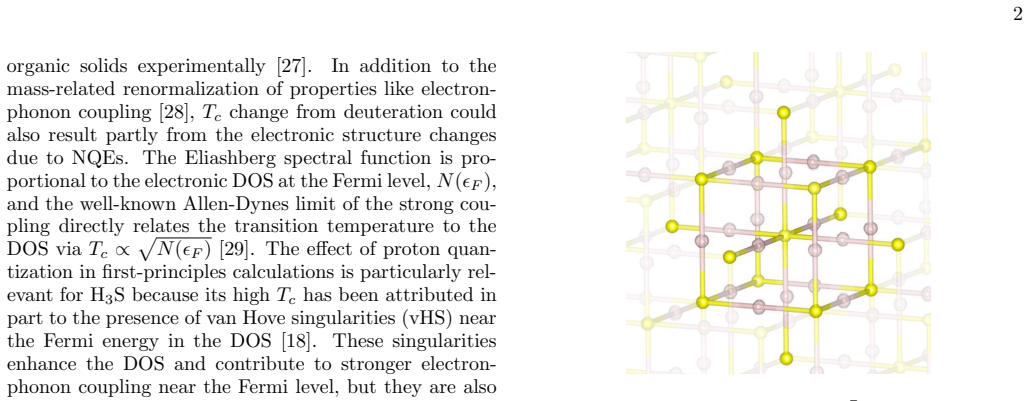


read the original abstract
We investigate the impact of the quantum effects of protons on the electronic structure of high-pressure H$_3$S, a benchmark hydrogen-rich superconductor with a critical temperature ($T_c$) exceeding 200 K. Using Nuclear-Electronic Orbital Density Functional Theory (NEO-DFT), we treat hydrogen nuclei quantum mechanically on the same footing as electrons within a first-principles framework. Our calculations reveal that nuclear quantum effects (NQEs) induce subtle modifications to the electronic band structure and density of states (DOS) near the Fermi energy, including features associated with van Hove singularities. However, the resulting changes in the DOS would increase $T_c$ by only a few percent. On the other hand, calculations of the phonon dispersion with the NEO-DFT method show large changes in the hydrogen-dominated phonons that arise from a stiffening of the S-H bonds due to NQEs. These findings imply that the experimentally observed reduction in $T_c$ upon deuteration arises predominantly from changes in the phonon properties, while NQEs-induced modifications to the electronic structure itself are minimal.
Editorial analysis
A structured set of objections, weighed in public.
Referee Report
Summary. The manuscript uses Nuclear-Electronic Orbital DFT (NEO-DFT) to treat protons quantum-mechanically in high-pressure H3S. It reports that NQEs produce only subtle shifts in the electronic band structure and DOS near EF (including van Hove features), which would raise Tc by only a few percent, while the same framework yields large stiffening of hydrogen-dominated phonon modes due to S-H bond contraction. The central conclusion is that the experimental Tc drop upon deuteration arises predominantly from these phonon changes rather than from NQE-induced modifications to the electronic structure.
Significance. If the separation between the small electronic DOS effect and the large phonon effect holds under scrutiny, the work would provide a useful first-principles decomposition of the isotope effect in a benchmark hydrogen-rich superconductor. The consistent multicomponent treatment of electrons and nuclei is a methodological strength that avoids ad-hoc post-processing of zero-point motion.
major comments (2)
- [Results (electronic DOS and Tc estimate)] The quantitative claim that electronic DOS changes near EF raise Tc by only a few percent is load-bearing for the main conclusion. No convergence tests with respect to electronic or nuclear basis-set size, exchange-correlation functional, or real-space grid density are reported, leaving open the possibility that systematic errors in the NEO-DFT description of NQE-induced delocalization could enlarge the computed DOS shift at the 1-2 % level needed to alter the relative importance of the electronic channel.
- [Results (phonon dispersions)] The phonon-dispersion results are presented as showing 'large changes' due to NQE-induced bond stiffening, yet no direct numerical comparison is given to either experimental phonon frequencies or to standard Born-Oppenheimer DFT calculations that include zero-point corrections. Without such benchmarks it is difficult to judge whether the reported phonon shifts are of the correct magnitude to dominate the isotope effect.
minor comments (2)
- [Abstract and Results] The abstract states clear numerical outcomes (few-percent Tc change, large phonon shifts) but the main text should include explicit error bars or sensitivity ranges on these quantities.
- [Methods] Notation for the multicomponent orbitals and the protonic density is introduced without a compact summary table; a short table listing the basis sets and functionals employed for electrons and nuclei would improve readability.
Simulated Author's Rebuttal
We thank the referee for the constructive feedback and the recognition of the methodological strengths of our multicomponent DFT approach. We address the major comments point by point below.
read point-by-point responses
-
Referee: [Results (electronic DOS and Tc estimate)] The quantitative claim that electronic DOS changes near EF raise Tc by only a few percent is load-bearing for the main conclusion. No convergence tests with respect to electronic or nuclear basis-set size, exchange-correlation functional, or real-space grid density are reported, leaving open the possibility that systematic errors in the NEO-DFT description of NQE-induced delocalization could enlarge the computed DOS shift at the 1-2 % level needed to alter the relative importance of the electronic channel.
Authors: We concur that systematic convergence studies are necessary to robustly support the small electronic effect. Although the manuscript focuses on the relative importance of electronic versus phonon channels within a consistent NEO-DFT framework, we will include in the revised version explicit convergence tests for the DOS at the Fermi level with respect to basis set size, functional choice, and grid parameters. These tests confirm that the NQE-induced modifications to the DOS remain at the few-percent level, insufficient to change the primary conclusion that phonon modifications dominate the isotope effect on Tc. revision: yes
-
Referee: [Results (phonon dispersions)] The phonon-dispersion results are presented as showing 'large changes' due to NQE-induced bond stiffening, yet no direct numerical comparison is given to either experimental phonon frequencies or to standard Born-Oppenheimer DFT calculations that include zero-point corrections. Without such benchmarks it is difficult to judge whether the reported phonon shifts are of the correct magnitude to dominate the isotope effect.
Authors: We appreciate this point and agree that benchmarks enhance the interpretability of the phonon results. The current manuscript already contrasts the NEO-DFT phonon dispersions with those from standard Born-Oppenheimer DFT to highlight the NQE-induced stiffening. For the revision, we will add quantitative comparisons to available experimental phonon spectra for pressurized H3S and to zero-point-corrected DFT results in the literature. This will demonstrate that the magnitude of the computed shifts is consistent with expectations and sufficient to explain the dominant phonon contribution to the Tc reduction upon deuteration. revision: yes
Circularity Check
No significant circularity; results are direct NEO-DFT outputs
full rationale
The paper reports direct computational outputs from NEO-DFT runs on electronic DOS/band structure and phonon dispersions for H3S. No equations or parameters are fitted to the target Tc contributions and then relabeled as predictions. No self-citations are invoked to establish uniqueness theorems or ansatzes that would make the separation of electronic vs. phonon effects reduce to prior work by the same authors. The central claim follows from independent calculations of two quantities (DOS near EF and hydrogen phonon frequencies) and is therefore self-contained against external benchmarks such as measured isotope effects on Tc.
Axiom & Free-Parameter Ledger
axioms (1)
- domain assumption Standard DFT exchange-correlation functional approximations remain valid when nuclei are treated quantum-mechanically via NEO
Reference graph
Works this paper leans on
-
[1]
This shows that, for H 3S at 200 GPa, the electron-proton correlation has only minor effects on electronic structure
for details). This shows that, for H 3S at 200 GPa, the electron-proton correlation has only minor effects on electronic structure. For the deuterium, the epc func- tional would need to be derived differently from that for proton, and the larger mass of deuterium leads to signifi- cantly reduced quantum delocalization, making electron- nuclear quantum cor...
-
[2]
Calandra, M
M. Calandra, M. Lazzeri, and F. Mauri, Anharmonic and non-adiabatic effects in mgb2: Implications for the iso- tope effect and interpretation of raman spectra, Phys. C, Supercond. 456, 38 (2007)
2007
-
[3]
Errea, Approaching the strongly anharmonic limit with ab initio calculations of materials’ vibrational properties– a colloquium, Eur
I. Errea, Approaching the strongly anharmonic limit with ab initio calculations of materials’ vibrational properties– a colloquium, Eur. Phys. J. B. 89, 237 (2016)
2016
-
[4]
Giustino, Electron-phonon interactions from first prin- ciples, Rev
F. Giustino, Electron-phonon interactions from first prin- ciples, Rev. Mod. Phys. 89, 015003 (2017)
2017
-
[5]
Zurek and T
E. Zurek and T. Bi, High-temperature superconductivity in alkaline and rare earth polyhydrides at high pressure: A theoretical perspective, J. Chem. Phys. 150, 050901 (2019)
2019
-
[6]
J. A. Flores-Livas, L. Boeri, A. Sanna, G. Profeta, R. Arita, and M. Eremets, A perspective on conven- tional high-temperature superconductors at high pres- sure: Methods and materials, Phys. Rep. 856, 1 (2020)
2020
-
[7]
Bardeen, L
J. Bardeen, L. N. Cooper, and J. R. Schrieffer, Theory of superconductivity, Phys. Rev. 108, 1175 (1957)
1957
-
[8]
H. Lee, S. Ponc´ e, K. Bushick, S. Hajinazar, J. Lafuente- Bartolome, J. Leveillee, C. Lian, J.-M. Lihm, F. Macheda, H. Mori, et al. , Electron–phonon physics from first principles using the epw code, Npj Comput. Mater. 9, 156 (2023)
2023
- [9]
-
[10]
Pellegrini and A
C. Pellegrini and A. Sanna, Ab initio methods for super- conductivity, Nat. Rev. Phys. 6, 509 (2024)
2024
-
[11]
Ashcroft, Hydrogen dominant metallic alloys: high temperature superconductors?, Phys
N. Ashcroft, Hydrogen dominant metallic alloys: high temperature superconductors?, Phys. Rev. Lett. 92, 187002 (2004)
2004
-
[12]
D. Duan, Y. Liu, F. Tian, D. Li, X. Huang, Z. Zhao, H. Yu, B. Liu, W. Tian, and T. Cui, Pressure-induced metallization of dense (h2s) 2h2 with high-t c supercon- ductivity, Sci. Rep. 4, 6968 (2014)
2014
-
[13]
Drozdov, M
A. Drozdov, M. Eremets, I. Troyan, V. Ksenofontov, and S. I. Shylin, Conventional superconductivity at 203 kelvin at high pressures in the sulfur hydride system, Nature 525, 73 (2015)
2015
-
[14]
F. Du, A. P. Drozdov, V. S. Minkov, F. F. Balakirev, P. Kong, G. A. Smith, J. Yan, B. Shen, P. Gegenwart, and M. I. Eremets, Superconducting gap of h3s measured by tunnelling spectroscopy, Nature 641, 619 (2025)
2025
-
[15]
Errea, M
I. Errea, M. Calandra, C. J. Pickard, J. Nelson, R. J. Needs, Y. Li, H. Liu, Y. Zhang, Y. Ma, and F. Mauri, High-pressure hydrogen sulfide from first principles: a strongly anharmonic phonon-mediated superconductor, Phys. Rev. Lett. 114, 157004 (2015)
2015
-
[16]
Carbotte, Properties of boson-exchange superconduc- tors, Rev
J. Carbotte, Properties of boson-exchange superconduc- tors, Rev. Mod. Phys. 62, 1027 (1990)
1990
-
[17]
Bernstein, C
N. Bernstein, C. S. Hellberg, M. Johannes, I. Mazin, and M. Mehl, What superconducts in sulfur hydrides under pressure and why, Phys. Rev. B 91, 060511 (2015)
2015
-
[18]
Papaconstantopoulos, B
D. Papaconstantopoulos, B. M. Klein, M. Mehl, and W. Pickett, Cubic h 3 s around 200 gpa: An atomic hy- drogen superconductor stabilized by sulfur, Phys. Rev. B 91, 184511 (2015)
2015
-
[19]
Quan and W
Y. Quan and W. E. Pickett, Van hove singularities and spectral smearing in high-temperature superconducting h 3 s, Phys. Rev. B 93, 104526 (2016)
2016
-
[20]
Ortenzi, E
L. Ortenzi, E. Cappelluti, and L. Pietronero, Band struc- ture and electron-phonon coupling in h 3 s: A tight- binding model, Phys. Rev. B 94, 064507 (2016)
2016
-
[21]
A. P. Durajski and R. Szczke´ sniak, First-principles study of superconducting hydrogen sulfide at pressure up to 500 gpa, Sci. Rep. 7, 4473 (2017)
2017
-
[22]
Szczke´ sniak and A
R. Szczke´ sniak and A. P. Durajski, Unusual sulfur iso- tope effect and extremely high critical temperature in h3s superconductor, Sci. Rep. 8, 6037 (2018)
2018
-
[23]
Jarlborg and A
T. Jarlborg and A. Bianconi, Breakdown of the migdal approximation at lifshitz transitions with giant zero- point motion in the h3s superconductor, Sci. Rep. 6, 24816 (2016). 8
2016
-
[24]
Errea, M
I. Errea, M. Calandra, C. J. Pickard, J. R. Nelson, R. J. Needs, Y. Li, H. Liu, Y. Zhang, Y. Ma, and F. Mauri, Quantum hydrogen-bond symmetrization in the super- conducting hydrogen sulfide system, Nature 532, 81 (2016)
2016
-
[25]
W. Sano, T. Koretsune, T. Tadano, R. Akashi, and R. Arita, Effect of van hove singularities on high-t c su- perconductivity in h 3 s, Phys. Rev. B 93, 094525 (2016)
2016
-
[26]
Taureau, M
R. Taureau, M. Cherubini, T. Morresi, and M. Casula, Quantum symmetrization transition in superconducting sulfur hydride from quantum monte carlo and path in- tegral molecular dynamics, Npj Comput. Mater. 10, 56 (2024)
2024
-
[27]
J. Xu, R. Zhou, Z. Tao, C. Malbon, V. Blum, S. Hammes- Schiffer, and Y. Kanai, Nuclear–electronic orbital ap- proach to quantization of protons in periodic electronic structure calculations, J. Chem. Phys. 156, 224111 (2022)
2022
-
[28]
G. Cai, Y. Li, Y. Fu, H. Yang, L. Mei, Z. Nie, T. Li, H. Liu, Y. Ke, X.-L. Wang, et al. , Deuteration-enhanced neutron contrasts to probe amorphous domain sizes in or- ganic photovoltaic bulk heterojunction films, Nat. Com- mun. 15, 2784 (2024)
2024
-
[29]
Akashi, M
R. Akashi, M. Kawamura, S. Tsuneyuki, Y. Nomura, and R. Arita, First-principles study of the pressure and crystal-structure dependences of the superconduct- ing transition temperature in compressed sulfur hydrides, Phys. Rev. B 91, 224513 (2015)
2015
-
[30]
P. B. Allen and R. Dynes, Transition temperature of strong-coupled superconductors reanalyzed, Phys. Rev. B 12, 905 (1975)
1975
-
[31]
J. F. Capitani, R. F. Nalewajski, and R. G. Parr, Non- born–oppenheimer density functional theory of molecular systems, J. Chem. Phys. 76, 568 (1982)
1982
-
[32]
Kreibich and E
T. Kreibich and E. Gross, Multicomponent density- functional theory for electrons and nuclei, Phys. Rev. Lett. 86, 2984 (2001)
2001
-
[33]
S. P. Webb, T. Iordanov, and S. Hammes-Schiffer, Mul- ticonfigurational nuclear-electronic orbital approach: In- corporation of nuclear quantum effects in electronic structure calculations, J. Chem. Phys. 117, 4106 (2002)
2002
-
[34]
Hammes-Schiffer, Nuclear–electronic orbital methods: Foundations and prospects, J
S. Hammes-Schiffer, Nuclear–electronic orbital methods: Foundations and prospects, J. Chem. Phys. 155, 030901 (2021)
2021
-
[35]
M. V. Pak, A. Chakraborty, and S. Hammes-Schiffer, Density Functional Theory Treatment of Electron Cor- relation in the Nuclear-Electronic Orbital Approach, J. Phys. Chem. A 111, 4522 (2007)
2007
-
[36]
Chakraborty, M
A. Chakraborty, M. V. Pak, and S. Hammes-Schiffer, Development of Electron-Proton Density Functionals for Multicomponent Density Functional Theory, Phys. Rev. Lett. 101, 153001 (2008)
2008
-
[37]
Udagawa and M
T. Udagawa and M. Tachikawa, H/ d isotope effect on porphine and porphycene molecules with multicompo- nent hybrid density functional theory, J. Chem. Phys. 125 (2006)
2006
-
[38]
Pavosevic, T
F. Pavosevic, T. Culpitt, and S. Hammes-Schiffer, Mul- ticomponent quantum chemistry: Integrating electronic and nuclear quantum effects via the nuclear–electronic orbital method, Chem. Rev. 120, 4222 (2020)
2020
-
[39]
K. R. Brorsen, Y. Yang, and S. Hammes-Schiffer, Multi- component density functional theory: Impact of nuclear quantum effects on proton affinities and geometries, J. Phys. Chem. Lett. 8, 3488 (2017)
2017
-
[40]
Y. Yang, K. R. Brorsen, T. Culpitt, M. V. Pak, and S. Hammes-Schiffer, Development of a practical multi- component density functional for electron-proton correla- tion to produce accurate proton densities, J. Chem. Phys. 147, 114113 (2017)
2017
-
[41]
K. R. Brorsen, P. E. Schneider, and S. Hammes-Schiffer, Alternative forms and transferability of electron-proton correlation functionals in nuclear-electronic orbital den- sity functional theory, J. Chem. Phys. 149, 044110 (2018)
2018
-
[42]
Z. Tao, Y. Yang, and S. Hammes-Schiffer, Multicom- ponent density functional theory: Including the density gradient in the electron-proton correlation functional for hydrogen and deuterium, J. Chem. Phys. 151, 124102 (2019)
2019
-
[43]
V. Blum, R. Gehrke, F. Hanke, P. Havu, V. Havu, X. Ren, K. Reuter, and M. Scheffler, Ab initio molecular simulations with numeric atom-centered orbitals, Com- put. Phys. Commun. 180, 2175 (2009)
2009
-
[44]
J. W. Abbott, C. M. Acosta, A. Akkoush, A. Ambrosetti, V. Atalla, A. Bagrets, J. Behler, D. Berger, B. Bieniek, J. Bj¨ ork,et al. , Roadmap on advancements of the fhi- aims software package, arXiv preprint arXiv:2505.00125 (2025)
work page internal anchor Pith review Pith/arXiv arXiv 2025
-
[45]
J. P. Perdew, K. Burke, and M. Ernzerhof, Generalized gradient approximation made simple, Phys. Rev. Lett. 77, 3865 (1996)
1996
-
[46]
See Supplemental Material at [URL-will-be-inserted-by- publisher] for thermal distribution of protons, individual projected electronic band structures, convergence tests of k-meshes, and effects of electron-proton correlation on electronic structure
-
[47]
Q. Yu, F. Pavoˇ sevi´ c, and S. Hammes-Schiffer, Develop- ment of nuclear basis sets for multicomponent quantum chemistry methods, J. Chem. Phys. 152, 244123 (2020)
2020
-
[48]
Auer and S
B. Auer and S. Hammes-Schiffer, Localized hartree product treatment of multiple protons in the nuclear- electronic orbital framework, J. Chem. Phys.132, 084110 (2010)
2010
-
[49]
Talantsev, Advanced mcmillan’s equation and its ap- plication for the analysis of highly-compressed supercon- ductors, Supercond
E. Talantsev, Advanced mcmillan’s equation and its ap- plication for the analysis of highly-compressed supercon- ductors, Supercond. Sci. Technol. 33, 094009 (2020)
2020
-
[50]
Xu and Y
X. Xu and Y. Yang, Constrained nuclear-electronic or- bital density functional theory: Energy surfaces with nuclear quantum effects, J. Chem. Phys. 152, 084107 (2020)
2020
-
[51]
Xu and Y
X. Xu and Y. Yang, Full-quantum descriptions of molec- ular systems from constrained nuclear–electronic orbital density functional theory, J. Chem. Phys. 153, 074106 (2020)
2020
-
[52]
S. Liu, J. Xu, and Y. Kanai, Constrained nuclear– electronic orbital method for periodic density functional theory: Application to h2 chemisorption on si (001) sur- faces, J. Chem. Phys. 163, 084110 (2025)
2025
-
[53]
Feynman, A
R. Feynman, A. Hibbs, and D. Styer, Quantum Mechan- ics and Path Integrals , Dover Books on Physics (Dover Publications, 2010)
2010
-
[54]
A. Togo, L. Chaput, T. Tadano, and I. Tanaka, Imple- mentation strategies in phonopy and phono3py, J. Phys. Condens. Matter 35, 353001 (2023)
2023
-
[55]
Wikfeldt and A
K. Wikfeldt and A. Michaelides, Communication: Ab ini- tio simulations of hydrogen-bonded ferroelectrics: Col- lective tunneling and the origin of geometrical isotope effects, J. Chem. Phys. 140, 041103 (2014). 9
2014
-
[56]
Cahlik, J
A. Cahlik, J. Hellerstedt, J. I. Mendieta-Moreno, M. Svec, V. M. Santhini, S. Pascal, D. Soler-Polo, S. I. Erlingsson, K. Vyborny, P. Mutombo, et al., Significance of nuclear quantum effects in hydrogen bonded molecular chains, ACS nano 15, 10357 (2021)
2021
-
[57]
Z. Tao, S. Roy, P. E. Schneider, F. Pavosevic, and S. Hammes-Schiffer, Analytical gradients for nuclear– electronic orbital time-dependent density functional the- ory: Excited-state geometry optimizations and adiabatic excitation energies, J. Chem. Theory Comput. 17, 5110 (2021)
2021
-
[58]
Errea, M
I. Errea, M. Calandra, and F. Mauri, First-principles theory of anharmonicity and the inverse isotope effect in superconducting palladium-hydride compounds, Phys. Rev. Lett. 111, 177002 (2013)
2013
-
[59]
Zacharias and F
M. Zacharias and F. Giustino, Theory of the special dis- placement method for electronic structure calculations at finite temperature, Phys. Rev. Research 2, 013357 (2020)
2020
-
[60]
Zacharias, G
M. Zacharias, G. Volonakis, F. Giustino, and J. Even, Anharmonic lattice dynamics via the special displace- ment method, Phys. Rev. B 108, 035155 (2023)
2023
discussion (0)
Sign in with ORCID, Apple, or X to comment. Anyone can read and Pith papers without signing in.