Recognition: 2 theorem links
· Lean TheoremCloning Encrypted Quantum States in Arbitrary Dimensions
Pith reviewed 2026-05-10 18:47 UTC · model grok-4.3
The pith
Encrypted quantum states can be cloned in any finite dimension using a new unitary operator.
A machine-rendered reading of the paper's core claim, the machinery that carries it, and where it could break.
Core claim
We generalize the encrypted cloning protocol and prove that it also applies to higher-order quantum systems. Given that a straightforward generalization of the protocol using the exponential of the shift and phase operators fails to satisfy the unitary requirement for a quantum gate, we propose a different approach. We introduce a new operator to be used in the encryption process and show that it is unitary. We adapt the decryption operator from the reference paper to fit in the framework of multi-level quantum systems. We analyze the circuit implementation of the proposed operators and show that the overhead imposed by larger dimensions scales linearly with qudit dimension.
What carries the argument
A newly constructed unitary operator that encrypts qudit states so that cloning remains possible while encryption is preserved.
If this is right
- The cloning protocol works for quantum systems of any finite dimension.
- Circuit resources required for encryption, cloning, and decryption increase only linearly with dimension.
- Decryption recovers the cloned states correctly while leaving the original encryption intact.
- The construction satisfies both the no-cloning theorem and the encryption security requirement.
Where Pith is reading between the lines
- The linear scaling makes the protocol potentially feasible to test on current qudit platforms such as trapped ions or photonic systems.
- Similar operator constructions might be explored for other qubit-limited protocols that one wishes to lift to higher dimensions.
- The approach preserves encryption during duplication, which could matter for protocols that must handle protected quantum data without revealing it.
Load-bearing premise
The new operator must satisfy the unitarity condition for every dimension, and the adapted decryption step must recover identical cloned copies without violating encryption or no-cloning constraints.
What would settle it
An explicit matrix calculation showing that the proposed operator fails U dagger times U equals the identity matrix for dimension three, or a numerical simulation in which the decrypted output states differ from the original input by more than the expected cloning fidelity.
Figures
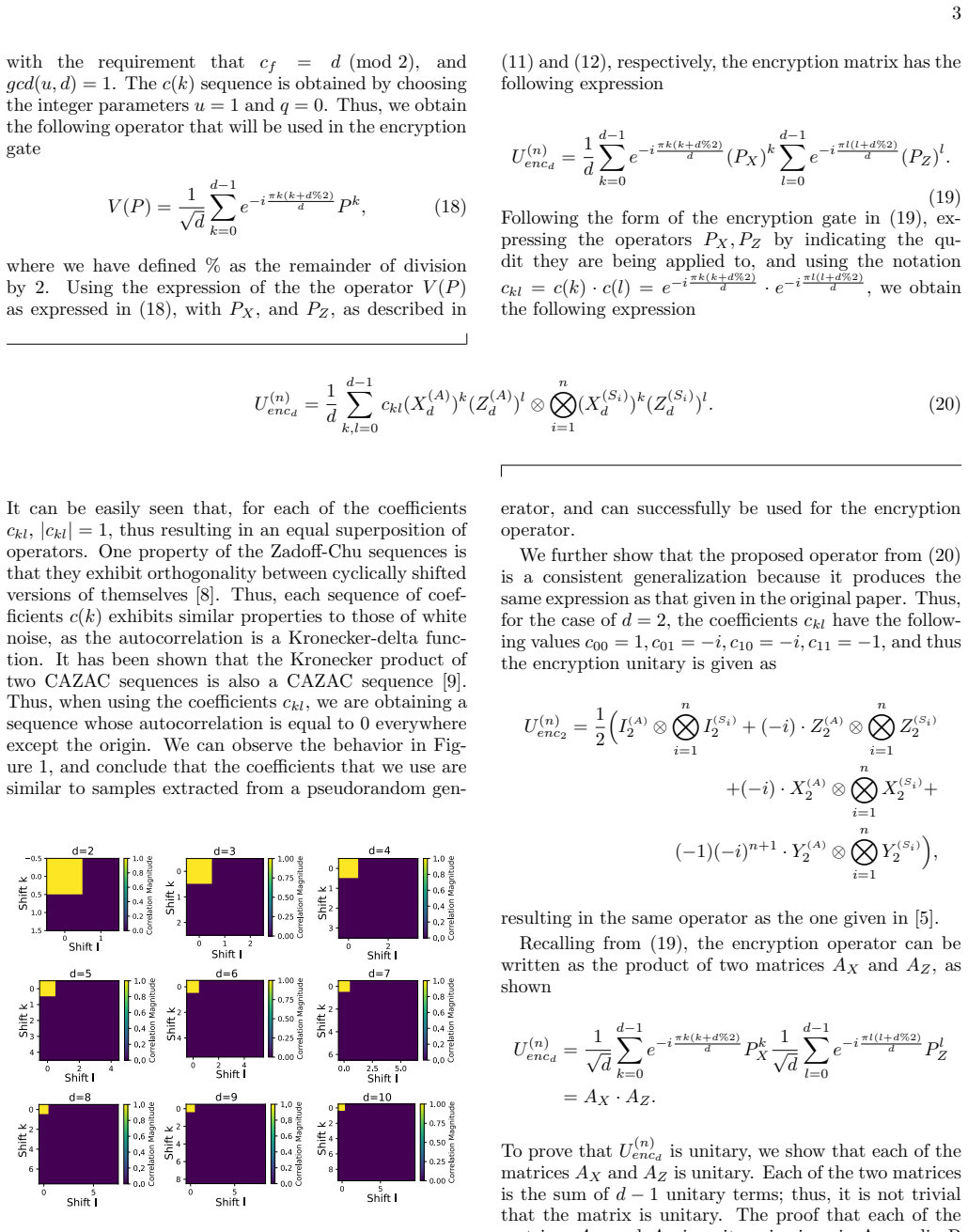


read the original abstract
Recently, Yamaguchi and Kempf [Phys. Rev. Lett. 136:010801, arXiv:2501.02757] proved that encrypted qubits can be cloned. In this work, we generalize the encrypted cloning protocol and prove that it also applies to higher-order quantum systems. Given that a straightforward generalization of the protocol using the exponential of the shift and phase operators fails to satisfy the unitary requirement for a quantum gate, we propose a different approach. We introduce a new operator to be used in the encryption process and show that it is unitary. We adapt the decryption operator from the reference paper to fit in the framework of multi-level quantum systems. We analyze the circuit implementation of the proposed operators and show that the overhead imposed by larger dimensions scales linearly with qudit dimension.
Editorial analysis
A structured set of objections, weighed in public.
Referee Report
Summary. The manuscript generalizes the encrypted cloning protocol of Yamaguchi and Kempf from qubits to qudits of arbitrary dimension d. Because the direct generalization via exp(shift + phase) fails to be unitary, a new encryption operator is introduced and proven unitary; the decryption operator is adapted from the qubit case, and the circuit implementation is analyzed to show that overhead scales linearly with d.
Significance. If the unitarity proof and the correctness of the adapted decryption hold, the result extends encrypted quantum cloning beyond qubits, which is relevant for qudit-based quantum information processing and cryptography. The explicit linear scaling of circuit overhead is a concrete practical strength of the work.
major comments (2)
- [§2] §2 (new encryption operator): the manuscript must supply the explicit definition of the new operator together with the derivation that it is unitary for general d (i.e., U†U = I). The abstract states the result but the load-bearing claim requires the algebraic verification.
- [§3] §3 (adapted decryption): unitarity of the encryption operator alone does not guarantee that the adapted decryption map commutes correctly with the cloning operation on the encrypted state. The paper must demonstrate explicitly that both cloned copies are recovered without introducing dimension-dependent phase or basis mismatch that would violate the original encryption constraints.
minor comments (2)
- Include a small table or explicit matrix elements for the new operator at small d (e.g., d=3) to allow immediate verification of unitarity.
- [§4] The circuit diagram in §4 should label every gate with its dimension-dependent cost so that the claimed linear scaling is visually evident.
Simulated Author's Rebuttal
We thank the referee for the careful reading and constructive feedback on our manuscript. The comments highlight areas where additional explicit details will strengthen the presentation. We address each major comment below and have revised the manuscript to incorporate the requested clarifications and algebraic verifications.
read point-by-point responses
-
Referee: [§2] §2 (new encryption operator): the manuscript must supply the explicit definition of the new operator together with the derivation that it is unitary for general d (i.e., U†U = I). The abstract states the result but the load-bearing claim requires the algebraic verification.
Authors: We agree that the explicit definition and full algebraic verification of unitarity for arbitrary d should be provided in detail. Although the manuscript states that the new operator is unitary, the step-by-step derivation was not expanded sufficiently in §2. In the revised version, we now include the explicit operator expression (defined via its action on the computational basis of the qudit space) and derive U†U = I by direct computation, verifying the inner products and orthogonality conditions hold independently of d. revision: yes
-
Referee: [§3] §3 (adapted decryption): unitarity of the encryption operator alone does not guarantee that the adapted decryption map commutes correctly with the cloning operation on the encrypted state. The paper must demonstrate explicitly that both cloned copies are recovered without introducing dimension-dependent phase or basis mismatch that would violate the original encryption constraints.
Authors: This observation is correct and helpful. Unitarity alone does not automatically ensure compatibility with the cloning map and decryption. In the revised manuscript, we have added an explicit operator-level verification in §3: we compose the full sequence (encryption, cloning, adapted decryption) and show by direct calculation on basis states that each cloned copy decrypts to the original state without extraneous d-dependent phases or basis transformations. The adapted decryption is shown to commute appropriately with the cloning operation within the encrypted subspace. revision: yes
Circularity Check
Independent generalization of encrypted cloning via new unitary operator
full rationale
The paper cites an external qubit protocol (Yamaguchi and Kempf) and explicitly notes that a direct exponential generalization fails unitarity, then defines and proves unitarity for a new operator before adapting the decryption map. All load-bearing steps are direct constructions and verifications in standard quantum mechanics for arbitrary d, with no reduction to self-definitions, fitted inputs renamed as predictions, or load-bearing self-citations. The central claim is a proof of applicability to qudits, which remains self-contained against external benchmarks.
Axiom & Free-Parameter Ledger
axioms (2)
- standard math Quantum operations must be unitary to preserve probability.
- domain assumption The no-cloning theorem applies to unknown quantum states but can be circumvented for encrypted states.
invented entities (1)
-
New encryption operator for qudits
no independent evidence
Lean theorems connected to this paper
-
IndisputableMonolith/Cost/FunctionalEquation.leanwashburn_uniqueness_aczel unclear?
unclearRelation between the paper passage and the cited Recognition theorem.
We introduce a new operator to be used in the encryption process and show that it is unitary... V(P) = 1/√d ∑_{k=0}^{d-1} exp(-i π k(k+d%2)/d) P^k
-
IndisputableMonolith/Foundation/RealityFromDistinction.leanreality_from_one_distinction unclear?
unclearRelation between the paper passage and the cited Recognition theorem.
Theorem III.2... Tr_B((O1 ⊗ I_B)|Φ_d⟩⟨Φ_d|(O2† ⊗ I_B)) = (1/d) O1 O2†
What do these tags mean?
- matches
- The paper's claim is directly supported by a theorem in the formal canon.
- supports
- The theorem supports part of the paper's argument, but the paper may add assumptions or extra steps.
- extends
- The paper goes beyond the formal theorem; the theorem is a base layer rather than the whole result.
- uses
- The paper appears to rely on the theorem as machinery.
- contradicts
- The paper's claim conflicts with a theorem or certificate in the canon.
- unclear
- Pith found a possible connection, but the passage is too broad, indirect, or ambiguous to say the theorem truly supports the claim.
Forward citations
Cited by 1 Pith paper
-
Encrypted clones can leak: Classification of informative subsets in Quantum Encrypted Cloning
Non-authorized subsets in quantum encrypted cloning can retain restricted residual information about the input state in a parity-dependent pattern, revealing a structural confidentiality limitation.
Reference graph
Works this paper leans on
-
[1]
,3},(21) where the operatorsσ µ represent the Pauli operators {I2, X2, Y2, Z2}
In the original paper, the authors used the following result σ(Ni) µ T ⊗σ (Si) µ |Φ2⟩=|Φ 2⟩,∀µ∈ {0, . . . ,3},(21) where the operatorsσ µ represent the Pauli operators {I2, X2, Y2, Z2}. Ford≥3, this result does not apply; thus, we propose the following theorem, whose proof is provided in Appendix E 1. Theorem III.1.The following identity X (Q1 ) d k1 Z (Q...
-
[2]
In this Appendix, we provide the derivation for the qudit identity X (A) d k1 Z (A) d −k2 ⊗X (B) d k1 Z (B) d k2 |Φd⟩=|Φ d⟩,(E1) for any dimensiond≥2 andk 1, k2 ∈ {0,
Proof of the Theorem III.1 Let|Φ d⟩be the generalized Bell state andX d, Zd be the generalized Pauli operators. In this Appendix, we provide the derivation for the qudit identity X (A) d k1 Z (A) d −k2 ⊗X (B) d k1 Z (B) d k2 |Φd⟩=|Φ d⟩,(E1) for any dimensiond≥2 andk 1, k2 ∈ {0, . . . , d−1}. Proof.We prove the theorem by fixing one of the opera- tors, con...
-
[3]
We prove the identity TrB (O1 ⊗I (B) d )|Φ d⟩A,B ⟨Φd|A,B (O† 2 ⊗I (B) d ) = 1 d O1O† 2
Proof of the Theorem III.2 Let|Φ d⟩be the generalized Bell state,O 1, O2 be two general one-qudit operators andI (B) d be the identity ap- plied on the subsystem B. We prove the identity TrB (O1 ⊗I (B) d )|Φ d⟩A,B ⟨Φd|A,B (O† 2 ⊗I (B) d ) = 1 d O1O† 2. (E2) Proof. LHS= 1 d d−1X l,p1,p2=0 (I (A) d ⟨l|B)(O1 ⊗I (B) d ) (|p1⟩A ⟨p2|A)· ·(|p 1⟩B ⟨p2|B) (O† 2 ⊗I...
-
[4]
We prove the identity Tr (X k dZ l d ⊗I d)|Φ d⟩ ⟨Φd|(Z −n d X −m d ⊗I d) =δ k,mδl,n, (E3) for anym, n∈ {0,
Proof of the Theorem III.3 Let|Φ d⟩be the generalized Bell state andX d, Zd be the generalized Pauli operators. We prove the identity Tr (X k dZ l d ⊗I d)|Φ d⟩ ⟨Φd|(Z −n d X −m d ⊗I d) =δ k,mδl,n, (E3) for anym, n∈ {0, . . . , d−1}. Proof. LHS= Tr (X k d Z l d ⊗I d)|Φ d⟩ ⟨Φd|)(Z −n d X m d ⊗I d) Using the permutation property of the trace = Tr ⟨Φd|(Z −n d...
-
[5]
M. M. Wilde,Quantum Information Theory(Cambridge University Press, 2013)
2013
-
[6]
N. T. Islam, C. C. W. Lim, C. Cahall, J. Kim, and D. J. Gauthier, Provably secure and high-rate quantum key distribution with time-bin qudits, Science Advances3, e1701491 (2017)
2017
-
[7]
Ionicioiu, Sorting quantum systems efficiently, Sci
R. Ionicioiu, Sorting quantum systems efficiently, Sci. Rep.6, 25356 (2016)
2016
-
[8]
Tavakoli, I
A. Tavakoli, I. Herbauts, M. ˙Zukowski, and M. Bouren- nane, Secret sharing with a singled-level quantum sys- tem, Phys. Rev. A92, 030302 (2015)
2015
-
[9]
Yamaguchi and A
K. Yamaguchi and A. Kempf, Encrypted qubits can be cloned, Phys. Rev. Lett.136, 010801 (2026)
2026
-
[10]
Weyl,The Theory of Groups and Quantum Mechanics (Dover, 1931)
H. Weyl,The Theory of Groups and Quantum Mechanics (Dover, 1931)
1931
-
[11]
M. A. Nielsen and I. L. Chuang,Quantum Computa- tion and Quantum Information: 10th Anniversary Edi- tion(Cambridge University Press, 2010)
2010
-
[12]
Chu, Polyphase codes with good periodic correlation properties (corresp.), IEEE Transactions on Information Theory18, 531 (1972)
D. Chu, Polyphase codes with good periodic correlation properties (corresp.), IEEE Transactions on Information Theory18, 531 (1972)
1972
-
[13]
Popovic, Generalized chirp-like polyphase sequences with optimum correlation properties, IEEE Transactions on Information Theory38, 1406 (1992)
B. Popovic, Generalized chirp-like polyphase sequences with optimum correlation properties, IEEE Transactions on Information Theory38, 1406 (1992)
1992
-
[14]
A. S. Nikolaeva, E. O. Kiktenko, and A. K. Fedorov, Effi- cient realization of quantum algorithms with qudits, EPJ Quantum Technology11, 43 (2024)
2024
-
[15]
Di and H.-R
Y.-M. Di and H.-R. Wei, Synthesis of multivalued quan- tum logic circuits by elementary gates, Phys. Rev. A87, 012325 (2013)
2013
discussion (0)
Sign in with ORCID, Apple, or X to comment. Anyone can read and Pith papers without signing in.