Recognition: no theorem link
Quantum state randomization constrained by non-Abelian symmetries
Pith reviewed 2026-05-10 19:12 UTC · model grok-4.3
The pith
Unentangled initial states prevent quantum systems with non-Abelian symmetries from reaching Haar-like randomness at late times.
A machine-rendered reading of the paper's core claim, the machinery that carries it, and where it could break.
Core claim
Time-evolved states can reproduce Haar-like behavior at the level of finite statistical moments provided the initial state matches the moments of conserved operators in the Haar ensemble, but unentangled initial states commonly used in programmable quantum systems cannot meet this requirement, so late-time states remain distinguishable from Haar-random states in probes such as entanglement entropy with deviations that remain finite with increasing system size.
What carries the argument
The moment-matching condition between the initial state and the Haar ensemble for conserved operators, which determines whether finite-moment randomization is reachable under symmetry-constrained unitary dynamics.
If this is right
- Late-time states remain distinguishable from Haar-random states in standard probes such as entanglement entropy.
- Deviations from Haar behavior stay finite as system size grows.
- The maximum achievable entanglement entropy is set by the choice of unentangled initial condition.
- Certain unentangled initial states produce the most entropic late-time states under the symmetry constraints.
Where Pith is reading between the lines
- Programmable quantum devices may require preparation of states with tuned moments rather than relying on long-time evolution alone to approach randomness.
- Tests of quantum thermalization or chaos should incorporate explicit checks of initial-state moments of conserved quantities.
- The same moment-matching logic may apply to other non-Abelian symmetry groups beyond SU(2) and to higher-order statistical probes.
- Preparing initial states whose low-order moments already match Haar expectations could serve as a practical route to higher late-time entropy.
Load-bearing premise
Unentangled initial states cannot be prepared to match the finite moments of conserved operators under the Haar ensemble.
What would settle it
Prepare an unentangled initial state in an SU(2)-symmetric many-body system, evolve it for long times in a regime known to be strongly chaotic, and check whether entanglement entropy saturates to the Haar value or instead shows a system-size-independent deficit.
Figures


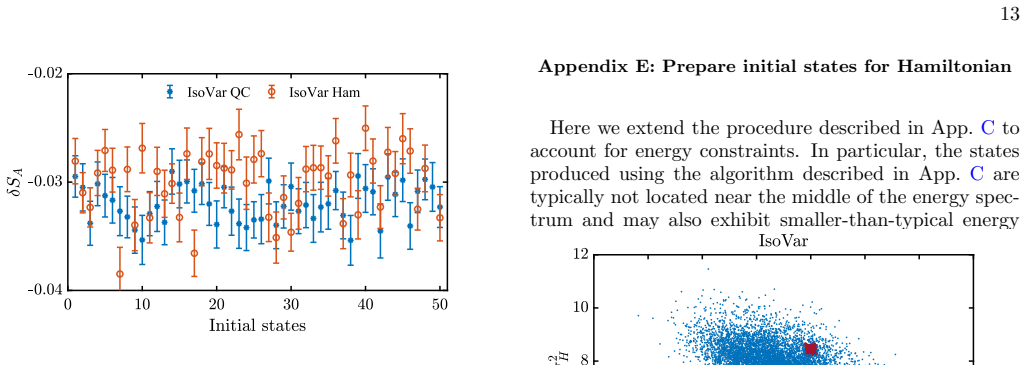

read the original abstract
The emergence of randomness from unitary quantum dynamics is a central problem across diverse disciplines, ranging from the foundations of statistical mechanics to quantum algorithms and quantum computation. Physical systems are invariably subject to constraints -- from simple scalar symmetries to more complex non-Abelian ones -- that restrict the accessible regions of Hilbert space and obstruct the generation of pure random states. In this work, we show that for systems with noncommuting symmetries such as SU(2), the degree of Haar-like randomization achievable under unitary dynamics is strongly constrained by experimental limitations on state initialization, in particular low-entanglement initial states, rather than by the symmetry-constrained dynamics themselves. Specifically, we show that time-evolved states can, in principle, reproduce Haar-like behavior at the level of finite statistical moments (i.e., those accessible under realistic experimental conditions with a finite number of state copies) provided that the initial state matches the corresponding moments of the conserved operators in the Haar ensemble. However, for the unentangled initial states commonly used in programmable quantum systems, this condition cannot be satisfied. Consequently, even at asymptotically long times in strongly quantum-chaotic regimes, late-time states remain distinguishable from Haar-random states in probes such as entanglement entropy, with deviations from Haar behavior that remain finite with increasing system size. We quantify the maximal entanglement entropy achievable and identify the unentangled initial conditions that yield the most entropic late-time states. Our results show that the combination of non-Abelian symmetry structure and experimental constraints on state preparation can strongly limit the degree of Haar-like randomization achievable at late times.
Editorial analysis
A structured set of objections, weighed in public.
Referee Report
Summary. The paper examines the emergence of Haar-random-like behavior under unitary dynamics in systems constrained by non-Abelian symmetries such as SU(2). It claims that time-evolved states can match the finite statistical moments of the Haar ensemble (accessible with finite state copies) if the initial state matches the corresponding moments of the conserved operators, but that unentangled initial states—common in programmable quantum systems—cannot satisfy this, leading to persistent, finite deviations from Haar behavior in late-time probes such as entanglement entropy even in strongly chaotic regimes and with increasing system size. The work quantifies the maximal achievable entanglement entropy and identifies optimal unentangled initial conditions.
Significance. If the central claims hold, the result clarifies that preparational constraints on low-entanglement states, rather than the symmetry-constrained dynamics themselves, limit randomization in non-Abelian systems. This has direct relevance to quantum simulation, many-body thermalization, and experimental quantum information platforms. The paper earns credit for distinguishing dynamical vs. initial-state effects, providing moment-matching conditions, and deriving quantitative bounds on late-time entanglement entropy.
major comments (2)
- [§3.2, Eq. (12)] §3.2, Eq. (12): the necessity of matching all finite moments of the conserved operators for the initial state to enable Haar-like behavior at late times is asserted but the derivation from the unitary evolution operator appears incomplete; specifically, it is unclear whether higher-order commutators in the non-Abelian algebra introduce additional constraints not captured by the moment-matching condition alone.
- [§5, Fig. 3] §5, Fig. 3 and surrounding text: the claim that entanglement entropy deviations remain finite (non-vanishing) with increasing system size relies on numerical data up to N=12; the extrapolation argument to the thermodynamic limit needs an analytic bound or scaling analysis to be load-bearing for the central conclusion.
minor comments (2)
- [Abstract] Abstract, line 4: 'noncommuting' should be hyphenated as 'non-commuting' for consistency with standard usage in the field.
- [§2.1] §2.1: the definition of the 'Haar ensemble' for the symmetry-constrained case could include an explicit reference to the induced measure on the coadjoint orbit to aid readers unfamiliar with non-Abelian random matrix ensembles.
Simulated Author's Rebuttal
We thank the referee for the careful reading and constructive comments. We address each major point below. The central claims rest on the distinction between dynamical constraints from non-Abelian symmetries and preparational constraints from unentangled initial states; we have revised the manuscript to clarify the former and strengthen the supporting analysis for the latter.
read point-by-point responses
-
Referee: [§3.2, Eq. (12)] §3.2, Eq. (12): the necessity of matching all finite moments of the conserved operators for the initial state to enable Haar-like behavior at late times is asserted but the derivation from the unitary evolution operator appears incomplete; specifically, it is unclear whether higher-order commutators in the non-Abelian algebra introduce additional constraints not captured by the moment-matching condition alone.
Authors: The moment-matching condition follows directly from the fact that the Hamiltonian commutes with all generators of the non-Abelian symmetry, so the unitary evolution operator U(t) = exp(-iHt) acts as an adjoint action that leaves the algebra invariant. Because the Lie algebra is closed, all nested commutators remain within the same set of generators; no new independent constraints arise beyond the moments already fixed by the initial state. If the initial state matches the Haar moments of the conserved operators up to finite order k, the evolved state continues to match them at all times. We have added an explicit expansion in the revised §3.2 showing how the adjoint action preserves these moments order by order. revision: yes
-
Referee: [§5, Fig. 3] §5, Fig. 3 and surrounding text: the claim that entanglement entropy deviations remain finite (non-vanishing) with increasing system size relies on numerical data up to N=12; the extrapolation argument to the thermodynamic limit needs an analytic bound or scaling analysis to be load-bearing for the central conclusion.
Authors: We agree that finite-size numerics alone are insufficient. The manuscript already contains an analytic upper bound on the late-time entanglement entropy for unentangled initial states: the maximal value is set by the largest symmetry sector that can be populated from a product state, yielding a deviation from the Haar value that is independent of system size and remains O(1) in the thermodynamic limit. We have added an explicit scaling analysis in the revised §5 that confirms the deviation approaches a nonzero constant, consistent with the representation-theoretic counting of accessible sectors. While a fully rigorous infinite-volume proof would require additional tools, the combination of the analytic bound and the numerics up to N=12 is now load-bearing for the claim. revision: partial
Circularity Check
No significant circularity; derivation is self-contained
full rationale
The paper's central argument compares unitary time evolution under non-Abelian symmetries (e.g., SU(2)) from given initial states to the independently defined Haar ensemble, showing that finite-moment matching is possible in principle but fails for unentangled initial states commonly used in experiments. This leads to persistent deviations in late-time entanglement entropy. All load-bearing steps rest on external definitions of Haar randomness and symmetry constraints rather than self-referential fitting, redefinition of quantities, or load-bearing self-citations. The claims are falsifiable against the Haar benchmark and do not reduce to their own inputs by construction.
Axiom & Free-Parameter Ledger
axioms (2)
- standard math Unitary time evolution preserves the non-Abelian symmetries of the Hamiltonian
- domain assumption The Haar ensemble defines the uniform measure over states invariant under the full unitary group
Forward citations
Cited by 1 Pith paper
-
Typical entanglement entropy with charge conservation
Typical entanglement entropy with fixed global charge is given by the local thermal entropy at fixed charge density for both U(1) and SU(2) symmetries in the thermodynamic limit.
Reference graph
Works this paper leans on
-
[1]
Quantum statistical mechanics in a closed system,
J. M. Deutsch, “Quantum statistical mechanics in a closed system,” Phys. Rev. A43, 2046–2049 (1991)
2046
-
[2]
The approach to thermal equilibrium in quantized chaotic systems,
Mark Srednicki, “The approach to thermal equilibrium in quantized chaotic systems,” Journal of Physics A: Math- ematical and General32, 1163–1175 (1999)
1999
-
[3]
Thermalization and its mechanism for generic isolated quantum systems,
Marcos Rigol, Vanja Dunjko, and Maxim Olshanii, “Thermalization and its mechanism for generic isolated quantum systems,” Nature452, 854–858 (2008)
2008
-
[4]
Colloquium: 14 Nonequilibrium dynamics of closed interacting quantum systems,
Anatoli Polkovnikov, Krishnendu Sengupta, Alessan- dro Silva, and Mukund Vengalattore, “Colloquium: 14 Nonequilibrium dynamics of closed interacting quantum systems,” Rev. Mod. Phys.83, 863–883 (2011)
2011
-
[5]
Equilibration, ther- malisation, and the emergence of statistical mechanics in closed quantum systems,
Christian Gogolin and Jens Eisert, “Equilibration, ther- malisation, and the emergence of statistical mechanics in closed quantum systems,” Reports on Progress in Physics 79, 056001 (2016)
2016
-
[6]
Preparing random states and bench- marking with many-body quantum chaos,
Joonhee Choi, Adam L. Shaw, Ivaylo S. Madjarov, Xin Xie, Ran Finkelstein, Jacob P. Covey, Jordan S. Cotler, Daniel K. Mark, Hsin-Yuan Huang, Anant Kale, Hannes Pichler, Fernando G. S. L. Brand˜ ao, Soonwon Choi, and Manuel Endres, “Preparing random states and bench- marking with many-body quantum chaos,” Nature613, 468–473 (2023)
2023
-
[7]
Benchmarking quantum simulators using ergodic quantum dynamics,
Daniel K. Mark, Joonhee Choi, Adam L. Shaw, Manuel Endres, and Soonwon Choi, “Benchmarking quantum simulators using ergodic quantum dynamics,” Phys. Rev. Lett.131, 110601 (2023)
2023
-
[8]
Shadow tomography of quantum states,
Scott Aaronson, “Shadow tomography of quantum states,” SIAM Journal on Computing49, STOC18–368– STOC18–394 (2020)
2020
-
[9]
Predicting many properties of a quantum system from very few measurements,
Hsin-Yuan Huang, Richard Kueng, and John Preskill, “Predicting many properties of a quantum system from very few measurements,” Nature Physics16, 1050–1057 (2020)
2020
-
[10]
Quantum metrology with quantum-chaotic sensors,
Lukas J. Fiderer and Daniel Braun, “Quantum metrology with quantum-chaotic sensors,” Nature Communications 9, 1351 (2018)
2018
-
[11]
Improving metrology with quantum scrambling,
Zeyang Li, Simone Colombo, Chi Shu, Gustavo Velez, Sa´ ul Pilatowsky-Cameo, Roman Schmied, Soonwon Choi, Mikhail Lukin, Edwin Pedrozo-Pe˜ nafiel, and Vladan Vuletic, “Improving metrology with quantum scrambling,” Science380, 1381–1384 (2023)
2023
-
[12]
Enhanced quantum frequency estimation by nonlinear scrambling,
Victor Montenegro, Sara Dornetti, Alessandro Ferraro, and Matteo G. A. Paris, “Enhanced quantum frequency estimation by nonlinear scrambling,” Phys. Rev. Lett. 135, 030802 (2025)
2025
-
[13]
Quantum supremacy using a programmable superconducting processor,
Google Team and Collaborators, “Quantum supremacy using a programmable superconducting processor,” Na- ture574, 505–510 (2019)
2019
-
[14]
Information scram- bling in quantum circuits,
Google Team and Collaborators, “Information scram- bling in quantum circuits,” Science374, 1479–1483 (2021)
2021
-
[15]
Restrictions on realizable unitary opera- tions imposed by symmetry and locality,
Iman Marvian, “Restrictions on realizable unitary opera- tions imposed by symmetry and locality,” Nature Physics 18, 283–289 (2022)
2022
-
[16]
Maximum entropy principle in deep thermalization and in hilbert-space ergodicity,
Daniel K. Mark, Federica Surace, Andreas Elben, Adam L. Shaw, Joonhee Choi, Gil Refael, Manuel En- dres, and Soonwon Choi, “Maximum entropy principle in deep thermalization and in hilbert-space ergodicity,” Phys. Rev. X14, 041051 (2024)
2024
-
[17]
Late- time ensembles of quantum states in quantum chaotic systems,
Souradeep Ghosh, Christopher M. Langlett, Nicholas Hunter-Jones, and Joaquin F. Rodriguez-Nieva, “Late- time ensembles of quantum states in quantum chaotic systems,” Phys. Rev. B112, 094302 (2025)
2025
-
[18]
Random quan- tum circuits are approximate 2-designs,
Aram W. Harrow and Richard A. Low, “Random quan- tum circuits are approximate 2-designs,” Communica- tions in Mathematical Physics291, 257–302 (2009)
2009
-
[19]
Nicholas Hunter-Jones, “Unitary designs from statisti- cal mechanics in random quantum circuits,” (2019), arXiv:1905.12053
-
[20]
Local Random Quantum Circuits are Approximate Polynomial-Designs,
F. G. S. L. Brand˜ ao, A. W. Harrow, and M. Horodecki, “Local Random Quantum Circuits are Approximate Polynomial-Designs,” Commun. Math. Phys.346, 397 (2016)
2016
-
[21]
Incompress- ibility and spectral gaps of random circuits,
Chi-Fang Chen, Jeongwan Haah, Jonas Haferkamp, Yun- chao Liu, Tony Metger, and Xinyu Tan, “Incompress- ibility and spectral gaps of random circuits,” (2024), arXiv:2406.07478
-
[22]
Randomization times under quantum chaotic hamiltonian evolution,
Souradeep Ghosh, Nicholas Hunter-Jones, and Joaquin F. Rodriguez-Nieva, “Randomization times under quantum chaotic hamiltonian evolution,” (2025), arXiv:2512.25074
-
[23]
Quantum simulation of fundamental particles and forces,
Christian W. Bauer, Zohreh Davoudi, Natalie Klco, and Martin J. Savage, “Quantum simulation of fundamental particles and forces,” Nature Reviews Physics5, 420–432 (2023)
2023
-
[24]
Spin transport in a tunable heisenberg model realized with ultracold atoms,
Paul Niklas Jepsen, Jesse Amato-Grill, Ivana Dimitrova, Wen Wei Ho, Eugene Demler, and Wolfgang Ketterle, “Spin transport in a tunable heisenberg model realized with ultracold atoms,” Nature588, 403–407 (2020)
2020
-
[25]
Quan- tum gas microscopy of kardar-parisi-zhang superdiffu- sion,
David Wei, Antonio Rubio-Abadal, Bingtian Ye, Fran- cisco Machado, Jack Kemp, Kritsana Srakaew, Simon Hollerith, Jun Rui, Sarang Gopalakrishnan, Norman Y. Yao, Immanuel Bloch, and Johannes Zeiher, “Quan- tum gas microscopy of kardar-parisi-zhang superdiffu- sion,” Science376, 716–720 (2022)
2022
-
[26]
Simulation of non-abelian gauge the- ories with optical lattices,
L. Tagliacozzo, A. Celi, P. Orland, M. W. Mitchell, and M. Lewenstein, “Simulation of non-abelian gauge the- ories with optical lattices,” Nature Communications4, 2615 (2013)
2013
-
[27]
Dynamics of magne- tization at infinite temperature in a Heisenberg spin chain,
Google Team and Collaborators, “Dynamics of magne- tization at infinite temperature in a Heisenberg spin chain,” Science384, 48–53 (2024)
2024
-
[28]
Universal prethermal dynamics in heisenberg ferromagnets,
Saraswat Bhattacharyya, Joaquin F. Rodriguez-Nieva, and Eugene Demler, “Universal prethermal dynamics in heisenberg ferromagnets,” Phys. Rev. Lett.125, 230601 (2020)
2020
-
[29]
Far-from-equilibrium universality in the two-dimensional Heisenberg model,
Joaquin F. Rodriguez-Nieva, Asier Pi˜ neiro Orioli, and Jamir Marino, “Far-from-equilibrium universality in the two-dimensional Heisenberg model,” PNAS119, e2122599119 (2022)
2022
-
[30]
Experimental observation of thermal- ization with noncommuting charges,
Florian Kranzl, Aleksander Lasek, Manoj K. Joshi, Amir Kalev, Rainer Blatt, Christian F. Roos, and Nicole Yunger Halpern, “Experimental observation of thermal- ization with noncommuting charges,” PRX Quantum4, 020318 (2023)
2023
-
[31]
Non-abelian trans- port distinguishes three usually equivalent notions of en- tropy production,
Twesh Upadhyaya, William F. Braasch, Gabriel T. Landi, and Nicole Yunger Halpern, “Non-abelian trans- port distinguishes three usually equivalent notions of en- tropy production,” PRX Quantum5, 030355 (2024)
2024
-
[32]
Noncommuting conserved charges in quantum thermodynamics and beyond,
Shayan Majidy, William F. Braasch, Aleksander Lasek, Twesh Upadhyaya, Amir Kalev, and Nicole Yunger Halpern, “Noncommuting conserved charges in quantum thermodynamics and beyond,” Nature Reviews Physics5, 689–698 (2023)
2023
-
[33]
Eigenstate thermalization hypothesis in two-dimensionalxxzmodel with or without su(2) sym- metry,
Jae Dong Noh, “Eigenstate thermalization hypothesis in two-dimensionalxxzmodel with or without su(2) sym- metry,” Phys. Rev. E107, 014130 (2023)
2023
-
[34]
Non-abelian symmetry can in- crease entanglement entropy,
Shayan Majidy, Aleksander Lasek, David A. Huse, and Nicole Yunger Halpern, “Non-abelian symmetry can in- crease entanglement entropy,” Phys. Rev. B107, 045102 (2023)
2023
-
[35]
Non-Abelian symmetry-resolved entanglement en- tropy,
Eugenio Bianchi, Pietro Dona, and Rishabh Ku- mar, “Non-Abelian symmetry-resolved entanglement en- tropy,” SciPost Phys.17, 127 (2024)
2024
-
[36]
Prob- ing many-body dynamics on a 51-atom quantum simula- tor,
Hannes Bernien, Sylvain Schwartz, Alexander Keesling, Harry Levine, Ahmed Omran, Hannes Pichler, Soon- won Choi, Alexander S. Zibrov, Manuel Endres, Markus 15 Greiner, Vladan Vuletic, and Mikhail D. Lukin, “Prob- ing many-body dynamics on a 51-atom quantum simula- tor,” Nature551, 579–584 (2017)
2017
-
[37]
Quantum phases of mat- ter on a 256-atom programmable quantum simulator,
Sepehr Ebadi, Tout T. Wang, Harry Levine, Alexander Keesling, Giulia Semeghini, Ahmed Omran, Dolev Blu- vstein, Rhine Samajdar, Hannes Pichler, Wen Wei Ho, Soonwon Choi, Subir Sachdev, Markus Greiner, Vladan Vuletic, and Mikhail D. Lukin, “Quantum phases of mat- ter on a 256-atom programmable quantum simulator,” Nature595, 227–232 (2021)
2021
-
[38]
Quantum simulation of 2D an- tiferromagnets with hundreds of rydberg atoms,
Pascal Scholl, Michael Schuler, Hannah J. Williams, Alexander A. Eberharter, Daniel Barredo, Kai- Niklas Schymik, Vincent Lienhard, Louis-Paul Henry, Thomas C. Lang, Thierry Lahaye, Andreas M. L¨ auchli, and Antoine Browaeys, “Quantum simulation of 2D an- tiferromagnets with hundreds of rydberg atoms,” Nature 595, 233–238 (2021)
2021
-
[39]
Observation of a many-body dynami- cal phase transition with a 53-qubit quantum simulator,
J. Zhang, G. Pagano, P. W. Hess, A. Kyprianidis, P. Becker, H. Kaplan, A. V. Gorshkov, Z.-X. Gong, and C. Monroe, “Observation of a many-body dynami- cal phase transition with a 53-qubit quantum simulator,” Nature551, 601–604 (2017)
2017
-
[40]
Programmable quantum simulations of spin sys- tems with trapped ions,
C. Monroe, W. C. Campbell, L.-M. Duan, Z.-X. Gong, A. V. Gorshkov, P. W. Hess, R. Islam, K. Kim, N. M. Linke, G. Pagano, P. Richerme, C. Senko, and N. Y. Yao, “Programmable quantum simulations of spin sys- tems with trapped ions,” Rev. Mod. Phys.93, 025001 (2021)
2021
-
[41]
Full counting statistics of charge in chaotic many-body quantum systems,
Ewan McCulloch, Jacopo De Nardis, Sarang Gopalakr- ishnan, and Romain Vasseur, “Full counting statistics of charge in chaotic many-body quantum systems,” Phys. Rev. Lett.131, 210402 (2023)
2023
-
[42]
Distinct universality classes of diffusive transport from full counting statis- tics,
Sarang Gopalakrishnan, Alan Morningstar, Romain Vasseur, and Vedika Khemani, “Distinct universality classes of diffusive transport from full counting statis- tics,” Phys. Rev. B109, 024417 (2024)
2024
-
[43]
Prob- ing entanglement in a many-body localized system,
Alexander Lukin, Matthew Rispoli, Robert Schittko, M. Eric Tai, Adam M. Kaufman, Soonwon Choi, Vedika Khemani, Julian L´ eonard, and Markus Greiner, “Prob- ing entanglement in a many-body localized system,” Sci- ence364, 256–260 (2019)
2019
-
[44]
R´ enyi entropies from random quenches in atomic hubbard and spin models,
A. Elben, B. Vermersch, M. Dalmonte, J. I. Cirac, and P. Zoller, “R´ enyi entropies from random quenches in atomic hubbard and spin models,” Phys. Rev. Lett.120, 050406 (2018)
2018
-
[45]
Probing renyi en- tanglement entropy via randomized measurements,
Tiff Brydges, Andreas Elben, Petar Jurcevic, Benoˆ ıt Ver- mersch, Christine Maier, Ben P. Lanyon, Peter Zoller, Rainer Blatt, and Christian F. Roos, “Probing renyi en- tanglement entropy via randomized measurements,” Sci- ence364, 260–263 (2019)
2019
-
[46]
The randomized measurement toolbox,
Andreas Elben, Steven T. Flammia, Hsin-Yuan Huang, Richard Kueng, John Preskill, Benoˆ ıt Vermersch, and Peter Zoller, “The randomized measurement toolbox,” Nature Reviews Physics5, 9–24 (2023)
2023
-
[47]
Universal entanglement of mid-spectrum eigenstates of chaotic local hamiltonians,
Yichen Huang, “Universal entanglement of mid-spectrum eigenstates of chaotic local hamiltonians,” Nuclear Physics B966, 115373 (2021)
2021
-
[48]
Entanglement of midspectrum eigenstates of chaotic many-body systems: Reasons for deviation from random ensembles,
Masudul Haque, Paul A. McClarty, and Ivan M. Khay- movich, “Entanglement of midspectrum eigenstates of chaotic many-body systems: Reasons for deviation from random ensembles,” Phys. Rev. E105, 014109 (2022)
2022
-
[49]
Quantifying quantum chaos through micro- canonical distributions of entanglement,
Joaquin F. Rodriguez-Nieva, Cheryne Jonay, and Vedika Khemani, “Quantifying quantum chaos through micro- canonical distributions of entanglement,” Phys. Rev. X 14, 031014 (2024)
2024
-
[50]
Entanglement patterns of quantum chaotic hamiltonians with a scalar u(1) charge,
Christopher M. Langlett and Joaquin F. Rodriguez- Nieva, “Entanglement patterns of quantum chaotic hamiltonians with a scalar u(1) charge,” Phys. Rev. Lett. 134, 230402 (2025)
2025
-
[51]
Eigen- state correlations, thermalization, and the butterfly ef- fect,
Amos Chan, Andrea De Luca, and J. T. Chalker, “Eigen- state correlations, thermalization, and the butterfly ef- fect,” Phys. Rev. Lett.122, 220601 (2019)
2019
-
[52]
Eigenstate thermaliza- tion hypothesis and out of time order correlators,
Laura Foini and Jorge Kurchan, “Eigenstate thermaliza- tion hypothesis and out of time order correlators,” Phys. Rev. E99, 042139 (2019)
2019
-
[53]
Eigenstate thermalization hypoth- esis beyond standard indicators: Emergence of random- matrix behavior at small frequencies,
Jonas Richter, Anatoly Dymarsky, Robin Steinigeweg, and Jochen Gemmer, “Eigenstate thermalization hypoth- esis beyond standard indicators: Emergence of random- matrix behavior at small frequencies,” Phys. Rev. E102, 042127 (2020)
2020
-
[54]
Local pairing of feyn- man histories in many-body floquet models,
S. J. Garratt and J. T. Chalker, “Local pairing of feyn- man histories in many-body floquet models,” Phys. Rev. X11, 021051 (2021)
2021
-
[55]
Eigenstate thermalization hypothesis and its deviations from random-matrix theory beyond the thermalization time,
Jiaozi Wang, Mats H. Lamann, Jonas Richter, Robin Steinigeweg, Anatoly Dymarsky, and Jochen Gemmer, “Eigenstate thermalization hypothesis and its deviations from random-matrix theory beyond the thermalization time,” Phys. Rev. Lett.128, 180601 (2022)
2022
-
[56]
Fluctuations of subsystem entropies at late times,
Jordan Cotler, Nicholas Hunter-Jones, and Daniel Ranard, “Fluctuations of subsystem entropies at late times,” Phys. Rev. A105, 022416 (2022)
2022
-
[57]
Out-of-time-order correlations and the fine structure of eigenstate thermal- ization,
Marlon Brenes, Silvia Pappalardi, Mark T. Mitchison, John Goold, and Alessandro Silva, “Out-of-time-order correlations and the fine structure of eigenstate thermal- ization,” Phys. Rev. E104, 034120 (2021)
2021
-
[58]
Emergent quantum state designs from individual many-body wavefunctions,
Jordan S. Cotler, Daniel K. Mark, Hsin-Yuan Huang, Felipe Hernandez, Joonhee Choi, Adam L. Shaw, Manuel Endres, and Soonwon Choi, “Emergent quantum state designs from individual many-body wavefunctions,” PRX Quantum4, 010311 (2023)
2023
-
[59]
Exact emergent quan- tum state designs from quantum chaotic dynamics,
Wen Wei Ho and Soonwon Choi, “Exact emergent quan- tum state designs from quantum chaotic dynamics,” Phys. Rev. Lett.128, 060601 (2022)
2022
-
[60]
Solvable model of deep thermalization with distinct design times,
Matteo Ippoliti and Wen Wei Ho, “Solvable model of deep thermalization with distinct design times,” Quan- tum6, 886 (2022)
2022
-
[61]
Complete Hilbert-Space Ergodicity in Quantum Dynamics of Generalized Fibonacci Drives,
Saul Pilatowsky-Cameo, Ceren B. Dag, Wen Wei Ho, and Soonwon Choi, “Complete Hilbert-Space Ergodicity in Quantum Dynamics of Generalized Fibonacci Drives,” Phys. Rev. Lett.131, 250401 (2023)
2023
-
[62]
Characterizing complexity of many-body quantum dy- namics by higher-order eigenstate thermalization,
Kazuya Kaneko, Eiki Iyoda, and Takahiro Sagawa, “Characterizing complexity of many-body quantum dy- namics by higher-order eigenstate thermalization,” Phys. Rev. A101, 042126 (2020)
2020
-
[63]
Designs via free probability,
Michele Fava, Jorge Kurchan, and Silvia Pappalardi, “Designs via free probability,” Phys. Rev. X15, 011031 (2025)
2025
-
[64]
Entanglement entropy of eigenstates of quantum chaotic hamiltonians,
Lev Vidmar and Marcos Rigol, “Entanglement entropy of eigenstates of quantum chaotic hamiltonians,” Phys. Rev. Lett.119, 220603 (2017)
2017
-
[65]
Typical entangle- ment entropy in the presence of a center: Page curve and its variance,
Eugenio Bianchi and Pietro Don` a, “Typical entangle- ment entropy in the presence of a center: Page curve and its variance,” Phys. Rev. D100, 105010 (2019)
2019
-
[66]
Volume-law entanglement en- tropy of typical pure quantum states,
Eugenio Bianchi, Lucas Hackl, Mario Kieburg, Marcos Rigol, and Lev Vidmar, “Volume-law entanglement en- tropy of typical pure quantum states,” PRX Quantum3, 030201 (2022)
2022
-
[67]
Quantum fisher information from randomized measurements,
Aniket Rath, Cyril Branciard, Anna Minguzzi, and 16 Benoˆ ıt Vermersch, “Quantum fisher information from randomized measurements,” Phys. Rev. Lett.127, 260501 (2021)
2021
-
[68]
Exploring large-scale entan- glement in quantum simulation,
Manoj K. Joshi, Christian Kokail, Rick van Bijnen, Flo- rian Kranzl, Torsten V. Zache, Rainer Blatt, Christian F. Roos, and Peter Zoller, “Exploring large-scale entan- glement in quantum simulation,” Nature624, 539–544 (2023)
2023
-
[69]
Average entropy of a subsystem,
Don N. Page, “Average entropy of a subsystem,” Phys. Rev. Lett.71, 1291–1294 (1993)
1993
-
[70]
Random pure states: Quantifying bipartite entangle- ment beyond the linear statistics,
Pierpaolo Vivo, Mauricio P. Pato, and Gleb Oshanin, “Random pure states: Quantifying bipartite entangle- ment beyond the linear statistics,” Phys. Rev. E93, 052106 (2016)
2016
-
[71]
Proof of vivo-pato-oshanin’s conjecture on the fluctuation of von neumann entropy,
Lu Wei, “Proof of vivo-pato-oshanin’s conjecture on the fluctuation of von neumann entropy,” Phys. Rev. E96, 022106 (2017)
2017
-
[72]
Christopher M. Langlett, Cheryne Jonay, Vedika Khe- mani, and Joaquin F. Rodriguez-Nieva, “Quantum chaos at finite temperature in local spin hamiltonians,” (2025), arXiv:2501.13164
-
[73]
Average pure-state entanglement entropy in spin systems with su(2) symmetry,
Rohit Patil, Lucas Hackl, George R. Fagan, and Marcos Rigol, “Average pure-state entanglement entropy in spin systems with su(2) symmetry,” Phys. Rev. B108, 245101 (2023)
2023
-
[74]
Quantum entanglement growth un- der random unitary dynamics,
Adam Nahum, Jonathan Ruhman, Sagar Vijay, and Jeongwan Haah, “Quantum entanglement growth un- der random unitary dynamics,” Phys. Rev. X7, 031016 (2017)
2017
-
[75]
Random quantum circuits,
Matthew P.A. Fisher, Vedika Khemani, Adam Nahum, and Sagar Vijay, “Random quantum circuits,” Annual Review of Condensed Matter Physics14, 335–379 (2023)
2023
discussion (0)
Sign in with ORCID, Apple, or X to comment. Anyone can read and Pith papers without signing in.