Recognition: 2 theorem links
· Lean TheoremParametrized quasinormal modes, greybody factors and their correspondence
Pith reviewed 2026-05-10 18:53 UTC · model grok-4.3
The pith
Small corrections to the black hole potential alter quasinormal mode frequencies and greybody factors according to their perturbative order and polynomial power.
A machine-rendered reading of the paper's core claim, the machinery that carries it, and where it could break.
Core claim
In the parametrized quasinormal mode framework, modifications to general relativity appear as small corrections to the effective potential; the resulting quasinormal mode frequencies and greybody factors then depend systematically on the perturbative order of the correction and on the power of the polynomial term. The paper also tests the recently proposed correspondence between quasinormal modes and greybody factors inside this framework and identifies the regime in which the correspondence ceases to hold.
What carries the argument
The parametrized quasinormal mode framework, which encodes modifications to general relativity as small corrections to the potential and thereby tracks their effect on quasinormal modes, greybody factors, and their mutual correspondence.
Load-bearing premise
Modifications to general relativity can be introduced as small corrections in the potential within the parametrized quasinormal mode framework, and the framework remains valid for the orders and powers considered.
What would settle it
A measured black-hole ringdown spectrum whose frequency shifts fail to follow the predicted dependence on the order of a potential correction would show that the framework does not apply to that system.
Figures



read the original abstract
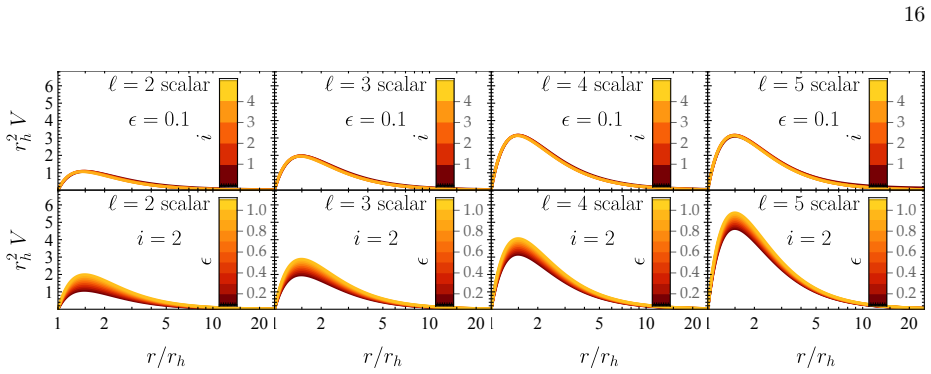
We present a detailed study of quasinormal modes and greybody factors in the context of the parametrized quasinormal mode framework, in which modifications to general relativity are introduced as small corrections in the potential. We deduce the QNMs' and GBFs' dependence on the order of the modifications and their polynomial power. We also test the validity of the recently proposed QNM-GBF correspondence in the pQNM framework by inspecting the regime at which it breaks down.
Editorial analysis
A structured set of objections, weighed in public.
Referee Report
Summary. The manuscript investigates quasinormal modes (QNMs) and greybody factors (GBFs) within the parametrized quasinormal mode (pQNM) framework, modeling modifications to general relativity as small corrections to the effective potential. It derives the explicit dependence of QNMs and GBFs on the order of these modifications and the polynomial power of the corrections, and tests the recently proposed QNM-GBF correspondence by determining the regime in which it breaks down through comparison of perturbative results with direct numerical integration.
Significance. If the central results hold, the work supplies a controlled perturbative toolkit for mapping how deviations from GR propagate into observable black-hole ringdown and scattering quantities. The systematic expansion of the wave equation combined with WKB/continued-fraction methods and explicit numerical cross-checks of the breakdown threshold constitute a reproducible and falsifiable contribution that could inform template construction for future gravitational-wave tests of gravity.
minor comments (2)
- The abstract states that the dependence on 'order of the modifications and their polynomial power' is deduced, but does not specify the precise functional forms (e.g., the powers or the range of orders) considered in the potential corrections; this should be stated explicitly for reproducibility.
- In the description of the breakdown regime, the criterion used to declare that the perturbative QNM formula 'deviates' from numerical integration should be quantified (e.g., a relative error threshold or a specific figure of merit) rather than left qualitative.
Simulated Author's Rebuttal
We thank the referee for their positive summary of our manuscript and the recommendation for minor revision. The referee accurately captures our investigation of how QNMs and GBFs depend on the order of modifications and the polynomial power of corrections within the pQNM framework, as well as our numerical tests of the QNM-GBF correspondence breakdown. No specific major comments were raised in the report.
Circularity Check
No significant circularity; derivations rely on independent perturbative expansions
full rationale
The paper applies standard perturbative expansions to the wave equation in the pQNM framework using WKB and continued-fraction methods to derive QNM/GBF dependence on modification order and power. The QNM-GBF correspondence test compares against an externally proposed relation and checks breakdown via direct numerical integration against the perturbative formula. No load-bearing step reduces to self-definition, fitted inputs renamed as predictions, or self-citation chains; the framework remains self-contained within stated perturbative assumptions without internal fitting loops.
Axiom & Free-Parameter Ledger
Lean theorems connected to this paper
-
IndisputableMonolith/Cost/FunctionalEquation.leanwashburn_uniqueness_aczel unclear?
unclearRelation between the paper passage and the cited Recognition theorem.
modifications to general relativity are introduced as small corrections in the potential... δṼ = 1/r² Σ α(i) (r_h/r)^i ... α(i) ≪ α_max^(i) = (1 + 1/i)^i (i+1)
-
IndisputableMonolith/Foundation/RealityFromDistinction.leanreality_from_one_distinction unclear?
unclearRelation between the paper passage and the cited Recognition theorem.
ω = ω_GR + Σ α(i) e(i) ... WKB formula to arbitrary order... correspondence formula (20) truncated at O(ℓ^{-2})
What do these tags mean?
- matches
- The paper's claim is directly supported by a theorem in the formal canon.
- supports
- The theorem supports part of the paper's argument, but the paper may add assumptions or extra steps.
- extends
- The paper goes beyond the formal theorem; the theorem is a base layer rather than the whole result.
- uses
- The paper appears to rely on the theorem as machinery.
- contradicts
- The paper's claim conflicts with a theorem or certificate in the canon.
- unclear
- Pith found a possible connection, but the passage is too broad, indirect, or ambiguous to say the theorem truly supports the claim.
Forward citations
Cited by 1 Pith paper
-
Novel ringdown tests of general relativity with black hole greybody factors
GreyRing model based on greybody factors reproduces numerical relativity ringdown signals with mismatches of order 10^{-6} and enables a new post-merger consistency test of general relativity applied to GW250114.
Reference graph
Works this paper leans on
-
[1]
Regge and J
T. Regge and J. A. Wheeler, Phys. Rev.108, 1063 (1957)
1957
-
[2]
C. V. Vishveshwara, Nature227, 936 (1970)
1970
-
[3]
Chandrasekhar and S
S. Chandrasekhar and S. L. Detweiler, Proc. Roy. Soc. Lond. A344, 441 (1975)
1975
-
[4]
K. D. Kokkotas and B. G. Schmidt, Living Rev. Rel.2, 2 (1999), arXiv:gr-qc/9909058
work page internal anchor Pith review arXiv 1999
-
[5]
Nollert, Class
H.-P. Nollert, Class. Quant. Grav.16, R159 (1999)
1999
-
[6]
Quasinormal modes of black holes and black branes
E. Berti, V. Cardoso, and A. O. Starinets, Class. Quant. Grav.26, 163001 (2009), arXiv:0905.2975 [gr-qc]
work page internal anchor Pith review arXiv 2009
-
[7]
V. Cardoso, M. Kimura, A. Maselli, E. Berti, C. F. B. Macedo, and R. McManus, Phys. Rev. D99, 104077 (2019), arXiv:1901.01265 [gr-qc]
-
[8]
R. McManus, E. Berti, C. F. B. Macedo, M. Kimura, A. Maselli, and V. Cardoso, Phys. Rev. D100, 044061 (2019), arXiv:1906.05155 [gr-qc]
- [9]
-
[10]
N. Franchini and S. H. V¨ olkel, Phys. Rev. D107, 124063 (2023), arXiv:2210.14020 [gr-qc]
-
[11]
P. A. Cano, L. Capuano, N. Franchini, S. Maenaut, and S. H. V¨ olkel, Phys. Rev. D110, 104007 (2024), 17 -0.5-0.4-0.3-0.2-0.1 0 0.1 0.2 0.3 0.4 0.5 0.2 0.4 0.6 0.8 0.3 0.5 0.7 0.9 1.1 0.2 0.4 0.6 0.8 0.30.5 0.7 0.9 1.1 0.30.5 0.7 0.9 1.1 0.30.5 0.7 0.9 1.1 0.30.5 0.7 0.9 1.1 FIG. 7.Top:we show the real and imaginary parts of the scalar fundamental (n= 0) ...
- [12]
-
[13]
S. Thomopoulos, S. H. V¨ olkel, and H. P. Pfeiffer, Phys. Rev. D112, 064054 (2025), arXiv:2504.17848 [gr-qc]
-
[14]
N. G. Sanchez, Phys. Rev. D16, 937 (1977). 18
1977
-
[15]
N. G. Sanchez, Phys. Rev. D18, 1030 (1978)
1978
-
[16]
D. N. Page, Phys. Rev. D13, 198 (1976)
1976
-
[17]
G. Antoniou, T. D. Pappas, and P. Kanti, Phys. Rev. D112, 084013 (2025), arXiv:2507.17329 [gr-qc]
- [18]
- [19]
-
[20]
Malik, JCAP 04, 042 (2025), arXiv:2412.19443 [gr- qc]
Z. Malik, JCAP04, 042 (2025), arXiv:2412.19443 [gr-qc]
-
[21]
M. Skvortsova, Eur. Phys. J. C85, 854 (2025), arXiv:2411.06007 [gr-qc]
-
[22]
A. Dubinsky, Mod. Phys. Lett. A40, 2550111 (2025), arXiv:2412.00625 [gr-qc]
- [23]
- [24]
- [25]
-
[26]
H. Han and B. Gwak, (2026), arXiv:2601.18613 [gr-qc]
work page internal anchor Pith review Pith/arXiv arXiv 2026
-
[27]
Quasinormal mode/grey-body factor correspondence for Kerr black holes
Z.-X. Huang and P.-C. Li, (2025), arXiv:2512.23510 [gr-qc]
work page internal anchor Pith review Pith/arXiv arXiv 2025
- [28]
- [29]
-
[30]
E. W. Leaver, Proc. Roy. Soc. Lond. A402, 285 (1985)
1985
-
[31]
D. Pedrotti and M. Calz` a, Phys. Rev. D111, 124056 (2025), arXiv:2504.01909 [gr-qc]
-
[32]
B. F. Schutz and C. M. Will, Astrophys. J. Lett.291, L33 (1985)
1985
-
[33]
Iyer and C
S. Iyer and C. M. Will, Phys. Rev. D35, 3621 (1987)
1987
-
[34]
Iyer, Phys
S. Iyer, Phys. Rev. D35, 3632 (1987)
1987
-
[35]
R. A. Konoplya and A. Zhidenko, Rev. Mod. Phys.83, 793 (2011), arXiv:1102.4014 [gr-qc]
work page internal anchor Pith review arXiv 2011
-
[36]
R. A. Konoplya, A. Zhidenko, and A. F. Zinhailo, Class. Quant. Grav.36, 155002 (2019), arXiv:1904.10333 [gr-qc]
work page Pith review arXiv 2019
discussion (0)
Sign in with ORCID, Apple, or X to comment. Anyone can read and Pith papers without signing in.