Recognition: 2 theorem links
· Lean TheoremSpecies-dependent viscous corrections at particlization: A novel relaxation time approximation approach
Pith reviewed 2026-05-10 18:32 UTC · model grok-4.3
The pith
A generalized relaxation time approximation for multi-species gases produces mass-dependent viscous corrections that alter identified hadron yields and ratios at particlization.
A machine-rendered reading of the paper's core claim, the machinery that carries it, and where it could break.
Core claim
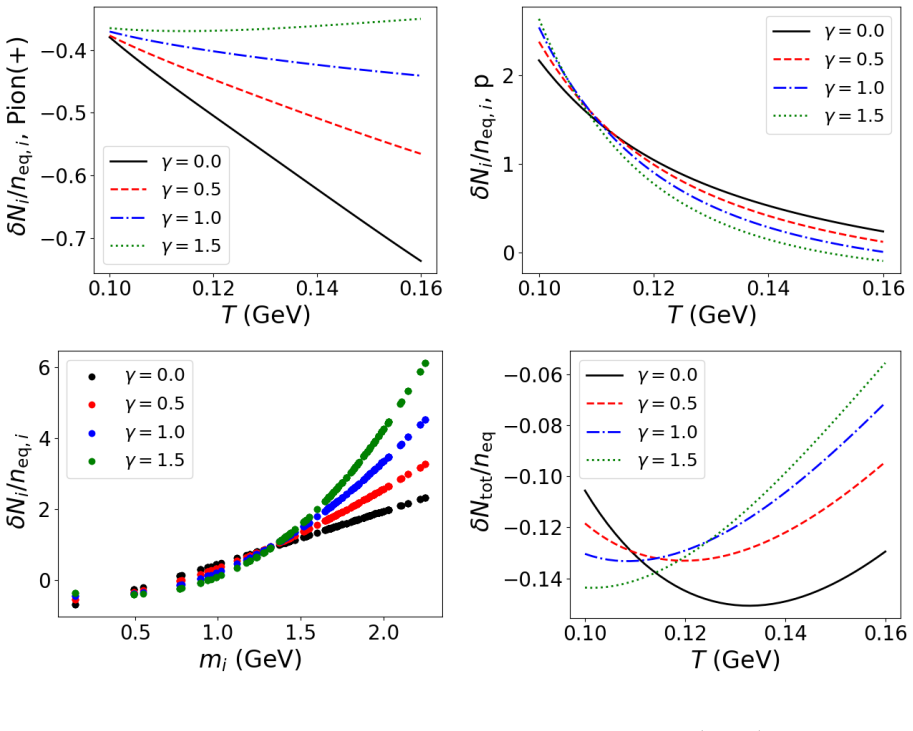
The generalized RTA with counter-terms permits species- and momentum-dependent relaxation times τ_i(p) while enforcing local conservation; the resulting viscous corrections δf_i therefore carry an explicit dependence on particle mass m_i, producing observable deformations of identified hadron spectra and ratios at the particlization surface that remain consistent with bulk flow observables.
What carries the argument
Generalized multi-species relaxation time approximation augmented by conservation-preserving counter-terms in the collision kernel, which generate mass-dependent first-order viscous corrections δf_i.
If this is right
- Yields and p_T spectra of light hadrons (π, K, p) are modified, shifting ratios such as K/π and p/π.
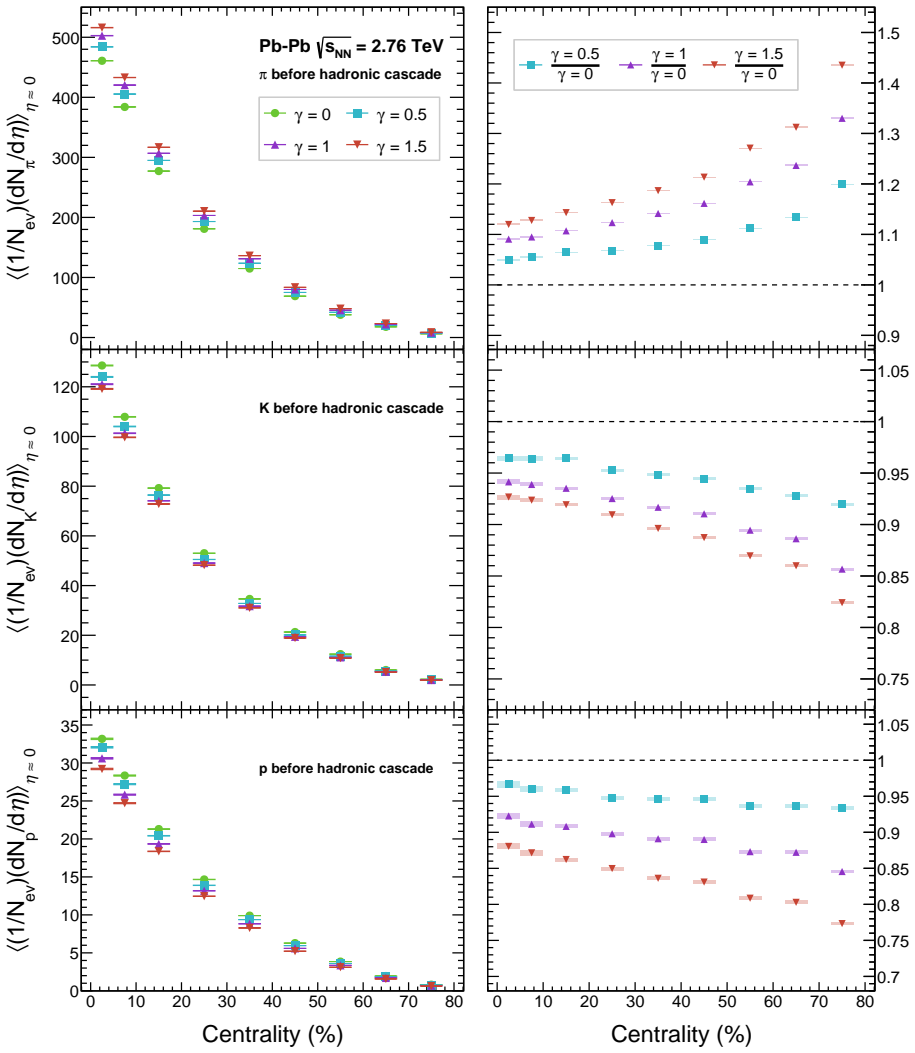
- The species-dependent corrections persist, although reduced, after the hadronic cascade.
- Inclusive charged-particle observables remain largely unchanged because species enhancements and suppressions cancel.
- The new corrections add independent sensitivity directions for Bayesian inference of hydrodynamic and particlization parameters.
Where Pith is reading between the lines
- The mass dependence may help reconcile tensions between hydrodynamic models and measured light-hadron ratios in small systems.
- Similar counter-term constructions could be applied to other kinetic-theory approximations used for multi-component systems.
- Extending the method beyond first order would test whether flavor-dependent viscous effects accumulate during hydrodynamic evolution.
- Standard single-species RTA prescriptions may systematically underestimate differences among light-hadron species at freeze-out.
Load-bearing premise
The counter-terms continue to enforce local energy-momentum conservation when relaxation times depend on both momentum and species, and the resulting δf_i still solve the linearized Boltzmann equation to first order in gradients.
What would settle it
Direct substitution of the derived δf_i into the multi-species Boltzmann equation for momentum-dependent τ_i(p) to verify that the residual vanishes at linear order in hydrodynamic gradients.
Figures



read the original abstract
We assess the effects of a recently proposed generalized relaxation time approximation (RTA) for multi-species relativistic gases within a realistic numerical hybrid framework and study its phenomenological consequences in p-Pb and Pb-Pb collisions. The novel approximation introduces counter-terms to the collision kernel, allowing for momentum-dependent relaxation times $\tau_i(p)$ while preserving local energy-momentum conservation. As a consequence, the resulting first-order viscous corrections $\delta f_i$ to the phase-space distribution functions depend explicitly on the particle species mass $m_i$. We systematically investigate the impact of these species-dependent corrections on particle production at particlization, focusing on identified hadron yields and transverse momentum ($p_T$) spectra obtained from Cooper-Frye sampling. We find that the yields and spectra of light hadrons ($\pi, K, p$) are significantly affected, leading to modifications of relative particle yields such as the $K/\pi$ and $p/\pi$ ratios. We show that these effects persist, albeit with reduced magnitude, after the inclusion of the hadronic cascade stage. In contrast, the impact on inclusive charged-particle observables is strongly reduced due to compensating enhancements and suppressions among different species. This controlled deformation of identified hadron observables, which selectively modifies flavor-sensitive quantities, makes the new prescription particularly well suited for Bayesian inference, as it introduces new sensitivity directions without spoiling existing constraints. Overall, our results demonstrate that species-dependent viscous corrections arising from the generalized RTA can leave significant and observable imprints on identified hadron production and relative yields, while remaining fully consistent with the successful description of bulk collective flow observables.
Editorial analysis
A structured set of objections, weighed in public.
Referee Report
Summary. The paper introduces a generalized relaxation time approximation (RTA) for multi-species relativistic gases that incorporates momentum-dependent relaxation times τ_i(p) through counter-terms in the collision kernel, thereby preserving local energy-momentum conservation. This construction yields first-order viscous corrections δf_i that depend explicitly on the species mass m_i. The authors embed the approach in a hybrid hydrodynamic + hadronic cascade model and perform numerical studies of p-Pb and Pb-Pb collisions, reporting that the mass-dependent corrections produce sizable changes in identified hadron yields, p_T spectra, and ratios such as K/π and p/π, while inclusive charged-particle observables remain largely unaffected.
Significance. If the generalized RTA is shown to be a controlled approximation to the underlying Boltzmann equation, the work supplies a new, conservation-preserving mechanism for species-dependent viscous corrections at particlization. The hybrid-model implementation and the demonstration that flavor-sensitive observables are selectively modified while bulk flow constraints are preserved constitute a concrete phenomenological advance that could be directly useful for Bayesian analyses of heavy-ion data.
major comments (2)
- [§2] §2 (generalized RTA derivation): The manuscript states that counter-terms are added to the collision kernel to enforce ∫ p^μ C[f] d³p = 0 for arbitrary momentum-dependent τ_i(p), but does not provide the explicit algebraic form of these counter-terms nor the subsequent steps showing that the resulting δf_i, when re-inserted into the linearized Boltzmann equation, reproduces p^μ ∂_μ f to first order in gradients. Without this verification the mass dependence of δf_i could be an artifact of the ansatz rather than a consistent solution of the kinetic equation.
- [§4] §4 (numerical implementation and error control): No quantitative estimate is given for the truncation error introduced by the generalized RTA relative to the full Boltzmann collision integral, nor is a direct comparison performed between the new δf_i and the standard RTA δf_i for the same hydrodynamic background. Such a benchmark is required to establish that the reported modifications to identified yields are attributable to the species dependence rather than to uncontrolled higher-order effects.
minor comments (2)
- [Abstract] The abstract and introduction refer to “the novel approximation” without a concise one-sentence statement of the precise modification to the standard RTA kernel; adding such a statement would improve readability.
- [Figure captions] Figure captions for the p_T spectra and ratio plots should explicitly state whether the curves include statistical uncertainties from the Cooper-Frye sampling or only systematic variations from the choice of τ_i(p).
Simulated Author's Rebuttal
We thank the referee for the careful reading and constructive comments on our manuscript. We address the major points below and will revise the manuscript to improve the presentation of the derivation and add requested benchmarks where feasible.
read point-by-point responses
-
Referee: [§2] §2 (generalized RTA derivation): The manuscript states that counter-terms are added to the collision kernel to enforce ∫ p^μ C[f] d³p = 0 for arbitrary momentum-dependent τ_i(p), but does not provide the explicit algebraic form of these counter-terms nor the subsequent steps showing that the resulting δf_i, when re-inserted into the linearized Boltzmann equation, reproduces p^μ ∂_μ f to first order in gradients. Without this verification the mass dependence of δf_i could be an artifact of the ansatz rather than a consistent solution of the kinetic equation.
Authors: We agree that greater explicitness will strengthen the presentation. In the revised manuscript we will supply the explicit algebraic form of the counter-terms added to the collision kernel. We will also insert a step-by-step verification that the resulting species-dependent δf_i, when substituted into the linearized Boltzmann equation, reproduces the first-order driving term p^μ ∂_μ f. This will demonstrate that the mass dependence follows directly from the momentum-dependent τ_i(p) together with the imposed conservation constraints, rather than being an artifact of the ansatz. revision: yes
-
Referee: [§4] §4 (numerical implementation and error control): No quantitative estimate is given for the truncation error introduced by the generalized RTA relative to the full Boltzmann collision integral, nor is a direct comparison performed between the new δf_i and the standard RTA δf_i for the same hydrodynamic background. Such a benchmark is required to establish that the reported modifications to identified yields are attributable to the species dependence rather than to uncontrolled higher-order effects.
Authors: We will add to the revised manuscript a direct side-by-side comparison of the new δf_i against the standard RTA δf_i evaluated on identical hydrodynamic backgrounds. This will isolate the contribution of the species (mass) dependence to the changes in identified yields and ratios. A quantitative estimate of the truncation error relative to the full nonlinear Boltzmann collision integral, however, lies beyond the scope of the present phenomenological study. revision: partial
- Quantitative estimate of the truncation error of the generalized RTA relative to the full Boltzmann collision integral
Circularity Check
No significant circularity: derivation self-contained via explicit counter-term construction
full rationale
The paper introduces counter-terms to the multi-species RTA collision kernel to enforce local energy-momentum conservation for arbitrary momentum- and species-dependent τ_i(p). The resulting first-order δf_i is obtained by direct solution of the linearized Boltzmann equation with this kernel, yielding explicit mass dependence m_i without reducing to a fitted parameter or prior ansatz by construction. Phenomenological results follow from numerical Cooper-Frye sampling and hybrid evolution, which are independent of the internal derivation. No load-bearing step equates the output to the input via self-definition, self-citation chain, or renaming; the central claim remains externally testable against identified hadron data.
Axiom & Free-Parameter Ledger
free parameters (1)
- momentum-dependent relaxation times τ_i(p)
axioms (2)
- domain assumption Local energy-momentum conservation must be preserved by the collision kernel even when relaxation times are momentum- and species-dependent.
- domain assumption First-order viscous corrections δf_i remain adequate for the Cooper-Frye sampling step in realistic hybrid simulations.
Reference graph
Works this paper leans on
-
[1]
D. J. Gross and F. Wilczek, Ultraviolet Behavior of Nonabelian Gauge Theories, Phys. Rev. Lett.30, 1343 (1973)
1973
-
[2]
Politzer, Reliable Perturbative Results for Strong Interactions?, Phys
H. Politzer, Reliable Perturbative Results for Strong Interactions?, Phys. Rev. Lett.30, 1346 (1973)
1973
-
[3]
E. V. Shuryak, Quark-Gluon Plasma and Hadronic Production of Leptons, Photons and Psions, Sov. J. Nucl. Phys.28, 408 (1978)
1978
-
[4]
de Forcrand, PoSLAT2009, 010 (2009), arXiv:1005.0539 [hep-lat]
P. de Forcrand, Simulating QCD at finite density, PoSLAT2009, 010 (2009), arXiv:1005.0539 [hep-lat]
- [5]
-
[6]
I. Arseneet al.(BRAHMS), Quark gluon plasma and color glass condensate at RHIC? The Perspective from the BRAHMS experiment, Nucl. Phys. A757, 1 (2005), arXiv:nucl-ex/0410020
-
[7]
B. Backet al.(PHOBOS), The PHOBOS perspective on discoveries at RHIC, Nucl. Phys. A 757, 28 (2005), arXiv:nucl-ex/0410022
-
[8]
K. Adcoxet al.(PHENIX), Formation of dense partonic matter in relativistic nucleus-nucleus collisions at RHIC: Experimental evaluation by the PHENIX collaboration, Nucl. Phys. A757, 184 (2005), arXiv:nucl-ex/0410003
- [9]
- [10]
-
[11]
Long-range angular correlations on the near and away side in p-Pb collisions at √ sNN = 5.02 TeV
B. Abelevet al.(ALICE), Long-range angular correlations on the near and away side inp-Pb collisions at √sN N = 5.02TeV, Phys. Lett. B719, 29 (2013), arXiv:1212.2001 [nucl-ex]
-
[12]
G. Aadet al.(ATLAS), Observation of Associated Near-Side and Away-Side Long-Range Correlations in √sN N=5.02 TeV Proton-Lead Collisions with the ATLAS Detector, Phys. Rev. Lett.110, 182302 (2013), arXiv:1212.5198 [hep-ex]
-
[13]
S. Chatrchyanet al.(CMS), Observation of Long-Range Near-Side Angular Correlations in Proton-Lead Collisions at the LHC, Phys. Lett. B718, 795 (2013), arXiv:1210.5482 [nucl-ex]. 32
-
[14]
A. Adareet al.(PHENIX), Quadrupole Anisotropy in Dihadron Azimuthal Correlations in Cen- tral d+Au Collisions at√sN N=200 GeV, Phys. Rev. Lett.111, 212301 (2013), arXiv:1303.1794 [nucl-ex]
-
[15]
Collective flow and viscosity in relativistic heavy-ion collisions
U. Heinz and R. Snellings, Collective flow and viscosity in relativistic heavy-ion collisions, Ann. Rev. Nucl. Part. Sci.63, 123 (2013), arXiv:1301.2826 [nucl-th]
work page Pith review arXiv 2013
-
[16]
P. Foka and M. g. A. Janik, An overview of experimental results from ultra-relativistic heavy-ion collisions at the CERN LHC: Bulk properties and dynamical evolution, Rev. Phys.1, 154 (2016), arXiv:1702.07233 [hep-ex]
-
[17]
Loizides, Experimental overview on small collision systems at the LHC, Nucl
C. Loizides, Experimental overview on small collision systems at the LHC, Nucl. Phys. A956, 200 (2016), arXiv:1602.09138 [nucl-ex]
-
[18]
Israel, Nonstationary irreversible thermodynamics: A Causal relativistic theory, Annals Phys.100, 310 (1976)
W. Israel, Nonstationary irreversible thermodynamics: A Causal relativistic theory, Annals Phys.100, 310 (1976)
1976
-
[19]
Israel and J
W. Israel and J. Stewart, Transient relativistic thermodynamics and kinetic theory, Annals Phys.118, 341 (1979)
1979
-
[20]
H. Petersen, J. Steinheimer, G. Burau, M. Bleicher, and H. Stocker, A Fully Integrated Transport Approach to Heavy Ion Reactions with an Intermediate Hydrodynamic Stage, Phys. Rev. C78, 044901 (2008), arXiv:0806.1695 [nucl-th]
- [21]
-
[22]
A. Bazavovet al.(HotQCD), Equation of state in ( 2+1 )-flavor QCD, Phys. Rev. D90, 094503 (2014), arXiv:1407.6387 [hep-lat]
-
[23]
Cooper and G
F. Cooper and G. Frye, Single-particle distribution in the hydrodynamic and statistical thermo- dynamic models of multiparticle production, Phys. Rev. D10, 186 (1974)
1974
- [24]
- [25]
-
[26]
S. Borsanyi, G. Endrodi, Z. Fodor, A. Jakovac, S. D. Katz, S. Krieg, C. Ratti, and K. K. Szabo, The QCD equation of state with dynamical quarks, JHEP11, 077, arXiv:1007.2580 [hep-lat]. 33
-
[27]
Bazavovet al., Equation of state and QCD transition at finite temperature, Phys
A. Bazavovet al., Equation of state and QCD transition at finite temperature, Phys. Rev. D 80, 014504 (2009), arXiv:0903.4379 [hep-lat]
-
[28]
Hagedorn, Statistical thermodynamics of strong interactions at high-energies, Nuovo Cim
R. Hagedorn, Statistical thermodynamics of strong interactions at high-energies, Nuovo Cim. Suppl.3, 147 (1965)
1965
-
[29]
Venugopalan and M
R. Venugopalan and M. Prakash, Thermal properties of interacting hadrons, Nucl. Phys. A 546, 718 (1992)
1992
- [30]
-
[31]
P. Huovinen and P. Petreczky, QCD Equation of State and Hadron Resonance Gas, Nucl. Phys. A837, 26 (2010), arXiv:0912.2541 [hep-ph]
-
[32]
Ratti and R
C. Ratti and R. Bellwied,The Deconfinement Transition of QCD: Theory Meets Experiment, Lecture Notes in Physics, Vol. 981 (2021)
2021
-
[33]
Y. Aoki, G. Endrodi, Z. Fodor, S. D. Katz, and K. K. Szabo, The Order of the quantum chromodynamics transition predicted by the standard model of particle physics, Nature443, 675 (2006), arXiv:hep-lat/0611014
work page Pith review arXiv 2006
-
[34]
Cooper and G
F. Cooper and G. Frye, Comment on the Single Particle Distribution in the Hydrodynamic and Statistical Thermodynamic Models of Multiparticle Production, Phys. Rev. D10, 186 (1974)
1974
-
[35]
de Groot, W
S. de Groot, W. van Leeuwen, and C. van Weert,Relativistic Kinetic Theory: Principles and Applications(North-Holland Publishing Co., 1980)
1980
-
[36]
L. D. Landau and E. M. Lifshitz,Fluid Mechanics - Volume 6 (Corse of Theoretical Physics), 2nd ed. (Butterworth-Heinemann, 1987) p. 552
1987
-
[37]
Chapman, Vi
S. Chapman, Vi. on the law of distribution of molecular velocities, and on the theory of viscosity and thermal conduction, in a non-uniform simple monatomic gas, Philosophical Transactions of the Royal Society of London. Series A, Containing Papers of a Mathematical or Physical Character216, 279 (1916)
1916
-
[38]
Enskog, Kinetische theorie der Vorgänge in mässig verdünnten gasen
D. Enskog, Kinetische theorie der Vorgänge in mässig verdünnten gasen. I. Allgemeiner teil (1917)
1917
-
[39]
Cercignani and G
C. Cercignani and G. M. Kremer,The Relativistic Boltzmann Equation: Theory and Applications (Springer, 2002)
2002
-
[40]
Denicol and D
G. Denicol and D. H. Rischke,Microscopic Foundations of Relativistic Fluid Dynamics(Springer, 2021). 34
2021
- [41]
- [42]
-
[43]
M. McNelis, D. Everett, and U. Heinz, Particlization in fluid dynamical simulations of heavy-ion collisions: The i S3D module, Comput. Phys. Commun.258, 107604 (2021), arXiv:1912.08271 [nucl-th]
- [44]
-
[45]
Anderson and H
J. Anderson and H. Witting, Relativistic quantum transport coefficients, Physica74, 489 (1974)
1974
- [46]
- [47]
-
[48]
Calzetta and B
E. Calzetta and B. L. Hu, Nonequilibrium Quantum Fields: Closed Time Path Effective Action, Wigner Function and Boltzmann Equation, Phys. Rev. D37, 2878 (1988)
1988
-
[49]
S. A. Bass and et al, Prog. Part. Nucl. Phys.41, 255 (1998)
1998
-
[50]
Bleicher and et al, J
M. Bleicher and et al, J. Phys.G25, 1859 (1999)
1999
-
[51]
J. S. Moreland, J. E. Bernhard, and S. A. Bass, Phys. Rev.C92, 011901 (2015)
2015
-
[52]
Broniowski, W
W. Broniowski, W. Florkowski, M. Chojnacki, and A. Kisiel, Free-streaming approximation in early dynamics of relativistic heavy-ion collisions, Phys. Rev.C80, 034902 (2009)
2009
-
[53]
Rev.C91, 064906 (2015), [Erratum: Phys
J.Liu, C.Shen,andU.Heinz,Pre-equilibriumevolutioneffectsonheavy-ioncollisionobservables, Phys. Rev.C91, 064906 (2015), [Erratum: Phys. Rev.C92,049904(2015)]
2015
-
[54]
Schenke, S
B. Schenke, S. Jeon, and C. Gale, Phys. Rev.C82, 014903 (2010)
2010
-
[55]
Schenke, S
B. Schenke, S. Jeon, and C. Gale, Phys. Rev.C85, 024901 (2012)
2012
- [56]
- [57]
-
[58]
D. Everettet al.(JETSCAPE), Multisystem Bayesian constraints on the transport coefficients of QCD matter, Phys. Rev. C103, 054904 (2021), arXiv:2011.01430 [hep-ph]
- [59]
- [60]
discussion (0)
Sign in with ORCID, Apple, or X to comment. Anyone can read and Pith papers without signing in.