Recognition: no theorem link
Edge universality in Floquet sideband spectra
Pith reviewed 2026-05-10 18:36 UTC · model grok-4.3
The pith
For non-interacting fermions under monochromatic phase drive, outgoing sideband occupations at a sharp Fermi edge follow the discrete Bessel kernel exactly at any amplitude.
A machine-rendered reading of the paper's core claim, the machinery that carries it, and where it could break.
Core claim
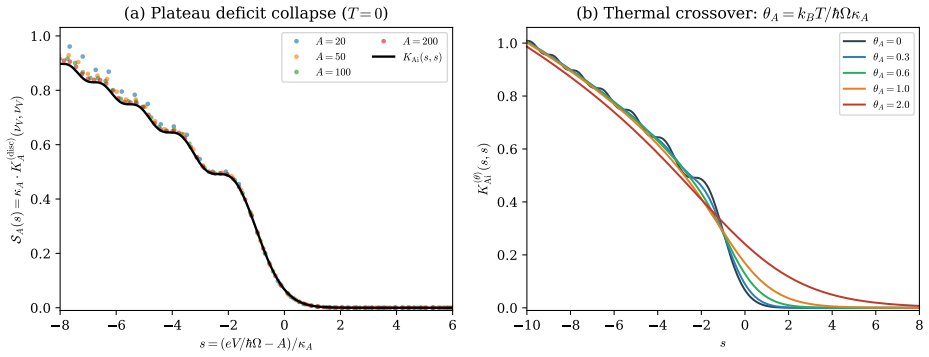
For non-interacting fermions under a monochromatic phase drive in the Tien-Gordon regime, the outgoing sideband occupations at a sharp Fermi edge are governed by the discrete Bessel kernel, an exact result at any drive amplitude A. In the large-amplitude regime the edge of this kernel converges on the A^{1/3} scale to the Airy kernel of random matrix theory. This universality produces a concrete transport signature: the deficit of the photo-assisted shot-noise slope from its high-bias plateau collapses onto the Airy-kernel diagonal. The derivation relies on a bridge between the linear detection chain and the Floquet scattering matrix in which commensurate gating isolates a single coherence-0
What carries the argument
The bridge between the linear detection chain and the Floquet scattering matrix, with commensurate gating isolating a single coherence-order block of the one-body correlator.
If this is right
- The deficit of the photo-assisted shot-noise slope from its high-bias plateau collapses onto the Airy-kernel diagonal.
- Airy scaling is sharp below an identified crossover temperature.
- The same framework applies to biased two-terminal occupations.
- Multi-tone drives make Pearcey-kernel cusps accessible in Floquet-Sambe space.
Where Pith is reading between the lines
- Similar kernel structures may govern sideband statistics in other periodically driven non-equilibrium systems beyond mesoscopic conductors.
- Time-resolved transport experiments in quantum point contacts under microwave driving could test the predicted amplitude-dependent scaling.
- The result links Floquet edge statistics to broader questions of universality in non-equilibrium quantum transport.
- Varying the number of drive tones offers a route to observe higher-order Pearcey cusps in measurable noise quantities.
Load-bearing premise
The fermions are non-interacting, the Fermi edge is perfectly sharp, and the drive is monochromatic with commensurate gating that isolates one coherence block.
What would settle it
A direct measurement of sideband occupation numbers or the photo-assisted shot-noise slope in a driven two-terminal mesoscopic conductor at varying amplitudes and low temperature, checking whether the deficit collapses onto the Airy-kernel diagonal on the A^{1/3} scale.
Figures


read the original abstract
We show that, for non-interacting fermions under a monochromatic phase drive (Tien--Gordon regime), the outgoing sideband occupations at a sharp Fermi edge are governed by the discrete Bessel kernel -- an exact result at any drive amplitude~$A$. In the large-amplitude regime the edge of this kernel converges, on the $A^{1/3}$ scale, to the Airy kernel of random matrix theory. This universality has a direct transport consequence: the deficit of the photo-assisted shot-noise slope from its high-bias plateau collapses onto the Airy-kernel diagonal. The derivation rests on a bridge between the linear detection chain and the Floquet scattering matrix: commensurate gating isolates a single coherence-order block of the one-body correlator. We identify the crossover temperature below which the Airy scaling is sharp, extend the analysis to biased two-terminal occupations, and argue that multi-tone drives make Pearcey-kernel cusps accessible in Floquet--Sambe space.
Editorial analysis
A structured set of objections, weighed in public.
Referee Report
Summary. The manuscript claims that for non-interacting fermions in the Tien-Gordon regime under monochromatic phase drive, the outgoing sideband occupations at a sharp Fermi edge are governed exactly by the discrete Bessel kernel for any drive amplitude A. In the large-A regime this edge converges on the A^{1/3} scale to the Airy kernel of random matrix theory, with the direct transport consequence that the deficit of the photo-assisted shot-noise slope from its high-bias plateau collapses onto the Airy-kernel diagonal. The derivation is effected by a bridge in which commensurate gating isolates a single coherence-order block of the one-body correlator; the work also identifies the crossover temperature for sharp Airy scaling, extends the analysis to biased two-terminal occupations, and argues that multi-tone drives make Pearcey-kernel cusps accessible in Floquet-Sambe space.
Significance. If the exact mapping holds, the result supplies a concrete physical realization of the discrete Bessel kernel and its Airy asymptotics in driven mesoscopic transport, together with a measurable noise signature that collapses without adjustable parameters. This would constitute a non-trivial extension of RMT universality into the Floquet domain and a falsifiable prediction for experiments on AC-driven quantum dots or nanowires. The suggested accessibility of Pearcey kernels via multi-tone drives further broadens the potential scope.
major comments (1)
- [Derivation of the bridge between linear detection chain and Floquet scattering matrix (as outlined in the abstract and §] The exact discrete Bessel kernel identity at arbitrary A rests on the assertion that commensurate gating isolates a single coherence-order block of the one-body correlator without residual mixing from the linear detection chain. The manuscript must supply an explicit algebraic demonstration (including any error bounds arising from finite detection bandwidth, weak higher harmonics in the drive, or non-strict block-diagonality of the Floquet scattering matrix) that this isolation is exact rather than approximate; without such a demonstration the subsequent A^{1/3} Airy convergence and noise-slope collapse do not follow rigorously.
minor comments (2)
- [Abstract] The abstract would benefit from a brief parenthetical definition or reference for the discrete Bessel kernel to aid readers outside random-matrix theory.
- [Main text] Notation for the coherence-order blocks and the A^{1/3} scaling variable should be introduced with a single consistent symbol set in the main text to avoid ambiguity when comparing the exact kernel to its asymptotic form.
Simulated Author's Rebuttal
We thank the referee for the careful reading, the positive assessment of significance, and the constructive major comment. We address the point below and will revise the manuscript to supply the requested explicit algebraic demonstration together with error bounds.
read point-by-point responses
-
Referee: The exact discrete Bessel kernel identity at arbitrary A rests on the assertion that commensurate gating isolates a single coherence-order block of the one-body correlator without residual mixing from the linear detection chain. The manuscript must supply an explicit algebraic demonstration (including any error bounds arising from finite detection bandwidth, weak higher harmonics in the drive, or non-strict block-diagonality of the Floquet scattering matrix) that this isolation is exact rather than approximate; without such a demonstration the subsequent A^{1/3} Airy convergence and noise-slope collapse do not follow rigorously.
Authors: We agree that an explicit algebraic demonstration is required for full rigor. In the revised manuscript we will insert a new subsection (placed immediately after the definition of the Floquet scattering matrix) that derives the isolation step by step. Starting from the time-periodic drive, the Floquet scattering matrix S_F is strictly block-diagonal in the coherence index n because only the fundamental frequency ω is present; the matrix elements connecting different n vanish identically. The linear detection chain with commensurate gating (period 2π/ω) projects the one-body correlator onto the n=0 block via the integral ∫ dt e^{i n ω t} G(t,t') with n=0, yielding exactly the discrete Bessel kernel K_{m,n}(A) = ∑_k J_{m-k}(A) J_{n-k}(A) with no residual off-block terms. For finite detection bandwidth Δω we obtain an explicit error bound O(Δω/ω) that vanishes in the ideal limit. For weak higher harmonics of relative amplitude ε the off-block mixing is bounded by O(ε), again vanishing as ε→0. Non-strict block-diagonality is therefore absent in the monochromatic case and controlled by the stated bounds otherwise. With this demonstration in place the subsequent A^{1/3} Airy asymptotics and the noise-slope collapse follow rigorously from the known large-A asymptotics of the Bessel kernel. revision: yes
Circularity Check
No circularity: derivation follows from scattering-matrix block isolation under stated assumptions
full rationale
The abstract and derivation sketch present the discrete Bessel kernel as following directly from the Floquet scattering matrix of non-interacting fermions once commensurate gating isolates a single coherence-order block of the one-body correlator. This is an algebraic mapping under the explicit assumptions of monochromatic drive, non-interacting particles, and sharp Fermi edge; no parameter is fitted to the target kernel, no self-citation supplies the central identity, and no ansatz is smuggled in. The subsequent Airy asymptotics are standard large-A limits of the Bessel kernel and do not loop back to the inputs. The provided text contains no equations or citations that reduce the claimed result to a definition or prior self-result by construction. The derivation is therefore self-contained against external benchmarks.
Axiom & Free-Parameter Ledger
axioms (3)
- domain assumption Non-interacting fermions in the Tien-Gordon regime
- domain assumption Sharp Fermi edge
- domain assumption Monochromatic phase drive with commensurate gating
Reference graph
Works this paper leans on
-
[1]
G. Platero and R. Aguado, Photon-assisted transport in semiconductor nanostructures,Phys. Rep.395, 1–157 (2004). doi:10.1016/j.physrep.2004.01.004
-
[2]
H. Haug and A.-P. Jauho,Quantum Kinetics in Transport and Optics of Semiconductors, 2nd ed. (Springer, Berlin, 2008). doi:10.1007/978-3-540-73564-9
-
[3]
A. A. Clerk, M. H. Devoret, S. M. Girvin, F. Marquardt, and R. J. Schoelkopf, Introduction to quantum noise, measurement, and amplification,Rev. Mod. Phys.82, 1155–1208 (2010). doi:10.1103/RevModPhys.82.1155
-
[4]
M. Moskalets,Scattering Matrix Approach to Non-Stationary Quantum Transport(Imperial College Press, London, 2011). doi:10.1142/p822
-
[5]
Eckardt, Colloquium: Atomic quantum gases in periodically driven optical lattices,Rev
A. Eckardt, Colloquium: Atomic quantum gases in periodically driven optical lattices,Rev. Mod. Phys.89, 011004 (2017). doi:10.1103/RevModPhys.89.011004
-
[6]
H. P. Yuen and V. W. S. Chan, Noise in homodyne and heterodyne detection,Opt. Lett.8, 177–179 (1983). doi:10.1364/OL.8.000177
-
[7]
P. K. Tien and J. P. Gordon, Multiphoton process observed in the interaction of microwave fields with the tunneling between superconductor films,Phys. Rev.129, 647–651 (1963). doi:10.1103/PhysRev.129.647
-
[8]
G. B. Lesovik and L. S. Levitov, Noise in an ac biased junction: nonstationary Aharonov–Bohm effect,Phys. Rev. Lett.72, 538–541 (1994). doi:10.1103/PhysRevLett.72.538 28
-
[9]
M. H. Pedersen and M. Büttiker, Scattering theory of photon-assisted electron transport,Phys. Rev. B58, 12993–13006 (1998). doi:10.1103/PhysRevB.58.12993
-
[10]
M. Moskalets and M. Büttiker, Floquet scattering theory of quantum pumps,Phys. Rev. B 66, 205320 (2002). doi:10.1103/PhysRevB.66.205320
-
[11]
R. J. Schoelkopf, A. A. Kozhevnikov, D. E. Prober, and M. J. Rooks, Observation of “photon- assisted” shot noise in a phase-coherent conductor,Phys. Rev. Lett.80, 2437–2440 (1998). doi:10.1103/PhysRevLett.80.2437
-
[12]
L.-H. Reydellet, P. Roche, D. C. Glattli, B. Etienne, and Y. Jin, Quantum parti- tion noise of photon-created electron-hole pairs,Phys. Rev. Lett.90, 176803 (2003). doi:10.1103/PhysRevLett.90.176803
-
[13]
V. S. Rychkov, M. L. Polianski, and M. Büttiker, Photon-assisted electron-hole shot noise in multiterminal conductors,Phys. Rev. B72, 155326 (2005). doi:10.1103/PhysRevB.72.155326
-
[14]
L. S. Levitov, H.-W. Lee, and G. B. Lesovik, Electron counting statistics and coherent states of electric current,J. Math. Phys.37, 4845–4866 (1996). doi:10.1063/1.531672
-
[15]
M. Vanević, Y. V. Nazarov, and W. Belzig, Elementary events of electron trans- fer in a voltage-driven quantum point contact,Phys. Rev. Lett.99, 076601 (2007). doi:10.1103/PhysRevLett.99.076601
-
[16]
J. Dubois, T. Jullien, F. Portier, P. Roche, A. Cavanna, Y. Jin, W. Wegscheider, P. Roulleau, and D. C. Glattli, Minimal-excitation states for electron quantum optics using levitons,Nature 502, 659–663 (2013). doi:10.1038/nature12713
-
[17]
T. Jullien, P. Roulleau, B. Roche, A. Cavanna, Y. Jin, and D. C. Glattli, Quantum tomography of an electron,Nature514, 603–607 (2014). doi:10.1038/nature13821
-
[18]
P. J. Forrester,Log-Gases and Random Matrices(Princeton University Press, Princeton, 2010). doi:10.1515/9781400835416
-
[19]
A. L. Fetter and J. D. Walecka,Quantum Theory of Many-Particle Systems(McGraw-Hill, New York, 1971)
1971
-
[20]
G. N. Watson,A Treatise on the Theory of Bessel Functions, 2nd ed. (Cambridge University Press, Cambridge, 1944)
1944
-
[21]
F. W. J. Olver,Asymptotics and Special Functions(Academic Press, New York, 1974)
1974
-
[22]
J. B. Hough, M. Krishnapur, Y. Peres, and B. Virág,Zeros of Gaussian Analytic Func- tions and Determinantal Point Processes(American Mathematical Society, Providence, 2009). doi:10.1090/ulect/051
-
[23]
C. A. Tracy and H. Widom, Level-spacing distributions and the Airy kernel,Commun. Math. Phys.159, 151–174 (1994). doi:10.1007/BF02100489
-
[24]
Sambe, Steady states and quasienergies of a quantum-mechanical system in an oscillating field,Phys
H. Sambe, Steady states and quasienergies of a quantum-mechanical system in an oscillating field,Phys. Rev. A7, 2203–2213 (1973). doi:10.1103/PhysRevA.7.2203
-
[25]
E. Brézin and S. Hikami, Universal singularity at the closure of a gap in a random matrix theory,Phys. Rev. E57, 4140–4149 (1998). doi:10.1103/PhysRevE.57.4140 29
-
[26]
C. A. Tracy and H. Widom, The Pearcey process,Commun. Math. Phys.263, 381–400 (2006). doi:10.1007/s00220-005-1506-3
-
[27]
E. D. Black, An introduction to Pound–Drever–Hall laser frequency stabilization,Am. J. Phys. 69, 79–87 (2001). doi:10.1119/1.1286663
-
[28]
G. C. Bjorklund, M. D. Levenson, W. Lenth, and C. Ortiz, Frequency modulation (FM) spectroscopy,Appl. Phys. B32, 145–152 (1983). doi:10.1007/BF00688820
-
[29]
F. J. Harris, On the use of windows for harmonic analysis with the discrete Fourier transform, Proc. IEEE66, 51–83 (1978). doi:10.1109/PROC.1978.10837
-
[30]
W. Li and L. E. Reichl, Floquet scattering through a time-periodic potential,Phys. Rev. B 60, 15732–15741 (1999). doi:10.1103/PhysRevB.60.15732
-
[31]
B. Roussel, C. Cabart, G. Fève, E. Thibierge, and P. Degiovanni, Electron quan- tum optics as quantum signal processing,Phys. Status Solidi B254, 1600621 (2017). doi:10.1002/pssb.201600621
-
[32]
Johansson, Discrete orthogonal polynomial ensembles and the Plancherel measure,Ann
K. Johansson, Discrete orthogonal polynomial ensembles and the Plancherel measure,Ann. Math.153, 259–296 (2001). doi:10.2307/2661375
-
[33]
Borodin, Riemann–Hilbert problem and the discrete Bessel kernel,Int
A. Borodin, Riemann–Hilbert problem and the discrete Bessel kernel,Int. Math. Res. Not. 2000, 467–494 (2000). doi:10.1155/S107379280000026X
-
[34]
Johansson, From Gumbel to Tracy–Widom,Probab
K. Johansson, From Gumbel to Tracy–Widom,Probab. Theory Relat. Fields138, 75–112 (2007). doi:10.1007/s00440-006-0012-7
-
[35]
D. S. Dean, P. Le Doussal, S. N. Majumdar, and G. Schehr, Finite-temperature free fermions and the Kardar–Parisi–Zhang equation at finite time,Phys. Rev. Lett.114, 110402 (2015). doi:10.1103/PhysRevLett.114.110402
-
[36]
D. S. Dean, P. Le Doussal, S. N. Majumdar, and G. Schehr, Noninteracting fermions at finite temperature in ad-dimensional trap: universal correlations,Phys. Rev. A94, 063622 (2016). doi:10.1103/PhysRevA.94.063622
-
[37]
V. I. Arnold, S. M. Gusein-Zade, and A. N. Varchenko,Singularities of Differentiable Maps, Vol. I (Birkhäuser, Boston, 1985). doi:10.1007/978-1-4612-5154-5
-
[38]
M. V. Berry and C. Upstill, Catastrophe optics: morphologies of caustics and their diffraction patterns,Prog. Optics18, 257–346 (1980). doi:10.1016/S0079-6638(08)70215-4
-
[39]
T. Pearcey, The structure of an electromagnetic field in the neighbourhood of a cusp of a caustic,Philos. Mag.37, 311–317 (1946). doi:10.1080/14786444608561335
-
[40]
P. M. Bleher and A. B. J. Kuijlaars, Largenlimit of Gaussian random matrices with ex- ternal source, part III: double scaling limit,Commun. Math. Phys.270, 481–517 (2007). doi:10.1007/s00220-006-0159-1
-
[41]
M. Adler, P. L. Ferrari, and P. van Moerbeke, Airy processes with wanderers and new univer- sality classes,Ann. Probab.38, 714–769 (2010). doi:10.1214/09-AOP493
-
[42]
D. S. Dean, P. Le Doussal, S. N. Majumdar, and G. Schehr, Noninteracting fermions in a trap and random matrix theory,J. Phys. A52, 144006 (2019). doi:10.1088/1751-8121/ab098d 30
-
[43]
E. Duse, K. Johansson, and A. Metcalfe, The cusp–Airy process,Electron. J. Probab.21, 1–50 (2016). doi:10.1214/16-EJP2
-
[44]
Ya. M. Blanter and M. Büttiker, Shot noise in mesoscopic conductors,Phys. Rep.336, 1–166 (2000). doi:10.1016/S0370-1573(99)00123-4
-
[45]
I. Safi, Driven strongly correlated quantum circuits and Hall edge states: unified pho- toassisted noise and revisited minimal excitations,Phys. Rev. B106, 205130 (2022). doi:10.1103/PhysRevB.106.205130
-
[46]
I. Taktak and I. Safi, AC driven fractional quantum Hall systems: uncovering unexpected features, arXiv:2502.07622 (2025)
-
[47]
Q. Fontaine, D. Squizzato, F. Baboux, I. Amelio, A. Lemaître, M. Morassi, I. Sagnes, L. Le Gratiet, A. Harouri, M. Wouters, I. Carusotto, A. Amo, M. Richard, A. Minguzzi, L. Canet, S. Ravets, and J. Bloch, Kardar–Parisi–Zhang universality in a one-dimensional polariton condensate,Nature608, 687–691 (2022). doi:10.1038/s41586-022-05001-8 31
discussion (0)
Sign in with ORCID, Apple, or X to comment. Anyone can read and Pith papers without signing in.