Recognition: no theorem link
Stability and superstructural ordering of alkali-triel-pnictide clathrates A₈T₂₇Pn₁₉
Pith reviewed 2026-05-10 18:37 UTC · model grok-4.3
The pith
The ionization potential of alkali guest atoms strongly influences stability and rattler dynamics in electron-exact A8T27Pn19 clathrates.
A machine-rendered reading of the paper's core claim, the machinery that carries it, and where it could break.
Core claim
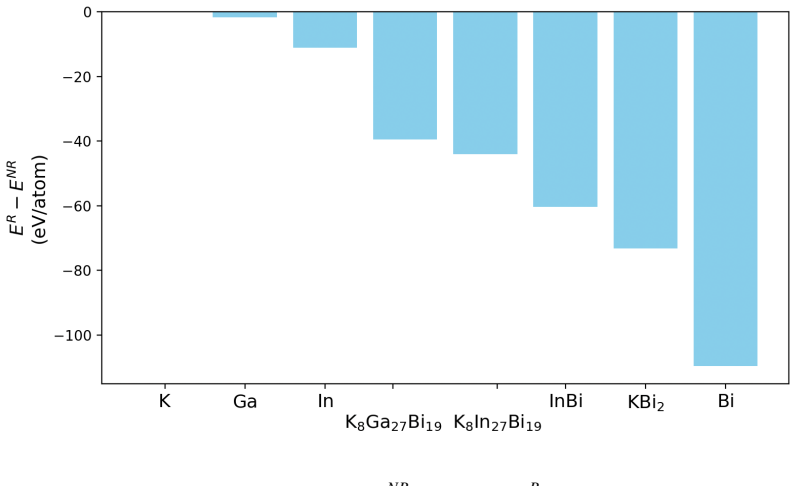
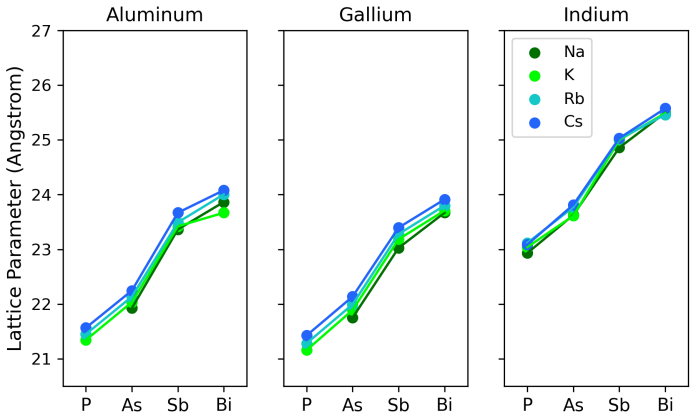
Electronic structure calculations and first-principles molecular dynamics simulations show that the ionization potential of guest alkaline atoms strongly influences the stability of electron-exact clathrates and affects their rattler behavior. High-throughput screening reveals systematic trends in formation energy and electronic properties across the A8T27Pn19 family. Spin-orbit coupling, frequently omitted in such screens, is essential for reliable stability predictions when heavy elements like bismuth are present. Targeted synthesis from elemental precursors yields two novel ternary compounds but not the intended clathrate phases, while chemically induced superstructural ordering is linked
What carries the argument
The ionization potential of the alkali guest atoms, acting through electronic structure and molecular-dynamics trajectories to set formation energies and guest-atom dynamics in electron-exact clathrates.
If this is right
- Clathrate stability can be tuned by selecting alkali guests with ionization potentials matched to the host framework.
- Rattler frequencies and thermal conductivity become predictable from the guest atom's ionization potential.
- Superstructural ordering on specific Wyckoff sites offers an independent handle for lowering formation energy.
- High-throughput screens of heavy-element clathrates require explicit spin-orbit terms to avoid false negatives.
- Synthesis routes should target compositions where the calculated ionization-potential trend favors low formation energy.
Where Pith is reading between the lines
- Similar ionization-potential control may operate in other guest-host solids where electron transfer sets framework charge balance.
- Omitting spin-orbit coupling in broad materials searches risks discarding viable heavy-element candidates whose stability only appears at higher levels of theory.
- The observed synthesis failure points to a need for precursors or conditions that accommodate the large relativistic stabilization of bismuth-based frameworks.
- Extending the same high-throughput plus dynamics workflow to other triel-pnictide ratios could map broader stability islands in clathrate chemistry.
Load-bearing premise
Standard density-functional-theory formation energies computed without spin-orbit coupling give reliable initial stability trends for the entire family, including compounds with heavy pnictides.
What would settle it
A direct experimental synthesis or calorimetric measurement that shows bismuth-containing A8T27Pn19 clathrates forming readily once spin-orbit coupling is included in the computational stability ranking, reversing the order found in scalar-relativistic DFT.
Figures



read the original abstract
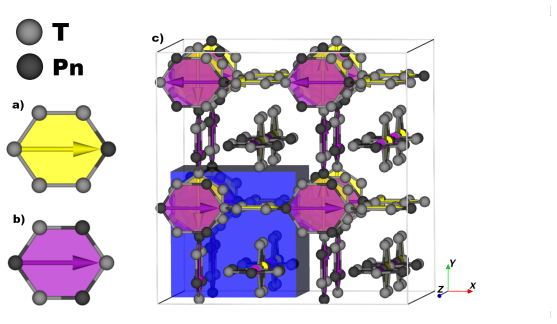
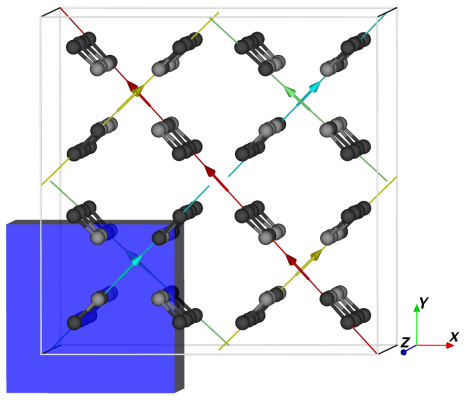
Clathrates are a class of inclusion compounds that offer various useful and surprising phenomena, including superconductivity, thermoelectricity, and the potential for high-density ion storage. Stability conditions within the Alkali-Triel-Pnictide A$_8$T$_{27}$Pn$_{19}$ family of unconventional clathrates are investigated with high-throughput density functional theory calculations, establishing trends in formation energy, structural and electronic properties. Electronic structure calculations and first-principles molecular dynamics simulations show that the ionization potential of guest alkaline atoms strongly influences the stability of electron-exact clathrates and affects their rattler behavior. Targeted reactive synthesis from elemental precursors is attempted, resulting in two novel ternary compounds. However, the targeted clathrate phases are not obtained. Further analysis reveals that the stability of ATPn clathrate compounds containing heavy elements, such as bismuth, depends strongly on spin-orbit effects, which are often neglected in high-throughput studies that compute formation energies. Finally, chemically induced superstructural ordering is described in relation to Wyckoff sites in the prototypical type-I clathrate unit cell.
Editorial analysis
A structured set of objections, weighed in public.
Referee Report
Summary. The paper investigates stability conditions in the alkali-triel-pnictide clathrate family A₈T₂₇Pn₁₉ using high-throughput DFT calculations to map formation energies, structural, and electronic trends. It claims that the ionization potential of the guest alkali atoms (A) is a dominant factor controlling the stability of these electron-exact phases and their rattler dynamics, as evidenced by electronic structure analysis and first-principles molecular dynamics (FPMD) simulations. Targeted synthesis from elemental precursors yields two new ternary compounds but not the desired clathrate phases. The work further notes that spin-orbit coupling (SOC) strongly affects stability for heavy pnictogens such as Bi (often omitted in screening) and describes chemically induced superstructural ordering relative to Wyckoff sites in the type-I clathrate cell.
Significance. If the central trends hold after addressing SOC, the work would usefully link guest-atom ionization potential to both thermodynamic stability and dynamic rattler behavior in this unconventional clathrate family, complementing existing literature on type-I clathrates. Strengths include the high-throughput DFT screening, explicit FPMD support for rattler claims, and honest reporting of unsuccessful targeted synthesis attempts. The post-hoc SOC analysis is a valuable cautionary note for similar high-throughput studies. However, the failure to realize the predicted phases and the partial support for Bi-containing members limit immediate impact on materials design.
major comments (2)
- [Spin-orbit coupling discussion] Spin-orbit coupling discussion (near end of results): The central stability trends and ionization-potential correlation are derived from standard DFT formation energies that omit SOC. The manuscript itself states that 'the stability of ATPn clathrate compounds containing heavy elements, such as bismuth, depends strongly on spin-orbit effects'. This creates a load-bearing concern for the Bi subset, as the reported trends could be artifacts; the electronic-structure and MD conclusions therefore do not yet generalize reliably across the full A₈T₂₇Pn₁₉ family.
- [Synthesis and targeted-phase section] Synthesis and targeted-phase section: The computed stability trends are presented as predictive, yet reactive synthesis from elemental precursors produces only two novel ternary compounds and none of the targeted clathrate phases. This outcome indicates that additional factors (possibly including the neglected SOC or kinetic barriers) are not captured by the formation-energy screening, weakening the claim that the DFT trends reliably identify stable members.
minor comments (2)
- [Introduction] Notation for the clathrate composition (A₈T₂₇Pn₁₉) is clear in the abstract but should be consistently defined on first use in the main text with explicit mapping to the type-I Wyckoff sites.
- [Methods/Results figures] Figure captions for the MD trajectories or phonon spectra should explicitly state the simulation temperature, timestep, and supercell size to allow reproducibility assessment.
Simulated Author's Rebuttal
We thank the referee for their constructive comments on our manuscript investigating stability in the A₈T₂₇Pn₁₉ clathrate family. We address the two major concerns point by point below, proposing targeted revisions to clarify scope and strengthen the presentation of results.
read point-by-point responses
-
Referee: Spin-orbit coupling discussion (near end of results): The central stability trends and ionization-potential correlation are derived from standard DFT formation energies that omit SOC. The manuscript itself states that 'the stability of ATPn clathrate compounds containing heavy elements, such as bismuth, depends strongly on spin-orbit effects'. This creates a load-bearing concern for the Bi subset, as the reported trends could be artifacts; the electronic-structure and MD conclusions therefore do not yet generalize reliably across the full A₈T₂₇Pn₁₉ family.
Authors: We agree that SOC omission in the high-throughput screen requires careful qualification, particularly for Bi. The manuscript already reports follow-up SOC calculations showing strong stabilization for Bi compounds. In revision we will: (i) explicitly restrict the primary ionization-potential correlation and stability trends to the lighter pnictogens (P, As, Sb) where SOC effects are small (<0.05 eV/atom), (ii) add a table comparing formation energies with/without SOC for all Bi compositions, and (iii) move the SOC discussion forward with quantitative energy shifts. The FPMD rattler analysis was performed on representative lighter systems; we will state this limitation clearly. These changes will prevent over-generalization while preserving the core findings. revision: partial
-
Referee: Synthesis and targeted-phase section: The computed stability trends are presented as predictive, yet reactive synthesis from elemental precursors produces only two novel ternary compounds and none of the targeted clathrate phases. This outcome indicates that additional factors (possibly including the neglected SOC or kinetic barriers) are not captured by the formation-energy screening, weakening the claim that the DFT trends reliably identify stable members.
Authors: We accept that the unsuccessful targeted synthesis limits the direct predictive power of formation energies alone. The manuscript already reports these outcomes transparently, including the two new ternary phases obtained. In revision we will expand the synthesis discussion to distinguish thermodynamic stability (our DFT focus) from experimental accessibility, noting that kinetic barriers and competing phases are not captured by formation-energy screening. We will qualify that the ionization-potential descriptor identifies relative stability within the computed set but does not guarantee synthesizability, and we will highlight the new ternary compounds as a positive outcome of the work. No new experimental data can be added at this stage. revision: partial
Circularity Check
No significant circularity in the derivation chain
full rationale
The paper derives its stability trends and ionization-potential correlations directly from independent high-throughput DFT formation-energy calculations and first-principles molecular dynamics runs performed on the A8T27Pn19 systems. These are external computational evaluations, not reductions of outputs to inputs by construction. The explicit note that spin-orbit coupling is crucial for heavy elements like Bi and is omitted from screening calculations is presented as a methodological caveat, not as a self-referential justification or fitted parameter. No equations, self-citations, or ansatzes are invoked that would make the central claims equivalent to the input data by definition. The attempted syntheses and structural analysis further stand as separate empirical checks.
Axiom & Free-Parameter Ledger
axioms (2)
- domain assumption Density functional theory approximations accurately predict relative formation energies for screening clathrate stability
- domain assumption First-principles molecular dynamics reliably captures rattler dynamics of guest atoms
Reference graph
Works this paper leans on
-
[1]
author author R. Eisenberg \ and\ author D. G. \ Nocera ,\ 10.1021/ic058006i journal journal Inorganic Chemistry \ volume 44 ,\ pages 6799 ( year 2005 ) NoStop
-
[2]
author author N. Armaroli \ and\ author V. Balzani ,\ 10.1002/anie.200602373 journal journal Angewandte Chemie International Edition \ volume 46 ,\ pages 52 ( year 2007 ) ,\ note \_eprint: https://onlinelibrary.wiley.com/doi/pdf/10.1002/anie.200602373 NoStop
-
[3]
author author A. Jain , author S. P. \ Ong , author G. Hautier , author W. Chen , author W. D. \ Richards , author S. Dacek , author S. Cholia , author D. Gunter , author D. Skinner , author G. Ceder , \ and\ author K. A. \ Persson ,\ 10.1063/1.4812323 journal journal APL Materials \ volume 1 ,\ pages 011002 ( year 2013 ) NoStop
-
[4]
author author H. Kawaji , author H.-o. \ Horie , author S. Yamanaka , \ and\ author M. Ishikawa ,\ 10.1103/PhysRevLett.74.1427 journal journal Phys. Rev. Lett. \ volume 74 ,\ pages 1427 ( year 1995 ) NoStop
-
[5]
author author H. Fukuoka , author J. Kiyoto , \ and\ author S. Yamanaka ,\ 10.1016/j.jpcs.2003.10.025 journal journal Journal of Physics and Chemistry of Solids \ volume 65 ,\ pages 333 ( year 2004 ) NoStop
-
[6]
editor G. S. \ Nolas ,\ ed.,\ 10.1007/978-94-017-9127-4 title The Physics and Chemistry of Inorganic Clathrates ,\ series Springer Series in Materials Science , Vol.\ volume 199 \ ( publisher Springer Netherlands ,\ address Dordrecht ,\ year 2014 ) NoStop
-
[7]
author author L. Zhu , author H. Liu , author M. Somayazulu , author Y. Meng , author P. A. \ Guńka , author T. B. \ Shiell , author C. Kenney-Benson , author S. Chariton , author V. B. \ Prakapenka , author H. Yoon , author J. A. \ Horn , author J. Paglione , author R. Hoffmann , author R. E. \ Cohen , \ and\ author T. A. \ Strobel ,\ http://arxiv.org/ab...
-
[8]
author author J. Brorsson , author Y. Zhang , author A. E. C. \ Palmqvist , \ and\ author P. Erhart ,\ 10.1021/acs.chemmater.1c00731 journal journal Chemistry of Materials \ volume 33 ,\ pages 4500 ( year 2021 ) NoStop
-
[9]
author author F. Dubois \ and\ author T. F. \ Fässler ,\ 10.1021/ja043500r journal journal Journal of the American Chemical Society \ volume 127 ,\ pages 3264 ( year 2005 ) NoStop
-
[10]
author author B. Owens-Baird , author P. Yox , author S. Lee , author X. B. \ Carroll , author S. Grass Wang , author Y.-S. \ Chen , author O. I. \ Lebedev , \ and\ author K. Kovnir ,\ 10.1039/D0SC03846F journal journal Chemical Science \ volume 11 ,\ pages 10255 ( year 2020 a ) NoStop
-
[11]
author author J. S. \ Kasper , author P. Hagenmuller , author M. Pouchard , \ and\ author C. Cros ,\ 10.1126/science.150.3704.1713 journal journal Science \ volume 150 ,\ pages 1713 ( year 1965 ) ,\ http://arxiv.org/abs/https://www.science.org/doi/pdf/10.1126/science.150.3704.1713 https://www.science.org/doi/pdf/10.1126/science.150.3704.1713 NoStop
-
[12]
author author G. K. \ Ramachandran , author J. Dong , author J. Diefenbacher , author J. Gryko , author R. F. \ Marzke , author O. F. \ Sankey , \ and\ author P. F. \ McMillan ,\ 10.1006/jssc.1999.8295 journal journal Journal of Solid State Chemistry \ volume 145 ,\ pages 716 ( year 1999 ) NoStop
-
[13]
author author S. Johnsen , author A. Bentien , author G. K. H. \ Madsen , author M. Nygren , \ and\ author B. B. \ Iversen ,\ 10.1103/PhysRevB.76.245126 journal journal Physical Review B \ volume 76 ,\ pages 245126 ( year 2007 ) NoStop
-
[14]
author author Y. Liu , author L.-M. \ Wu , author L.-H. \ Li , author S.-W. \ Du , author J. D. \ Corbett , \ and\ author L. Chen ,\ 10.1002/ange.200806158 journal journal Angewandte Chemie \ volume 121 ,\ pages 5409 ( year 2009 ) ,\ note \_eprint: https://onlinelibrary.wiley.com/doi/pdf/10.1002/ange.200806158 NoStop
-
[15]
author author H. He , author A. Zevalkink , author Z. M. \ Gibbs , author G. J. \ Snyder , \ and\ author S. Bobev ,\ 10.1021/cm3020226 journal journal Chemistry of Materials \ volume 24 ,\ pages 3596 ( year 2012 ) NoStop
-
[16]
author author J. Wang , author J.-A. \ Dolyniuk , \ and\ author K. Kovnir ,\ 10.1021/acs.accounts.7b00469 journal journal Accounts of Chemical Research \ volume 51 ,\ pages 31 ( year 2018 a ) NoStop
-
[17]
Owens-Baird , author J
author author B. Owens-Baird , author J. Wang , author S. G. \ Wang , author Y.-S. \ Chen , author S. Lee , author D. Donadio , \ and\ author K. Kovnir ,\ @noop journal journal J. Am. Chem. Soc. \ ,\ pages 11 ( year 2020 b ) NoStop
2020
-
[18]
author author P. Yox , author O. I. \ Lebedev , author D. Donadio , \ and\ author K. Kovnir ,\ 10.1039/D1CC05167A journal journal Chemical Communications \ volume 57 ,\ pages 13780 ( year 2021 ) NoStop
-
[19]
author author P. Yox , author F. Cerasoli , author A. Sarkar , author V. Kyveryga , author G. Viswanathan , author D. Donadio , \ and\ author K. Kovnir ,\ 10.1021/jacs.2c12435 journal journal J. Am. Chem. Soc. \ volume 145 ,\ pages 4638 ( year 2023 ) ,\ note publisher: American Chemical Society NoStop
-
[20]
author author P. Yox , author F. T. \ Cerasoli , author A. Sarkar , author G. Amobi , author G. Viswanathan , author J. Voyles , author O. l. \ Lebedev , author D. Donadio , \ and\ author K. Kovnir ,\ 10.1021/acs.chemmater.4c00419 journal journal Chem. Mater. \ ( year 2024 ),\ 10.1021/acs.chemmater.4c00419 NoStop
-
[21]
author author H. Powell ,\ 10.1039/JR9480000061 journal journal The Structure of Molecular Compounds \ ,\ pages 61 ( year 1948 ) NoStop
-
[22]
author author B. C. \ Sales , author D. Mandrus , author B. C. \ Chakoumakos , author V. Keppens , \ and\ author J. R. \ Thompson ,\ 10.1103/PhysRevB.56.15081 journal journal Physical Review B \ volume 56 ,\ pages 15081 ( year 1997 ) NoStop
-
[23]
author author R. David M. ,\ @noop title CRC Handbook of Thermoelectrics \ ( publisher CRC Press ,\ year 2005 ) NoStop
2005
-
[24]
author author T. Takabatake , author K. Suekuni , author T. Nakayama , \ and\ author E. Kaneshita ,\ 10.1103/RevModPhys.86.669 journal journal Reviews of Modern Physics \ volume 86 ,\ pages 669 ( year 2014 ) ,\ note arXiv:1402.5756 [cond-mat] NoStop
-
[25]
author author J. Wang , author L.-L. \ Wang , \ and\ author K. Kovnir ,\ 10.1039/C8TA00553B journal journal Journal of Materials Chemistry A \ volume 6 ,\ pages 4759 ( year 2018 b ) NoStop
-
[26]
author author A. Ammar , author C. Cros , author M. Pouchard , author N. Jaussaud , author J.-M. \ Bassat , author G. Villeneuve , author M. Duttine , author M. Ménétrier , \ and\ author E. Reny ,\ 10.1016/j.solidstatesciences.2004.02.006 journal journal Solid State Sciences \ volume 6 ,\ pages 393 ( year 2004 ) NoStop
-
[27]
author author A. M. \ Guloy , author R. Ramlau , author Z. Tang , author W. Schnelle , author M. Baitinger , \ and\ author Y. Grin ,\ 10.1038/nature05145 journal journal Nature \ volume 443 ,\ pages 320 ( year 2006 ) NoStop
-
[28]
author author J.-A. \ Dolyniuk , author B. Owens-Baird , author J. Wang , author J. V. \ Zaikina , \ and\ author K. Kovnir ,\ 10.1016/j.mser.2016.08.001 journal journal Materials Science and Engineering: R: Reports \ volume 108 ,\ pages 1 ( year 2016 ) NoStop
-
[29]
author author L. Chen , author R. Liu , \ and\ author X. Shi ,\ in\ 10.1016/B978-0-12-818413-4.00004-1 booktitle Thermoelectric Materials and Devices \ ( publisher Elsevier ,\ year 2021 )\ pp.\ pages 81--145 NoStop
-
[30]
author author A. Nainani , author B. R. \ Bennett , author J. Brad Boos , author M. G. \ Ancona , \ and\ author K. C. \ Saraswat ,\ 10.1063/1.4718381 journal journal Journal of Applied Physics \ volume 111 ,\ pages 103706 ( year 2012 ) NoStop
-
[31]
author author S. Takeya , author A. Hori , author T. Uchida , \ and\ author R. Ohmura ,\ 10.1021/jp060198v journal journal The Journal of Physical Chemistry B \ volume 110 ,\ pages 12943 ( year 2006 ) NoStop
-
[32]
author author K. W. \ Allen ,\ 10.1063/1.1725970 journal journal The Journal of Chemical Physics \ volume 41 ,\ pages 840 ( year 1964 ) NoStop
-
[33]
author author M. Christensen , author S. Johnsen , author F. Juranyi , \ and\ author B. B. \ Iversen ,\ 10.1063/1.3099589 journal journal Journal of Applied Physics \ volume 105 ,\ pages 073508 ( year 2009 ) NoStop
-
[34]
author author S. P. \ Ong , author W. D. \ Richards , author A. Jain , author G. Hautier , author M. Kocher , author S. Cholia , author D. Gunter , author V. L. \ Chevrier , author K. A. \ Persson , \ and\ author G. Ceder ,\ 10.1016/j.commatsci.2012.10.028 journal journal Computational Materials Science \ volume 68 ,\ pages 314 ( year 2013 ) NoStop
-
[35]
QUANTUM ESPRESSO: a modular and open-source software project for quantum simulations of materials,
author author P. Giannozzi , author S. Baroni , author N. Bonini , author M. Calandra , author R. Car , author C. Cavazzoni , author D. Ceresoli , author G. L. \ Chiarotti , author M. Cococcioni , author I. Dabo , author A. Dal Corso , author S. de Gironcoli , author S. Fabris , author G. Fratesi , author R. Gebauer , author U. Gerstmann , author C. Gougo...
-
[36]
author author P. Giannozzi , author O. Baseggio , author P. Bonfà , author D. Brunato , author R. Car , author I. Carnimeo , author C. Cavazzoni , author S. de Gironcoli , author P. Delugas , author F. F. \ Ruffino , author A. Ferretti , author N. Marzari , author I. Timrov , author A. Urru , \ and\ author S. Baroni ,\ 10.1063/5.0005082 journal journal Th...
-
[37]
Pseudopotentials periodic table: From H to Pu,
author author A. Dal Corso ,\ 10.1016/j.commatsci.2014.07.043 journal journal Computational Materials Science \ volume 95 ,\ pages 337 ( year 2014 ) NoStop
-
[38]
author author P. E. \ Blöchl ,\ 10.1103/PhysRevB.50.17953 journal journal Physical Review B \ volume 50 ,\ pages 17953 ( year 1994 ) NoStop
-
[39]
author author J. P. \ Perdew , author K. Burke , \ and\ author M. Ernzerhof ,\ 10.1103/PhysRevLett.77.3865 journal journal Physical Review Letters \ volume 77 ,\ pages 3865 ( year 1996 ) NoStop
-
[40]
author author H. J. \ Monkhorst \ and\ author J. D. \ Pack ,\ 10.1103/PhysRevB.13.5188 journal journal Physical Review B \ volume 13 ,\ pages 5188 ( year 1976 ) NoStop
-
[41]
author author P. Vinet , author J. Ferrante , author J. H. \ Rose , \ and\ author J. R. \ Smith ,\ 10.1029/JB092IB09P09319 \ volume 92 ,\ pages 9319 ( year 1987 ) NoStop
-
[42]
author author T. D. \ Kühne , author M. Iannuzzi , author M. Del Ben , author V. V. \ Rybkin , author P. Seewald , author F. Stein , author T. Laino , author R. Z. \ Khaliullin , author O. Schütt , author F. Schiffmann , author D. Golze , author J. Wilhelm , author S. Chulkov , author M. H. \ Bani-Hashemian , author V. Weber , author U. Borštnik , author ...
-
[43]
author author G. Bussi , author D. Donadio , \ and\ author M. Parrinello ,\ 10.1063/1.2408420 journal journal J. Chem. Phys. \ volume 126 ,\ pages 014101 ( year 2007 ) NoStop
-
[44]
author author J. VandeVondele \ and\ author J. Hutter ,\ 10.1063/1.2770708 journal journal The Journal of Chemical Physics \ volume 127 ,\ pages 114105 ( year 2007 ) ,\ note publisher: American Institute of Physics NoStop
-
[45]
author author S. Goedecker , author M. Teter , \ and\ author J. Hutter ,\ 10.1103/PhysRevB.54.1703 journal journal Physical Review B \ volume 54 ,\ pages 1703 ( year 1996 ) NoStop
-
[46]
author author C. Hartwigsen , author S. Goedecker , \ and\ author J. Hutter ,\ 10.1103/PhysRevB.58.3641 journal journal Physical Review B \ volume 58 ,\ pages 3641 ( year 1998 ) NoStop
-
[47]
author author M. Krack ,\ 10.1007/s00214-005-0655-y journal journal Theoretical Chemistry Accounts \ volume 114 ,\ pages 145 ( year 2005 ) NoStop
-
[48]
author author F. L. \ Hirshfeld ,\ 10.1007/BF00549096 journal journal Theoretica Chimica Acta \ volume 44 ,\ pages 129 ( year 1977 ) NoStop
-
[49]
author author B. Owens-Baird , author V. Gvozdetskyi , author A. Sarkar , author B. Selvaratnam , author A. Mar , \ and\ author K. Kovnir ,\ 10.1021/acs.chemmater.4c00937 journal journal Chemistry of Materials \ volume 36 ,\ pages 6180 ( year 2024 ) NoStop
-
[50]
doi:10.1524/zkri.1991.197.3-4.291 journal journal Zeitschrift für Kristallographie - Crystalline Materials \ volume 197 ,\ pages 291 ( year 1991 ) NoStop
-
[51]
doi:10.1524/zkri.1995.210.1.60 journal journal Zeitschrift für Kristallographie - Crystalline Materials \ volume 210 ,\ pages 60 ( year 1995 ) NoStop
-
[52]
author author P. Pyykko ,\ 10.1021/cr00085a006 journal journal Chemical Reviews \ volume 88 ,\ 10.1021/cr00085a006 NoStop
-
[53]
author author S. Chen , author R. Maezono , author J. Chen , author F. M. \ Grosche , author C. J. \ Pickard , \ and\ author B. Monserrat ,\ 10.1088/2515-7639/ab4c2b journal journal Journal of Physics: Materials \ volume 3 ,\ pages 015007 ( year 2019 ) NoStop
-
[54]
author author L. Talirz , author S. Kumbhar , author E. Passaro , author A. V. \ Yakutovich , author V. Granata , author F. Gargiulo , author M. Borelli , author M. Uhrin , author S. P. \ Huber , author S. Zoupanos , author C. S. \ Adorf , author C. W. \ Andersen , author O. Schütt , author C. A. \ Pignedoli , author D. Passerone , author J. VandeVondele ...
discussion (0)
Sign in with ORCID, Apple, or X to comment. Anyone can read and Pith papers without signing in.