Recognition: 2 theorem links
· Lean TheoremSquare-root Time Atom Reconfiguration Plan for Lattice-shaped Mobile Tweezers
Pith reviewed 2026-05-10 20:14 UTC · model grok-4.3
The pith
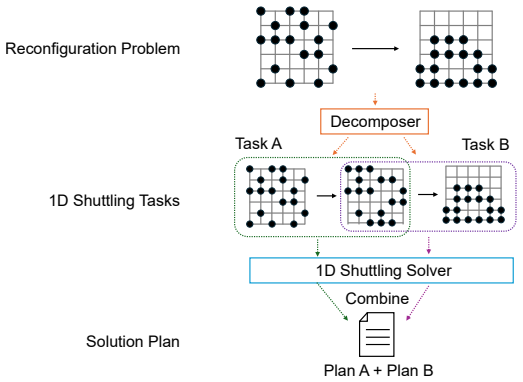
A divide-and-conquer method rearranges N atoms into defect-free arrays using at most three parallel one-dimensional moves each.
A machine-rendered reading of the paper's core claim, the machinery that carries it, and where it could break.
Core claim
The paper's central claim is that any reconfiguration of N atoms can be planned as a sequence of at most three one-dimensional shuttling operations per atom by using two-dimensional lattice patterns, yielding a total transportation cost of O(sqrt N) while guaranteeing feasibility through the Gale-Ryser theorem; for grid targets an additional peephole step further optimizes the plan.
What carries the argument
The divide-and-conquer strategy that decomposes arbitrary atom reconfiguration into at most three 1D shuttling tasks, enabling parallel transport via AOD-generated 2D lattices, with the Gale-Ryser theorem ensuring reliable matching.
If this is right
- The total transportation cost for reconfiguring large arrays drops dramatically, reaching only one-seventh of previous methods in simulations.
- Atom capture success rates improve by 32 to 35 percent for grid-shaped targets.
- Systems can scale to much larger numbers of atoms without proportional increases in reconfiguration time.
- The method provides a reliable solution for arbitrary target geometries, not just regular grids.
Where Pith is reading between the lines
- Similar parallel transport planning could apply to other physical systems where multiple particles must be moved simultaneously, such as in optical tweezers for biology.
- Minimizing total move distance might also lower the chance of atom loss or heating during the process, improving overall fidelity.
- Implementing the plan on real hardware would need to account for any deviations from ideal lattice patterns produced by the deflectors.
- Extending the peephole optimization to non-grid shapes could yield further efficiency gains beyond what is shown.
Load-bearing premise
The method assumes acousto-optic deflectors can create accurate two-dimensional lattice patterns that allow many atoms to be transported in parallel without significant positioning errors or hardware constraints.
What would settle it
Running the algorithm on a physical neutral-atom setup with thousands of atoms and measuring whether the actual number of successful captures matches the simulated 32-35 percent improvement and whether move times scale as predicted.
Figures





read the original abstract
This paper proposes a scalable planning algorithm for creating defect-free atom arrays in neutral-atom systems. The algorithm generates a $\mathcal{O}(\sqrt N)$ time plan for $N$ atoms by parallelizing atom transport using a two-dimensional lattice pattern generated by acousto-optic deflectors. Our approach is based on a divide-and-conquer strategy that decomposes an arbitrary reconfiguration problem into at most three one-dimensional shuttling tasks, enabling each atom to be transported with a total transportation cost of $\mathcal{O}(\sqrt N)$. Using the Gale--Ryser theorem, the proposed algorithm provides a highly reliable solution for arbitrary target geometries. We further introduce a peephole optimization technique that improves reconfiguration efficiency for grid target geometries. Numerical simulations on a 632$\times$632 atom array demonstrate that the proposed algorithm achieves a grid configuration plan that reduces the total transportation cost to 1/7 of state-of-the-art algorithms, while resulting in 32%--35% more atom captures. We believe that our scalability improvement contributes to realizing large-scale quantum computers based on neutral atoms. Our experimental code is available from https://github.com/kotamanegi/sqrt-time-atom-reconfigure.
Editorial analysis
A structured set of objections, weighed in public.
Referee Report
Summary. The manuscript proposes a divide-and-conquer algorithm for reconfiguring neutral-atom arrays into defect-free configurations using acousto-optic deflectors to generate 2D lattice-shaped mobile tweezers. It claims an O(√N) time plan for N atoms by decomposing arbitrary geometries into at most three 1D shuttling tasks, applying the Gale-Ryser theorem for reliable bipartite matching, and adding a peephole optimization for grid targets. Numerical simulations on a 632×632 array report a total transportation cost reduced to 1/7 of state-of-the-art methods with 32-35% more atom captures, supported by open-source code.
Significance. If the idealized hardware assumptions hold, the O(√N) scaling and reported performance gains would represent a substantial advance for large-scale neutral-atom quantum computing by enabling faster reconfiguration of defect-free arrays. Strengths include the mathematical grounding via the Gale-Ryser theorem, the explicit decomposition strategy, and the provision of reproducible code. The work's impact is currently limited by the absence of hardware validation or error modeling for the parallel 2D transports.
major comments (3)
- [Abstract and Numerical Simulations] The central O(√N) time claim and the 1/7 cost reduction reported in the abstract rest on the assumption that AOD-generated 2D lattice moves can be executed in parallel with no additional collisions, intensity fluctuations, positioning errors, or desynchronization. The numerical simulations count ideal move costs under perfect parallelism; the manuscript provides no analysis or sensitivity study of realistic AOD constraints such as bandwidth limits or beam crosstalk.
- [Algorithm Description] The divide-and-conquer decomposition into ≤3 1D shuttling tasks (combined with Gale-Ryser matching) is presented as enabling O(√N) total transportation cost per atom, but the manuscript does not supply an explicit bound on the number of sequential parallel steps or prove that the 2D lattice parallelization preserves the claimed complexity when physical constraints are considered.
- [Numerical Simulations] The 32-35% capture improvement and grid-configuration results on the 632×632 array are obtained under the ideal-transport model; without modeling atom loss or trap-depth variation during lattice moves, it is unclear whether these gains survive translation to hardware, making the performance claims load-bearing on an unvalidated assumption.
minor comments (2)
- The abstract states that the code is available at the cited GitHub repository, but the manuscript would benefit from a short paragraph in the methods or simulation section listing the key parameters (array size, move-cost metric, baseline algorithms) used to obtain the 1/7 and 32-35% figures.
- A few sentences clarifying the precise definition of 'transportation cost' (e.g., total distance summed over all atoms or number of sequential steps) would improve readability when comparing to prior work.
Simulated Author's Rebuttal
We thank the referee for their constructive comments, which have helped us improve the clarity of our manuscript. We address each of the major comments point by point below. We have revised the manuscript to better highlight the idealized assumptions and to provide additional analysis where possible.
read point-by-point responses
-
Referee: [Abstract and Numerical Simulations] The central O(√N) time claim and the 1/7 cost reduction reported in the abstract rest on the assumption that AOD-generated 2D lattice moves can be executed in parallel with no additional collisions, intensity fluctuations, positioning errors, or desynchronization. The numerical simulations count ideal move costs under perfect parallelism; the manuscript provides no analysis or sensitivity study of realistic AOD constraints such as bandwidth limits or beam crosstalk.
Authors: We agree that the reported O(√N) scaling and performance improvements are based on an idealized model of parallel 2D lattice transports. The algorithm generates a plan where the total time is O(√N) assuming perfect parallelism, and the numerical results count the number of such parallel steps. To address the concern, we have added a new paragraph in the discussion section acknowledging these assumptions and outlining how bandwidth limits or crosstalk could affect execution, suggesting that the plan can be serialized if needed. A full sensitivity analysis would depend on specific hardware details not modeled here, but we note this as a direction for future work. revision: partial
-
Referee: [Algorithm Description] The divide-and-conquer decomposition into ≤3 1D shuttling tasks (combined with Gale-Ryser matching) is presented as enabling O(√N) total transportation cost per atom, but the manuscript does not supply an explicit bound on the number of sequential parallel steps or prove that the 2D lattice parallelization preserves the claimed complexity when physical constraints are considered.
Authors: The divide-and-conquer approach reduces the 2D reconfiguration to three sequential 1D shuttling phases. In each phase, the lattice-shaped tweezers enable parallel movement of atoms along one dimension. Since the array is of size √N × √N, each 1D shuttling phase requires at most O(√N) sequential steps to complete all transports in that phase. Thus, the total number of sequential parallel steps is O(√N). We have revised the algorithm description to include this explicit bound and a short justification of why the parallelization in 2D lattice preserves the complexity under the assumed model. Physical constraints would require adjusting the plan, but the base complexity holds for the ideal case. revision: yes
-
Referee: [Numerical Simulations] The 32-35% capture improvement and grid-configuration results on the 632×632 array are obtained under the ideal-transport model; without modeling atom loss or trap-depth variation during lattice moves, it is unclear whether these gains survive translation to hardware, making the performance claims load-bearing on an unvalidated assumption.
Authors: The simulations assume ideal transport to isolate the effect of the planning algorithm on total cost and capture rates, where lower cost directly correlates with higher survival probability in the model. We have added a caveat in the numerical results section stating that these gains are under ideal conditions and that real hardware may see reduced benefits due to atom loss or trap variations. However, the relative improvement over state-of-the-art should still hold as long as the cost reduction is significant. Full modeling of loss mechanisms is left for future experimental validation. revision: partial
- Absence of hardware validation or experimental implementation of the proposed plans.
Circularity Check
No circularity: algorithmic derivation is self-contained
full rationale
The paper's core contribution is an explicit divide-and-conquer algorithm that reduces arbitrary 2D reconfiguration to at most three 1D shuttling subproblems, invokes the external Gale-Ryser theorem for existence and construction of transport plans, and reports simulation counts under that plan. No equation or claim reduces by construction to a fitted parameter, a self-defined quantity, or a load-bearing self-citation; the O(sqrt N) bound follows directly from the decomposition depth and the parallel-lattice assumption is stated as an external hardware premise rather than derived from the algorithm itself. Simulations are forward numerical evaluations, not retrofitted predictions.
Axiom & Free-Parameter Ledger
axioms (1)
- standard math Gale-Ryser theorem guarantees the existence of a 0-1 matrix with given row and column sums.
Lean theorems connected to this paper
-
IndisputableMonolith/Foundation/AlexanderDuality.leanalexander_duality_circle_linking unclear?
unclearRelation between the paper passage and the cited Recognition theorem.
The algorithm generates a O(√N) time plan for N atoms by parallelizing atom transport using a two-dimensional lattice pattern generated by acousto-optic deflectors... Using the Gale–Ryser theorem, the proposed algorithm provides a highly reliable solution for arbitrary target geometries.
-
IndisputableMonolith/Cost/FunctionalEquation.leanJ_uniquely_calibrated_via_higher_derivative unclear?
unclearRelation between the paper passage and the cited Recognition theorem.
Numerical simulations on a 632×632 atom array demonstrate that the proposed algorithm achieves a grid configuration plan that reduces the total transportation cost to 1/7 of state-of-the-art algorithms
What do these tags mean?
- matches
- The paper's claim is directly supported by a theorem in the formal canon.
- supports
- The theorem supports part of the paper's argument, but the paper may add assumptions or extra steps.
- extends
- The paper goes beyond the formal theorem; the theorem is a base layer rather than the whole result.
- uses
- The paper appears to rely on the theorem as machinery.
- contradicts
- The paper's claim conflicts with a theorem or certificate in the canon.
- unclear
- Pith found a possible connection, but the passage is too broad, indirect, or ambiguous to say the theorem truly supports the claim.
Reference graph
Works this paper leans on
-
[1]
Manuel Endres, Hannes Bernien, Alexander Keesling, Harry Levine, Eric R Anschuetz, Alexandre Krajenbrink, Crystal Senko, Vladan Vuletic, Markus Greiner, and Mikhail D Lukin. Atom-by-atom assembly of defect-free one-dimensional cold atom arrays.Science, 354(6315): 1024–1027, November 2016. DOI: 10.1126/science.aah3752
-
[2]
Hyosub Kim, Woojun Lee, Han-Gyeol Lee, Hanlae Jo, Yunheung Song, and Jaewook Ahn. In situ single-atom array synthesis using dynamic holographic optical tweezers.Nature Commu- nications, 7(13317), October 2016. DOI: 10.1038/ncomms13317
-
[3]
Daniel Barredo, Sylvain de Léséleuc, Vincent Lienhard, Thierry Lahaye, and Antoine Browaeys. An atom-by-atom assembler of defect-free arbitrary two-dimensional atomic ar- rays.Science, 354(6315):1021–1023, November 2016. DOI: 10.1126/science.aah3778
-
[4]
Demonstration of a Logical Architecture Uniting Motion and In-Place Entanglement
Rich Rines, Benjamin Hall, Mariesa H. Teo, Joshua Viszlai, Daniel C. Cole, David Mason, Cameron Barker, Matt J. Bedalov, Matt Blakely, Tobias Bothwell, Caitlin Carnahan, Fred- eric T. Chong, Samuel Y. Eubanks, Brian Fields, Matthew Gillette, Palash Goiporia, Pranav Gokhale, Garrett T. Hickman, Marin Iliev, Eric B. Jones, Ryan A. Jones, Kevin W. Ku- per, S...
work page internal anchor Pith review Pith/arXiv arXiv doi:10.48550/arxiv.2509.13247 2025
-
[5]
Kai-Niklas Schymik, Vincent Lienhard, Daniel Barredo, Pascal Scholl, Hannah Williams, An- toine Browaeys, and Thierry Lahaye. Enhanced atom-by-atom assembly of arbitrary tweezer arrays.Physical Review A,102(063107), December2020. DOI:10.1103/PhysRevA.102.063107
-
[6]
Sepehr Ebadi, Tout T. Wang, Harry Levine, Alexander Keesling, Giulia Semeghini, Ahmed Omran, Dolev Bluvstein, Rhine Samajdar, Hannes Pichler, Wen Wei Ho, Soonwon Choi, Subir Sachdev, Markus Greiner, Vladan Vuletic, and Mikhail D. Lukin. Quantum phases of matter on a 256-atom programmable quantum simulator.Nature, 595:227–232, July 2021. DOI: 10.1038/s4158...
-
[7]
Adam M. Kaufman and Kang-Kuen Ni. Quantum science with optical tweezer arrays of ultracold atoms and molecules.Nature Physics, 17:1324–1333, December 2021. DOI: 10.1038/s41567-021-01357-2
-
[8]
Dolev Bluvstein, Simon J. Evered, Alexandra A. Geim, Sophie H. Li, Hengyun Zhou, Tom Manovitz, Sepehr Ebadi, Madelyn Cain, Marcin Kalinowski, Dominik Hangleiter, J. Pablo Bonilla Ataides, Nishad Maskara, Iris Cong, Xun Gao, Pedro Sales Rodriguez, Thomas Karolyshyn, Giulia Semeghini, Michael J. Gullans, Markus Greiner, Vladan Vuletić, and Mikhail D. Lukin....
-
[9]
T. M. Graham, Y. Song, J. Scott, C. Poole, L. Phuttitarn, K. Jooya, P. Eichler, X. Jiang, A. Marra, B. Grinkemeyer, M. Kwon, M. Ebert, J. Cherek, M. T. Lichtman, M. Gillette, 22 J. Gilbert, D. Bowman, T. Ballance, C. Campbell, E. D. Dahl, O. Crawford, N. S. Blunt, B. Rogers, T. Noel, and M. Saffman. Multi-qubit entanglement and algorithms on a neutral- at...
-
[10]
Manetsch, Gyohei Nomura, Elie Bataille, Kon H
Hannah J. Manetsch, Gyohei Nomura, Elie Bataille, Kon H. Leung, Xudong Lv, and Manuel Endres. A tweezer array with 6100 highly coherent atomic qubits.Nature, 647:60–67, Septem- ber 2025. DOI: 10.1038/s41586-025-09641-4
-
[11]
Nathan Constantinides, Ali Fahimniya, Dhruv Devulapalli, Dolev Bluvstein, Michael J. Gullans, J. V. Porto, Andrew M. Childs, and Alexey V. Gorshkov. Optimal Rout- ing Protocols for Reconfigurable Atom Arrays.arXiv preprint, November 2024. DOI: 10.48550/arXiv.2411.05061
-
[12]
Weikun Tian, Wen Jun Wee, An Qu, Billy Jun Ming Lim, Prithvi Raj Datla, Vanessa Pei Wen Koh, and Huanqian Loh. Parallel Assembly of Arbitrary Defect-Free Atom Arrays with a Mul- titweezer Algorithm.Physical Review Applied, 19(034048), March 2023. DOI: 10.1103/Phys- RevApplied.19.034048
-
[13]
Efficient preparation of two-dimensional defect-free atom arrays with near-fewest sorting-atom moves.Physical Review Research, 3(023008), April
Cheng Sheng, Jiayi Hou, Xiaodong He, Peng Xu, Kunpeng Wang, Jun Zhuang, Xiao Li, Min Liu, Jin Wang, and Mingsheng Zhan. Efficient preparation of two-dimensional defect-free atom arrays with near-fewest sorting-atom moves.Physical Review Research, 3(023008), April
-
[14]
DOI: 10.1103/PhysRevResearch.3.023008
-
[15]
Accelerating the Assembly of Defect-Free Atomic Arrays with Maximum Parallelisms
Shuai Wang, WenjunZhang, TaoZhang, Shuyao Mei, Yuqing Wang, Jiazhong Hu, and Wenlan Chen. Accelerating the Assembly of Defect-Free Atomic Arrays with Maximum Parallelisms. Physical Review Applied, 19(054032), May 2023. DOI: 10.1103/PhysRevApplied.19.054032
-
[16]
Barry Cimring, Remy El Sabeh, Marc Bacvanski, Stephanie Maaz, Izzat El Hajj, Naomi Nishimura, Amer E. Mouawad, and Alexandre Cooper. Efficient algorithms to solve atom reconfiguration problems. I. Redistribution-reconfiguration algorithm.Physical Review A, 108 (023107), August 2023. DOI: 10.1103/PhysRevA.108.023107
-
[17]
Daniel Ohl de Mello, Dominik Schäffner, Jan Werkmann, Tilman Preuschoff, Lars Kohfahl, Malte Schlosser, and Gerhard Birkl. Defect-Free Assembly of 2D Clusters of More Than 100 Single-Atom Quantum Systems.Physical Review Letters, 122(203601), May 2019. DOI: 10.1103/PhysRevLett.122.203601
-
[18]
Alkaline-Earth Atoms in Optical Tweezers.Physical Review X, 8(041055), December 2018
Alexandre Cooper, Jacob P Covey, Ivaylo S Madjarov, Sergey G Porsev, Marianna S Safronova, and Manuel Endres. Alkaline-Earth Atoms in Optical Tweezers.Physical Review X, 8(041055), December 2018. DOI: 10.1103/PhysRevX.8.041055
-
[19]
A theorem on flows in networks.Pacific Journal of Mathematics, 7(2):1073–1082, June 1957
David Gale. A theorem on flows in networks.Pacific Journal of Mathematics, 7(2):1073–1082, June 1957
1957
-
[20]
H. J. Ryser. Combinatorial properties of matrices of zeros and ones.Canadian Journal of Mathematics, 9:371–377, 1957
1957
-
[21]
Neng-Chun Chiu, Elias C. Trapp, Jinen Guo, Mohamed H. Abobeih, Luke M. Stewart, Simon Hollerith, Pavel L. Stroganov, Marcin Kalinowski, Alexandra A. Geim, Simon J. Evered, Sophie H. Li, Xingjian Lyu, Lisa M. Peters, Dolev Bluvstein, Tout T. Wang, Markus Greiner, Vladan Vuletić, and Mikhail D. Lukin. Continuous operation of a coherent 3,000-qubit system. N...
-
[22]
Nikhil K Harle, Bo-Yu Chen, Bob Bao, and Hannes Bernien. atommovr: An open-source simulation framework for rearrangement in atomic arrays.arXiv preprint, August 2025. DOI: 10.48550/arXiv.2508.02670
-
[23]
A fault-tolerant neutral-atom architecture for universal quantum computation,
Dolev Bluvstein, Alexandra A. Geim, Sophie H. Li, Simon J. Evered, J. Pablo Bonilla Ataides, Gefen Baranes, Andi Gu, Tom Manovitz, Muqing Xu, Marcin Kalinowski, Shayan Ma- jidy, Christian Kokail, Nishad Maskara, Elias C. Trapp, Luke M. Stewart, Simon Hollerith, Hengyun Zhou, Michael J. Gullans, Susanne F. Yelin, Markus Greiner, Vladan Vuletić, Made- lyn C...
-
[24]
H. W. Kuhn. The Hungarian method for the assignment problem.Naval Research Logistics Quarterly, 2(1-2):83–97, March 1955
1955
-
[25]
Defect-free atomic array formation using the Hungarian matching algorithm.Physical Review
Woojun Lee, Hyosub Kim, and Jaewook Ahn. Defect-free atomic array formation using the Hungarian matching algorithm.Physical Review. A, 95(053424), May 2017. DOI: 10.1103/PhysRevA.95.053424. 23
-
[26]
Shangguo Zhu, Yun Long, Mingbo Pu, and Xiangang Luo. Parallel compression algorithm for fast preparation of defect-free atom arrays.arXiv preprint, December 2022. DOI: 10.48550/arXiv.2212.03047
-
[27]
Yiyi Li, Yicheng Bao, Michael Peper, Chenyuan Li, and Jeff D Thompson. Fast, continuous and coherent atom replacement in a neutral atom qubit array.arXiv preprint, June 2025. DOI: 10.48550/arXiv.2506.15633
-
[28]
M.A.Norcia, H.Kim, W.B.Cairncross, M.Stone, A.Ryou, M.Jaffe, M.O.Brown, K.Barnes, P. Battaglino, T. C. Bohdanowicz, A. Brown, K. Cassella, C.-A. Chen, R. Coxe, D. Crow, J. Epstein, C. Griger, E. Halperin, F. Hummel, A. M. W. Jones, J. M. Kindem, J. King, K. Kotru, J. Lauigan, M. Li, M. Lu, E. Megidish, J. Marjanovic, M. McDonald, T. Mittiga, J. A. Muniz, ...
-
[29]
Flavien Gyger, Maximilian Ammenwerth, Renhao Tao, Hendrik Timme, Stepan Snigirev, Immanuel Bloch, and Johannes Zeiher. Continuous operation of large-scale atom arrays in optical lattices.Physical Review Research, 6(033104), July 2024. DOI: 10.1103/PhysRevRe- search.6.033104
-
[30]
Fast and reliable atom transport by optical tweezers.Optica quantum, 3(1):64–71, January 2025
Sunhwa Hwang, Hansub Hwang, Kangjin Kim, Andrew Byun, Kangheun Kim, Seokho Jeong, Maynardo Pratama Soegianto, and Jaewook Ahn. Fast and reliable atom transport by optical tweezers.Optica quantum, 3(1):64–71, January 2025. DOI: 10.1364/OPTICAQ.546797. 24 A General Form of 2D Tweezer System We present a general form of the 2D tweezer system used in previous...
-
[31]
The leftxcolumns ofA (γ′) match those ofA(tgt) as follows: ∀i∈X,∀j∈{1,2,...,x}:A(γ′) i,j =A (tgt) i,j (B.7) We consider the effect of theRight(I,J)operation applied during loopx(line 5) for an arbitrary rowi. There are two possibilities for the geometryA(tgt) before this operation: (i) CaseA (tgt) i,x = 0:TheRight(I,J)operation shifts the portion of rowif...
discussion (0)
Sign in with ORCID, Apple, or X to comment. Anyone can read and Pith papers without signing in.