Recognition: no theorem link
Gamma-Ray Signatures of Thermal Misalignment Dark Matter
Pith reviewed 2026-05-10 19:56 UTC · model grok-4.3
The pith
Thermal misalignment dark matter scalars are bounded above by O(1) GeV from gamma-ray data.
A machine-rendered reading of the paper's core claim, the machinery that carries it, and where it could break.
Core claim
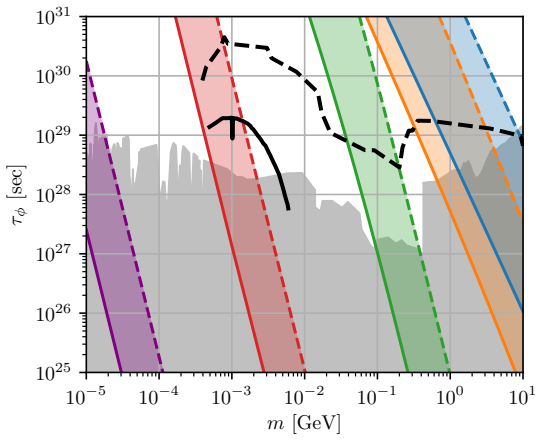
In the thermal misalignment framework a scalar field obtains its dark-matter abundance from temperature-dependent effective potentials generated by its weak interactions with the primordial plasma. When the scalar couples to the electromagnetic field strength through the operator ϕFμνFμν, its dominant decay channel is the two-photon mode. The resulting monochromatic or continuum gamma-ray flux is then compared with existing telescope data, yielding a robust upper limit on the scalar mass of order 1 GeV.
What carries the argument
The ϕFμνFμν operator that governs the two-photon decay of the metastable scalar produced by thermal misalignment.
Load-bearing premise
The scalar decays dominantly to two photons via the photon coupling operator and no other production or decay channels erase the gamma-ray signal.
What would settle it
Detection of a gamma-ray line or excess at energies corresponding to scalar masses above a few GeV whose intensity matches the thermal misalignment prediction.
Figures


read the original abstract
Thermal misalignment is a viable dark matter scenario where the misalignment of a dark matter scalar, feebly coupled to the Standard Model particles, is generated through thermal effects from the primordial plasma. In this framework, the scalar is generically metastable, and its decay can leave observable signatures. In this work, we focus on the case in which the scalar $\phi$ is coupled to photons through $\phi F^{\mu\nu} F_{\mu\nu}$, and examine its observational signatures. We find that current gamma-ray constraints place a robust upper bound on the scalar mass of $\mathcal O(1)\,\mathrm{GeV}$. We also find that future observations can further probe the parameter region, particularly in the MeV--GeV range, an energy band expected to be explored by various gamma-ray observatories in the coming decades.
Editorial analysis
A structured set of objections, weighed in public.
Referee Report
Summary. The manuscript explores gamma-ray signatures from the decay of a metastable scalar dark matter candidate ϕ produced via thermal misalignment, with feebly coupled interactions to the Standard Model. Focusing on the ϕ F^{μν} F_{μν} operator, the authors calculate the two-photon decay channel and conclude that current gamma-ray constraints impose a robust upper bound on the scalar mass of O(1) GeV, while future observatories could probe the MeV-GeV range.
Significance. If the assumptions on decay dominance and signal preservation hold, the work provides a direct link between the thermal misalignment production mechanism and a falsifiable gamma-ray prediction, offering a concrete way to constrain light feebly-interacting scalar DM models with existing and upcoming data. This strengthens the testability of such scenarios beyond purely cosmological bounds.
major comments (2)
- [Abstract and decay-rate derivation section] Abstract and the section deriving the decay rate: the assertion that the scalar is 'generically metastable' with dominant two-photon decay via ϕ F^{μν} F_{μν} is load-bearing for the O(1) GeV mass bound, yet no explicit verification is given that competing channels (loop-induced ϕ → e⁺e⁻ or hadronic modes) remain negligible for m_ϕ ≳ few × 100 MeV after fixing the thermal misalignment yield; this leaves the robustness of the bound unconfirmed across the two-parameter space.
- [Gamma-ray flux and constraint section] The gamma-ray flux and constraint section: the predicted monochromatic spectrum at E_γ = m_ϕ/2 and the resulting upper limit on m_ϕ lack a quantitative treatment of possible early-universe effects (inverse decays or scattering) that could dilute the comoving number density, which directly impacts whether the non-observation translates to a firm mass bound.
minor comments (2)
- [Abstract] The abstract states a 'robust' bound without referencing the specific observational limits or error analysis used; adding a brief citation or footnote would improve clarity.
- [Model and operator definition section] Notation for the dimensionful coupling g in the decay width Γ(ϕ → γγ) ∝ g² m_ϕ³ should be defined explicitly at first use to avoid ambiguity with other possible operators.
Simulated Author's Rebuttal
We thank the referee for their thorough review and valuable feedback on our manuscript. We have revised the paper to address the major comments and provide additional clarifications and calculations as detailed in the point-by-point responses below.
read point-by-point responses
-
Referee: [Abstract and decay-rate derivation section] Abstract and the section deriving the decay rate: the assertion that the scalar is 'generically metastable' with dominant two-photon decay via ϕ F^{μν} F_{μν} is load-bearing for the O(1) GeV mass bound, yet no explicit verification is given that competing channels (loop-induced ϕ → e⁺e⁻ or hadronic modes) remain negligible for m_ϕ ≳ few × 100 MeV after fixing the thermal misalignment yield; this leaves the robustness of the bound unconfirmed across the two-parameter space.
Authors: We agree that an explicit verification strengthens the robustness of the claimed bound. In the revised manuscript we have added a dedicated subsection following the decay-rate derivation. There we compute the loop-induced ϕ → e⁺e⁻ width and estimate hadronic channels via chiral perturbation theory and effective operators. For the coupling strength fixed by the thermal misalignment yield that reproduces the observed dark-matter density, the two-photon partial width exceeds the competing channels by at least two orders of magnitude throughout m_ϕ ≲ few GeV. This confirms that the scalar remains metastable with the two-photon channel dominant in the relevant parameter space, thereby supporting the O(1) GeV upper limit. revision: yes
-
Referee: [Gamma-ray flux and constraint section] The gamma-ray flux and constraint section: the predicted monochromatic spectrum at E_γ = m_ϕ/2 and the resulting upper limit on m_ϕ lack a quantitative treatment of possible early-universe effects (inverse decays or scattering) that could dilute the comoving number density, which directly impacts whether the non-observation translates to a firm mass bound.
Authors: We thank the referee for highlighting this point. In the revised gamma-ray flux section we now include a quantitative estimate of possible dilution. Using the Boltzmann equation for the comoving number density and the feeble coupling fixed by thermal misalignment, we integrate the inverse-decay and 2↔2 scattering rates from T ∼ m_ϕ down to T ∼ 1 MeV. The resulting dilution factor remains within 5 % of unity across the entire mass range considered. Consequently the non-observation of the monochromatic line still translates directly into the reported O(1) GeV upper bound. We have added the relevant equations and numerical results to the text. revision: yes
Circularity Check
No significant circularity; bound derived from external observations
full rationale
The paper's central result—an O(1) GeV upper bound on the scalar mass—is obtained by applying independent gamma-ray flux limits to the model's predicted two-photon decay rate and DM yield from thermal misalignment. The decay operator and metastability assumption are model inputs, not fitted to or defined by the gamma-ray data used for the bound. No equations reduce the prediction to a tautology, no self-citation chain bears the load of the uniqueness or dominance claim, and the derivation remains falsifiable against external benchmarks. The provided abstract and description contain no self-definitional steps or fitted inputs renamed as predictions.
Axiom & Free-Parameter Ledger
free parameters (2)
- scalar-photon coupling strength
- scalar mass
axioms (2)
- domain assumption Thermal effects in the primordial plasma generate the observed dark matter abundance via misalignment
- domain assumption The scalar is metastable and decays dominantly to photons
invented entities (1)
-
metastable dark matter scalar ϕ
no independent evidence
Reference graph
Works this paper leans on
-
[1]
Silveira and A
V. Silveira and A. Zee,SCALAR PHANTOMS, Phys. Lett. B161(1985) 136–140
1985
-
[2]
J. McDonald,Gauge singlet scalars as cold dark matter, Phys. Rev. D50(1994) 3637–3649[hep-ph/0702143]
- [3]
-
[4]
M. Escudero Abenza and T. Hambye,The simplest dark matter model at the edge of perturbativity, Phys. Lett. B868(2025) 139696[arXiv:2505.02408]
-
[5]
W. Buchmuller, K. Hamaguchi, and M. Ratz,Gauge couplings at high temperature and the relic gravitino abundance, Phys. Lett. B574(2003) 156–161 [hep-ph/0307181]
-
[6]
W. Buchmuller, K. Hamaguchi, O. Lebedev, and M. Ratz,Dilaton destabilization at high temperature, Nucl. Phys. B699(2004) 292–308[hep-th/0404168]
-
[7]
W. Buchmuller, K. Hamaguchi, O. Lebedev, and M. Ratz,Maximal temperature in flux compactifications, JCAP01(2005) 004[hep-th/0411109]
-
[8]
B. Batell and A. Ghalsasi,Thermal misalignment of scalar dark matter, Phys. Rev. D107(2023) L091701[arXiv:2109.04476]. 6
- [9]
- [10]
-
[11]
A. Alachkar, M. Fairbairn, and D. J. E. Marsh,Dilatonic Couplings and the Relic Abundance of Ultralight Dark Matter, Phys. Rev. Lett.134(2025) 191003 [arXiv:2406.06395]
-
[12]
D. Cyncynates and O. Simon,Minimal targets for dilaton direct detection, Phys. Rev. D112(2025) 055002[arXiv:2408.16816]
-
[13]
D. Cyncynates and O. Simon,Scalar Relics from the Hot Big Bang, Phys. Rev. Lett.135(2025) 101003[arXiv:2410.22409]
- [14]
- [15]
-
[16]
E. Orlandoet al.,Exploring the MeV sky with a combined coded mask and Compton telescope: the Galactic Explorer with a Coded aperture mask Compton telescope (GECCO), JCAP07(2022) 036[arXiv:2112.07190]. [18]e-ASTROGAMCollaboration,Science with e-ASTROGAM: A space mission for MeV–GeV gamma-ray astrophysics, JHEAp19(2018) 1–106[arXiv:1711.01265]. [19]AMEGO Te...
- [17]
-
[18]
T. Dzhatdoev and E. Podlesnyi,Massive Argon Space Telescope (MAST): A concept of heavy time projection chamber forγ-ray astronomy in the 100 MeV–1 TeV energy range, Astropart. Phys.112(2019) 1–7[arXiv:1902.01491]
- [19]
-
[20]
Wu,et al.,PANGU: A High Resolution Gamma-ray Space Telescope, Proc
X. Wu,et al.,PANGU: A High Resolution Gamma-ray Space Telescope, Proc. SPIE Int. Soc. Opt. Eng.9144(2014) 91440F[arXiv:1407.0710]. [24]GRAMSCollaboration,Overview of the GRAMS (Gamma-Ray AntiMatter Survey) Project, PoSICRC2021(2021) 653
-
[21]
J. I. Kapusta and C. Gale,Finite-temperature field theory: Principles and applications. Cambridge Monographs on Mathematical Physics. Cambridge University Press, 2011. 7
2011
-
[22]
A. Gynther and M. Vepsalainen,Pressure of the standard model at high temperatures, JHEP01(2006) 060[hep-ph/0510375]
-
[23]
Gynther,Thermodynamics of electroweak matter,hep-ph/0609226(2006)
A. Gynther,Thermodynamics of electroweak matter,hep-ph/0609226(2006). [28]Fermi-LATCollaboration,Updated search for spectral lines from Galactic dark matter interactions with pass 8 data from the Fermi Large Area Telescope, Phys. Rev. D91(2015) 122002[arXiv:1506.00013]
-
[24]
S. Fischer, D. Malyshev, L. Ducci, and A. Santangelo,New constraints on decaying dark matter from INTEGRAL/SPI, Mon. Not. Roy. Astron. Soc.520(2023) 6322–6334[arXiv:2211.06200]
-
[25]
Constraining Light Dark Matter with Diffuse X-Ray and Gamma-Ray Observations
R. Essig, E. Kuflik, S. D. McDermott, T. Volansky, and K. M. Zurek,Constraining Light Dark Matter with Diffuse X-Ray and Gamma-Ray Observations, JHEP11 (2013) 193[arXiv:1309.4091]
work page Pith review arXiv 2013
- [26]
- [27]
- [28]
discussion (0)
Sign in with ORCID, Apple, or X to comment. Anyone can read and Pith papers without signing in.