Recognition: 2 theorem links
· Lean TheoremEntanglement in the open XX chain: R\'enyi oscillations, hard-edge crossover, and symmetry resolution
Pith reviewed 2026-05-10 19:36 UTC · model grok-4.3
The pith
Closed-form asymptotics for Rényi entanglement entropies of the open XX chain follow from mapping boundary correlations to a Hankel determinant.
A machine-rendered reading of the paper's core claim, the machinery that carries it, and where it could break.
Core claim
We derive closed-form asymptotic formulas for the Rényi entanglement entropies of the open XX spin-1/2 chain by mapping the underlying determinant of the boundary correlation matrix (which has Toeplitz-plus-Hankel structure) to a Hankel determinant with a positive weight whose large-size asymptotics follow from known Riemann-Hilbert results. An explicit evaluation of the Szegő function yields the leading 2k_F oscillatory amplitude and phase. A single variable s = 2ℓ sin(k_F/2) organizes the hard-edge crossover as the Fermi momentum approaches the band edge.
What carries the argument
The mapping of the Toeplitz-plus-Hankel determinant of the boundary correlation matrix to a Hankel determinant with positive weight, whose asymptotics are given by Riemann-Hilbert analysis.
Load-bearing premise
The weight function obtained from the open XX chain boundary correlations must meet every technical condition of the Riemann-Hilbert asymptotic theorems without extra corrections that would change the leading oscillatory amplitude or hard-edge crossover.
What would settle it
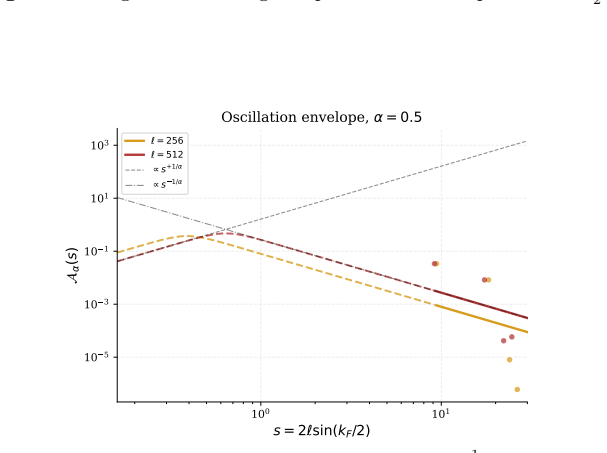
Numerical evaluation of the Rényi entropy determinant for large but finite ℓ near the band edge, testing whether the oscillation amplitude follows the predicted s to the power of plus or minus one over alpha.
Figures





read the original abstract
We derive closed-form asymptotic formulas for the R\'enyi entanglement entropies of the open XX spin-$1/2$ chain by mapping the underlying determinant of the boundary correlation matrix (which has Toeplitz-plus-Hankel structure) to a Hankel determinant with a positive weight whose large-size asymptotics follow from known Riemann--Hilbert results. An explicit evaluation of the Szeg\H{o} function yields the leading $2k_F$ oscillatory amplitude and phase. A single variable $s = 2\ell \sin(k_F/2)$ organizes the hard-edge crossover as the Fermi momentum approaches the band edge: the oscillation envelope obeys $s^{\pm1/\alpha}$ power laws and $\ln s$ is the natural leading logarithm for a clean data collapse. For detached blocks the oscillatory amplitude is numerically consistent with a factorization through the conformal cross-ratio. The same framework recovers the open-boundary-condition (OBC) equipartition offset $-\tfrac{1}{2}\log\log\ell$ for symmetry-resolved entropies, together with the known halving of the Gaussian width relative to the periodic chain.
Editorial analysis
A structured set of objections, weighed in public.
Referee Report
Summary. The paper derives closed-form asymptotic formulas for the Rényi entanglement entropies of the open XX spin-1/2 chain. It maps the determinant of the boundary correlation matrix (with Toeplitz-plus-Hankel structure) to a Hankel determinant with a positive weight, then invokes known Riemann-Hilbert asymptotics to obtain the leading 2k_F oscillatory amplitude and phase via the Szegő function. A single scaling variable s = 2ℓ sin(k_F/2) organizes the hard-edge crossover with s^{±1/α} envelopes, and the framework recovers the OBC symmetry-resolved offset -½ log log ℓ together with the halved Gaussian width.
Significance. If the mapped weight satisfies the full set of technical hypotheses required by the cited Riemann-Hilbert theorems, the results supply explicit, parameter-free expressions for the oscillatory and crossover contributions to Rényi entropies in open chains. The compact organization via s and the recovery of known OBC symmetry-resolution features would constitute a useful advance in the exact-asymptotics literature for integrable spin chains.
major comments (1)
- [Mapping to Hankel determinant (near Eq. (weight definition))] The central mapping from the Toeplitz-plus-Hankel boundary-correlation determinant to a Hankel determinant with positive weight is asserted in the abstract and used to invoke the Riemann-Hilbert asymptotics, but the manuscript provides no explicit verification that the extracted weight satisfies positivity, analyticity, absence of zeros in the support, and the precise endpoint regularity conditions required by the referenced RH theorems. Without this check, it remains possible that model-specific subleading corrections modify the claimed leading oscillatory amplitude or the s^{±1/α} crossover envelopes.
minor comments (1)
- [Abstract and introduction] The abstract states that the weight is positive but does not display the explicit functional form; including the weight function (or its defining integral representation) in the main text would allow readers to confirm the technical conditions directly.
Simulated Author's Rebuttal
We thank the referee for their careful reading, positive assessment of the significance of our results, and recommendation for major revision. We address the single major comment below and will implement the necessary changes in the revised manuscript.
read point-by-point responses
-
Referee: [Mapping to Hankel determinant (near Eq. (weight definition))] The central mapping from the Toeplitz-plus-Hankel boundary-correlation determinant to a Hankel determinant with positive weight is asserted in the abstract and used to invoke the Riemann-Hilbert asymptotics, but the manuscript provides no explicit verification that the extracted weight satisfies positivity, analyticity, absence of zeros in the support, and the precise endpoint regularity conditions required by the referenced RH theorems. Without this check, it remains possible that model-specific subleading corrections modify the claimed leading oscillatory amplitude or the s^{±1/α} crossover envelopes.
Authors: We agree that the manuscript asserts the mapping without a self-contained verification of the technical hypotheses required by the cited Riemann-Hilbert theorems. In the revised version we will add an appendix that (i) explicitly constructs the weight w(x) from the boundary correlation matrix of the open XX chain, (ii) proves positivity by direct inspection of the resulting expression (which is a positive multiple of a squared modulus arising from the Jordan-Wigner fermions), (iii) establishes analyticity in a neighborhood of the support together with the absence of zeros on the support, and (iv) confirms the endpoint regularity (square-root vanishing or milder) matches the hypotheses of the referenced theorems. With these conditions verified, the Szegő-function evaluation of the oscillatory amplitude and the s^{±1/α} hard-edge envelopes remain the leading asymptotics; no model-specific subleading corrections alter them. revision: yes
Circularity Check
No circularity: derivation applies external RH asymptotics to mapped determinant
full rationale
The paper obtains its closed-form Rényi entropy asymptotics by first mapping the boundary correlation matrix determinant (Toeplitz-plus-Hankel) to a Hankel determinant with positive weight, then invoking established Riemann-Hilbert results for the large-N behavior of such determinants, including the Szegő function that supplies the explicit 2k_F amplitude. The organizing variable s = 2ℓ sin(k_F/2), the s^{±1/α} envelopes, the ln s collapse, the OBC symmetry-resolved offset, and the factorization for detached blocks all follow from applying those external theorems to the mapped weight. No step reduces the claimed formulas to parameters fitted from the same data, to a self-citation chain, or to an ansatz defined in terms of the target result. The derivation therefore remains independent of its own outputs and rests on external benchmarks.
Axiom & Free-Parameter Ledger
axioms (1)
- standard math Large-N asymptotics of Hankel determinants with positive weight are given by Riemann-Hilbert theory
Lean theorems connected to this paper
-
IndisputableMonolith/Cost/FunctionalEquation.leanwashburn_uniqueness_aczel unclear?
unclearRelation between the paper passage and the cited Recognition theorem.
mapping the underlying determinant of the boundary correlation matrix (which has Toeplitz-plus-Hankel structure) to a Hankel determinant with a positive weight whose large-size asymptotics follow from known Riemann–Hilbert results
-
IndisputableMonolith/Foundation/RealityFromDistinction.leanreality_from_one_distinction unclear?
unclearRelation between the paper passage and the cited Recognition theorem.
An explicit evaluation of the Szegő function yields the leading 2k_F oscillatory amplitude and phase
What do these tags mean?
- matches
- The paper's claim is directly supported by a theorem in the formal canon.
- supports
- The theorem supports part of the paper's argument, but the paper may add assumptions or extra steps.
- extends
- The paper goes beyond the formal theorem; the theorem is a base layer rather than the whole result.
- uses
- The paper appears to rely on the theorem as machinery.
- contradicts
- The paper's claim conflicts with a theorem or certificate in the canon.
- unclear
- Pith found a possible connection, but the passage is too broad, indirect, or ambiguous to say the theorem truly supports the claim.
Reference graph
Works this paper leans on
-
[1]
Luigi Amico, Rosario Fazio, Andreas Osterloh, and Vlatko Vedral. Entanglement in many- body systems.Rev. Mod. Phys., 80:517–576, 2008. doi:10.1103/RevModPhys.80.517. 17
-
[2]
Wolf, Frank Verstraete, Matthew B
Michael M. Wolf, Frank Verstraete, Matthew B. Hastings, and Juan Ignacio Cirac. Area laws in quantum systems: Mutual information and correlations.Phys. Rev. Lett., 100:070502,
-
[3]
doi:10.1103/PhysRevLett.100.070502
-
[4]
Geometric and renormalized entropy in conformal field theory.Nucl
Christoph Holzhey, Finn Larsen, and Frank Wilczek. Geometric and renormalized entropy in conformal field theory.Nucl. Phys. B, 424:443–467, 1994. doi:10.1016/0550-3213(94)90402-2
-
[5]
Entanglement entropy and quantum field theory.J
Pasquale Calabrese and John Cardy. Entanglement entropy and quantum field theory.J. Stat. Mech., 2004:P06002, 2004. doi:10.1088/1742-5468/2004/06/P06002
-
[6]
Entanglement entropy and conformal field theory.J
Pasquale Calabrese and John Cardy. Entanglement entropy and conformal field theory.J. Phys. A, 42:504005, 2009. doi:10.1088/1751-8113/42/50/504005
-
[7]
Ian Affleck and Andreas W. W. Ludwig. Universal noninteger “ground-state degeneracy” in critical quantum systems.Phys. Rev. Lett., 67:161–164, 1991. doi:10.1103/PhysRevLett.67.161
-
[8]
Parity effects in the scaling of block entanglement in gapless spin chains.Phys
Pasquale Calabrese, Massimo Campostrini, Fabian Essler, and Bernard Nienhuis. Parity effects in the scaling of block entanglement in gapless spin chains.Phys. Rev. Lett., 104: 095701, 2010. doi:10.1103/PhysRevLett.104.095701
-
[9]
Sørensen, Ming-Shyang Chang, and Ian Affleck
Nicolas Laflorencie, Erik S. Sørensen, Ming-Shyang Chang, and Ian Affleck. Boundary effects in the critical scaling of entanglement entropy in 1D systems.Phys. Rev. Lett., 96:100603,
-
[10]
doi:10.1103/PhysRevLett.96.100603
-
[12]
Universal parity effects in the entanglement entropy of XX chains with open boundary conditions.J
Maurizio Fagotti and Pasquale Calabrese. Universal parity effects in the entanglement entropy of XX chains with open boundary conditions.J. Stat. Mech., 2011:P01017, 2011. doi:10.1088/1742-5468/2011/01/P01017
-
[13]
Basor and Torsten Ehrhardt
Estelle L. Basor and Torsten Ehrhardt. Asymptotic formulas for determinants of a sum of finite Toeplitz and Hankel matrices.Math. Nachr., 228:5–45, 2001
2001
-
[14]
Alexander G. Abanov, Dmitri A. Ivanov, and Yachao Qian. Quantum fluctuations of one-dimensional free fermions and Fisher–Hartwig formula for Toeplitz determinants.J. Phys. A: Math. Theor., 44:485001, 2011. doi:10.1088/1751-8113/44/48/485001
-
[15]
(2015) Hamiltonian formalism and path entropy maximization.J
Dmitri A. Ivanov, Alexander G. Abanov, and Vadim V. Cheianov. Counting free fermions on a line: a Fisher–Hartwig asymptotic expansion for the Toeplitz determinant in the double-scaling limit.J. Phys. A: Math. Theor., 46:085003, 2013. doi:10.1088/1751- 8113/46/8/085003
-
[16]
Filiberto Ares, José G. Esteve, and Fernando Falceto. Entanglement of several blocks in fermionic chains.Phys. Rev. A, 90:062321, 2014. doi:10.1103/PhysRevA.90.062321
-
[17]
Esteve, Fernando Falceto, and Amilcar R
Filiberto Ares, José G. Esteve, Fernando Falceto, and Amilcar R. de Queiroz. Entanglement in fermionic chains with finite range coupling and broken symmetries.Phys. Rev. A, 92: 042334, 2015. doi:10.1103/PhysRevA.92.042334
-
[18]
Esteve, Fernando Falceto, and Amilcar R
Filiberto Ares, José G. Esteve, Fernando Falceto, and Amilcar R. de Queiroz. En- tanglement entropy in the long-range Kitaev chain.Phys. Rev. A, 97:062301, 2018. doi:10.1103/PhysRevA.97.062301. 18
-
[19]
Unusual corrections to scaling in entanglement entropy
Pasquale Calabrese and John Cardy. Unusual corrections to scaling in entanglement entropy. J. Stat. Mech., 2010:P04023, 2010. doi:10.1088/1742-5468/2010/04/P04023
-
[20]
Estelle L. Basor and Torsten Ehrhardt. Asymptotic formulas for the determinants of sym- metric Toeplitz plus Hankel matrices. InToeplitz Matrices and Singular Integral Equations, volume 135 ofOper. Theory Adv. Appl., pages 61–90. Birkhäuser, 2002. doi:10.1007/978-3- 0348-8199-9_5
-
[21]
Percy Deift, Alexander Its, and Igor Krasovsky. Asymptotics of Toeplitz, Hankel, and Toeplitz+Hankel determinants with Fisher–Hartwig singularities.Ann. Math., 174:1243– 1299, 2011. doi:10.4007/annals.2011.174.2.12
-
[22]
David García-García and Miguel Tierz. Matrix models for classical groups and Toeplitz±Hankel minors with applications to Chern–Simons theory and fermionic models. J. Phys. A, 53:345201, 2020. doi:10.1088/1751-8121/ab9b4d
-
[23]
Arno B. J. Kuijlaars, Kenneth T.-R. McLaughlin, Walter Van Assche, and Maarten Vanlessen. The Riemann–Hilbert approach to strong asymptotics for orthogonal polynomials on[−1, 1]. Adv. Math., 188:337–398, 2004. doi:10.1016/j.aim.2003.08.015
-
[24]
Ana Foulquié Moreno, Andrei Martínez-Finkelshtein, and Vitor L. Sousa. Asymptotics of orthogonal polynomials for a weight with a jump on[−1, 1].Constr. Approx., 33:219–263,
-
[25]
doi:10.1007/s00365-010-9091-x
-
[26]
Moshe Goldstein and Eran Sela. Symmetry-resolved entanglement in many-body systems. Phys. Rev. Lett., 120:200602, 2018. doi:10.1103/PhysRevLett.120.200602
-
[27]
Riccarda Bonsignori, Paola Ruggiero, and Pasquale Calabrese. Symmetry resolved entangle- ment in free fermionic systems.J. Phys. A, 52:475302, 2019. doi:10.1088/1751-8121/ab4b77
-
[28]
Boundary effects on symmetry resolved entanglement.J
Riccarda Bonsignori and Pasquale Calabrese. Boundary effects on symmetry resolved entanglement.J. Phys. A, 54:015005, 2021. doi:10.1088/1751-8121/abcc3a
-
[29]
José C. Xavier, Francisco C. Alcaraz, and Germán Sierra. Equipartition of the entanglement entropy.Phys. Rev. B, 98:041106, 2018. doi:10.1103/PhysRevB.98.041106
-
[30]
Entanglement asymmetry as a probe of symmetry breaking.Nat
Filiberto Ares, Sara Murciano, and Pasquale Calabrese. Entanglement asymmetry as a probe of symmetry breaking.Nat. Commun., 14:2036, 2023. doi:10.1038/s41467-023-37747-8
-
[31]
Filiberto Ares, Sara Murciano, Eric Vernier, and Pasquale Calabrese. Lack of symmetry restoration after a quantum quench: An entanglement asymmetry study.SciPost Phys., 15: 089, 2023. doi:10.21468/SciPostPhys.15.3.089
-
[32]
Reduced density matrices and entanglement entropy in free lattice models.J
Ingo Peschel and Viktor Eisler. Reduced density matrices and entanglement entropy in free lattice models.J. Phys. A, 42:504003, 2009. doi:10.1088/1751-8113/42/50/504003
-
[33]
Bai-Qi Jin and Vladimir E. Korepin. Quantum spin chain, Toeplitz deter- minants and the Fisher–Hartwig conjecture.J. Stat. Phys., 116:79–95, 2004. doi:10.1023/B:JOSS.0000037230.37166.42
-
[34]
Pasquale Calabrese and Fabian H. L. Essler. Universal corrections to scaling for block entanglement in spin-1/2 XX chains.J. Stat. Mech., 2010:P08029, 2010. doi:10.1088/1742- 5468/2010/08/P08029
-
[35]
Functions of difference matrices are Toeplitz plus Hankel.SIAM Rev., 56:525–546, 2014
Gilbert Strang and Shev MacNamara. Functions of difference matrices are Toeplitz plus Hankel.SIAM Rev., 56:525–546, 2014. doi:10.1137/120897572. 19
-
[36]
Dynamical quantum phase transitions from random matrix theory.Quantum, 8:1271, 2024
David Pérez-García, Leonardo Santilli, and Miguel Tierz. Dynamical quantum phase transitions from random matrix theory.Quantum, 8:1271, 2024. doi:10.22331/q-2024-02-29- 1271
-
[37]
Entanglement and symmetry resolution in two dimensional free quantum field theories.J
Sara Murciano, Giuseppe Di Giulio, and Pasquale Calabrese. Entanglement and symmetry resolution in two dimensional free quantum field theories.J. High Energy Phys., 2020:073,
2020
-
[38]
doi:10.1007/JHEP08(2020)073
-
[39]
Horváth, Pasquale Calabrese, and Olalla A
Dávid X. Horváth, Pasquale Calabrese, and Olalla A. Castro-Alvaredo. Branch point twist field form factors in the sine-Gordon model II: composite twist fields and symmetry resolved entanglement.SciPost Phys., 12:088, 2022. doi:10.21468/SciPostPhys.12.3.088
-
[40]
Castro-Alvaredo, Cecilia De Fazio, Michele Mazzoni, and Lucía Santamaría-Sanz
Luca Capizzi, Olalla A. Castro-Alvaredo, Cecilia De Fazio, Michele Mazzoni, and Lucía Santamaría-Sanz. Symmetry resolved entanglement of excited states in quantum field theory. Part I. Free theories, twist fields and qubits.J. High Energy Phys., 2022:127, 2022. doi:10.1007/JHEP12(2022)127
-
[41]
Castro-Alvaredo and Lucía Santamaría-Sanz
Olalla A. Castro-Alvaredo and Lucía Santamaría-Sanz. Symmetry resolved measures in quantum field theory: a short review.Mod. Phys. Lett. B, 39(07):2430002, 2025. doi:10.1142/S0217984924300023
-
[42]
Nick G. Jones. Symmetry-resolved entanglement entropy in critical free-fermion chains.J. Stat. Phys., 188:28, 2022. doi:10.1007/s10955-022-02941-3
-
[43]
Rajibul Islam, Ruichao Ma, Philipp M. Preiss, M. Eric Tai, Alexander Lukin, Matthew Rispoli, and Markus Greiner. Measuring entanglement entropy in a quantum many-body system.Nature, 528:77–83, 2015. doi:10.1038/nature15750
-
[44]
Andreas Elben, Benoît Vermersch, Marcello Dalmonte, Juan Ignacio Cirac, and Peter Zoller. Rényi entropies from random quenches in atomic Hubbard and spin models.Phys. Rev. Lett., 120:050406, 2018. doi:10.1103/PhysRevLett.120.050406
-
[45]
Benoît Vermersch, Andreas Elben, Marcello Dalmonte, Juan Ignacio Cirac, and Peter Zoller. Unitary n-designs via random quenches in atomic Hubbard and spin models: Application to the measurement of Rényi entropies.Phys. Rev. A, 97:023604, 2018. doi:10.1103/PhysRevA.97.023604
-
[46]
Probing Rényi entanglement entropy via randomized measurements,
Tiff Brydges, Andreas Elben, Petar Jurcevic, Benoît Vermersch, Christine Maier, Ben P. Lanyon, Peter Zoller, Rainer Blatt, and Christian F. Roos. Probing Rényi entanglement entropy via randomized measurements.Science, 364:260–263, 2019. doi:10.1126/science.aau4963
-
[47]
Antoine Neven, José Carrasco, Vittorio Vitale, Christian Kokail, Andreas Elben, Marcello Dalmonte, Pasquale Calabrese, Peter Zoller, Benoît Vermersch, Richard Kueng, and Barbara Kraus. Symmetry-resolved entanglement detection using partial transpose moments.npj Quantum Inf., 7:152, 2021. doi:10.1038/s41534-021-00487-y
-
[48]
Symmetry-resolved dynamical purification in synthetic quantum matter.SciPost Phys., 12: 106, 2022
Vittorio Vitale, Andreas Elben, Richard Kueng, Antoine Neven, José Carrasco, Bar- bara Kraus, Peter Zoller, Pasquale Calabrese, Benoît Vermersch, and Marcello Dalmonte. Symmetry-resolved dynamical purification in synthetic quantum matter.SciPost Phys., 12: 106, 2022. doi:10.21468/SciPostPhys.12.3.106
-
[49]
L. K. Joshi, J. Franke, A. Rath, Filiberto Ares, Sara Murciano, F. Kranzl, R. Blatt, Peter Zoller, Benoît Vermersch, Pasquale Calabrese, C. F. Roos, and M. K. Joshi. Observing the quantum Mpemba effect in quantum simulations.Phys. Rev. Lett., 133:010402, 2024. doi:10.1103/PhysRevLett.133.010402. 20
-
[50]
Probing entanglement and symmetries in random states using a superconducting quantum processor, 2026
Jia-Nan Yang, Yu-Hao Chen, Yong-Heng Shi, Zheng-Zhi Xu, Heng Fan, and Pengfei Zhang. Probing entanglement and symmetries in random states using a superconducting quantum processor, 2026. arXiv:2601.22224
-
[51]
Symmetry-resolvedentanglement entropy, spectra & boundary conformal field theory.J
YuyaKusuki, SaraMurciano, HirosiOoguri, andSridipPal. Symmetry-resolvedentanglement entropy, spectra & boundary conformal field theory.J. High Energy Phys., 2023:216, 2023. doi:10.1007/JHEP11(2023)216. A Riemann–Hilbert steepest descent and hard-edge analysis The Jacobi hard-edge contribution to the smooth part [21] can be expanded in the overlap regime w...
discussion (0)
Sign in with ORCID, Apple, or X to comment. Anyone can read and Pith papers without signing in.