Recognition: no theorem link
Rare B meson decays in the Minimal R-symmetric Supersymmetric Standard Model
Pith reviewed 2026-05-10 19:45 UTC · model grok-4.3
The pith
In the minimal R-symmetric supersymmetric standard model the branching ratio of B_d to mu tau is four orders of magnitude below future experimental sensitivity.
A machine-rendered reading of the paper's core claim, the machinery that carries it, and where it could break.
Core claim
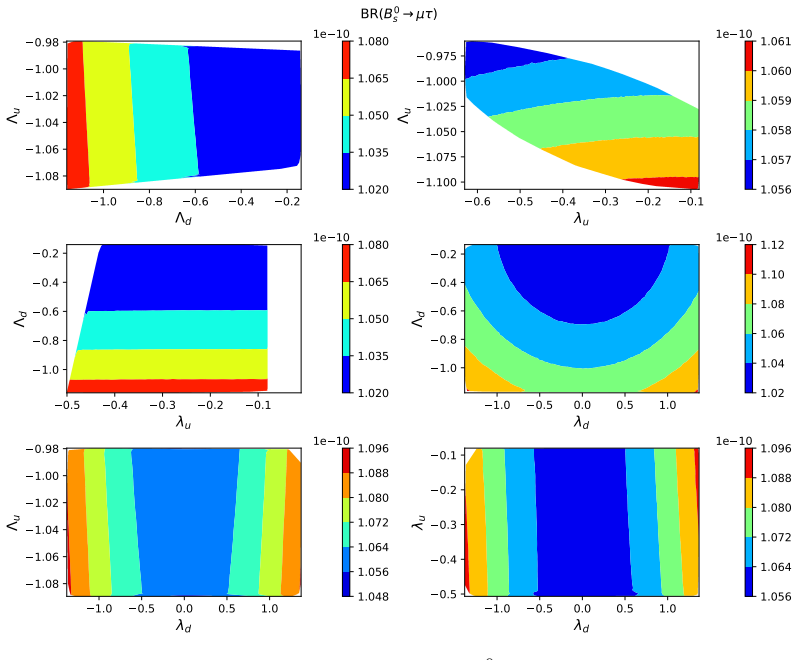
Taking into account the constraints imposed by experimental data on the parameter space, the branching ratio of B^0_d → μτ is predicted to be four orders of magnitude below the future experimental sensitivity in the minimal R-symmetric supersymmetric standard model. The prediction is strongly affected by tan beta and the off-diagonal entries in the slepton and squark mass matrices, which are constrained by radiative two-body decays of leptons and low-energy B observables.
What carries the argument
Off-diagonal entries in the slepton and squark mass matrices, constrained by limits on radiative lepton decays and low-energy B observables, which set the size of lepton flavor violating contributions to rare B decays.
If this is right
- Branching ratios rise with larger tan beta yet stay bounded by the same constraints.
- The B_d^0 → μτ mode remains unobservable with current and near-future sensitivities.
- Other lepton flavor violating modes may lie closer to experimental reach.
- The numerical results remain stable once the mass-matrix entries are fixed by data.
Where Pith is reading between the lines
- Non-observation of these decays at projected sensitivities would be expected under the model rather than excluding it.
- The same constraint procedure could be applied to predict rates for additional rare processes in the MRSSM.
- An order-of-magnitude improvement in experimental sensitivity would begin to probe the parameter space.
Load-bearing premise
The off-diagonal entries in the slepton and squark mass matrices are sufficiently constrained by existing limits on radiative lepton decays and low-energy B observables to yield reliable numerical predictions for the branching ratios.
What would settle it
An experimental measurement finding the B^0_d → μτ branching ratio at a level four orders of magnitude larger than the predicted value or within the sensitivity of next-generation detectors.
Figures



read the original abstract
Taking into account the constraints imposed by experimental data on the parameter space, we analyze the lepton flavor violating decays of B meson in the scenario of the minimal R-symmetric supersymmetric standard model. The prediction of the branching ratios is strongly affected by $\tan\beta$ and the off-diagonal entries in the slepton and squark mass matrices. The off-diagonal entries in the slepton mass matrix are constrained by the experimental limits of radiative two body decays of leptons. The off-diagonal entries in the squark mass matrix are constrained by the experimental limits of low energy observables related to B meson physics. The branching ratio of $B^0_d\rightarrow \mu \tau$ is predicted to be four orders of magnitude below the future experimental sensitivity and the decay $B^0_d\rightarrow \mu \tau$ has a higher chance of being observed in the future.
Editorial analysis
A structured set of objections, weighed in public.
Referee Report
Summary. The paper examines lepton flavor violating B-meson decays in the Minimal R-symmetric Supersymmetric Standard Model (MRSSM). After imposing experimental constraints on tan β and the off-diagonal entries of the slepton and squark mass matrices (from l → l'γ limits and low-energy B observables, respectively), it computes branching ratios and concludes that BR(B_d^0 → μτ) lies four orders of magnitude below future experimental sensitivity while another mode may be accessible.
Significance. If the numerical results are robust, the work supplies concrete, model-specific predictions for LFV B decays under the MRSSM flavor structure, illustrating how R-symmetry and existing bounds combine to produce strong suppression. This could help prioritize experimental channels at Belle II or LHCb upgrades. The significance is reduced, however, because the quoted suppression is largely inherited from the input constraints rather than arising as an independent output of the model.
major comments (2)
- [Numerical results / branching-ratio predictions] The central claim that BR(B_d^0 → μτ) is four orders of magnitude below sensitivity is load-bearing and requires explicit verification that the maximum allowed values of the relevant off-diagonal entries (primarily δ^l_23 and δ^d_13) still produce this suppression after all cited constraints are applied simultaneously. No scan results, allowed ranges, or upper-bound calculation for the branching ratio under the full set of limits are provided in the numerical section.
- [Parameter constraints and numerical analysis] The prediction is stated to be 'strongly affected by tan β and the off-diagonal entries,' yet the manuscript does not demonstrate that the experimental bounds on these same parameters leave a non-empty region in which the four-order suppression is guaranteed; if the allowed intervals still permit larger mixings that raise the branching ratio closer to sensitivity, the claim does not hold.
minor comments (2)
- [Abstract] The abstract contains an apparent typographical repetition: both the suppression statement and the 'higher chance of being observed' clause refer to the identical decay B_d^0 → μτ.
- [Model setup] Notation for the flavor-violating parameters (e.g., δ^l_23, δ^d_13) should be defined at first use and consistently related to the mass-insertion parameters appearing in the loop functions.
Simulated Author's Rebuttal
We thank the referee for the careful reading of our manuscript and the constructive comments. We address the two major points below and have revised the manuscript to strengthen the numerical presentation of the constraints and branching-ratio results.
read point-by-point responses
-
Referee: [Numerical results / branching-ratio predictions] The central claim that BR(B_d^0 → μτ) is four orders of magnitude below sensitivity is load-bearing and requires explicit verification that the maximum allowed values of the relevant off-diagonal entries (primarily δ^l_23 and δ^d_13) still produce this suppression after all cited constraints are applied simultaneously. No scan results, allowed ranges, or upper-bound calculation for the branching ratio under the full set of limits are provided in the numerical section.
Authors: We agree that an explicit demonstration of the upper bound on the branching ratio under the simultaneous application of all constraints would strengthen the central claim. In the revised manuscript we have added a dedicated subsection in the numerical analysis that performs a scan over the off-diagonal entries δ^l_23 and δ^d_13 (and the relevant tan β range) within the intervals permitted by the l → l'γ limits and the B-physics observables. The results confirm that the maximum values still yield BR(B_d^0 → μτ) four orders of magnitude below the projected Belle II sensitivity; a new table and figure summarize the allowed ranges and the corresponding branching ratios. revision: yes
-
Referee: [Parameter constraints and numerical analysis] The prediction is stated to be 'strongly affected by tan β and the off-diagonal entries,' yet the manuscript does not demonstrate that the experimental bounds on these same parameters leave a non-empty region in which the four-order suppression is guaranteed; if the allowed intervals still permit larger mixings that raise the branching ratio closer to sensitivity, the claim does not hold.
Authors: The experimental bounds do leave a non-empty region, and the four-order suppression holds throughout that region. In the revision we have added an explicit statement and a brief scan summary showing that the upper limits on the off-diagonal entries (set by the cited observables) cannot be increased further without violating the input constraints; within the surviving parameter space the R-symmetric structure of the MRSSM together with these bounds keeps the branching ratio suppressed by the reported amount. We have also clarified the text to emphasize that the suppression is a direct consequence of applying the experimental limits to the MRSSM flavor parameters. revision: yes
Circularity Check
No circularity: branching-ratio predictions use independent experimental constraints on flavor-violating parameters
full rationale
The paper constrains off-diagonal slepton and squark mass-matrix entries from limits on l→l'γ decays and other low-energy B observables, then computes BR(B_d^0→μτ) within the resulting allowed ranges. This is a standard parameter-space scan using distinct observables as inputs; the target decay is not among the constraining data, so the four-order suppression is an output rather than a definitional identity or fitted input renamed as prediction. No self-citations, uniqueness theorems, or ansatz smuggling appear in the abstract or derivation description.
Axiom & Free-Parameter Ledger
free parameters (3)
- tan beta
- off-diagonal slepton mass-matrix entries
- off-diagonal squark mass-matrix entries
axioms (2)
- domain assumption The minimal R-symmetric supersymmetric standard model is the correct effective theory below the SUSY-breaking scale.
- domain assumption Experimental upper limits on lepton radiative decays and B observables can be mapped one-to-one onto upper limits on the off-diagonal mass-matrix entries.
Reference graph
Works this paper leans on
-
[1]
Navas et al., Phys
S. Navas et al., Phys. Rev. D 110, 030001 (2024)
2024
-
[2]
S. M. Bilenky, S. T. Petcov, and B. Pontecorvo, Phys. Lett. B 67, 309 (1977). 15
1977
-
[3]
Esteban, M
I. Esteban, M. C. Gonzalez-Garcia, A. Hernandez-Cabezudo, M. Maltoni, and T. Schwetz, JHEP 01, 106 (2019)
2019
-
[4]
Calibbi and G
L. Calibbi and G. Signorelli, Riv.Nuovo Cim. 41, 71 (2018)
2018
-
[5]
Lindner, M
M. Lindner, M. Platscher, and F. S. Queiroz, Phys. Rept. 731, 1 (2018)
2018
-
[6]
Ardu and G
M. Ardu and G. Pezzullo, Universe 8, 299 (2022)
2022
- [7]
-
[8]
Altmannshofer et al., PTEP 2019 (2019) 123C01
W. Altmannshofer et al., PTEP 2019 (2019) 123C01. [Erratum: PTEP 2020, 029201 (2020)]
2019
-
[9]
R. A. Diaz, R. Martinez, and C. E. Sandoval, Eur. Phys. J. C 46, 403 (2006)
2006
-
[10]
Dedes, J
A. Dedes, J. Ellis, and M. Raidal, Phys. Lett. B 549, 159 (2002)
2002
-
[11]
Dedes, J
A. Dedes, J. Rosiek, and P. Tanedo, Phys. Rev. D 79, 055006 (2009)
2009
-
[12]
Y.-T. Wang, J. Ma, X.-Y. Han, X.-X. Long, T.-T. Wang, H.-B. Zhang, and S.-M. Zhao, J. Phys. G: Nucl. Part. Phys. 51, 125004 (2024)
2024
-
[13]
Crivellin et al., Phys
A. Crivellin et al., Phys. Rev. D 92, 054013 (2015)
2015
-
[14]
Ilakovac, Phys
A. Ilakovac, Phys. Rev. D 62, 036010 (2000)
2000
-
[15]
de Medeiros Varzielas and G
I. de Medeiros Varzielas and G. Hiller, JHEP 06, 072 (2015)
2015
-
[16]
Smirnov, Mod
A.D. Smirnov, Mod. Phys. Lett. A 33, 1850019 (2018)
2018
-
[17]
Povarov, Phys
A.V. Povarov, Phys. Part. Nucl. Lett. 16, 1 (2019)
2019
-
[18]
Martynov and A.D
M.V. Martynov and A.D. Smirnov, Mod. Phys. Lett. A 36, 2150018 (2021)
2021
-
[19]
J. C. Pati and A. Salam, Phys. Rev. D 10, 275 (1974); Phys.Rev.D 11, 703 (1975) (erratum)
1974
-
[20]
Sun and X.-Y
K.-S. Sun and X.-Y. Yang, Mod. Phys. Lett. A 33, 1850214 (2018)
2018
-
[21]
Dreiner, K
H. Dreiner, K. Nickel, W. Porod, and F. Staub, Comput. Phys. Commun. 184, 2604 (2013)
2013
-
[22]
G. D. Kribs, E. Poppitz and N. Weiner, Phys. Rev. D 78, 055010 (2008)
2008
-
[23]
Fayet, Nucl
P. Fayet, Nucl. Phys. B 90, 104 (1975)
1975
-
[24]
Salam, J
A. Salam, J. Strathdee, Nucl. Phys. B 87, 85 (1975)
1975
-
[25]
Diessner, J
P. Diessner, J. Kalinowski, W. Kotlarski, and D. Stöckinger, Adv. High Energy Phys. 2015, 760729 (2015)
2015
-
[26]
Diessner, J
P. Diessner, J. Kalinowski, W. Kotlarski, and D. Stöckinger, JHEP 12, 124 (2014)
2014
-
[27]
Diessner, W
P. Diessner, W. Kotlarski, S. Liebschner, D. Stöckinger, JHEP 1710, 142 (2017)
2017
-
[28]
Diessner, J
P. Diessner, J. Kalinowski, W. Kotlarski, D. Stöckinger, JHEP1603, 007 (2016)
2016
-
[29]
Diessner and G
P. Diessner and G. Weiglein, JHEP 07, 011 (2019)
2019
-
[30]
Kumar, D
A. Kumar, D. Tucker-Smith, N. Weiner, JHEP 1009, 111 (2010). 16
2010
-
[31]
A. E. Blechman, Mod. Phys. Lett. A 24, 633 (2009)
2009
-
[32]
G. D. Kribs, A. Martin, T. S. Roy, JHEP 0906, 042 (2009)
2009
-
[33]
Frugiuele, T
C. Frugiuele, T. Gregoire, Phys. Rev. D 85, 015016 (2012)
2012
-
[34]
Kalinowski, Acta Phys
J. Kalinowski, Acta Phys. Polon. B 47, 203 (2016)
2016
-
[35]
Chakraborty, A
S. Chakraborty, A. Chakraborty, S. Raychaudhuri, Phys. Rev. D 94, 035014 (2016)
2016
-
[36]
Braathen, M
J. Braathen, M. D. Goodsell, P. Slavich, JHEP 1609, 045 (2016)
2016
-
[37]
Athron, J.-hyeon Park, T
P. Athron, J.-hyeon Park, T. Steudtner, D. Stöckinger, A. Voigt, JHEP 1701, 079 (2017)
2017
-
[38]
Alvarado, A
C. Alvarado, A. Delgado, A. Martin, Phys. Rev. D 97, 115044 (2018)
2018
-
[39]
Kalinowski and W
J. Kalinowski and W. Kotlarski, JHEP 07, 037(2024)
2024
-
[40]
Sun, Z.-C
K.-S. Sun, Z.-C. Wang, X.-Y. Yang, T.-J. Gao, and H.-B. Zhang, Mod. Phys. Lett. A 39, 2450058 (2024)
2024
-
[41]
Sun, W.-H
K.-S. Sun, W.-H. Zhang, J.-B. Chen, H.-B. Zhang, and Q. Yan, Chin. Phys. C 47, 073106 (2023)
2023
-
[42]
K.-S. Sun, T. Guo, W. Li, X.-Y. Yang, and S.-M. Zhao, Eur. Phys. J. C 80, 1167 (2020)
2020
-
[43]
Sun, S.-K
K.-S. Sun, S.-K. Cui, W. Li, and H.-B. Zhang, Phys. Rev. D 102, 035029 (2020)
2020
-
[44]
R. H. Bernstein and P. S. Cooper, Phys. Rept. 532, 27 (2013)
2013
-
[45]
Bordone, C
M. Bordone, C. Cornella, J. Fuentes-Martin, and G. Isidori, JHEP, 10, 148 (2018)
2018
-
[46]
M. D. Goodsell and A. Joury, Comput. Phys. Commun. 297, 109057 (2023)
2023
-
[47]
H. Bahl, T. Biekötter, S. Heinemeyer, C. Li, S. Paasch, G. Weiglein, and J. Wittbrodt, Comput. Phys. Commun. 291, 108803 (2023)
2023
-
[48]
Feroz and M
F. Feroz and M. P. Hobson, Mon. Not. Roy. Astron. Soc. 384, 449 (2008)
2008
-
[49]
Feroz, M
F. Feroz, M. P. Hobson, and M. Bridges, Mon. Not. Roy. Astron. Soc. 398, 1601 (2009)
2009
- [50]
-
[51]
Staub, Comput
F. Staub, Comput. Phys. Commun. 184, 1792 (2013)
2013
-
[52]
Staub, Comput
F. Staub, Comput. Phys. Commun. 185, 1773 (2014)
2014
-
[53]
Porod, Comput
W. Porod, Comput. Phys. Commun. 153, 275 (2003)
2003
-
[54]
Porod and F
W. Porod and F. Staub, Comput. Phys. Commun. 183, 2458 (2012)
2012
-
[55]
Porod, F
W. Porod, F. Staub, and A. Vicente, Eur. Phys. J. C 74, 2992 (2014)
2014
-
[56]
Staub, Adv
F. Staub, Adv. High Energy Phys. 2015, 840780 (2015)
2015
-
[57]
Gabbiani, E
F. Gabbiani, E. Gabrielli, A. Masiero and L. Silvestrini, Nucl. Phys. B 477, 321 (1996)
1996
-
[58]
Misiak, S
M. Misiak, S. Pokorski and J. Rosiek, Adv. Ser. Direct. High Energy Phys. 15, 795 (1998). 17
1998
-
[59]
M. E. Peskin and T. Takeuchi, Phys. Rev. Lett. 65, 964 (1990)
1990
-
[60]
M. E. Peskin and T. Takeuchi, Phys. Rev. D 46, 381 (1992)
1992
-
[61]
Foreman-Mackey,The Journal of Open Source Software 1, 24 (2016)
D. Foreman-Mackey,The Journal of Open Source Software 1, 24 (2016). 18
2016
discussion (0)
Sign in with ORCID, Apple, or X to comment. Anyone can read and Pith papers without signing in.