Recognition: 2 theorem links
· Lean TheoremTowards Testable Type-III Leptogenesis in Non-Standard Early Universe Scenarios
Pith reviewed 2026-05-10 20:09 UTC · model grok-4.3
The pith
Triplet leptogenesis succeeds with few-TeV fermions when the early universe expands faster than radiation or follows scalar-tensor gravity.
A machine-rendered reading of the paper's core claim, the machinery that carries it, and where it could break.
Core claim
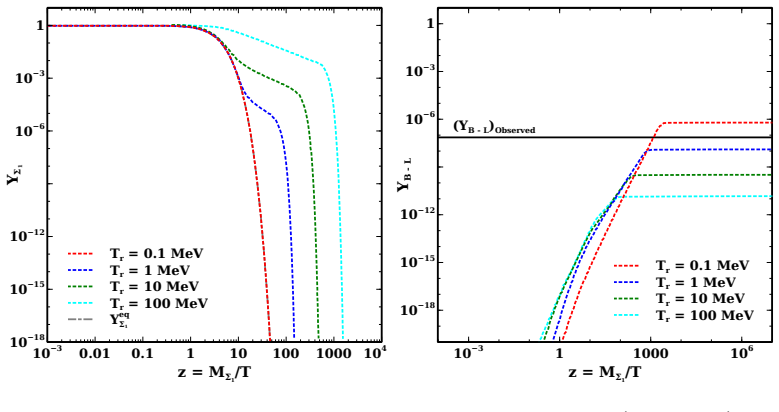
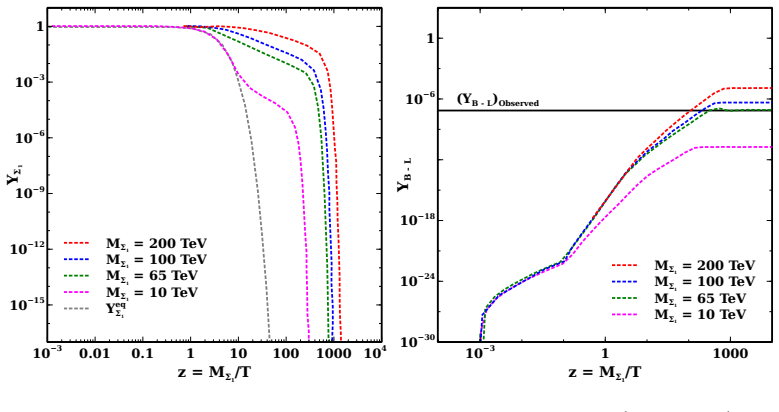
Successful generation of the observed baryon asymmetry is possible through the decay of triplet fermions as light as a few TeV in a fast-expanding universe and a few hundred TeV in scalar-tensor gravity, because the altered Hubble rate reduces the efficiency of washout processes.
What carries the argument
The Boltzmann equations for the triplet fermion number density and lepton asymmetry, solved with a non-standard Hubble expansion rate H(T) that is larger than the radiation-dominated value at early times.
If this is right
- Type-III leptogenesis moves into the mass range accessible to current and near-future collider searches.
- The same non-standard expansion histories can be applied to other high-scale baryogenesis mechanisms to lower their required energy scales.
- Neutrino-sector constraints on the triplet fermion remain unchanged while the leptogenesis window widens.
- The lower mass range allows the triplet to contribute to dark matter or other late-time observables if additional couplings are present.
Where Pith is reading between the lines
- If a few-TeV triplet is found, its decay products or relic abundance could serve as a diagnostic for whether the early universe was radiation-dominated.
- The mechanism could be combined with type-I leptogenesis to explore hybrid scenarios under the same modified cosmologies.
- Future precision cosmology measurements that tighten bounds on pre-BBN expansion would directly constrain the viable parameter space shown here.
Load-bearing premise
The non-standard expansion rate must persist down to temperatures above the triplet mass scale without conflicting with big-bang nucleosynthesis or other early-universe observations.
What would settle it
A collider discovery of a triplet fermion with mass of a few TeV that fails to produce the observed asymmetry when its Boltzmann equations are solved under standard radiation domination, but succeeds when solved with the faster expansion rate assumed in the paper.
Figures




read the original abstract
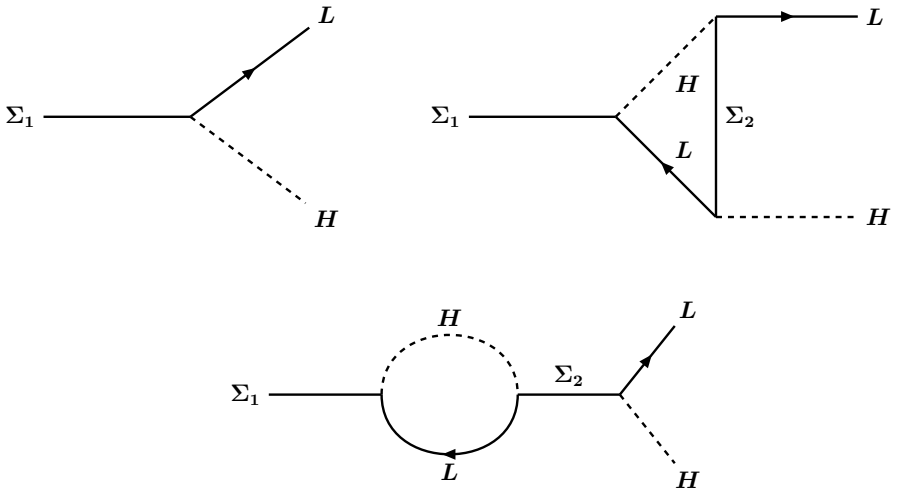
Leptogenesis is an elegant way to explain the baryon asymmetry of the Universe in connection to the neutrino mass and mixing. Although leptogenesis from the decay of a heavy Majorana neutrino has been the minimal set up, it is also motivating to look for leptogenesis from the decay of triplet fermion as it can have detectable signatures in the experiments. However, due to strong gauge annihilations and constraints from neutrino sector, the triplet fermions have to be as heavy as $10^{10}$ GeV or more to generate the observed baryon asymmetry. While this prediction is based on the standard radiation dominated history of the early Universe, it is also possible to have a non-standard expansion history of the Universe prior to the big-bang nucleosynthesis. In this work we study triplet leptogenesis in two non-standard cosmological scenarios, where the Universe expands faster than radiation and a scalar tensor theory of gravity. We show that it is possible to have successful leptogenesis with a few TeV triplet fermion for fast expanding Universe and a few hundered TeV for a scalar tensor gravity theory.
Editorial analysis
A structured set of objections, weighed in public.
Referee Report
Summary. The manuscript studies type-III leptogenesis via the out-of-equilibrium decay of SU(2)_L triplet fermions in two non-standard pre-BBN cosmologies: a fast-expanding universe (with Hubble rate H(T) > H_rad(T)) and scalar-tensor gravity. It adapts the standard Boltzmann equations for the triplet number density and lepton asymmetry, keeping the CP asymmetry and washout rates unchanged, and reports that the observed baryon asymmetry can be generated for triplet masses of a few TeV in the fast-expansion case and a few hundred TeV in the scalar-tensor case, relaxing the canonical ~10^10 GeV lower bound imposed by gauge annihilations and neutrino-mass constraints.
Significance. If the numerical solutions are accurate, the result is significant because it renders type-III leptogenesis potentially accessible at the LHC or future colliders, where TeV-scale triplets could be produced and their decays (including same-sign dileptons) observed, thereby linking neutrino data, baryogenesis, and early-universe expansion history in a falsifiable manner. The work provides a concrete, parameter-controlled demonstration that modified Hubble rates alone can suppress the required mass scale without altering the particle-physics sector.
major comments (2)
- [§3] §3 (Boltzmann equations): the implementation of the modified Hubble rate H(T) must be shown explicitly for both scenarios, including the precise functional form used for the fast-expansion case and the effective gravitational coupling in the scalar-tensor model, together with the resulting numerical evolution of Y_ΔL and Y_B; without these, it is impossible to verify that the reported mass reductions follow directly from the altered expansion rather than from adjusted Yukawa couplings.
- [§4] §4 (numerical results): the paper must demonstrate that the chosen expansion parameters (e.g., the power-law index or scalar-tensor coupling strength) are compatible with all pre-BBN constraints (BBN, CMB, and late-time cosmology) while still producing the observed Y_B for Yukawas consistent with neutrino oscillation data; otherwise the central claim that the mass bound is relaxed remains conditional on untested cosmological assumptions.
minor comments (3)
- [Abstract] Abstract: 'hundered' is a typographical error and should be corrected to 'hundred'.
- [Figures] Figure captions and axis labels should explicitly state the value of the non-standard expansion parameter used in each curve so that the reader can reproduce the mass-reduction factor.
- [§4] A brief comparison table of the effective washout factor and final asymmetry for standard vs. non-standard H(T) at the same triplet mass would improve clarity.
Simulated Author's Rebuttal
We thank the referee for the careful reading of our manuscript and the constructive comments. We address each major point below and will revise the manuscript to incorporate the requested clarifications and demonstrations.
read point-by-point responses
-
Referee: [§3] §3 (Boltzmann equations): the implementation of the modified Hubble rate H(T) must be shown explicitly for both scenarios, including the precise functional form used for the fast-expansion case and the effective gravitational coupling in the scalar-tensor model, together with the resulting numerical evolution of Y_ΔL and Y_B; without these, it is impossible to verify that the reported mass reductions follow directly from the altered expansion rather than from adjusted Yukawa couplings.
Authors: We agree that the explicit forms and evolution plots are needed for full verifiability. The current text adapts the Boltzmann equations with the modified H(T) but does not display the functional forms or the time evolution of the yields. In the revised manuscript we will add the precise expressions for H(T) in both scenarios (fast-expansion power-law modification and scalar-tensor effective coupling) together with new figures showing the numerical evolution of Y_Δ and Y_ΔL (hence Y_B) versus temperature for the benchmark points. These additions will confirm that the Yukawa couplings remain fixed to values consistent with neutrino oscillation data and that the lower mass scales arise solely from the altered expansion history. revision: yes
-
Referee: [§4] §4 (numerical results): the paper must demonstrate that the chosen expansion parameters (e.g., the power-law index or scalar-tensor coupling strength) are compatible with all pre-BBN constraints (BBN, CMB, and late-time cosmology) while still producing the observed Y_B for Yukawas consistent with neutrino oscillation data; otherwise the central claim that the mass bound is relaxed remains conditional on untested cosmological assumptions.
Authors: We acknowledge that an explicit compatibility discussion was insufficient in the original version. In the revision we will add a dedicated paragraph (or short subsection) in §4 that (i) states the temperature range over which the non-standard expansion operates, (ii) verifies that the chosen power-law indices and scalar-tensor couplings recover standard radiation domination and general relativity well above the BBN temperature (~1 MeV), and (iii) confirms that the Yukawa couplings used are those required by neutrino oscillation data while still yielding the observed baryon asymmetry. This will remove the conditional character of the claim. revision: yes
Circularity Check
No significant circularity in derivation chain
full rationale
The paper's central result follows from solving the standard Boltzmann equations for triplet abundance and lepton asymmetry, but with a modified Hubble rate H(T) taken from the assumed non-standard cosmology (faster expansion or scalar-tensor). The CP asymmetry parameter, decay widths, and washout rates are computed from the type-III seesaw Lagrangian and neutrino oscillation data, which are independent inputs. The observed baryon asymmetry is used only as a target value to be matched, not as a definition or fitted parameter that forces the outcome. No self-citation is invoked to justify the core equations or to declare uniqueness, and the adaptation of existing leptogenesis formulas to new H(T) does not reduce the final asymmetry to a tautology by construction.
Axiom & Free-Parameter Ledger
Lean theorems connected to this paper
-
IndisputableMonolith/Foundation/RealityFromDistinction.leanreality_from_one_distinction unclear?
unclearRelation between the paper passage and the cited Recognition theorem.
We show that it is possible to have successful leptogenesis with a few TeV triplet fermion for fast expanding Universe and a few hundred TeV for a scalar tensor gravity theory.
What do these tags mean?
- matches
- The paper's claim is directly supported by a theorem in the formal canon.
- supports
- The theorem supports part of the paper's argument, but the paper may add assumptions or extra steps.
- extends
- The paper goes beyond the formal theorem; the theorem is a base layer rather than the whole result.
- uses
- The paper appears to rely on the theorem as machinery.
- contradicts
- The paper's claim conflicts with a theorem or certificate in the canon.
- unclear
- Pith found a possible connection, but the passage is too broad, indirect, or ambiguous to say the theorem truly supports the claim.
Reference graph
Works this paper leans on
-
[1]
A. D. Sakharov,Violation of CP Invariance, C asymmetry, and baryon asymmetry of the universe, Pisma Zh. Eksp. Teor. Fiz.5(1967) 32–35
1967
-
[2]
Fukugita and T
M. Fukugita and T. Yanagida,Baryogenesis Without Grand Unification, Phys. Lett. B 174(1986) 45–47
1986
-
[3]
Minkowski,µ→eγat a Rate of One Out of10 9 Muon Decays?, Phys
P. Minkowski,µ→eγat a Rate of One Out of10 9 Muon Decays?, Phys. Lett. B67 (1977) 421–428
1977
-
[4]
R. N. Mohapatra and G. Senjanovic,Neutrino Masses and Mixings in Gauge Models with Spontaneous Parity Violation, Phys. Rev. D23(1981) 165
1981
-
[5]
V. A. Kuzmin, V. A. Rubakov, and M. E. Shaposhnikov,On the Anomalous Electroweak Baryon Number Nonconservation in the Early Universe, Phys. Lett. B 155(1985) 36
1985
-
[6]
Yanagida,Horizontal Symmetry and Masses of Neutrinos, Prog
T. Yanagida,Horizontal Symmetry and Masses of Neutrinos, Prog. Theor. Phys.64 (1980) 1103
1980
-
[7]
Davidson and A
S. Davidson and A. Ibarra,A lower bound on the right-handed neutrino mass from leptogenesis, Physics Letters B535(May, 2002) 25–32
2002
-
[8]
R. Foot, H. Lew, X. G. He, and G. C. Joshi,Seesaw Neutrino Masses Induced by a Triplet of Leptons, Z. Phys. C44(1989) 441
1989
- [9]
-
[10]
Hambye, Leptogenesis: beyond the minimal type-I seesaw scenario, New J
T. Hambye,Leptogenesis: beyond the minimal type I seesaw scenario, New J. Phys.14 (2012) 125014, [arXiv:1212.2888]
-
[11]
D. Vatsyayan and S. Goswami,Lowering the scale of fermion triplet leptogenesis with two Higgs doublets, Phys. Rev. D107(2023), no. 3 035014, [arXiv:2208.12011]
- [12]
-
[13]
D. Mahanta and D. Borah,TeV Scale Leptogenesis with Dark Matter in Non-standard Cosmology, JCAP04(2020), no. 04 032, [arXiv:1912.09726]
- [14]
-
[15]
A. Di Marco, A. D. Banik, A. Ghoshal, and G. Pradisi,Minimal leptogenesis in brane-inspired cosmology, Phys. Rev. D107(2023), no. 10 103509, [arXiv:2211.11361]
-
[16]
S. Jyoti Das, D. Mahanta, and D. Borah,Low scale leptogenesis and dark matter in the presence of primordial black holes, JCAP11(2021) 019, [arXiv:2104.14496]
-
[17]
Z.-F. Chang, Z.-X. Chen, J.-S. Xu, and Z.-L. Han,FIMP Dark Matter from Leptogenesis in Fast Expanding Universe, JCAP06(2021) 006, [arXiv:2104.02364]
-
[18]
M. Chakraborty and S. Roy,Baryon asymmetry and lower bound on right handed neutrino mass in fast expanding Universe: an analytical approach, JCAP11(2022) 053, [arXiv:2208.04046]
-
[19]
Verifiable radiative seesaw mechanism of neutrino mass and dark matter,
E. Ma,Verifiable radiative seesaw mechanism of neutrino mass and dark matter, Phys. Rev. D73(2006) 077301, [hep-ph/0601225]
-
[20]
D. Mahanta and D. Borah,WIMPy leptogenesis in non-standard cosmologies, JCAP 03(2023) 049, [arXiv:2208.11295]
-
[21]
Pathways to naturally small neutrino masses,
E. Ma,Pathways to naturally small neutrino masses, Phys. Rev. Lett.81(1998) 1171–1174, [hep-ph/9805219]
-
[22]
J. A. Casas and A. Ibarra,Oscillating neutrinos andµ→e, γ, Nucl. Phys. B618 (2001) 171–204, [hep-ph/0103065]
work page Pith review arXiv 2001
-
[23]
A lower bound on the right-handed neutrino mass from leptogenesis
S. Davidson and A. Ibarra,A Lower bound on the right-handed neutrino mass from leptogenesis, Phys. Lett. B535(2002) 25–32, [hep-ph/0202239]
work page Pith review arXiv 2002
- [24]
-
[25]
Baldes,Leptogenesis with perturbations in type-II and type-III seesaw models, Eur
I. Baldes,Leptogenesis with perturbations in type-II and type-III seesaw models, Eur. Phys. J. C85(2025), no. 5 535, [arXiv:2503.02936]. [27]ATLASCollaboration, G. Aad et al.,Search for type-III seesaw heavy leptons in dilepton final states inppcollisions at √s= 13 TeV with the ATLAS detector, Eur. Phys. J. C81(2021), no. 3 218, [arXiv:2008.07949]. [28]CM...
- [26]
- [27]
- [28]
-
[29]
S. Goswami, V. K. N., A. Mukherjee, and N. Narendra,Leptogenesis and eV scale sterile neutrino, Phys. Rev. D105(2022), no. 9 095040, [arXiv:2111.14719]
-
[30]
S. Bhattacharya, D. Mahanta, N. Mondal, and D. Pradhan,Two-component dark matter and low scale thermal Leptogenesis, JCAP09(2025) 032, [arXiv:2412.21202]
- [31]
-
[32]
A. Pilaftsis and T. E. J. Underwood,Resonant leptogenesis, Nucl. Phys. B692(2004) 303–345, [hep-ph/0309342]
work page Pith review arXiv 2004
-
[33]
Fierz,On the physical interpretation of P.Jordan’s extended theory of gravitation, Helv
M. Fierz,On the physical interpretation of P.Jordan’s extended theory of gravitation, Helv. Phys. Acta29(1956) 128–134
1956
-
[34]
Brans and R
C. Brans and R. H. Dicke,Mach’s principle and a relativistic theory of gravitation, Phys. Rev.124(1961) 925–935
1961
-
[35]
F. D’Eramo, N. Fernandez, and S. Profumo,When the Universe Expands Too Fast: Relentless Dark Matter, JCAP05(2017) 012, [arXiv:1703.04793]
- [36]
-
[37]
R. R. Caldwell, R. Dave, and P. J. Steinhardt,Cosmological imprint of an energy component with general equation of state, Phys. Rev. Lett.80(1998) 1582–1585, [astro-ph/9708069]
work page Pith review arXiv 1998
-
[38]
The Case for a Positive Cosmological Lambda-term
V. Sahni and A. A. Starobinsky,The Case for a positive cosmological Lambda term, Int. J. Mod. Phys. D9(2000) 373–444, [astro-ph/9904398]
work page Pith review arXiv 2000
-
[39]
Ratra and P
B. Ratra and P. J. E. Peebles,Cosmological Consequences of a Rolling Homogeneous Scalar Field, Phys. Rev. D37(1988) 3406
1988
-
[40]
Cosmology and the Fate of Dilatation Symmetry
C. Wetterich,Cosmology and the Fate of Dilatation Symmetry, Nucl. Phys. B302 (1988) 668–696, [arXiv:1711.03844]
work page Pith review arXiv 1988
-
[41]
The Ekpyrotic Universe: Colliding Branes and the Origin of the Hot Big Bang
J. Khoury, B. A. Ovrut, P. J. Steinhardt, and N. Turok,The Ekpyrotic universe: Colliding branes and the origin of the hot big bang, Phys. Rev. D64(2001) 123522, [hep-th/0103239]
work page Pith review arXiv 2001
-
[42]
Choi,String or M theory axion as a quintessence, Phys
K. Choi,String or M theory axion as a quintessence, Phys. Rev. D62(2000) 043509, [hep-ph/9902292]
-
[43]
F. D’Eramo, N. Fernandez, and S. Profumo,Dark Matter Freeze-in Production in Fast-Expanding Universes, JCAP02(2018) 046, [arXiv:1712.07453]. 23
- [44]
- [45]
- [46]
- [47]
- [48]
- [49]
discussion (0)
Sign in with ORCID, Apple, or X to comment. Anyone can read and Pith papers without signing in.