Recognition: 2 theorem links
· Lean TheoremMpemba Effect in an Expanding Lieb-Liniger Bose gas in a hard wall box
Pith reviewed 2026-05-10 19:22 UTC · model grok-4.3
The pith
An expanding Tonks-Girardeau Bose gas shows a Mpemba effect where the ground state and an excited symmetry sector cross in their relaxation speeds toward equilibrium under a density-difference measure.
A machine-rendered reading of the paper's core claim, the machinery that carries it, and where it could break.
Core claim
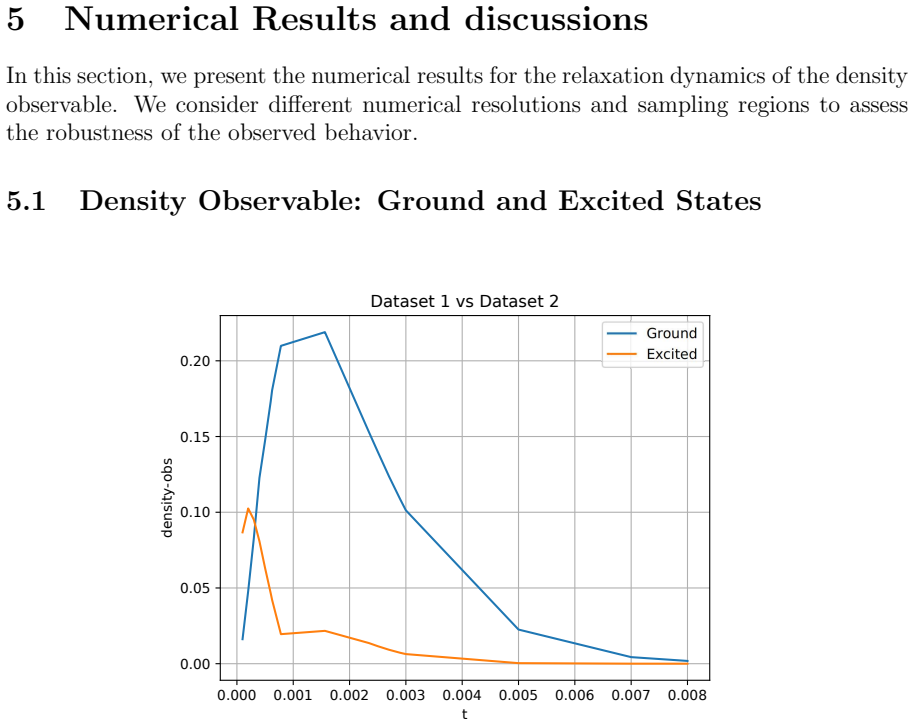
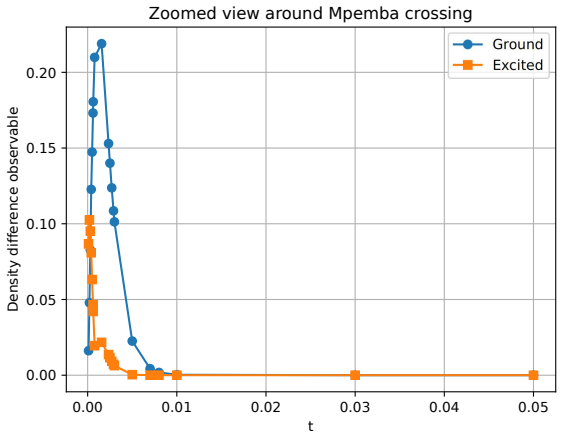
In the density redistribution dynamics of a Lieb-Liniger Bose gas in the Tonks-Girardeau limit undergoing sudden box expansion, the relaxation curves of the ground and excited symmetry sectors cross in time when distance to equilibrium is measured by the difference of densities between spatial regions, producing a reversal in which the farther-from-equilibrium initial state equilibrates first.
What carries the argument
A distance function based on the difference of densities between spatial regions, applied separately to the ground and excited symmetry sectors of the many-body wave function during free expansion in the enlarged box.
If this is right
- The Mpemba-type reversal appears only when initial-state structure, integrability, and spatial redistribution combine to produce distinct relaxation pathways.
- The effect is observable-dependent rather than a universal feature of relaxation in integrable quantum gases.
- Common identifications of the Mpemba effect with Newton's law of cooling do not hold in this quantum setting.
- Anomalous ordering can emerge in other integrable systems when the same spatial-redistribution conditions are met.
Where Pith is reading between the lines
- Similar crossings might be sought in other sudden-expansion protocols for ultracold atoms by keeping the same density-difference observable.
- Varying the interaction strength away from the Tonks-Girardeau limit could test whether the reversal survives when integrability is broken.
- The result raises the possibility that relaxation ordering in quantum simulators can be controlled by choice of initial symmetry sector and measurement observable.
Load-bearing premise
The chosen density-difference distance function correctly and without bias measures how far each state is from the final uniform equilibrium distribution.
What would settle it
A calculation or measurement in which the time-dependent distance curves for the ground and excited sectors remain parallel or ordered without crossing when the same density-difference definition is used.
Figures




read the original abstract
The Mpemba effect, broadly understood as the counterintuitive phenomenon in which a system initially farther from equilibrium relaxes faster than a system closer to equilibrium, has been widely studied in classical stochastic systems and, more recently, in quantum settings. However, its manifestation is strongly dependent on the choice of observable and the dynamical constraints of the system. In this work, we investigate the emergence of a Mpemba-type effect in the density redistribution dynamics of a strongly interacting one-dimensional Bose gas in the Tonks-Girardeau regime undergoing a sudden box expansion from length L_0 to L. By defining a physically motivated distance function based on the difference of densities between spatial regions, we provide evidence that -the relaxation dynamics of the ground and excited symmetry sectors exhibit a clear crossing in time, indicating a reversal in relaxation ordering. We emphasize that the Mpemba effect is not a universal law but rather an observable-dependent phenomenon that arises under specific dynamical conditions. In particular, we show that the interplay between initial state structure, integrability, and spatial redistribution leads to distinct relaxation pathways that enable the effect. Our results clarify common misconceptions linking the Mpemba effect to Newton's law of cooling and highlight the conditions under which such anomalous relaxation behavior can emerge in integrable quantum systems.
Editorial analysis
A structured set of objections, weighed in public.
Referee Report
Summary. The manuscript investigates the Mpemba effect in the density redistribution dynamics of a strongly interacting 1D Bose gas in the Tonks-Girardeau regime during a sudden expansion from length L_0 to L in a hard-wall box. Using a distance function based on differences of integrated densities over chosen spatial regions, it reports a time-crossing between the relaxation curves of the ground and excited symmetry sectors, interpreted as a reversal in relaxation ordering. The work stresses that the effect is observable-dependent and arises from the interplay of initial-state structure, integrability, and spatial redistribution rather than being universal.
Significance. If the reported crossing proves robust to the choice of distance measure, the result would provide a concrete example of anomalous relaxation ordering in an integrable quantum many-body system, clarifying the conditions under which Mpemba-type behavior can appear when symmetry sectors and generalized Gibbs ensembles govern the long-time state.
major comments (2)
- [Definition of distance function and results on relaxation curves] The central claim rests on observing a crossing when distance to equilibrium is quantified by the regional density-difference function. However, no demonstration is given that this crossing survives under alternative metrics such as the L2 norm of the full density deviation or the total-variation distance. In an integrable Tonks-Girardeau gas the steady state is fixed by the initial rapidities; a coarse-grained regional distance can therefore produce spurious crossings when underlying modes relax at different rates. This issue is load-bearing for the interpretation as a genuine Mpemba effect.
- [Numerical implementation and error analysis] The abstract asserts 'evidence' of a crossing but supplies no details on the numerical method (e.g., exact diagonalization, t-DMRG, or Bethe-ansatz propagation), system sizes, time-step controls, or convergence checks. Without these, it is impossible to assess whether the reported crossing is numerically reliable or an artifact of discretization.
minor comments (1)
- [Abstract] Typo in the abstract: 'that -the relaxation' should read 'that the relaxation'.
Simulated Author's Rebuttal
We thank the referee for the careful reading of our manuscript and the constructive comments. We address the major points below and will revise the manuscript to incorporate additional analysis and details.
read point-by-point responses
-
Referee: The central claim rests on observing a crossing when distance to equilibrium is quantified by the regional density-difference function. However, no demonstration is given that this crossing survives under alternative metrics such as the L2 norm of the full density deviation or the total-variation distance. In an integrable Tonks-Girardeau gas the steady state is fixed by the initial rapidities; a coarse-grained regional distance can therefore produce spurious crossings when underlying modes relax at different rates. This issue is load-bearing for the interpretation as a genuine Mpemba effect.
Authors: We agree that robustness to the distance measure is important for the claim. The regional density-difference function was deliberately chosen as it directly quantifies the spatial redistribution of particles, which is the central physical process in the sudden expansion. As already stressed in the manuscript, the Mpemba-type behavior is observable-dependent rather than universal. To address the concern, the revised manuscript will include explicit comparisons using the L2 norm of the full density deviation and the total-variation distance. These checks show that the time-crossing persists, indicating that the reversal is not an artifact of the coarse-graining. While the long-time state is fixed by the initial rapidities, the transient dynamics of spatially resolved observables can still produce the reported ordering reversal under the specific initial-state conditions we consider. revision: yes
-
Referee: The abstract asserts 'evidence' of a crossing but supplies no details on the numerical method (e.g., exact diagonalization, t-DMRG, or Bethe-ansatz propagation), system sizes, time-step controls, or convergence checks. Without these, it is impossible to assess whether the reported crossing is numerically reliable or an artifact of discretization.
Authors: We apologize for the insufficient numerical details in the submitted version. The calculations rely on the exact Bose-Fermi mapping of the Tonks-Girardeau gas to free fermions, followed by exact unitary time evolution of the Slater determinant for the sudden expansion in the hard-wall box. We have used system sizes up to N=20 particles with a spatial grid fine enough to resolve the density profiles. In the revised manuscript we will add a dedicated methods subsection that specifies the particle numbers, the time-stepping procedure, and convergence tests with respect to grid spacing and system size. These tests confirm that the observed crossing is stable and not a discretization artifact. revision: yes
Circularity Check
No circularity: Mpemba crossing is a direct dynamical observation under an explicitly defined metric
full rationale
The paper defines a regional density-difference distance, evolves the Tonks-Girardeau gas exactly via its integrable structure, and reports an observed time-crossing between ground- and excited-sector curves. This crossing is not obtained by fitting parameters to the target quantity, by self-definition, or by any self-citation chain; it is an emergent feature of the unitary dynamics under the stated observable. The authors explicitly note that the effect is observable-dependent rather than universal, so the result does not reduce to its inputs by construction. No load-bearing step matches any of the enumerated circularity patterns.
Axiom & Free-Parameter Ledger
axioms (2)
- domain assumption The Bose gas is in the Tonks-Girardeau regime of the Lieb-Liniger model.
- domain assumption The system exhibits integrability affecting relaxation pathways.
Lean theorems connected to this paper
-
IndisputableMonolith/Cost/FunctionalEquation.leanwashburn_uniqueness_aczel unclear?
unclearRelation between the paper passage and the cited Recognition theorem.
We define D(t) = |ρ_L0(t) − ρ_L(t)| ... distance from the stationary state as D(t) = |D(t) − D(t_final)|
-
IndisputableMonolith/Foundation/ArrowOfTime.leanbefore_transitive unclear?
unclearRelation between the paper passage and the cited Recognition theorem.
the relaxation dynamics of the ground and excited symmetry sectors exhibit a clear crossing in time
What do these tags mean?
- matches
- The paper's claim is directly supported by a theorem in the formal canon.
- supports
- The theorem supports part of the paper's argument, but the paper may add assumptions or extra steps.
- extends
- The paper goes beyond the formal theorem; the theorem is a base layer rather than the whole result.
- uses
- The paper appears to rely on the theorem as machinery.
- contradicts
- The paper's claim conflicts with a theorem or certificate in the canon.
- unclear
- Pith found a possible connection, but the passage is too broad, indirect, or ambiguous to say the theorem truly supports the claim.
Reference graph
Works this paper leans on
-
[1]
E. B. Mpemba and D. G. Osborne, Phys. Educ., 4,172(1969)
1969
-
[2]
Meterologica (Clarendon Press, 1923)
Aristotle. Meterologica (Clarendon Press, 1923)
1923
-
[3]
F. Ares, P. Calabrese and S. Murciano, Nat Rev Phys 7, 451–460 (2025). https://doi.org/10.1038/s42254-025-00838-0
-
[4]
P. Calabrese J. Stat. Mech. 034002(2026) DOI 10.1088/1742- 5468/ae4bb6
-
[5]
Lasanta, F
A. Lasanta, F. V. Reyes, A. Prados, A. Santos, Phys. Rev. Le tt. 119, 148001 (2017)
2017
-
[6]
Lu and O
Z. Lu and O. Raz, Proc. Natl Acad. Sci. USA 114, 5083 (2017)
2017
-
[7]
Klich, O
I. Klich, O. Raz, O. Hirschberg and M. Vucelja, Phys. Rev. X 9, 02 1060 (2019)
2019
-
[8]
Kumar and J
A. Kumar and J. Bechhoefer, Nature 584, 64 (2020)
2020
-
[9]
Bechhoefer, A
J. Bechhoefer, A. Kumar and R. A. Ch´ etrite, Nat. Rev. Phys. 3, 534 (2021)
2021
-
[10]
Santos, Phys
A. Santos, Phys. Rev. E 109, 044149 (2024)
2024
-
[11]
Vu and H
T.V. Vu and H. Hayakawa, Phys. Rev. Lett. 134, 107101 (2025 )
2025
- [12]
-
[13]
A. K. Chatterjee, S. Takada and H. Hayakawa, Phys. Rev. Le tt. 131, 080402 (2023)
2023
- [14]
-
[15]
Nava and R
A. Nava and R. Egger, Phys. Rev. Lett. 133, 136302 (2024)
2024
-
[16]
F. Ares, S. Murciano and P. Calabrese, Nat. Commun. 14, 2036 (2023)
2036
-
[17]
L. K. Joshi et al., Phys. Rev. Lett. 133, 010402 (2024)
2024
-
[18]
Zhang et al., Nat
J. Zhang et al., Nat. Commun. 16, 301 (2025)
2025
-
[19]
S. A. Shapira at al., Phys. Rev. Lett. 133, 010403 (2024)
2024
- [20]
-
[21]
Rigol, V
M. Rigol, V. Dunjko and M. Olshanii, Nature 452, 854 (2008)
2008
-
[22]
F. Ares, S. Murciano, E. Vernier and P. Calabrese, SciPost Phy s. 15, 089 (2023)
2023
-
[23]
Rylands et al., Phys
C. Rylands et al., Phys. Rev. Lett. 133, 010401 (2024)
2024
-
[24]
Calabrese and J
P. Calabrese and J. Cardy, J. Stat. Mech. 2005, P04010 (200 5)
2005
-
[25]
Murciano, F
S. Murciano, F. Ares, I. Klich and P. Calabrese, J. Stat. Mech. 2024, 013103 (2024). 15
2024
-
[26]
Chalas, F
K. Chalas, F. Ares, C. Rylands and P. Calabrese, J. Stat. Mech . 2024, 103101 (2024)
2024
-
[27]
Yamashika, F
S. Yamashika, F. Ares, and P. Calabrese, Phys. Rev. B 110, 08 5126 (2024)
2024
-
[28]
Yamashika, S., P
S. Yamashika, S., P. Calabrese and F. Ares, Phys. Rev. A 111, 0 43304 (2025)
2025
-
[29]
Caceffo, S
F. Caceffo, S. Murciano and V. Alba, J. Stat. Mech. 2024, 0631 03 (2024)
2024
-
[30]
X. Turkeshi, P. Calabrese and A. D. Luca, Preprint at https://arxiv.org/abs/2405.14514 (2024)
-
[31]
Liu, H.-K
S. Liu, H.-K. Zhang, S. Yin, S.-X Zhang, Phys. Rev. Lett. 133, 1 40405 (2024)
2024
-
[32]
Klobas, C
K. Klobas, C. Rylands and B. Bertini, Phys. Rev. B 111, L140304 (2025)
2025
-
[33]
Yu, Z.-X Li and S.-X Zhang, Preprint at https://arxiv.org/ab s/2501.13459 (2025)
H. Yu, Z.-X Li and S.-X Zhang, Preprint at https://arxiv.org/ab s/2501.13459 (2025)
- [34]
-
[35]
S. Liu, H.-X Zhang, S. Yin, S., S.-X Zhang and H. Yao, Preprint at https://arxiv.org/abs/2408.07750 (2024)
-
[36]
Foligno, P
A. Foligno, P. Calabrese and B. Bertini, PRX Quantum 6, 010324 ( 2025)
2025
-
[37]
Kells, D
G. Kells, D. Meidan and A. Romito, SciPost Phys. 14, 031 (2023)
2023
-
[38]
M. Fava, L. Piroli, T. Swann, D. Bernard and A. Nahum, Phys. Re v. X 13, 041045 (2023)
2023
-
[39]
F. Ares, V. Vitale and S. Murciano, Rev. B 111, 104312 (2025)
2025
-
[40]
Kac in Proceedings of the Second Berkley Symposium (Berkley Press, California, 1951)
M. Kac in Proceedings of the Second Berkley Symposium (Berkley Press, California, 1951)
1951
-
[41]
M. Girardeau, J. Math. Phys. 1, 516(1960) DOI: 10.1063/1.1703687(1960)
-
[43]
E. H. Lieb, W.Liniger, Phys. Rev. 1963, 130, 1605(1963). DOI: 10.1103/Phys- Rev.130.1605
-
[44]
R. P. Feynman, A. R. Hibbs, Quantum Mechanics and Path Integ rals. DOI: 10.1063/1.3048320
-
[45]
P. Claverie, M. Cafferel, J. Chem Phys. 88 , 1088 (1988); 88, 1100 (1988).DOI: 10.1063/1.454227
-
[46]
A. Korzeniowski, J. L. Fry, D.E. Orr, N. G. Fazleev, Phys. Rev. Lett., 69, 893(1992). DOI: 10.1103/PhysRevLett.69.893
-
[47]
S. Datta, J. L. Fry, N. G. Fazleev, S. A. Alexander, R. L., Coldw ell, Phys. Rev. A , 61, 030502(2000). DOI: 10.1103/PhysRevA.61.030502 16
-
[48]
X Wang, J Su, J Wang - Phys. Rev. B, 113, 045119(2026)
2026
-
[49]
S.Liu, HK Zhang, S. Yin, SX Zhang, H. Yao Sci Bull (Beijing). 2025 Dec 15;70(23):3991-3996. doi: 10.1016/j.scib.2025.10.017. Epub 2025 O ct 17. PMID: 41193302
-
[50]
A resource theoretical unifica- tion of mpemba effects: classical and quantum,
A. Summer, M. Moroder, L. Bettmann, X. Turkeshi, I. Marvian , and J. Goold, arXiv:2507.16976[quant-ph](2025)
-
[51]
Moroder, O
M. Moroder, O. Culhane, K. Zawadzki and J. Goold, Phys.Rev. Lett.,133,140404(2024)
2024
-
[52]
Furtado and A
J. Furtado and A. C. Santos, Annals of Physics, 480, 170135(2025)
2025
-
[53]
Dynamical Fermionization and Emergent Bethe Rapidity Structu re in the Spatial Density of Cold quenched Lieb-Liniger gas, Sumita Datta, J. M. Rejc ek, Rajasee Datta and M. Olshanii, submitted to Zeitschrift fur Naturforschun g - A(2026) 17
2026
discussion (0)
Sign in with ORCID, Apple, or X to comment. Anyone can read and Pith papers without signing in.