Recognition: 1 theorem link
· Lean TheoremImpact of neutron-proton pairing on the nucleon high-momentum distribution in symmetric nuclear matter
Pith reviewed 2026-05-10 19:28 UTC · model grok-4.3
The pith
Neutron-proton pairing increases the high-momentum fraction of nucleons by a maximum of about 6 percent relative to short-range correlations in symmetric nuclear matter.
A machine-rendered reading of the paper's core claim, the machinery that carries it, and where it could break.
Core claim
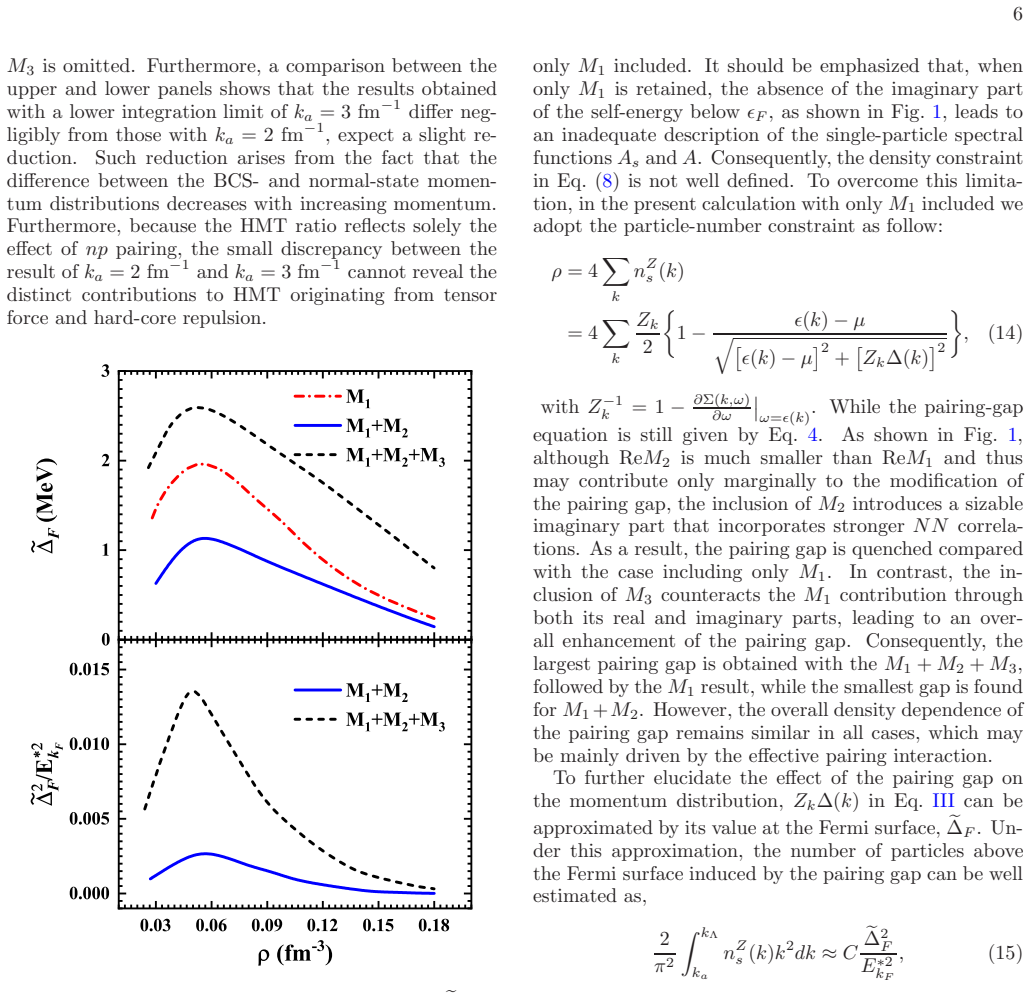
Within the extended Brueckner-Hartree-Fock approach combined with off-shell BCS theory, the HMT ratio reaches about 1.06 around the density of 0.052 fm^{-3}, indicating that the maximal contribution of the np pairing amounts to approximately 6% that from short-range correlations. This contribution exhibits a density dependence that closely follows the squared relative pairing gap with respect to the kinetic energy evaluated using the effective mass, suggesting that the squared relative pairing gap over the square of the effective kinetic energy provides a qualitative measure of the np pairing effect on the HMT.
What carries the argument
The HMT ratio, defined as the high-momentum fraction in the BCS state relative to the normal state, which isolates the additional effect of np pairing on the tail.
If this is right
- The np pairing contribution to the HMT is density-dependent and reaches its maximum at approximately 0.052 fm^{-3}.
- The pairing effect on the HMT can be qualitatively estimated using the ratio of the squared relative pairing gap to the square of the effective kinetic energy at the Fermi surface.
- The interplay between np pairing and SRCs must be considered jointly when modeling nucleon momentum distributions in nuclear matter.
- The enhancement remains modest, never exceeding 6 percent of the SRC contribution within the studied density range.
Where Pith is reading between the lines
- Similar small pairing corrections may appear in calculations for finite nuclei, potentially affecting interpretations of experimental momentum distributions from scattering data.
- Extending the framework to asymmetric nuclear matter could reveal whether the relative pairing contribution changes in neutron-rich environments.
- If higher-order many-body effects were included, they might alter the reported 6 percent upper limit at higher densities.
Load-bearing premise
The extended Brueckner-Hartree-Fock approach combined with off-shell BCS theory accurately captures the interplay between np pairing and short-range correlations without significant missing higher-order effects or model-specific artifacts.
What would settle it
A calculation or measurement of the nucleon momentum distribution at density 0.052 fm^{-3} that yields an HMT ratio differing from 1.06 by more than the reported precision would falsify the quantitative claim for the maximum pairing contribution.
Figures


read the original abstract
The effect of neutron-proton ($np$) pairing on the high-momentum tail (HMT) of nucleon momentum distributions in symmetric nuclear matter is investigated within a combined framework of the extended Brueckner-Hartree-Fock approach with off-shell BCS theory. The HMT ratio, quantifying the high-momentum fraction in the BCS state relative to the normal state, reaches about $1.06$ around the density of $0.052\ \mathrm{fm}^{-3}$, indicating that the maximal contribution of the $np$ pairing, amounts to approximately 6\% that from short-range correlations (SRCs). This contribution exhibits a density dependence that closely follows the squared relative pairing gap $\widetilde{\Delta}_F=Z_F\Delta(k_F)$ with respect to the kinetic energy $E_{k_F}^*$ evaluated using the effective mass, suggesting that $\widetilde{\Delta}_F^2/E_{k_F}^{*2}$ provides a qualitative measure of the $np$ pairing effect on the HMT. These findings highlight the significant role of $np$ pairing and its interplay with SRCs in shaping nucleon momentum distributions in nuclear matter.
Editorial analysis
A structured set of objections, weighed in public.
Referee Report
Summary. The manuscript investigates the effect of neutron-proton pairing on the high-momentum tail (HMT) of nucleon momentum distributions in symmetric nuclear matter. It employs a combined extended Brueckner-Hartree-Fock approach with off-shell BCS theory and reports that the HMT ratio (BCS state relative to normal state) reaches approximately 1.06 near density 0.052 fm^{-3}, implying a maximal np-pairing contribution of about 6% relative to short-range correlations. The density dependence of this contribution is stated to closely follow the squared relative pairing gap normalized by the effective-mass kinetic energy at the Fermi momentum, suggesting this quantity as a qualitative measure of the pairing effect on the HMT.
Significance. If the central result holds after validation, the work would indicate a modest (6%) but non-negligible role for np pairing in nucleon momentum distributions at subsaturation densities, complementing existing SRC studies. The proposed scaling with the squared gap offers a potentially simple diagnostic for pairing contributions. However, because the reported effect is small and occurs well below saturation density, its broader significance for nuclear-matter modeling remains limited without explicit checks on the framework's ability to separate pairing from SRC effects.
major comments (2)
- [Abstract] Abstract and results: The headline HMT ratio of 1.06 (corresponding to the 6% np-pairing contribution) is obtained by direct comparison of the high-momentum tail in the paired BCS state versus the unpaired state within the same extended BHF framework. This implicitly assumes that off-shell BCS adds pairing correlations orthogonally to the ladder-summed SRCs already present in BHF, with no significant interference or omitted higher-order diagrams. No explicit validation of this orthogonality (e.g., via comparison to alternative treatments or inclusion of three-body forces) is provided, yet even modest double-counting could alter a 6% signal at low density.
- [Abstract] Abstract: The claim that the density dependence 'closely follows' the squared relative pairing gap is presented as a finding, but the scaling is evaluated inside the identical model used to compute both quantities. This reduces the suggested qualitative measure to an internal consistency check rather than an independent test of the framework's completeness.
minor comments (1)
- [Abstract] The abstract introduces the relative pairing gap as Z_F Δ(k_F) but does not define Z_F or its relation to the effective mass; this notation should be clarified on first use.
Simulated Author's Rebuttal
We thank the referee for the detailed and constructive review of our manuscript. We address each of the major comments below, providing clarifications and indicating where revisions will be made to improve the presentation and discussion of our results.
read point-by-point responses
-
Referee: [Abstract] Abstract and results: The headline HMT ratio of 1.06 (corresponding to the 6% np-pairing contribution) is obtained by direct comparison of the high-momentum tail in the paired BCS state versus the unpaired state within the same extended BHF framework. This implicitly assumes that off-shell BCS adds pairing correlations orthogonally to the ladder-summed SRCs already present in BHF, with no significant interference or omitted higher-order diagrams. No explicit validation of this orthogonality (e.g., via comparison to alternative treatments or inclusion of three-body forces) is provided, yet even modest double-counting could alter a 6% signal at low density.
Authors: We agree that our calculation relies on the approximation that the pairing correlations from off-shell BCS can be added to the SRCs obtained from the extended BHF approach without significant interference. This is a common approach in the literature for treating pairing on top of correlated states in nuclear matter. While we do not perform explicit comparisons with methods including three-body forces in this study, the extended BHF framework already incorporates some higher-order effects through the ladder summation. The small magnitude of the reported effect (approximately 6%) suggests that any double-counting would be limited, but we acknowledge the need for caution. In the revised manuscript, we will expand the discussion section to explicitly address the assumptions of the framework, cite supporting literature on the separation of pairing and SRC effects, and note the absence of three-body forces as a limitation. revision: partial
-
Referee: [Abstract] Abstract: The claim that the density dependence 'closely follows' the squared relative pairing gap is presented as a finding, but the scaling is evaluated inside the identical model used to compute both quantities. This reduces the suggested qualitative measure to an internal consistency check rather than an independent test of the framework's completeness.
Authors: The referee correctly notes that the scaling relation is observed within our consistent model calculation. We present the quantity as a qualitative measure based on this observation, which may guide future studies. To avoid overstating its independence, we will revise the abstract and relevant sections to clarify that this is an empirical finding within the model rather than a model-independent result. This adjustment will better reflect the nature of the observation. revision: yes
- Explicit validation through inclusion of three-body forces or direct comparisons to alternative many-body methods (e.g., variational Monte Carlo or other pairing treatments) would require substantial new calculations that are beyond the scope of the present work.
Circularity Check
No significant circularity detected; HMT ratio is a direct model output
full rationale
The paper computes the high-momentum tail ratio by evaluating nucleon momentum distributions in the off-shell BCS paired state versus the normal state inside the extended Brueckner-Hartree-Fock framework. The quoted value of ~1.06 at ρ=0.052 fm^{-3} and the associated 6% estimate are therefore direct numerical results of that calculation rather than quantities redefined from inputs. The subsequent observation that the density dependence tracks the squared relative gap is a post-hoc correlation extracted from the same run; it does not constitute a reduction of the reported ratio to a fitted parameter or prior self-citation by construction. No load-bearing self-citation chain, ansatz smuggling, or uniqueness theorem imported from the authors' prior work is required for the central numerical claim. The derivation remains self-contained as a model evaluation against its own internal consistency checks.
Axiom & Free-Parameter Ledger
axioms (1)
- domain assumption Extended Brueckner-Hartree-Fock with off-shell BCS theory correctly incorporates both np pairing and short-range correlations
Lean theorems connected to this paper
-
IndisputableMonolith/Foundation/RealityFromDistinction.leanreality_from_one_distinction unclear?
unclearRelation between the paper passage and the cited Recognition theorem.
extended Brueckner-Hartree-Fock approach with off-shell BCS theory... HMT ratio NBCS/Nnormal reaches about 1.06
What do these tags mean?
- matches
- The paper's claim is directly supported by a theorem in the formal canon.
- supports
- The theorem supports part of the paper's argument, but the paper may add assumptions or extra steps.
- extends
- The paper goes beyond the formal theorem; the theorem is a base layer rather than the whole result.
- uses
- The paper appears to rely on the theorem as machinery.
- contradicts
- The paper's claim conflicts with a theorem or certificate in the canon.
- unclear
- Pith found a possible connection, but the passage is too broad, indirect, or ambiguous to say the theorem truly supports the claim.
Forward citations
Cited by 1 Pith paper
-
Large amplification of the isospin-dependence of proton emitting source size in radioactive heavy-ion collisions: a signal of n-p correlation
Proton emitting source size is amplified by 24% in neutron-rich versus neutron-deficient tin collisions, revealing a beyond-mean-field short-range n-p correlation effect.
Reference graph
Works this paper leans on
-
[1]
25, indicating the non-negligible effect of this renormalization term
75kF ) = 0 . 25, indicating the non-negligible effect of this renormalization term. In the present calculation, the self-energy is approximated up to third order as Σ( k, ω ) ∼ = M1(k, ω ) + M2(k, ω ) + M3(k, ω ). A. The off-shell gap equation Using the nucleon self-energy, the gap equation with the off-shell propagator [ 38, 44] in the coupled channel reads...
-
[2]
( 8) to obtain the pairing gap and the chemical potential
should be solved self- consistently with this density constraint of Eq. ( 8) to obtain the pairing gap and the chemical potential. B. The spectral function and momentum distribution The nucleon spectral function in symmetric nuclear matter is obtained from the Lehmann representation of the Green function, A(k, E ) = − 2ImG+(k, E ) = − 2ImΣ( k, E ) (E − k2...
-
[3]
The upper panel shows that the magnitude of Re M3 is sig- nificantly larger than that of Re M2, indicating that the M3 contribution should be treated on the same footing as the second-order contribution M2 for reliable predictions of the pairing gap. As discussed in the Formalism, M3 accounts for the partial occupation of hole states below the Fermi surfac...
-
[4]
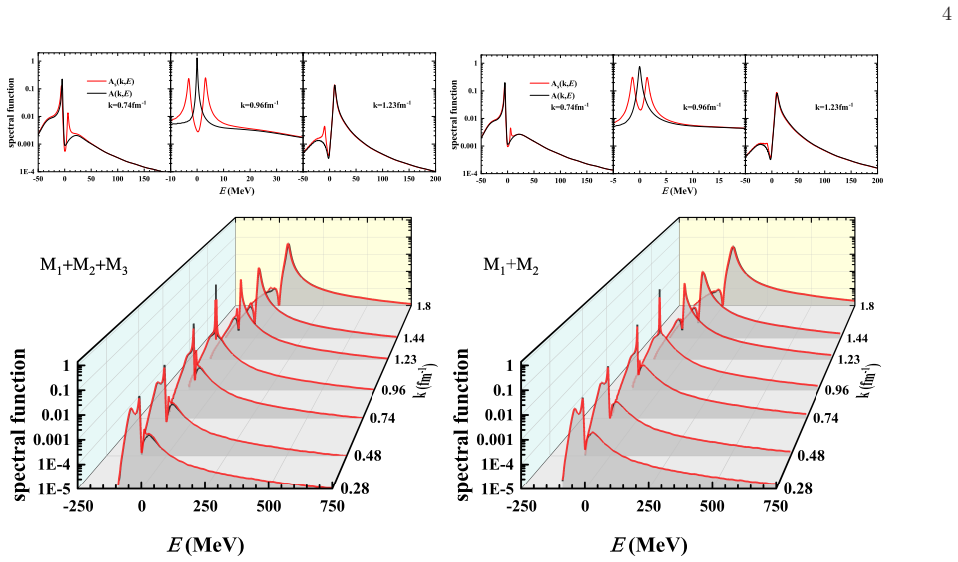
This vanishing behavior ensures the reliability of the quasiparticle approximation near the Fermi sur- face. However, away from ǫF , the imaginary part be- comes comparable to the real part of the self-energy and should therefore be treated more accurately. To provide a general understanding of the nucleon spectral functions in both the BCS and normal sta...
-
[5]
10 fm − 3. The upper panel shows the distributions including the third-order self-energy M3, while the lower panel shows the distributions without M3. function results, the momentum distribution exhibits the most significant deviation from the normal state near the Fermi momentum. Specifically, pairing enhances the de- pletion below the Fermi surface and in...
-
[6]
It should be noted that the pairing gap decreases monotonously for densities ρ > 0. 06 fm − 3 [38], and that the gap obtained from self-energy including contributions up to M3 is significantly larger than that obtained from self-energy up to M2. Moreover, as moving away from kF , even for momenta k ≫ kF , the momentum distri- bution in the BCS state remain...
-
[7]
is not well defined. To overcome this limita- tion, in the present calculation with only M1 included we adopt the particle-number constraint as follow: ρ = 4 ∑ k nZ s (k) = 4 ∑ k Zk 2 { 1 − ǫ(k) − µ√[ ǫ(k) − µ ]2 + [ Zk∆( k) ]2 } , (14) with Z − 1 k = 1 − ∂ Σ( k,ω ) ∂ω ⏐ ⏐ ω =ǫ(k). While the pairing-gap equation is still given by Eq
-
[8]
As shown in Fig. 1, although Re M2 is much smaller than Re M1 and thus may contribute only marginally to the modification of the pairing gap, the inclusion of M2 introduces a sizable imaginary part that incorporates stronger N N correla- tions. As a result, the pairing gap is quenched compared with the case including only M1. In contrast, the in- clusion o...
-
[9]
C. C. degli Atti, In-medium short-range dynamics of nu- cleons: Recent theoretical and experimental advances, Physics Reports 590, 1 (2015)
work page 2015
-
[10]
R. Subedi et al. , Probing cold dense nuclear matter, Science 320, 1476 (2008)
work page 2008
- [11]
-
[12]
Z.-H. Li and H.-J. Schulze, Correlation strength with modern nucleon-nucleon poten- tials in the Brueckner-Hartree-Fock approach, Phys. Rev. C 94, 024322 (2016)
work page 2016
-
[13]
C. Mahaux and R. Sartor, Theoretical approaches to the momentum distribution of a normal Fermi liquid, Physics Reports 211, 53 (1992)
work page 1992
- [14]
-
[15]
J. M. Dong, U. Lombardo, H. F. Zhang, and W. Zuo, Role of nucleonic Fermi surface depletion in neutron star cooling, The Astrophysical Journal 817, 6 (2016)
work page 2016
-
[16]
X.-l. Shang and A. Li, Revisiting the Post- glitch Relaxation of the 2000 Vela Glitch with the Neutron Star Equation of States in the Brueckner and Relativistic Brueckner Theories, The Astrophysical Journal 923, 108 (2021)
work page 2000
- [17]
-
[18]
A. Rios, A. Polls, and W. H. Dickhoff, Density and isospin-asymmetry dependence of high-momentum com- ponents, Phys. Rev. C 89, 044303 (2014)
work page 2014
-
[19]
Z. X. Yang, X. L. Shang, G. C. Yong, W. Zuo, and Y. Gao, Nucleon momentum distributions in asymmetric nuclear matter, Phys. Rev. C 100, 054325 (2019)
work page 2019
-
[20]
O. Hen, G. A. Miller, E. Piasetzky, and L. B. Weinstein, Nucleon-nucleon correlations, short-lived excitations, and the quarks within, Rev. Mod. Phys. 89, 045002 (2017)
work page 2017
-
[21]
A. De-Shalit and H. Feshbach, Theoretical Nuclear Physics: Nuclear Structure (John Wiley & Sons, 1974)
work page 1974
- [22]
-
[23]
Yong, Constraining nucleon high momentum in nu- clei, Physics Letters B 765, 104 (2017)
G.-C. Yong, Constraining nucleon high momentum in nu- clei, Physics Letters B 765, 104 (2017)
work page 2017
- [24]
-
[25]
R. Schiavilla, R. B. Wiringa, S. C. Pieper, and J. Carlso n, Tensor forces and the ground-state structure of nuclei, Phys. Rev. Lett. 98, 132501 (2007)
work page 2007
-
[26]
R. Starink et al. , Evidence for short-range correlations in 16o, Physics Letters B 474, 33 (2000)
work page 2000
-
[27]
C. J. G. Onderwater et al., Signatures for short-range cor- relations in 16O observed in the reaction 16O(e, e ′ pp)14C, Phys. Rev. Lett. 81, 2213 (1998)
work page 1998
-
[28]
R. Shneor et al. (Jefferson Lab Hall A Collab- oration), Investigation of proton-proton short- range correlations via the 12C(e, e ′ pp) reaction, Phys. Rev. Lett. 99, 072501 (2007)
work page 2007
-
[29]
M. Lyu, T. Myo, H. Toki, H. Horiuchi, C. Xu, and N. Wan, High-momentum components in the 4He nucleus caused by inter-nucleon correlations, Physics Letters B 805, 135421 (2020)
work page 2020
-
[30]
X.-l. Shang and W. Zuo, Angle-dependent gap state in asymmetric nuclear matter, Phys. Rev. C 88, 025806 (2013)
work page 2013
-
[31]
K. D. Duan, H. B. Zhang, and X. L. Shang, Phase di- agrams of neutron-proton superfluid in asymmetric nu- clear matter, Phys. Rev. C 111, 014320 (2025)
work page 2025
-
[32]
Tan, Energetics of a strongly correlated Fermi gas, Annals of Physics 323, 2952 (2008)
S. Tan, Energetics of a strongly correlated Fermi gas, Annals of Physics 323, 2952 (2008)
work page 2008
-
[33]
Tan, Large momentum part of a strongly correlated Fermi gas, Annals of Physics 323, 2971 (2008)
S. Tan, Large momentum part of a strongly correlated Fermi gas, Annals of Physics 323, 2971 (2008)
work page 2008
-
[34]
S. Tan, Generalized virial theorem and pres- sure relation for a strongly correlated Fermi gas, Annals of Physics 323, 2987 (2008)
work page 2008
-
[35]
O. Hen, L. B. Weinstein, E. Piasetzky, G. A. Miller, M. M. Sargsian, and Y. Sagi, Correlated fermions in nuclei and ultracold atomic gases, Phys. Rev. C 92, 045205 (2015)
work page 2015
-
[36]
J. T. Stewart, J. P. Gaebler, T. E. Drake, and D. S. Jin, Verification of universal relations in a strongly interacti ng Fermi gas, Phys. Rev. Lett. 104, 235301 (2010)
work page 2010
- [37]
-
[38]
R. Sartor and C. Mahaux, Self-energy, momentum dis- tribution, and effective masses of a dilute Fermi gas, Phys. Rev. C 21, 1546 (1980)
work page 1980
-
[39]
K. S. A. Hassaneen and H. M¨ uther, Correlations and spectral functions in asymmetric nuclear matter, Phys. Rev. C 70, 054308 (2004)
work page 2004
-
[40]
P. Wang, S.-X. Gan, P. Yin, and W. Zuo, Three-body force effect on off-shell mass operator and spectral func- tions in nuclear matter, Phys. Rev. C 87, 014328 (2013)
work page 2013
-
[41]
X.-L. Shang, J.-M. Dong, W. Zuo, P. Yin, and U. Lom- bardo, Exact solution of the Brueckner-Bethe-Goldstone equation with three-body forces in nuclear matter, Phys. Rev. C 103, 034316 (2021)
work page 2021
-
[42]
S. C. Han, X. L. Shang, W. Zuo, G. C. Yong, and Y. Gao, In-medium nucleon-nucleon cross section in nuclear mat- ter, Phys. Rev. C 106, 064332 (2022)
work page 2022
-
[43]
W. Dickhoff, Connection between Brueckner ladders and pairing correlations, Physics Letters B 210, 15 (1988)
work page 1988
-
[44]
Matsuo, Spatial structure of neutron Cooper pair in low density uniform matter, Phys
M. Matsuo, Spatial structure of neutron Cooper pair in low density uniform matter, Phys. Rev. C 73, 044309 (2006)
work page 2006
-
[45]
H. F. Arellano and J.-P. Delaroche, Low-density homo- geneous symmetric nuclear matter: Disclosing dinucleons in coexisting phases, Eur. Phys. J. A 51, 7 (2015)
work page 2015
- [46]
-
[47]
Bo˙ zek, Superfluidity with dressed nucleons, Physics Letters B 551, 93 (2003)
P. Bo˙ zek, Superfluidity with dressed nucleons, Physics Letters B 551, 93 (2003)
work page 2003
-
[48]
W. Zuo, I. Bombaci, and U. Lombardo, Asymmetric nu- clear matter from an extended Brueckner-Hartree-Fock approach, Phys. Rev. C 60, 024605 (1999)
work page 1999
-
[49]
J. H¨ ufner and C. Mahaux, Low density expan- sion of the nucleon-nucleus optical-model potential, Annals of Physics 73, 525 (1972)
work page 1972
-
[50]
J. Jeukenne, A. Lejeune, and C. Mahaux, Many-body theory of nuclear matter, Physics Reports 25, 83 (1976)
work page 1976
- [51]
- [52]
-
[53]
Bo˙ zek, Superfluid nuclear matter calculations, Nuclear Physics A 657, 187 (1999)
P. Bo˙ zek, Superfluid nuclear matter calculations, Nuclear Physics A 657, 187 (1999)
work page 1999
-
[54]
U. Lombardo, P. Schuck, and W. Zuo, Self-energy effects in the superfluidity of neutron matter, Phys. Rev. C 64, 021301 (2001)
work page 2001
-
[55]
U. Lombardo and P. Schuck, Superfluid states of nuclear matter beyond the BCS approximation, International Journal of Modern Physics E 14, 513 (2005)
work page 2005
-
[56]
J. Y. Fu, P. Yin, X. L. Shang, H. Y. Shang, E. Epelbaum, and W. Zuo, Tensor force contribution to the symmetry energy with chiral N N interactions, Phys. Rev. C 111, 064307 (2025)
work page 2025
-
[57]
S. K. Saha, D. R. Entem, R. Machleidt, and Y. Nosyk, Local position-space two-nucleon potentials from lead- ing to fourth order of chiral effective field theory, Phys. Rev. C 107, 034002 (2023)
work page 2023
-
[58]
E. Epelbaum, H. Krebs, and U.-G. Meißner, Improved chiral nucleon-nucleon potential up to next-to-next-to- next-to-leading order, The European Physical Journal A 51, 10.1140/epja/i2015-15053-8 (2015)
-
[59]
P. Reinert, H. Krebs, and E. Epelbaum, Semilocal momentum-space regularized chiral two-nucleon poten- tials up to fifth order, The European Physical Journal A 9 54, 10.1140/epja/i2018-12516-4 (2018)
-
[60]
P. Yin, X. L. Shang, J. N. Hu, J. Y. Fu, E. Epel- baum, and W. Zuo, Pairing properties of semilocal coordinate- and momentum-space regularized chiral in- teractions, Phys. Rev. C 108, 034002 (2023)
work page 2023
-
[61]
L. G. Cao, U. Lombardo, and P. Schuck, Screening effects in superfluid nuclear and neutron matter within Brueck- ner theory, Phys. Rev. C 74, 064301 (2006)
work page 2006
discussion (0)
Sign in with ORCID, Apple, or X to comment. Anyone can read and Pith papers without signing in.