REVIEW 2 major objections 2 minor 39 references
Learning to Synergize Semantic and Geometric Priors for Limited-Data Wheat Disease Segmentation
T0 review · 2 major / 2 minor · reviewed 2026-05-10 · grok-4.3
Pith's one-line read A framework turns pretrained semantic features into filtered point prompts that activate geometric boundary localization for accurate wheat disease segmentation despite limited training data and large appearance shifts.
desk verdict SGPer gives a concrete adapter-plus-prompt pipeline for limited-data wheat disease segmentation using DINOv2 and SAM, but the performance gains still need the actual tables to be convincing. read the letter →
The pith
A machine-rendered reading of the paper's core claim, the machinery that carries it, and where it could break.
The reading
What carries the argument
The prompt synergization pipeline that converts semantic features into dense category-specific point prompts and then filters them by iterative mask confidence and semantic consistency to guide precise boundary localization.
What would settle it
A new wheat image collection drawn from previously unseen growth stages and disease variants where the method's segmentation accuracy falls below that of standard fine-tuning baselines on the same limited training split.
Extended reading notes
Core claim
The central claim is that pretrained semantic priors provide category-aware robustness to intra-class temporal variations and can be transformed into dense point prompts; after dynamic filtering that cross-references mask generation confidence with semantic consistency, these prompts activate geometric priors to yield precise, boundary-accurate disease masks that remain invariant to appearance shifts across growth stages.
Load-bearing premise
That semantic features from a pretrained model can be turned into comprehensive yet non-redundant point prompts whose filtering by mask confidence will correctly retain only accurate candidates across every possible temporal appearance shift.
Editorial extensions
If this is right
- Delivers state-of-the-art results on wheat disease and organ segmentation benchmarks particularly when annotated data are scarce.
- Produces masks whose accuracy does not degrade when disease appearance changes substantially between growth stages.
- Reduces the volume of labeled examples required to reach usable segmentation quality in precision agriculture settings.
- Ensures comprehensive spatial coverage of all disease regions while suppressing redundant or low-quality prompts.
Reading between the lines
- The same prompt-conversion and filtering logic could be tested on segmentation tasks in other crops that also exhibit strong seasonal or stage-dependent appearance variation.
- If the filtering step proves robust, the approach might reduce annotation budgets for related agricultural monitoring problems such as nutrient deficiency or pest damage mapping.
- The explicit separation of semantic prompting from geometric localization offers a template for pairing other pretrained model families when labeled data are limited.
Editorial analysis
A structured set of objections, weighed in public.
Referee Report
Summary. The paper proposes SGPer, a Semantic-Geometric Prior Synergization framework for wheat disease segmentation under limited data. It inserts disease-sensitive adapters into pretrained DINOv2 and SAM, converts DINOv2 features into dense category-specific point prompts for comprehensive coverage, and filters redundant prompts by cross-referencing SAM iterative mask confidence against DINOv2 semantic consistency. The central claim is that this synergy yields state-of-the-art performance on wheat disease and organ segmentation benchmarks, especially in data-constrained settings, while remaining robust to temporal appearance shifts.
Significance. If the empirical results hold, the work could be significant for precision agriculture by showing how to adapt foundation models (DINOv2 for semantics, SAM for geometry) to domain-specific limited-data tasks without full retraining. The prompt-generation-plus-filtering pipeline offers a concrete mechanism for leveraging pretrained priors on problems with high intra-class variation.
major comments (2)
- [Methods / Prompt Filtering] The prompt filtering procedure (described after the adapter insertion in the methods) is load-bearing for the robustness claim. The paper asserts that cross-referencing SAM mask confidence with DINOv2 semantic consistency eliminates redundancy without introducing new errors across temporal shifts, yet no ablation isolating the filter (e.g., dense prompts vs. filtered prompts) or failure-case analysis on appearance changes is referenced; this leaves the central performance advantage unsubstantiated.
- [Experiments] The SOTA claim in the abstract and evaluation section rests on quantitative evidence that is not supplied in the provided manuscript excerpt. Specific metrics (mIoU, Dice, etc.), baseline comparisons (including vanilla SAM, DINOv2-only, and prior wheat segmentation methods), dataset splits, and data-constraint regimes (e.g., 1-shot, 5-shot) must be presented with statistical significance to support the assertion that SGPer outperforms existing approaches.
minor comments (2)
- [Abstract] The abstract is overly dense in its pipeline description; a single sentence summarizing the two-stage prompt generation and filtering would improve readability.
- [Methods] Notation for the adapters and filters (e.g., 'disease-friendly filters') should be introduced with a consistent symbol or acronym on first use and reused in the methods section.
Simulated Author's Rebuttal
We thank the referee for the constructive feedback on our manuscript. We address each major comment point by point below and outline the revisions we will make to strengthen the presentation of our method and results.
read point-by-point responses
-
Referee: [Methods / Prompt Filtering] The prompt filtering procedure (described after the adapter insertion in the methods) is load-bearing for the robustness claim. The paper asserts that cross-referencing SAM mask confidence with DINOv2 semantic consistency eliminates redundancy without introducing new errors across temporal shifts, yet no ablation isolating the filter (e.g., dense prompts vs. filtered prompts) or failure-case analysis on appearance changes is referenced; this leaves the central performance advantage unsubstantiated.
Authors: We agree that the prompt filtering step is central to the robustness claims and that its contribution should be isolated. The current manuscript describes the cross-referencing mechanism but does not include a dedicated ablation comparing dense versus filtered prompts or a targeted failure-case analysis under temporal shifts. In the revised manuscript we will add an ablation study in the Experiments section that reports mIoU and Dice scores for both variants across limited-data regimes and temporal appearance changes. We will also add a qualitative failure-case analysis in the supplementary material to show that the filter does not introduce new errors. revision: yes
-
Referee: [Experiments] The SOTA claim in the abstract and evaluation section rests on quantitative evidence that is not supplied in the provided manuscript excerpt. Specific metrics (mIoU, Dice, etc.), baseline comparisons (including vanilla SAM, DINOv2-only, and prior wheat segmentation methods), dataset splits, and data-constraint regimes (e.g., 1-shot, 5-shot) must be presented with statistical significance to support the assertion that SGPer outperforms existing approaches.
Authors: We acknowledge that the excerpt supplied to the referee does not contain the detailed quantitative results. To substantiate the state-of-the-art claims, the revised manuscript will expand the evaluation section to include all requested elements: mIoU and Dice scores, comparisons against vanilla SAM, DINOv2-only, and prior wheat segmentation methods, explicit dataset split information, results under 1-shot and 5-shot regimes, and statistical significance obtained from multiple independent runs. revision: yes
Circularity Check
No significant circularity in derivation chain
full rationale
The paper proposes SGPer as an empirical framework that converts DINOv2 semantic priors into point prompts for SAM, using newly designed adapters and a cross-referencing filter for redundancy removal. All load-bearing steps are architectural choices (adapters, prompt generation, confidence-based filtering) whose effectiveness is asserted via benchmark evaluations rather than any closed-form equations, fitted parameters renamed as predictions, or self-citation chains. The SOTA claim in limited-data settings is presented as an experimental outcome, not a logical necessity derived from the inputs themselves. No self-definitional loops, ansatzes smuggled via prior work, or uniqueness theorems appear in the provided description.
Assumptions & free parameters
Cite this review
Pith. "Pith review of Learning to Synergize Semantic and Geometric Priors for Limited-Data Wheat Disease Segmentation." pith.science (2026). https://pith.science/paper/2604.05415
@misc{pith2026260405415,
  author       = {Pith},
  title        = {Pith review of: Learning to Synergize Semantic and Geometric Priors for Limited-Data Wheat Disease Segmentation},
  year         = {2026},
  howpublished = {\url{https://pith.science/paper/2604.05415}},
  note         = {Machine review of arXiv:2604.05415}
}
read the original abstract
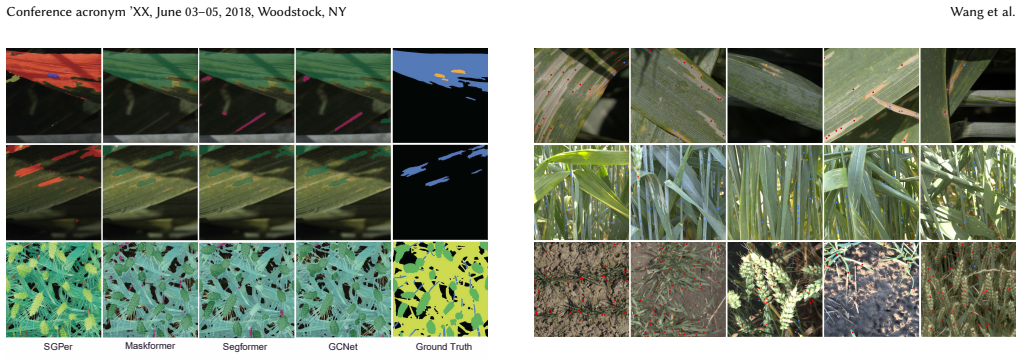
Wheat disease segmentation is fundamental to precision agriculture but faces severe challenges from significant intra-class temporal variations across growth stages. Such substantial appearance shifts make collecting a representative dataset for training from scratch both labor-intensive and impractical. To address this, we propose SGPer, a Semantic-Geometric Prior Synergization framework that treats wheat disease segmentation under limited data as a coupled task of disease-specific semantic perception and disease boundary localization. Our core insight is that pretrained DINOv2 provides robust category-aware semantic priors to handle appearance shifts, which can be converted into coarse spatial prompts to guide SAM for the precise localization of disease boundaries. Specifically, SGPer designs disease-sensitive adapters with multiple disease-friendly filters and inserts them into both DINOv2 and SAM to align their pretrained representations with disease-specific characteristics. To operationalize this synergy, SGPer transforms DINOv2-derived features into dense, category-specific point prompts to ensure comprehensive spatial coverage of all disease regions. To subsequently eliminate prompt redundancy and ensure highly accurate mask generation, it dynamically filters these dense candidates by cross-referencing SAM's iterative mask confidence with the category-specific semantic consistency derived from DINOv2. Ultimately, SGPer distills a highly informative set of prompts to activate SAM's geometric priors, achieving precise and robust segmentation that remains strictly invariant to temporal appearance changes. Extensive evaluations demonstrate that SGPer consistently achieves state-of-the-art performance on wheat disease and organ segmentation benchmarks, especially in data-constrained scenarios.
Figures

Reference graph
Works this paper leans on
-
[1]
Shubhra Aich and Ian Stavness. 2017. Leaf Counting with Deep Convolutional and Deconvolutional Networks. In2017 IEEE International Conference on Computer Vision Workshops, ICCV Workshops 2017, Venice, Italy, October 22-29, 2017. IEEE Computer Society, 2080–2089
work page 2017
-
[2]
Mathilde Caron, Hugo Touvron, Ishan Misra, Hervé Jégou, Julien Mairal, Piotr Bojanowski, and Armand Joulin. 2021. Emerging Properties in Self-Supervised Vision Transformers. In2021 IEEE/CVF International Conference on Computer Vision, ICCV 2021, Montreal, QC, Canada, October 10-17, 2021. IEEE, 9630–9640
work page 2021
-
[3]
Shoufa Chen, Chongjian Ge, Zhan Tong, Jiangliu Wang, Yibing Song, Jue Wang, and Ping Luo. 2022. Adaptformer: Adapting vision transformers for scalable visual recognition.Advances in Neural Information Processing Systems35 (2022), 16664–16678
work page 2022
-
[4]
Tianrun Chen, Lanyun Zhu, Chaotao Ding, Runlong Cao, Yan Wang, Shangzhan Zhang, Zejian Li, Lingyun Sun, Ying Zang, and Papa Mao. 2023. SAM-Adapter: Adapting Segment Anything in Underperformed Scenes. InIEEE/CVF Interna- tional Conference on Computer Vision, ICCV 2023 - Workshops, Paris, France, October 2-6, 2023. IEEE, 3359–3367
work page 2023
-
[5]
In: 2022 IEEE/CVF Conference on Computer Vision and Pat- tern Recognition (CVPR)
Bowen Cheng, Ishan Misra, Alexander G. Schwing, Alexander Kirillov, and Ro- hit Girdhar. 2022. Masked-attention Mask Transformer for Universal Image Segmentation. InIEEE/CVF Conference on Computer Vision and Pattern Recog- nition, CVPR 2022, New Orleans, LA, USA, June 18-24, 2022. IEEE, 1280–1289. doi:10.1109/CVPR52688.2022.00135
-
[6]
Schwing, and Alexander Kirillov
Bowen Cheng, Alexander G. Schwing, and Alexander Kirillov. 2021. Per-Pixel Classification is Not All You Need for Semantic Segmentation. InAdvances in Neu- ral Information Processing Systems 34: Annual Conference on Neural Information Processing Systems 2021, NeurIPS 2021, December 6-14, 2021, virtual, Marc’Aurelio Ranzato, Alina Beygelzimer, Yann N. Daup...
work page 2021
-
[7]
Etienne David, Simon Madec, Pouria Sadeghi-Tehran, Helge Aasen, Bangyou Zheng, Shouyang Liu, Norbert Kirchgessner, Goro Ishikawa, Koichi Nagasawa, Minhajul A Badhon, et al. 2020. Global wheat head detection (GWHD) dataset: A large and diverse dataset of high-resolution RGB-labelled images to develop and benchmark wheat head detection methods.Plant Phenomics(2020)
work page 2020
-
[8]
Zehua Fan, Cuiping Liu, Fengyuan Yu, Yongliang Lai, Qiang Wang, Zhiyong Zhang, Juanjuan Zhang, Jinpeng Cheng, Xinming Ma, Xiaohe Gu, and Shuping Xiong. 2026. Dynamic prediction of carbon and nitrogen accumulation in winter wheat grain: Source-sink theory integrated with UAV multispectral imagery. Comput. Electron. Agric.240 (2026), 111228
work page 2026
Show all 39 references
-
[9]
Mathieu Pagé Fortin. 2023. Class-Incremental Learning of Plant and Disease Detection: Growing Branches with Knowledge Distillation. InIEEE/CVF Inter- national Conference on Computer Vision, ICCV 2023 - Workshops, Paris, France, October 2-6, 2023. IEEE, 593–603
2023
-
[10]
Meng-Hao Guo, Cheng-Ze Lu, Qibin Hou, Zhengning Liu, Ming-Ming Cheng, and Shi-Min Hu. 2022. SegNeXt: Rethinking Convolutional Attention De- sign for Semantic Segmentation. InAdvances in Neural Information Process- ing Systems 35: Annual Conference on Neural Information Process...
2022
-
[11]
Edward J Hu, Yelong Shen, Phillip Wallis, Zeyuan Allen-Zhu, Yuanzhi Li, Shean Wang, Liang Wang, Weizhu Chen, et al. 2022. Lora: Low-rank adaptation of large language models.Iclr1, 2 (2022), 3
2022
-
[12]
Jie Jiang, Zhaopeng Fu, Jiayi Zhang, Jinpeng Yang, Wanping Fang, Qiang Cao, Yongchao Tian, Yan Zhu, Weixing Cao, and Xiaojun Liu. 2026. Developing a nitrogen management strategy for winter wheat to enhance economic profit and energy savings using satellite-based management zon...
2026
-
[13]
Lei Ke, Mingqiao Ye, Martin Danelljan, Yifan Liu, Yu-Wing Tai, Chi-Keung Tang, and Fisher Yu. 2023. Segment Anything in High Quality. InAdvances in Neural Information Processing Systems 36: Annual Conference on Neural Information Processing Systems 2023, NeurIPS 2023, New Orle...
2023
-
[14]
Kingma and Jimmy Ba
Diederik P. Kingma and Jimmy Ba. 2015. Adam: A Method for Stochastic Opti- mization. In3rd International Conference on Learning Representations, ICLR 2015, San Diego, CA, USA, May 7-9, 2015, Conference Track Proceedings, Yoshua Bengio and Yann LeCun (Eds.)
2015
-
[15]
Berg, Wan-Yen Lo, Piotr Dollár, and Ross B
Alexander Kirillov, Eric Mintun, Nikhila Ravi, Hanzi Mao, Chloé Rolland, Laura Gustafson, Tete Xiao, Spencer Whitehead, Alexander C. Berg, Wan-Yen Lo, Piotr Dollár, and Ross B. Girshick. 2023. Segment Anything. InIEEE/CVF International Conference on Computer Vision, ICCV 2023,...
2023
-
[16]
Yu Lei, Chen Yang, Jinling Zhao, Xue Yang, Chunchun Li, Wenjiang Huang, Hongbo Qiao, and Linsheng Huang. 2026. PPBM-YOLO: A lightweight and accurate detection model for multi-species airborne spores in wheat disease Cross-Infection scenarios.Comput. Electron. Agric.241 (2026), 111325
2026
-
[17]
Jiachen Li, Jitesh Jain, and Humphrey Shi. 2024. Matting Anything. InIEEE/CVF Conference on Computer Vision and Pattern Recognition, CVPR 2024 - Workshops, Seattle, W A, USA, June 17-18, 2024. IEEE, 1775–1785
2024
-
[18]
Yang Liu, Muzhi Zhu, Hengtao Li, Hao Chen, Xinlong Wang, and Chunhua Shen
-
[19]
InThe Twelfth International Conference on Learning Representations, ICLR 2024, Vienna, Austria, May 7-11, 2024
Matcher: Segment Anything with One Shot Using All-Purpose Feature Matching. InThe Twelfth International Conference on Learning Representations, ICLR 2024, Vienna, Austria, May 7-11, 2024. OpenReview.net
2024
-
[20]
Maxime Oquab, Timothée Darcet, Théo Moutakanni, Huy V. Vo, Marc Szafraniec, Vasil Khalidov, Pierre Fernandez, Daniel Haziza, Francisco Massa, Alaaeldin El-Nouby, Mido Assran, Nicolas Ballas, Wojciech Galuba, Russell Howes, Po- Yao Huang, Shang-Wen Li, Ishan Misra, Michael Rabb...
2024
-
[21]
Huihui Pan, Yuanduo Hong, Weichao Sun, and Yisong Jia. 2023. Deep Dual- Resolution Networks for Real-Time and Accurate Semantic Segmentation of Traffic Scenes.IEEE Trans. Intell. Transp. Syst.24, 3 (2023), 3448–3460. doi:10. 1109/TITS.2022.3228042
2023
-
[22]
Yongming Rao, Wenliang Zhao, Guangyi Chen, Yansong Tang, Zheng Zhu, Guan Huang, Jie Zhou, and Jiwen Lu. 2022. DenseCLIP: Language-Guided Dense Prediction with Context-Aware Prompting. InIEEE/CVF Conference on Computer Vision and Pattern Recognition, CVPR 2022, New Orleans, LA,...
2022
-
[23]
Vijai Singh and Ak K Misra. 2017. Detection of plant leaf diseases using image seg- mentation and soft computing techniques.Information processing in Agriculture 4, 1 (2017), 41–49
2017
-
[24]
Yanpeng Sun, Jiahui Chen, Shan Zhang, Xinyu Zhang, Qiang Chen, Gang Zhang, Errui Ding, Jingdong Wang, and Zechao Li. 2024. VRP-SAM: SAM with Vi- sual Reference Prompt. InIEEE/CVF Conference on Computer Vision and Pattern Recognition, CVPR 2024, Seattle, W A, USA, June 16-22, 2...
2024
-
[25]
Shijie Wang, Zijian Wang, Yadan Luo, Pengfei Zhang, and Xin Yu. [n. d.]. Parameter-Efficient Wheat Disease Segmentation. InDatabases Theory and Appli- cations - 36th Australasian Database Conference, ADC 2025, Sydney, NSW, Australia and Bali, Indonesia, December 4-6, 2025, Pro...
2025
-
[26]
Zijian Wang, Radek Zenkl, Latifa Greche, Benoit De Solan, Lucas Bernigaud Samatan, Safaa Ouahid, Andrea Visioni, Carlos A Robles-Zazueta, Francisco Pinto, Ivan Perez-Olivera, et al . 2025. The global wheat full semantic organ segmentation (GWFSS) dataset.Plant Phenomics7, 3 (2...
2025
-
[27]
Chapman, and Zi Huang
Tianqi Wei, Xin Yu, Zhi Chen, Scott C. Chapman, and Zi Huang. 2025. Aug- ment to Segment: Tackling Pixel-Level Imbalance in Wheat Disease and Pest Segmentation. InDatabases Theory and Applications - 36th Australasian Database Conference, ADC 2025, Sydney, NSW, Australia and Ba...
2025
-
[28]
Junde Wu, Rao Fu, Huihui Fang, Yuanpei Liu, Zhaowei Wang, Yanwu Xu, Yueming Jin, and Tal Arbel. 2023. Medical SAM Adapter: Adapting Segment Anything Model for Medical Image Segmentation.CoRRabs/2304.12620 (2023)
2023
-
[29]
Álvarez, and Ping Luo
Enze Xie, Wenhai Wang, Zhiding Yu, Anima Anandkumar, José M. Álvarez, and Ping Luo. 2021. SegFormer: Simple and Efficient Design for Seman- tic Segmentation with Transformers. InAdvances in Neural Information Pro- cessing Systems 34: Annual Conference on Neural Information Pro...
2021
-
[30]
Mengde Xu, Zheng Zhang, Fangyun Wei, Han Hu, and Xiang Bai. 2023. SAN: Side Adapter Network for Open-Vocabulary Semantic Segmentation.IEEE Trans. Pattern Anal. Mach. Intell.45, 12 (2023), 15546–15561. doi:10.1109/TPAMI.2023. 3311618
2023 doi
-
[31]
Guoyu Yang, Yuan Wang, Daming Shi, and Yanzhong Wang. 2025. Golden Cudgel Network for Real-Time Semantic Segmentation. InIEEE/CVF Conference on Computer Vision and Pattern Recognition, CVPR 2025, Nashville, TN, USA, June 11-15, 2025. Computer Vision Foundation / IEEE, 25367–25376
2025
-
[32]
Jinyu Yang, Mingqi Gao, Zhe Li, Shang Gao, Fangjing Wang, and Feng Zheng
-
[33]
Track Anything: Segment Anything Meets Videos.CoRRabs/2304.11968 (2023)
2023
-
[34]
Dongshuo Yin, Yiran Yang, Zhechao Wang, Hongfeng Yu, Kaiwen Wei, and Xian Sun. 2023. 1% vs 100%: Parameter-efficient low rank adapter for dense predictions. InProceedings of the IEEE/CVF conference on computer vision and pattern recognition. 20116–20126
2023
-
[35]
Wenxi Yue, Jing Zhang, Kun Hu, Yong Xia, Jiebo Luo, and Zhiyong Wang. 2024. SurgicalSAM: Efficient Class Promptable Surgical Instrument Segmentation. In Thirty-Eighth AAAI Conference on Artificial Intelligence, AAAI 2024, Thirty-Sixth Conference acronym ’XX, June 03–05, 2018, ...
2024
-
[36]
Radek Zenkl, Radu Timofte, Norbert Kirchgessner, Lukas Roth, Andreas Hund, Luc Van Gool, Achim Walter, and Helge Aasen. 2022. Outdoor plant segmentation with deep learning for high-throughput field phenotyping on a diverse wheat dataset.Frontiers in plant science12 (2022), 774068
2022
-
[37]
Renrui Zhang, Zhengkai Jiang, Ziyu Guo, Shilin Yan, Junting Pan, Hao Dong, Yu Qiao, Peng Gao, and Hongsheng Li. 2024. Personalize Segment Anything Model with One Shot. InThe Twelfth International Conference on Learning Representations, ICLR 2024, Vienna, Austria, May 7-11, 202...
2024
-
[38]
Yuchen Zhang, Xingan Hao, Feilong Li, Zexi Wang, Dongxiang Li, Mei Li, and Rui Mao. 2025. Unsupervised domain adaptation semantic segmentation method for wheat disease detection based on UAV multispectral images.Comput. Electron. Agric.236 (2025), 110473
2025
-
[39]
Tao Zhou, Yizhe Zhang, Yi Zhou, Ye Wu, and Chen Gong. 2023. Can SAM Segment Polyps?CoRRabs/2304.07583 (2023)
2023
Reviewed May 10, 2026 · model on record in the stance chip above.
Discussion (0). Continue with ORCID to comment.