Recognition: 2 theorem links
· Lean TheoremResource Implications of Different Encodings for Quantum Computational Fluid Dynamics
Pith reviewed 2026-05-10 19:55 UTC · model grok-4.3
The pith
The upper bound on executions for amplitude encoding in quantum CFD is too conservative, with empirical evidence suggesting milder scaling that enables a new encoding for the lattice Boltzmann method.
A machine-rendered reading of the paper's core claim, the machinery that carries it, and where it could break.
Core claim
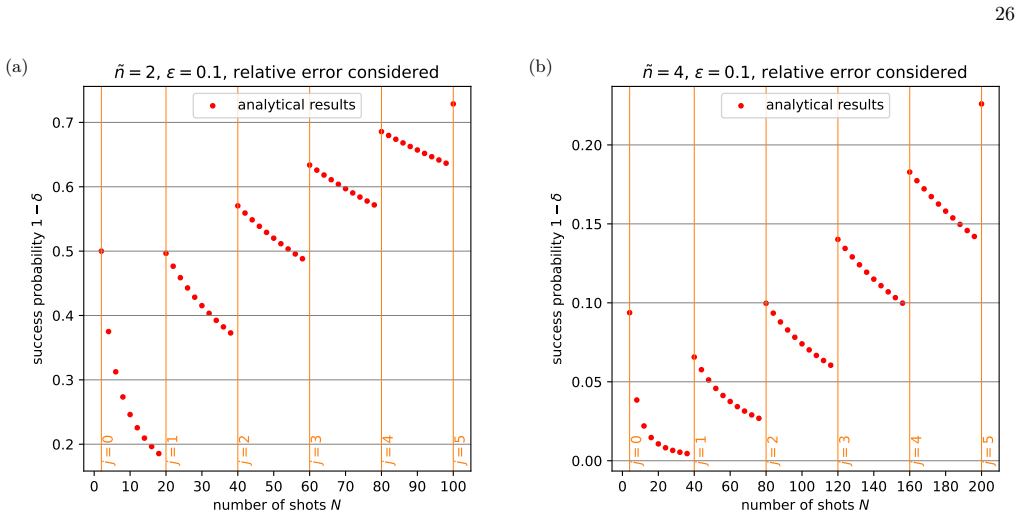
The paper claims that standard theoretical bounds on the resources for amplitude encoding in quantum CFD are overly conservative, as empirical study of equal-probability distributions shows the number of executions required for accurate readout follows a scaling of ñ ln(ñ) rather than the derived ñ² ln(ñ), and that the resulting resource insights directly motivate a new encoding tailored to quantum lattice Boltzmann algorithms.
What carries the argument
The empirical scaling law for the number of executions needed to extract encoded values with given accuracy from equal-probability distributions, which informs the proposal of a new encoding approach for quantum lattice Boltzmann methods.
If this is right
- Quantum CFD algorithms can operate with lower execution overhead than theoretical upper bounds predict.
- Readout of encoded field values becomes feasible with a number of runs that grows only as ñ ln(ñ) in the uniform case.
- A specialized encoding can be constructed for lattice Boltzmann methods that exploits the milder empirical scaling.
- Resource estimates for quantum algorithms computing entire fluid fields become more realistic and potentially closer to practical implementation.
Where Pith is reading between the lines
- The milder scaling may extend to other quantum algorithms that compute dense fields of values, such as electromagnetic or structural simulations.
- Testing the new encoding on small-scale fluid problems could reveal whether the empirical scaling persists when the probability distribution deviates from uniform.
- Direct resource comparisons between the new encoding and other proposed quantum CFD approaches would clarify its relative efficiency.
Load-bearing premise
That resource insights from general amplitude encoding and the equal-probability case translate directly into a practical and advantageous new encoding for CFD applications without further validation.
What would settle it
A quantum lattice Boltzmann simulation using the proposed encoding in which the observed number of executions required for target accuracy follows the higher quadratic-log scaling or shows no advantage over standard amplitude encoding.
Figures






read the original abstract
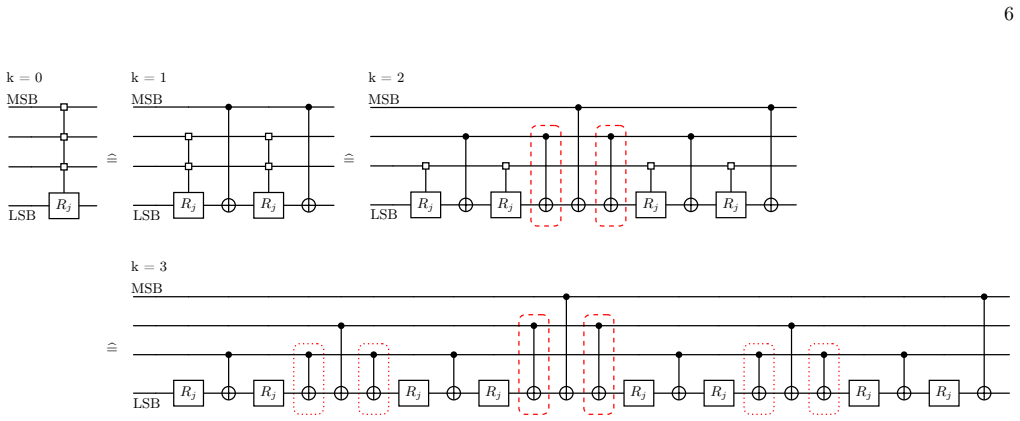
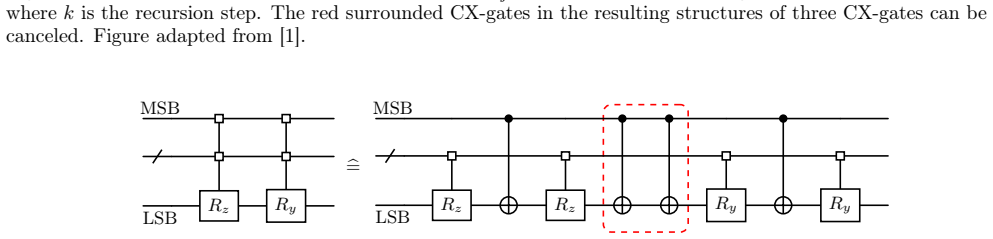
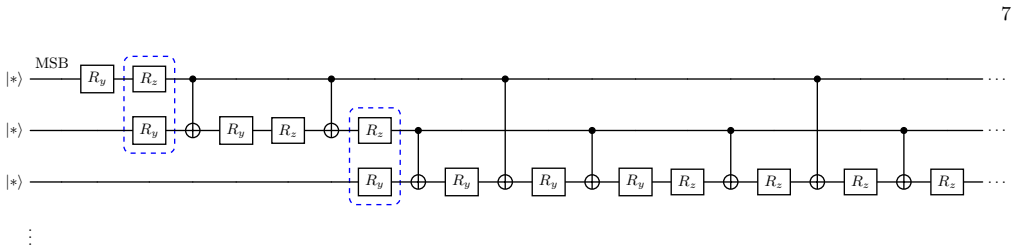
For quantum algorithms for problems in which the task is to compute an entire field of values, like e.g. computational fluid dynamics (CFD), it is often proposed amplitude encoding w.r.t. multiple qubits; however, the efforts implied by it for initialization and read-out are not addressed. This work is devoted specifically to this issue: It reviews different encoding schemes in quantum computing, discussing their computational costs for initialization and read-out as well as resulting aspects for their usage via minimal examples. The considerations in previous literature on the required computational resources for amplitude encoding w.r.t. multiple qubits are extended in the presented quantification by explicitly deducing the circuit depth that results for the decomposed initialization procedure of V. V. Shende et al. [1, 2] and deriving an upper bound for the necessary number of executions of a quantum algorithm to extract the encoded values with a specific accuracy. For these two results, an empirical verification via the means provided by IBM's quantum computing simulation framework $\textit{Qiskit}$ [3] is given. In the framework of the study on the required number of runs to achieve a desired accuracy, it is however found that the derived upper bound, scaling like $ {{\tilde{n}}^2} ~ {\ln( {\tilde{n}} )} $ with the number of encoded values $ {\tilde{n}} $, is too conservative to be used for precise estimations. Therefore, a corresponding study of the required runs for the reference distribution of equal probabilities for all basis states is done in particular, which suggests $ {\tilde{n}} ~ { \ln( {\tilde{n}} ) } $ as an empirical scaling law. Since the view regarding CFD applications is taken here, it is presented in particular that the insights from this work lead to a new encoding approach, which is proposed specifically for a quantum algorithm for the lattice Boltzmann method.
Editorial analysis
A structured set of objections, weighed in public.
Referee Report
Summary. The manuscript reviews quantum encoding schemes for applications such as computational fluid dynamics, focusing on the initialization and readout costs of amplitude encoding. It extends prior work by deriving the circuit depth of the Shende et al. initialization procedure and an upper bound scaling as ñ² ln(ñ) on the number of executions required to extract encoded values to a target accuracy. Qiskit simulations empirically verify that this bound is conservative; for the uniform (equal-probability) reference distribution the observed scaling is closer to ñ ln(ñ). These observations are used to motivate and propose a new encoding scheme specifically tailored to a quantum lattice Boltzmann method algorithm.
Significance. If the empirical scaling improvement and the proposed LBM encoding can be shown to persist under the non-uniform probability distributions that arise in actual fluid simulations, the work would supply concrete, actionable resource estimates that could guide the design of practical quantum CFD algorithms. The explicit circuit-depth calculation and the Qiskit verification of the initialization procedure are useful contributions to the literature on quantum state preparation.
major comments (1)
- [section proposing new LBM encoding] The proposal of the new encoding approach for the quantum lattice Boltzmann method (final section) is motivated by the ñ ln(ñ) empirical scaling obtained exclusively for the equal-probability reference distribution. Lattice Boltzmann velocity distributions are typically non-uniform and spatially structured; without a corresponding run-count or circuit-depth analysis for at least one representative CFD state (e.g., Poiseuille or lid-driven cavity), the claim that the new encoding yields a practical advantage remains an untested extrapolation and is load-bearing for the central contribution.
Simulated Author's Rebuttal
We thank the referee for their careful reading of the manuscript and for highlighting an important limitation in the motivation for the proposed encoding. We address the comment below and have revised the manuscript to incorporate the feedback.
read point-by-point responses
-
Referee: [section proposing new LBM encoding] The proposal of the new encoding approach for the quantum lattice Boltzmann method (final section) is motivated by the ñ ln(ñ) empirical scaling obtained exclusively for the equal-probability reference distribution. Lattice Boltzmann velocity distributions are typically non-uniform and spatially structured; without a corresponding run-count or circuit-depth analysis for at least one representative CFD state (e.g., Poiseuille or lid-driven cavity), the claim that the new encoding yields a practical advantage remains an untested extrapolation and is load-bearing for the central contribution.
Authors: We agree that the empirical scaling ñ ln(ñ) was obtained specifically for the uniform reference distribution, while the general upper bound ñ² ln(ñ) derived in the manuscript applies to arbitrary distributions. The new LBM encoding is motivated by the overall resource costs of amplitude encoding (initialization depth from the Shende decomposition plus readout overhead) quantified earlier in the paper, rather than solely by the uniform-case empirical result. Nevertheless, we acknowledge that the practical advantage for the non-uniform, spatially structured distributions that arise in actual lattice Boltzmann simulations has not been verified through explicit run-count or circuit-depth analysis on representative states such as Poiseuille flow or lid-driven cavity. In the revised manuscript we have updated the final section to state explicitly that the proposed encoding constitutes a conceptual direction whose resource savings under realistic CFD distributions remain to be quantified and that further numerical studies on non-uniform cases are required before a definitive practical advantage can be claimed. revision: yes
Circularity Check
No significant circularity; derivations use external references and independent empirical checks
full rationale
The paper derives a theoretical upper bound on the number of executions (scaling as ñ² ln(ñ)) from the Shende et al. initialization procedure and verifies it via Qiskit simulations. A separate empirical study on the equal-probability reference case yields the ñ ln(ñ) scaling as an observed pattern from direct simulation, not by fitting parameters to the paper's own bound or results. The new LBM encoding proposal is motivated by these insights without any self-definitional reduction, fitted-input-as-prediction, or load-bearing self-citation. All load-bearing steps reference external sources (Shende procedure, Qiskit) or standalone simulation data, keeping the chain self-contained against external benchmarks.
Axiom & Free-Parameter Ledger
axioms (2)
- domain assumption State preparation circuit depth follows the decomposition of Shende et al.
- standard math Measurement statistics follow standard quantum projective measurement rules for probability extraction.
invented entities (1)
-
New encoding approach for quantum lattice Boltzmann method
no independent evidence
Reference graph
Works this paper leans on
-
[1]
Bitstring Encoding For bitstring encoding, it is known that there is either the state|0⟩or|1⟩for every qubit, so that the state cor- responds to a classical configuration of the computation system. For a machine with ideal measurement opera- tions, the accuracy of the solution in bitstring encoding should be determined therefore just by the number of qubi...
1988
-
[2]
Representing Non-linear Functions On the one hand, the evolution of a quantum system with time is mediated by the time-evolution operator, which is set as a unitary and thus linear operator. On the other hand, measurement processes correspond to Hermi- tian projection operators, which set the system state to an eigenstate of the operator for the measured ...
-
[3]
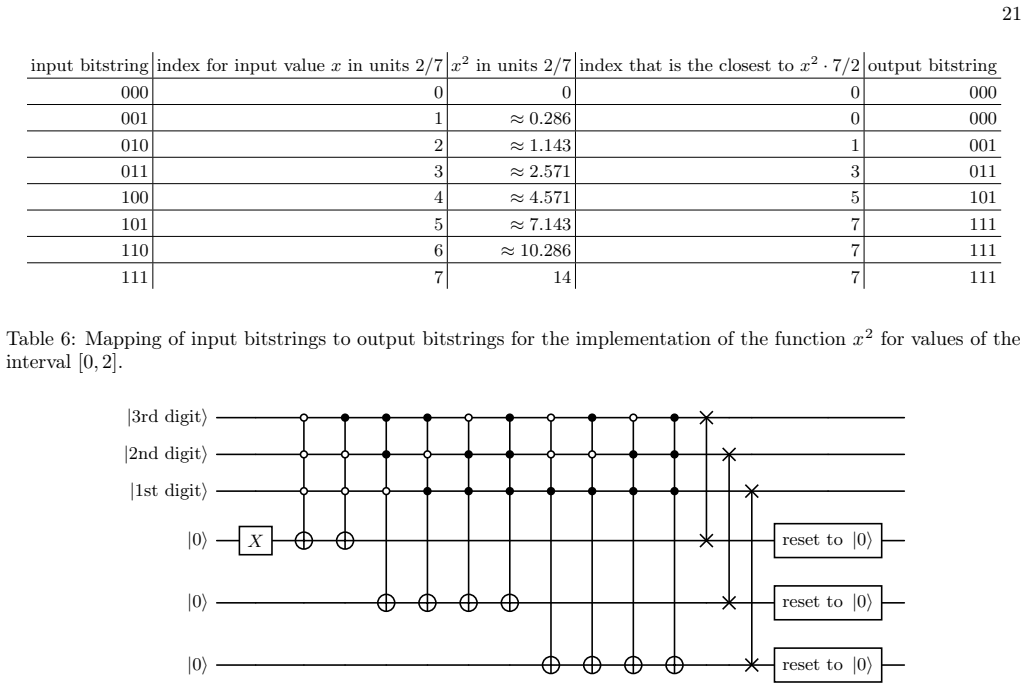
Fig. 13 depicts as well that if it is needed that the input ports are the output ports, the qubit states can be exchanged afterwards via SWAP-gates and the an- cilla qubits can then be reset back to the|0⟩-states from |3rd digit⟩ |2nd digit⟩ |1st digit⟩ |0⟩ reset to|0⟩ |0⟩ X reset to|0⟩ Fig. 14: Specific circuit implementation of the mapping of Table 6 ba...
-
[4]
A Mapping of the Linear Advection Equation to the Bernstein-Vazirani Quantum Algorithm For the potential of QC w.r.t. bitstring encoding, often the conceptual possibility is mentioned that QC allows to feed in all classically possible inputs in parallel and in principle also operate on them simultaneously. A situa- tion that illustrates this relatively we...
-
[5]
V. V. Shende, S. S. Bullock, and I. L. Markov,Syn- thesis of quantum-logic circuits, IEEE Transactions on Computer-Aided Design of Integrated Circuits and Sys- tems25, 6, pp. 1000-1010 (2006)
2006
-
[6]
V. V. Shende, S. S. Bullock, and I. L. Markov,Synthesis of quantum logic circuits, Proceedings of the 2005 Asia and South Pacific Design Automation Conference173, pp. 272-275 (2005)
2005
-
[7]
A. Javadi-Abhari, M. Treinish, K. Krsulich, C. J. Wood, J. Lishman, J. Gacon, S. Martiel, P. D. Na- tion, L. S. Bishop, A. W. Cross, B. R. Johnson, and J. M. Gambetta,Quantum computing with Qiskit, arXiv:2405.08810v3 [quant-ph] (2024)
work page internal anchor Pith review Pith/arXiv arXiv 2024
-
[8]
Succi, W
S. Succi, W. Itani, K. Sreenivasan, and R. Steijl,Quan- tum computing for fluids: Where do we stand?, EPL144, 10001 (2023)
2023
-
[9]
K. P. Griffin, S. S. Jain, T. J. Flint, and W. H. R. Chan,Investigation of quantum algorithms for direct nu- merical simulation of the Navier-Stokes equations, Cen- ter for Turbulence Research Annual Research Briefs, pp. 347–363 (Center for Turbulence Research, Stanford Uni- versity, 2019)
2019
-
[10]
M. A. Nielsen and I. L. Chuang,Quantum Computa- tion and Quantum Information(10th anniversary edi- tion, Cambridge University Press, 2010)
2010
-
[11]
Wawrzyniak, J
D. Wawrzyniak, J. Winter, S. Schmidt, T. Indinger, C. F. Janßen, U. Schramm, and N. A. Adams,A quantum algorithm for the lattice-Boltzmann method advection- diffusion equation, Computer Physics Communications 306, 109373 (2025)
2025
- [12]
-
[13]
Wawrzyniak, J
D. Wawrzyniak, J. Winter, S. Schmidt, T. Indinger, U. Schramm, C. Janßen, and N. A. Adams,Unitary quan- tum algorithm for the lattice-Boltzmann method, 16th World Congress in Computational Mechanics (WCCM), Vancouver, Canada, 2024
2024
-
[14]
P. Over, S. Bengoechea, P. Brearley, S. Laizet, and T. Rung,Quantum algorithm for the advection-diffusion equation by direct block encoding of the time-marching operator, Phys. Rev. A112, L010401 (2025)
2025
-
[15]
Quantum time-marching algorithms for solving linear transport problems including boundary conditions
S. Bengoechea, P. Over, and T. Rung,Quantum time- marching algorithms for solving linear transport prob- lems including boundary conditions, arXiv:2511.04271v1 [quant-ph] (2025)
work page internal anchor Pith review Pith/arXiv arXiv 2025
-
[16]
Nagel and J
A. Nagel and J. Löwe,Quantum lattice boltzmann method for multiple time steps without reinitialization for linear advection-Diffusion problems, Computer Physics Com- munications321, 110040 (2026)
2026
-
[17]
Kocherla, Z
S. Kocherla, Z. Song, F. Ezahra Chrit, B. Gard, E. F. Du- mitrescu, A. Alexeev, and S. H. Bryngelson,Fully quan- tum algorithm for mesoscale fluid simulations with ap- plication to partial differential equations, AVS Quantum Sci.6, 033806 (2024)
2024
-
[18]
Krüger, H
T. Krüger, H. Kusumaatmaja, A. Kuzmin, O. Shardt, G. Silva, E. M. Viggen,The Lattice Boltzmann Method (Springer, 2017)
2017
-
[19]
Succi,The Lattice Boltzmann Equation – For Com- plex States of Flowing Matter(Oxford University Press, 2022)
S. Succi,The Lattice Boltzmann Equation – For Com- plex States of Flowing Matter(Oxford University Press, 2022)
2022
-
[20]
Succi,The Lattice Boltzmann Equation – For Fluid Dynamics and Beyond(Oxford University Press, 2013)
S. Succi,The Lattice Boltzmann Equation – For Fluid Dynamics and Beyond(Oxford University Press, 2013)
2013
-
[21]
M. A. Schalkers and M. Möller,On the importance of data encoding in quantum Boltzmann methods, Quantum Inf. Process.23, 20 (2024)
2024
-
[22]
A. M. Childs and N. Wiebe,Hamiltonian simulation us- ing linear combinations of unitary operations, Quantum Information and Computation12, No. 11 & 12 (2012)
2012
-
[23]
Veltheim and E
O. Veltheim and E. Keski-Vakkuri,Optimizing Quantum Measurements by Partitioning Multisets of Observables, Phys. Rev. Lett.134, 030801 (2025)
2025
-
[24]
Veltheim and E
Supplemental Material of O. Veltheim and E. Keski- Vakkuri,Optimizing Quantum Measurements by Parti- tioning Multisets of Observables, Phys. Rev. Lett.134, 030801 (2025)
2025
-
[25]
Adedoyin, J
Abhijith J., A. Adedoyin, J. Ambrosiano, P. Anisimov, W. Casper, G. Chennupati, C. Coffrin, H. Djidjev, D. Gunter, S. Karra, N. Lemons, S. Lin, A. Malyzhenkov, 28 D. Mascarenas, S. Mniszewski, B. Nadiga, D. O’malley, D. Oyen, S. Pakin, L. Prasad, R. Roberts, P. Romero, N. Santhi, N. Sinitsyn, P. J. Swart, J. G. Wendelberger, B. Yoon, R. Zamora, W. Zhu, S....
2022
-
[26]
https://quantum.cloud.ibm.com/docs/en/guides/set- optimization (accessed 12 February 2026, 10:30 a.m. UTC+1)
2026
-
[27]
Tennie, S
F. Tennie, S. Laizet, S. Lloyd, and L. Magri,Quantum computing for nonlinear differential equations and turbu- lence, Nature Reviews Physics7, pp. 220–230 (2025)
2025
-
[28]
Kandala, K
A. Kandala, K. X. Wei, S. Srinivasan, E. Magesan, S. Carnevale, G. A. Keefe, D. Klaus, O. Dial, and D. C. McKay,Demonstration of a High-Fidelity CNOT Gate for Fixed-Frequency Transmons with Engineered ZZ Sup- pression, Phys. Rev. Lett.127, 130501 (2021)
2021
-
[29]
Tutorial on the quantikz package
A. Kay,Tutorial on the Quantikz Package, arXiv:1809.03842v7 [quant-ph] (2023)
-
[30]
Jaksch, P
D. Jaksch, P. Givi, A. J. Daley, and T. Rung,Variational Quantum Algorithms for Computational Fluid Dynam- ics, AIAA Journal61, 5, pp. 1885–1894 (2023)
2023
-
[31]
Quantum algorithm for nonlinear differential equations.arXiv preprint arXiv:2011.06571, 2020
S. Lloyd, G. De Palma, C. Gokler, B. Kiani, Z.- W. Liu, M. Marvian, F. Tennie, and Tim Palmer, Quantum algorithm for nonlinear differential equations, arXiv:2011.06571v2 [quant-ph] (2020)
-
[32]
M. Lăcătuş and M. Möller,Surrogate Quantum Circuit Design for the Lattice Boltzmann Collision Operator, arXiv:2507.12256v2 [quant-ph] (2025)
discussion (0)
Sign in with ORCID, Apple, or X to comment. Anyone can read and Pith papers without signing in.