Robust quantized thermal conductance of Majorana floating edge bands in d-wave superconductors
Pith reviewed 2026-05-10 19:09 UTC · model grok-4.3
The pith
Floating Majorana edge bands produce quantized thermal conductance in time-reversal-breaking superconductors.
A machine-rendered reading of the paper's core claim, the machinery that carries it, and where it could break.
Core claim
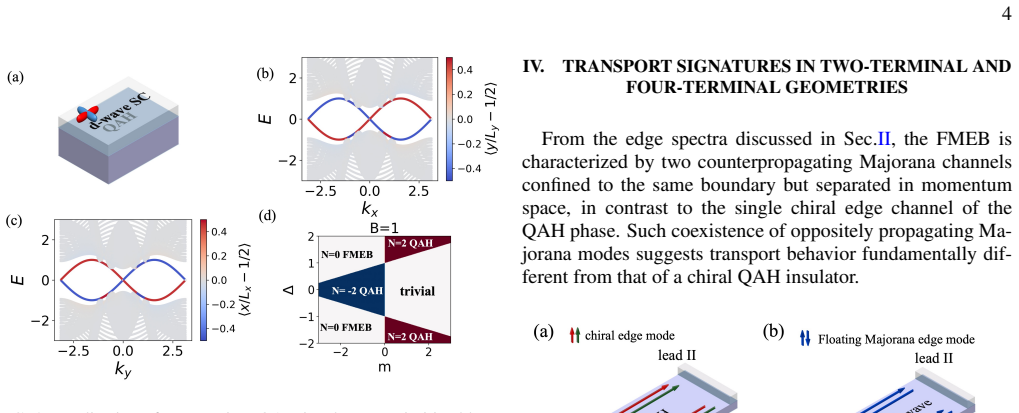
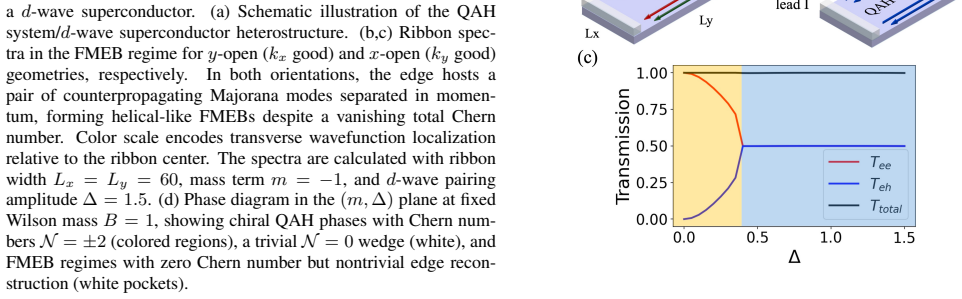
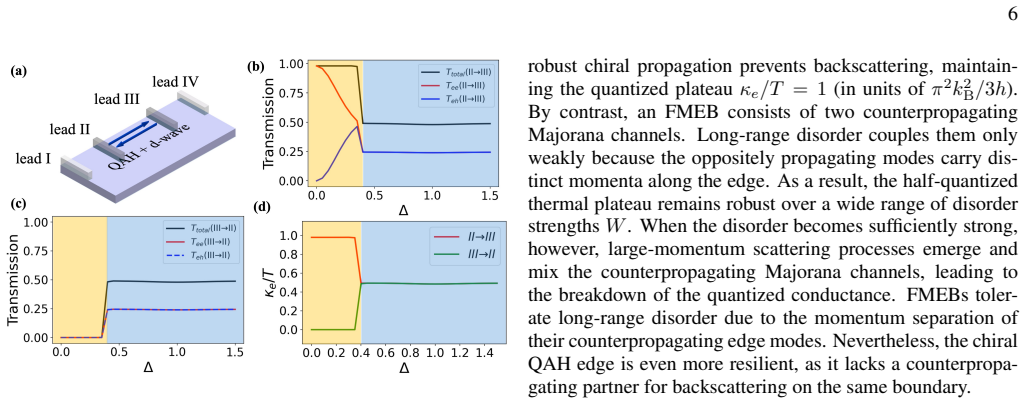
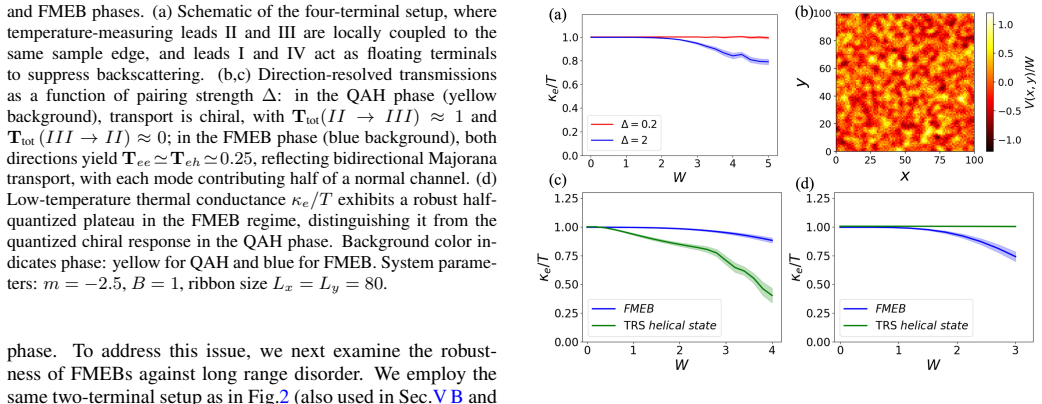
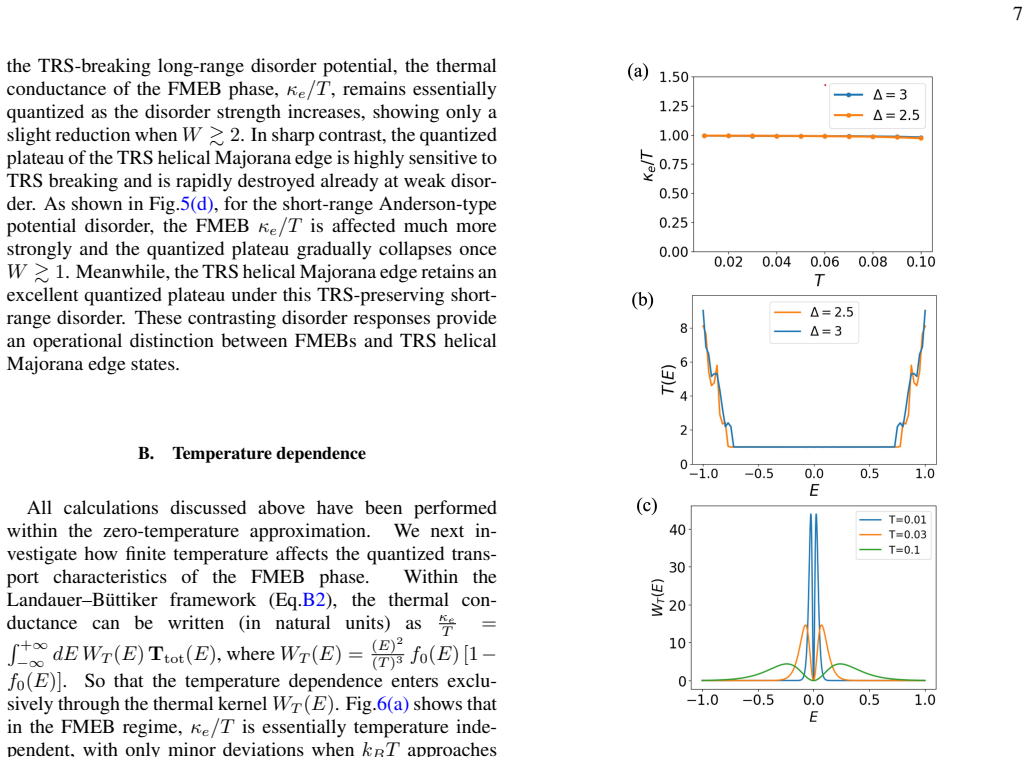
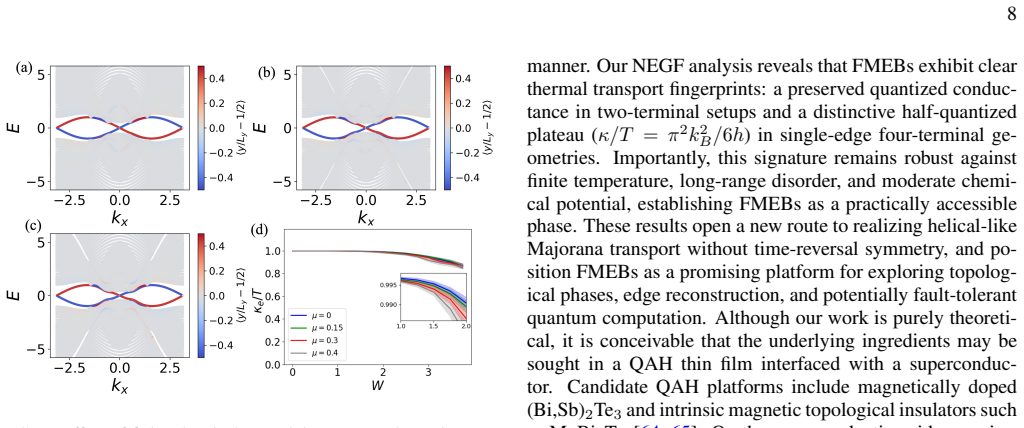
Floating Majorana edge bands form isolated, momentum-separated counterpropagating Majorana modes detached from the bulk continuum. In a quantum anomalous Hall insulator proximitized by a d-wave superconductor, these bands produce a quantized total thermal conductance in two-terminal devices and a robust half-quantized plateau in four-terminal geometries that distinguishes them from chiral N=±2 quantum anomalous Hall phases.
What carries the argument
Floating Majorana edge bands (FMEBs): momentum-separated counterpropagating Majorana modes that remain detached from the bulk continuum and carry the thermal transport.
If this is right
- Quantized total thermal conductance appears in two-terminal devices.
- A robust half-quantized plateau forms in four-terminal geometries.
- The signatures cleanly separate floating Majorana edge bands from chiral N=±2 quantum anomalous Hall phases.
- Thermal response stays stable under finite temperature, moderate long-range disorder, and finite chemical potential.
Where Pith is reading between the lines
- Similar bands may appear in other pairings or material stacks that produce anisotropic masses.
- The half-quantized plateau offers an experimental handle for detecting helical-like Majorana transport in non-time-reversal-symmetric platforms.
- Stability under disorder suggests these modes could be used in devices where conventional chiral or helical edges would be disrupted.
Load-bearing premise
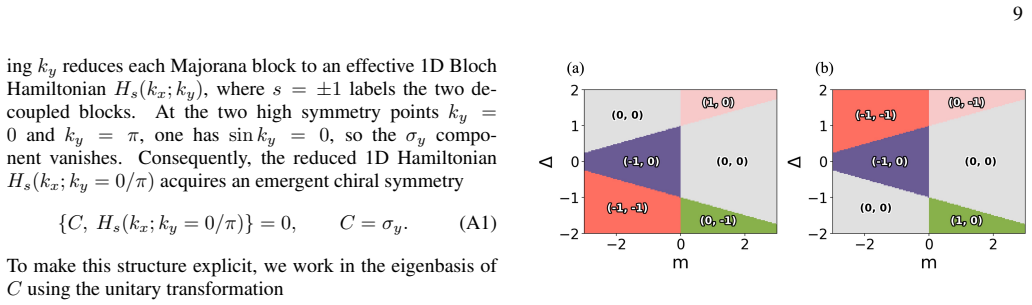
The isolated counterpropagating modes appear only when anisotropic Wilson masses are realized in the two-band Bogoliubov-de Gennes model of a quantum anomalous Hall insulator proximitized by a d-wave superconductor.
What would settle it
Absence of the half-quantized thermal conductance plateau in four-terminal measurements under moderate disorder would rule out the claimed isolation and robustness of the floating Majorana edge bands.
Figures

read the original abstract
We propose and characterize a new class of Majorana boundary states, i.e., floating Majorana edge bands (FMEBs), which emerge in two-dimensional (2D) superconductors that break time-reversal symmetry yet host helical-like transport. In contrast to conventional chiral or helical edge modes, FMEBs form isolated, momentum-separated counterpropagating Majorana modes detached from the bulk continuum. We identify a minimal mechanism for their emergence via anisotropic Wilson masses in a two-band Bogoliubov-de Gennes (BdG) model, and demonstrate their microscopic realization in a quantum anomalous Hall (QAH) insulator proximitized by a $d$-wave superconductor. Using nonequilibrium Green's function (NEGF) simulations, we uncover clear transport fingerprints: a quantized total thermal conductance in two-terminal devices, and a robust half-quantized plateau in four-terminal geometries that cleanly distinguishes FMEBs from chiral $\mathcal{N}= \pm 2$ QAH phases. This thermal response remains remarkably stable under finite temperature, moderate long-range disorder, and finite chemical potential. Our findings establish FMEBs as an experimentally accessible route toward helical-like Majorana transport in systems without time-reversal symmetry, with direct implications for topological quantum computation.
Editorial analysis
A structured set of objections, weighed in public.
Referee Report
Summary. The manuscript proposes floating Majorana edge bands (FMEBs) as a new class of isolated, momentum-separated counterpropagating Majorana modes in time-reversal symmetry breaking 2D superconductors. These emerge via anisotropic Wilson masses in a two-band BdG model microscopically realized by proximitizing a QAH insulator with d-wave superconductivity. NEGF transport simulations are used to demonstrate a quantized total thermal conductance in two-terminal geometries and a robust half-quantized plateau in four-terminal setups that distinguishes FMEBs from chiral N=±2 QAH phases, with the signatures remaining stable under finite temperature, moderate disorder, and finite chemical potential.
Significance. If the isolation of the FMEBs from the bulk continuum holds and the transport quantization is not an artifact, the work identifies a new mechanism for helical-like Majorana transport without TRS, offering clear experimental fingerprints via thermal conductance that could be relevant for topological quantum computation. The use of NEGF to extract falsifiable transport predictions is a positive aspect of the numerical approach.
major comments (2)
- [BdG model and microscopic realization] The central claim that FMEBs remain detached from the bulk continuum (producing the reported quantized conductances) rests on anisotropic Wilson masses in the two-band BdG model. However, d-wave pairing is nodal and momentum-dependent; the manuscript must demonstrate explicitly that the anisotropy opens a full gap at all Brillouin-zone momenta where the floating bands exist and prevents hybridization. Without the bulk dispersion or DOS shown for the microscopic QAH+d-wave realization, the NEGF signatures alone do not establish isolation (see the sections on the minimal mechanism and microscopic realization).
- [NEGF transport simulations] The two-terminal quantized thermal conductance and four-terminal half-quantized plateau are load-bearing for distinguishing FMEBs from chiral phases. The NEGF results should include convergence checks with respect to system size, lead coupling, and disorder averaging, as finite-size effects or partial spectral overlap could mimic quantization without true isolation of counterpropagating modes.
minor comments (1)
- [Abstract and introduction] Clarify the precise definition of 'floating' in the introduction, as the term is used to emphasize detachment from the bulk but could be confused with other edge-state terminology.
Simulated Author's Rebuttal
We thank the referee for the positive evaluation of our work and for the detailed comments, which help clarify the presentation of our results. We address each major comment below and have revised the manuscript to incorporate the requested demonstrations and checks.
read point-by-point responses
-
Referee: [BdG model and microscopic realization] The central claim that FMEBs remain detached from the bulk continuum (producing the reported quantized conductances) rests on anisotropic Wilson masses in the two-band BdG model. However, d-wave pairing is nodal and momentum-dependent; the manuscript must demonstrate explicitly that the anisotropy opens a full gap at all Brillouin-zone momenta where the floating bands exist and prevents hybridization. Without the bulk dispersion or DOS shown for the microscopic QAH+d-wave realization, the NEGF signatures alone do not establish isolation (see the sections on the minimal mechanism and microscopic realization).
Authors: We agree that explicit confirmation of the bulk gap is required to rigorously establish isolation of the FMEBs. In the revised manuscript we add the bulk dispersion and density-of-states plots for both the minimal two-band BdG model (with anisotropic Wilson masses) and the microscopic QAH+d-wave realization. These figures show that the anisotropy produces a full gap at all Brillouin-zone momenta relevant to the floating bands, with no spectral overlap or hybridization channels to the bulk continuum. The added data directly support the NEGF transport results and confirm that the observed quantization originates from truly detached counterpropagating Majorana modes. revision: yes
-
Referee: [NEGF transport simulations] The two-terminal quantized thermal conductance and four-terminal half-quantized plateau are load-bearing for distinguishing FMEBs from chiral phases. The NEGF results should include convergence checks with respect to system size, lead coupling, and disorder averaging, as finite-size effects or partial spectral overlap could mimic quantization without true isolation of counterpropagating modes.
Authors: We appreciate the referee’s emphasis on numerical convergence. The revised manuscript now includes explicit checks: thermal conductance versus system size (up to substantially larger lattices), versus lead-coupling strength, and averaged over an increased number of disorder realizations. These additional results demonstrate that the two-terminal quantization and four-terminal half-quantized plateau converge to the reported values and remain stable, excluding finite-size artifacts or incomplete averaging as explanations. The distinction from chiral N=±2 phases is thereby reinforced. revision: yes
Circularity Check
No significant circularity; derivation is self-contained numerical simulation of explicitly defined BdG model
full rationale
The paper defines a two-band BdG model incorporating anisotropic Wilson masses as the minimal mechanism for FMEBs, then computes transport signatures (quantized thermal conductance, half-quantized plateaus) directly via NEGF simulations on that model. No load-bearing self-citations, no parameters fitted to data and renamed as predictions, and no ansatz or uniqueness theorem imported from prior author work. The results follow from solving the stated Hamiltonian without any step reducing by construction to its own inputs; the central claims rest on explicit numerical output rather than circular redefinition.
Axiom & Free-Parameter Ledger
axioms (2)
- standard math Bogoliubov-de Gennes mean-field description of superconductivity
- standard math Nonequilibrium Green's function formalism for thermal transport
invented entities (1)
-
Floating Majorana edge bands (FMEBs)
no independent evidence
Reference graph
Works this paper leans on
- [1]
-
[2]
M. Sato and Y . Ando, Topological superconductors: a review, Rep. Prog. Phys.80, 076501 (2017)
work page 2017
-
[3]
D. Zhu, T. Jaako, Q. He, and P. Rabl, Quantum computing with superconducting circuits in the picosecond regime, Phys. Rev. Appl.16, 014024 (2021)
work page 2021
-
[4]
D. A. Ivanov, Non-abelian statistics of half-quantum vortices in p-wave superconductors, Phys. Rev. Lett.86, 268 (2001)
work page 2001
-
[6]
A. Y . Kitaev, Unpaired majorana fermions in quantum wires, Physics-Uspekhi44, 131 (2001)
work page 2001
-
[7]
Alicea, New directions in the pursuit of majorana fermions in solid state systems, Rep
J. Alicea, New directions in the pursuit of majorana fermions in solid state systems, Rep. Prog. Phys.75, 076501 (2012)
work page 2012
-
[8]
C. W. Beenakker, Search for majorana fermions in supercon- ductors, Annu. Rev. Condens. Matter Phys.4, 113 (2013)
work page 2013
-
[9]
Y . Han, Y . Yang, J. Cui, and R. Zhao, The impact of single- photon loss on symmetry breaking quantum error correction, Phys. Scr.100, 055101 (2025)
work page 2025
- [10]
-
[11]
S. Deng, L. Viola, and G. Ortiz, Majorana modes in time- reversal invariants-wave topological superconductors, Phys. Rev. Lett.108, 036803 (2012)
work page 2012
- [12]
-
[13]
N. Read and D. Green, Paired states of fermions in two di- mensions with breaking of parity and time-reversal symmetries and the fractional quantum hall effect, Phys. Rev. B61, 10267 (2000)
work page 2000
-
[14]
J. Wang and B. Lian, Multiple chiral majorana fermion modes and quantum transport, Phys. Rev. Lett.121, 256801 (2018)
work page 2018
-
[15]
Z.-X. Li, C. Chan, and H. Yao, Realizing majorana zero modes by proximity effect between topological insulators andd-wave high-temperature superconductors, Phys. Rev. B91, 235143 (2015)
work page 2015
-
[16]
P. Zareapour, A. Hayat, S. Y . Yang, D. Zhao, M. Kreshchuk, N. Jain, Z. Xu, G. Yang, G. Gu, X. Jia, L. Kisslinger, L. Krusin-Elbaum, A. Tsvelik, T. Valla, M. M. Qazilbash, D. N. Basov, L. H. Greene, S. Krishnamoorthy, Y . Kedem, Y . Luba- shevsky, K. West, B. Pang, and J. Wei, Proximity-induced high-temperature superconductivity in the topological insula-...
work page 2012
-
[17]
M.-X. Wang, C. Liu, J.-P. Xu, F. Yang, L. Miao, M.-Y . Yao, C. Gao, C. Shen, X. Ma, X. Chen,et al., The coexistence of superconductivity and topological order in the bi2se3 thin films, Science336, 52 (2012)
work page 2012
-
[18]
H. Zhao, B. Rachmilowitz, Z. Ren, R. Han, J. Schneeloch, R. Zhong, G. Gu, Z. Wang, and I. Zeljkovi ´c, Superconducting proximity effect in a topological insulator using fe(te,se), Phys. Rev. B97, 224504 (2018)
work page 2018
- [19]
-
[20]
R. M. Lutchyn, J. D. Sau, and S. D. Sarma, Majorana fermions and a topological phase transition in semiconductor– superconductor heterostructures, Phys. Rev. Lett105, 077001 (2010)
work page 2010
-
[21]
Y . Oreg, G. Refael, and F. von Oppen, Helical liquids and ma- jorana bound states in quantum wires, Phys. Rev. Lett105, 177002 (2010)
work page 2010
-
[22]
X.-L. Qi, T. L. Hughes, and S.-C. Zhang, Chiral topological superconductor from the quantum hall state, Phys. Rev. B82, 184516 (2010)
work page 2010
- [23]
-
[24]
S. Hart, H. Ren, T. Wagner, P. Leubner, M. M ¨uhlbauer, C. Br¨une, H. Buhmann, L. W. Molenkamp, and A. Yacoby, In- duced superconductivity in the quantum spin hall edge, Nat. Phys.10, 638 (2014)
work page 2014
-
[25]
V . S. Pribiag, A. J. A. Beukman, F. Qu, M. C. Cassidy, C. Char- pentier, W. Wegscheider, and L. P. Kouwenhoven, Edge-mode 11 superconductivity in a two-dimensional topological insulator, Nat. Nanotechnol.10, 593 (2015)
work page 2015
-
[26]
Q. L. He, L. Pan, A. L. Stern, E. C. Burks, X. Che, G. Yin, J. Wang, B. Lian, Q. Zhou, E. S. Choi, K. Murata, X. Kou, Z. Chen, T. Nie, Q. Shao, Y . Fan, S.-C. Zhang, J. Xia, and K. L. Wang, Chiral majorana fermion modes in a quantum anoma- lous hall insulator–superconductor structure, Science357, 294 (2017), retracted
work page 2017
-
[27]
M. Kayyalha, D. Xiao, R. Zhang, Y . Shin, J. Jiang, K. M. Fijalkowski, S. Mandal, M. Winnerlein, C. Gould, K. Brun- ner, S. Grauer, J. Liao, F. Schuba, S. M ¨uhlbauer, I. Siddiqi, G. Bauer, F. Amet, L. W. Molenkamp, C.-Z. Li, J. Wang, C.-X. Liu, and C.-Z. Chang, Absence of evidence for chiral majorana modes in quantum anomalous hall–superconductor structu...
work page 2020
- [28]
-
[29]
W. Ji and X.-G. Wen, 1 2(e2/h)conductance plateau without 1d chiral majorana fermions, Phys. Rev. Lett.120, 107002 (2018)
work page 2018
-
[30]
B. Lian, X.-Q. Sun, A. Vaezi, X.-L. Qi, and S.-C. Zhang, Topological quantum computation based on chiral majorana fermions, Proc. Natl. Acad. Sci. U.S.A.115, 10938 (2018)
work page 2018
-
[31]
J. Shen, J. Lyu, J. Z. Gao, Y .-M. Xie, C.-Z. Chen, C.-W. Cho, O. Atanov, Z. Chen, K. Liu, Y . J. Hu, K. Y . Yip, S. K. Goh, Q. L. He, L. Pan, K. L. Wang, K. T. Law, and R. Lortz, Spectroscopic fingerprint of chiral majorana modes at the edge of a quantum anomalous hall insulator/superconductor heterostructure, Proc. Natl. Acad. Sci. U.S.A.117, 16267 (2020)
work page 2020
-
[32]
M. Banerjee, M. Heiblum, V . Umansky, D. E. Feldman, Y . Oreg, and A. Stern, Observation of half-integer thermal hall conductance, Nature559, 205 (2018)
work page 2018
- [33]
-
[34]
S. H. Simon, Interpretation of thermal conductance of theν= 5/2edge, Phys. Rev. B97, 121406 (2018)
work page 2018
-
[35]
A. Topp, R. Queiroz, A. Gr ¨uneis, L. M ¨uchler, A. Rost, A. Varykhalov, D. Marchenko, M. Krivenkov, F. Rodolakis, J. L. McChesney, B. V . Lotsch, L. M. Schoop, and C. R. Ast, Surface floating 2d bands in layered nonsymmorphic semimet- als: Zrsis and related compounds, Phys. Rev. X7, 041073 (2017)
work page 2017
-
[36]
Z. Zhu, T.-R. Chang, C.-Y . Huang, H. Pan, X.-A. Nie, X.-Z. Wang, Z.-T. Jin, S.-Y . Xu, S.-M. Huang, D.-D. Guan, S. Wang, Y .-Y . Li, C. Liu, D. Qian, W. Ku, F. Song, H. Lin, H. Zheng, and J.-F. Jia, Quasiparticle interference and nonsymmorphic effect on a floating band surface state of zrsise, Nat. Commun.9, 4153 (2018)
work page 2018
-
[37]
S. Ma, Y . Ma, W. Gao, H. Yu, Q. Cheng, and T. J. Cui, Asym- metric frequency multiplexing topological devices based on a floating edge band, Photon. Res.12, 1728 (2024)
work page 2024
-
[38]
Y .-Y . Li and S.-B. Zhang, Floating edge bands in the bernevig- hughes-zhang model with altermagnetism, Phys. Rev. B111, 045106 (2025)
work page 2025
-
[39]
L. ˇSmejkal, J. Sinova, and T. Jungwirth, Emerging research landscape of altermagnetism, Phys. Rev. X12, 040501 (2022)
work page 2022
-
[40]
J. Krempask ´y, L. ˇSmejkal,et al., Altermagnetic lifting of kramers spin degeneracy, Nature626, 517 (2024)
work page 2024
-
[41]
S. Lee, J. Kapeghian, S. Park,et al., Broken kramers degener- acy in altermagnetic mnte, Phys. Rev. Lett.132, 036702 (2024)
work page 2024
-
[43]
D. Nakamura, K. Shiozaki, K. Shimomura, M. Sato, and K. Kawabata, Non-hermitian origin of detachable boundary states in topological insulators, Phys. Rev. Lett.135, 096601 (2025)
work page 2025
-
[44]
J. Ma, C. Ouyang, Y . Yang, D. Wang, H. Li, L. Niu, Y . Liu, Q. Xu, Y . Li, Z. Tian,et al., Asymmetric frequency multiplex- ing topological devices based on a floating edge band, Photon. Res.12, 1201 (2024)
work page 2024
-
[45]
W.-J. Yang, Z.-Z. Yang, X.-Y . Zou, and J.-C. Cheng, Charac- terization and experimental demonstration of corner states of boundary-obstructed topological insulators in a honeycomb lat- tice, Phys. Rev. B107, 174101 (2023)
work page 2023
-
[46]
L. Wang, Y . Jiang, J. Liu, S. Zhang, J. Li, P. Liu, Y . Sun, H. Weng, and X.-Q. Chen, Two-dimensional obstructed atomic insulators with fractional corner charge in theM A 2Z4 family, Phys. Rev. B106, 155144 (2022)
work page 2022
-
[47]
J. Wang, Q. Zhou, B. Lian, and S.-C. Zhang, Chiral topologi- cal superconductor and half-integer conductance plateau from quantum anomalous hall plateau transition, Phys. Rev. B92, 064520 (2015)
work page 2015
- [48]
-
[49]
Y .-H. Li, J. Liu, H. Liu, H. Jiang, Q.-F. Sun, and X. C. Xie, Noise signatures for determining chiral majorana fermion modes, Phys. Rev. B98, 045141 (2018)
work page 2018
-
[50]
X.-L. Qi and S.-C. Zhang, Topological insulators and supercon- ductors, Rev. Mod. Phys.83, 1057 (2011)
work page 2011
-
[51]
Q. Yan, H. Li, J. Zeng, Q.-F. Sun, and X. Xie, A majorana perspective on understanding and identifying axion insulators, Commun. Phys.4, 239 (2021)
work page 2021
-
[52]
J. K. Asb ´oth, L. Oroszl ´any, and A. P ´alyi,A short course on topological insulators, V ol. 919 (Springer, 2016)
work page 2016
-
[53]
Q. Yan, Y .-F. Zhou, and Q.-F. Sun, Electrically tunable chiral majorana edge modes in quantum anomalous hall insulator– topological superconductor systems, Phys. Rev. B100, 235407 (2019)
work page 2019
-
[54]
Y .-H. Wan and Q.-F. Sun, Magnetization-induced phase transi- tions on the surface of three-dimensional topological insulators, Phys. Rev. B109, 045418 (2024)
work page 2024
-
[55]
Y .-H. Wan and Q.-F. Sun, Altermagnetism-induced parity anomaly in weak topological insulators, Phys. Rev. B111, 045407 (2025)
work page 2025
-
[56]
H. Li, H. Jiang, Q.-F. Sun, and X. Xie, Emergent energy dissi- pation in quantum limit, Sci. Bull.69, 1221 (2024)
work page 2024
- [57]
-
[58]
N.-X. Yang, Q. Yan, and Q.-F. Sun, Half-integer quantized ther- mal conductance plateau in chiral topological superconductor systems, Phys. Rev. B105, 125414 (2022)
work page 2022
-
[59]
T. Kawarabayashi, Y . Hatsugai, and H. Aoki, Quantum hall plateau transition in graphene with spatially correlated random hopping, Phys. Rev. Lett.103, 156804 (2009)
work page 2009
- [60]
-
[61]
N.-X. Yang, Y .-F. Zhou, P. Lv, and Q.-F. Sun, Gate voltage con- trolled thermoelectric figure of merit in three-dimensional topo- 12 logical insulator nanowires, Phys. Rev. B97, 235435 (2018)
work page 2018
- [62]
- [63]
-
[64]
C.-Z. Chang, J. Zhang, X. Feng, J. Shen, Z. Zhang, M. Guo, K. Li, Y . Ou, P. Wei, L.-L. Wang, Z.-Q. Ji, Y . Feng, S. Ji, X. Chen, J. Jia, X. Dai, Z. Fang, S.-C. Zhang, K. He, Y . Wang, L. Lu, X.-C. Ma, and Q.-K. Xue, Experimental observation of the quantum anomalous hall effect in a magnetic topological insulator, Science340, 167 (2013)
work page 2013
-
[65]
Y . Deng, Y . Yu, M. Z. Shi, Z. Guo, Z. Xu, J. Wang, X. H. Chen, and Y . Zhang, Quantum anomalous hall effect in intrinsic mag- netic topological insulator mnbi2te4, Science367, 895 (2020)
work page 2020
-
[66]
P. Zareapour, A. Hayat, S. Y . F. Zhao, M. Kreshchuk, A. Jain, D. C. Kwok, N. Lee, S.-W. Cheong, Z. Xu, A. Yang,et al., Proximity-induced high-temperature superconductivity in the topological insulators bi2se3 and bi2te3, Nat. Commun.3, 1056 (2012)
work page 2012
-
[67]
A. Uday, G. Lippertz, K. Moors, H. F. Legg, R. Joris, A. Bliesener, L. M. Pereira, A. Taskin, and Y . Ando, Induced superconducting correlations in a quantum anomalous hall in- sulator, Nat. Phys.20, 1589 (2024)
work page 2024
-
[68]
A. M. Black-Schaffer and A. V . Balatsky, Proximity-induced unconventional superconductivity in topological insulators, Phys. Rev. B87, 220506 (2013)
work page 2013
- [69]
-
[70]
A. Altland, P. W. Brouwer, J. Dieplinger, M. S. Foster, M. Moreno-Gonzalez, and L. Trifunovic, Fragility of surface states in non-wigner-dyson topological insulators, Phys. Rev. X 14, 011057 (2024)
work page 2024
-
[71]
K. Shiozaki, D. Nakamura, K. Shimomura, M. Sato, and K. Kawabata,k-theory classification of wannier localizability and detachable topological boundary states, Phys. Rev. B112, 075152 (2025)
work page 2025
-
[72]
S. Ryu, A. P. Schnyder, A. Furusaki, and A. W. Ludwig, Topo- logical insulators and superconductors: tenfold way and dimen- sional hierarchy, New J. Phys.12, 065010 (2010)
work page 2010
-
[73]
X.-L. Qi, T. L. Hughes, S. Raghu, and S.-C. Zhang, Time- reversal-invariant topological superconductors and superfluids in two and three dimensions, Phys. Rev. Lett.102, 187001 (2009)
work page 2009
discussion (0)
Sign in with ORCID, Apple, or X to comment. Anyone can read and Pith papers without signing in.