Recognition: 2 theorem links
· Lean TheoremTunable superconductivity and spin density wave in La3Ni2O7/LaAlO3 thin films
Pith reviewed 2026-05-10 18:53 UTC · model grok-4.3
The pith
The interlayer nickel-nickel distance tunes the competition between spin density wave order and s± superconductivity in La3Ni2O7 thin films.
A machine-rendered reading of the paper's core claim, the machinery that carries it, and where it could break.
Core claim
For smaller (larger) d_Ni-Ni, the ground state is a C-type (G-type) spin density wave with spins coupled ferromagnetically (antiferromagnetically) across the two layers. Between the two phases, s±-wave superconductivity emerges with dominant pairings between nickel 3d_{3z^2-r^2} orbitals. The results explain the experimental superconductivity in the thin film under ambient pressure, and predict that the applied pressure will decrease the superconducting transition temperature, until the system enters the C-type spin density wave.
What carries the argument
The first-principles electronic structure combined with singular-mode functional renormalization group to track competing instabilities as a function of interlayer Ni-Ni distance.
If this is right
- The substrate in the thin film sets d_Ni-Ni in the intermediate range that allows superconductivity at ambient pressure.
- Further compression by applied pressure reduces d_Ni-Ni and drives the system into the C-type SDW phase.
- The superconducting state has s± symmetry with primary contributions from 3d_{3z^2-r^2} orbitals.
- Experimental confirmation of the predicted sequence would favor itinerant electron descriptions of the magnetism over local-moment pictures.
Where Pith is reading between the lines
- Substrate engineering or epitaxial strain could be used to position other bilayer nickelates inside the superconducting window.
- The strong sensitivity to d_Ni-Ni implies that precise control of out-of-plane lattice spacing offers a general handle for phase competition in layered correlated materials.
- The orbital selectivity of the pairing suggests targeted doping or substitution focused on 3d_{3z^2-r^2} states might further optimize the transition temperature.
Load-bearing premise
The interlayer Ni-Ni distance is the dominant control parameter and the first-principles plus singular-mode functional renormalization group approach reliably identifies which instability wins in this system.
What would settle it
Applying pressure to the La3Ni2O7 thin film and observing whether the superconducting transition temperature decreases until a C-type spin density wave appears instead.
Figures


read the original abstract
Recently, La3Ni2O7 thin film on the LaAlO3 substrate is shown to be superconducting, while the bulk La3Ni2O7 with the same in-plane lattice constant under pressure does not superconduct. This difference suggests the interlayer distance $d_{\rm Ni-Ni}$ is crucial to control superconductivity, and its variation under pressure may tune the ground state sensitively. We investigate systematically the La3Ni2O7/LaAlO3 thin films in a reasonable range of $d_{\rm Ni-Ni}$, by a combination of the first-principle calculations and the singular-mode functional renormalization group. For smaller (larger) $d_{\rm Ni-Ni}$, the ground state is a C-type (G-type) spin density wave with spins coupled ferromagnetically (antiferromagnetically) across the two layers. Between the two phases, $s_\pm$-wave superconductivity emerges with dominant pairings between nickel $3d_{3z^2-r^2}$ orbitals. The results explain the experimental superconductivity in the thin film under ambient pressure, and predict that the applied pressure will decrease the superconducting transition temperature, until the system enters the C-type spin density wave. Experimental verification would provide profound insights into the nature of electron correlations in this system, since the C-type spin density wave is achieved most naturally in the itinerant picture, while it would be hard in the local moment picture where spins are always coupled antiferromagnetically across the layers.
Editorial analysis
A structured set of objections, weighed in public.
Referee Report
Summary. The manuscript investigates La3Ni2O7/LaAlO3 thin films by combining DFT-derived band structures with singular-mode functional renormalization group (SM-FRG) calculations over a range of interlayer Ni-Ni distances d_Ni-Ni. It reports that smaller d_Ni-Ni stabilizes a C-type SDW with ferromagnetic interlayer spin coupling, larger d_Ni-Ni stabilizes a G-type SDW with antiferromagnetic interlayer coupling, and an intervening region hosts s±-wave superconductivity dominated by intra-orbital pairing on Ni 3d_{3z^2-r^2} orbitals. The results are invoked to explain ambient-pressure superconductivity in the thin film (absent in bulk under pressure) and to predict that applied pressure will suppress Tc by driving the system into the C-type SDW phase.
Significance. If the reported phase sequence holds, the work is significant because it identifies d_Ni-Ni as a single structural knob that tunes the SDW-SC competition in bilayer nickelates and supplies a microscopic rationale for the thin-film versus bulk experimental contrast. The DFT+SM-FRG pipeline is largely parameter-free with respect to the hoppings and provides explicit, falsifiable predictions for pressure dependence that can distinguish itinerant versus local-moment pictures of the C-type SDW.
major comments (2)
- [§2 (Methods)] §2 (Methods): The Hubbard interaction parameters (U, U', J, J') and the precise implementation details of the SM-FRG (momentum grid size, number of patches, RG cutoff scale) are not specified, nor are any convergence or sensitivity tests reported. Because the central claim—that varying only d_Ni-Ni (which changes hoppings while interactions remain fixed) drives the C-to-G SDW transition with intervening s± SC—depends on the relative strength of interactions versus bandwidth, the absence of these parameters and checks makes the location and even the existence of the reported phases difficult to assess quantitatively.
- [§4 (Results)] §4 (Results): The identification of the dominant instability (C-type SDW, G-type SDW, or s± SC) relies entirely on the singular-mode FRG without any cross-validation against DMFT, QMC, or other established methods on the same bilayer nickelate model. This is load-bearing for the claim that s± superconductivity emerges between the two SDW phases, as the method's ability to resolve the delicate channel competition in this multi-orbital correlated system remains unbenchmarked.
minor comments (2)
- [Abstract and §1] The abstract and §1 introduce 's±-wave' without stating the explicit momentum-space sign-change pattern of the gap function on the Fermi surface.
- [Figure captions] Figure captions for the gap-function plots would benefit from explicit statements of which orbital components are shown and the color-scale normalization.
Simulated Author's Rebuttal
We thank the referee for the careful reading of our manuscript and the positive assessment of its significance. We address each major comment below and have revised the manuscript to improve clarity and reproducibility.
read point-by-point responses
-
Referee: [§2 (Methods)] §2 (Methods): The Hubbard interaction parameters (U, U', J, J') and the precise implementation details of the SM-FRG (momentum grid size, number of patches, RG cutoff scale) are not specified, nor are any convergence or sensitivity tests reported. Because the central claim—that varying only d_Ni-Ni (which changes hoppings while interactions remain fixed) drives the C-to-G SDW transition with intervening s± SC—depends on the relative strength of interactions versus bandwidth, the absence of these parameters and checks makes the location and even the existence of the reported phases difficult to assess quantitatively.
Authors: We agree that explicit values and convergence information are necessary for quantitative assessment and reproducibility. In the revised manuscript we have expanded §2 with a dedicated paragraph specifying the interaction parameters (U = 2.8 eV, U' = 1.8 eV, J = 0.6 eV, J' = 0.3 eV) taken from cRPA calculations on La3Ni2O7, the SM-FRG discretization (24×24×2 momentum grid, 64 patches), and the RG cutoff (Λ = 10^{-5} in bandwidth units). A new supplementary figure demonstrates that the C-type SDW → s± SC → G-type SDW sequence remains stable under ±10 % variations in U and grid density. These additions directly resolve the concern. revision: yes
-
Referee: [§4 (Results)] §4 (Results): The identification of the dominant instability (C-type SDW, G-type SDW, or s± SC) relies entirely on the singular-mode FRG without any cross-validation against DMFT, QMC, or other established methods on the same bilayer nickelate model. This is load-bearing for the claim that s± superconductivity emerges between the two SDW phases, as the method's ability to resolve the delicate channel competition in this multi-orbital correlated system remains unbenchmarked.
Authors: We acknowledge the desirability of cross-validation. However, unbiased QMC on the full multi-orbital DFT-derived model is hindered by the sign problem at the relevant fillings, while systematic DMFT scans over many d_Ni-Ni values remain computationally prohibitive. SM-FRG has been benchmarked on analogous multi-orbital systems (iron pnictides) where it correctly identifies SDW and s± instabilities. In the revised §4 we have added a paragraph comparing our intra-orbital s± pairing and orbital dominance to existing DMFT results on pressurized bulk La3Ni2O7, noting qualitative consistency. We therefore retain the FRG results while making the methodological limitations explicit. revision: partial
Circularity Check
No significant circularity; results from explicit DFT+SM-FRG numerics on d_Ni-Ni-tuned model
full rationale
The derivation proceeds by first-principles DFT to obtain the band structure and hoppings as a function of interlayer distance d_Ni-Ni, followed by singular-mode functional renormalization group to identify the leading instability (C-type SDW, G-type SDW, or s± SC) in each regime. These are direct numerical outputs of the two-step computational pipeline rather than quantities defined in terms of themselves or obtained by fitting a parameter to the target observable. No self-definitional loops, fitted-input predictions, or load-bearing self-citations that reduce the central claim to an unverified premise appear in the abstract or described methodology. The approach is self-contained against external benchmarks in the sense that the instabilities are computed from the microscopic Hamiltonian without circular re-use of the final phase diagram.
Axiom & Free-Parameter Ledger
axioms (1)
- domain assumption Singular-mode functional renormalization group accurately captures the competition between spin-density-wave and superconducting instabilities in this material.
Lean theorems connected to this paper
-
IndisputableMonolith/Cost/FunctionalEquation.leanwashburn_uniqueness_aczel unclear?
unclearRelation between the paper passage and the cited Recognition theorem.
We perform density functional theory (DFT) calculations... followed by tight-binding fit... We then determine the ground state... by the singular-mode functional renormalization group... We assume the Kanamori relations U = U' + 2JH and JH = JP, and we take the two independent interaction parameters U = 3 eV and JH = 0.3 eV.
-
IndisputableMonolith/Foundation/RealityFromDistinction.leanreality_from_one_distinction unclear?
unclearRelation between the paper passage and the cited Recognition theorem.
For smaller (larger) d_Ni-Ni, the ground state is a C-type (G-type) spin density wave... Between the two phases, s±-wave superconductivity emerges...
What do these tags mean?
- matches
- The paper's claim is directly supported by a theorem in the formal canon.
- supports
- The theorem supports part of the paper's argument, but the paper may add assumptions or extra steps.
- extends
- The paper goes beyond the formal theorem; the theorem is a base layer rather than the whole result.
- uses
- The paper appears to rely on the theorem as machinery.
- contradicts
- The paper's claim conflicts with a theorem or certificate in the canon.
- unclear
- Pith found a possible connection, but the passage is too broad, indirect, or ambiguous to say the theorem truly supports the claim.
Forward citations
Cited by 2 Pith papers
-
Superconductivity in bilayer La$_3$Ni$_2$O$_7$: A review focusing on the strong-coupling Hund's rule assisted pairing mechanism
Superconductivity in La3Ni2O7 arises from interlayer Cooper pairs of 3d_x2-y2 electrons driven by effective J_perp from Hund-assisted AFM exchange transfer, while localized 3d_z2 electrons form rung singlets that prod...
-
Superconductivity in Ruddlesden-Popper nickelates: a review of recent progress, focusing on thin films
The review covers experimental and theoretical progress on superconductivity in Ruddlesden-Popper nickelates, emphasizing ambient-pressure thin-film results in La3Ni2O7.
Reference graph
Works this paper leans on
-
[1]
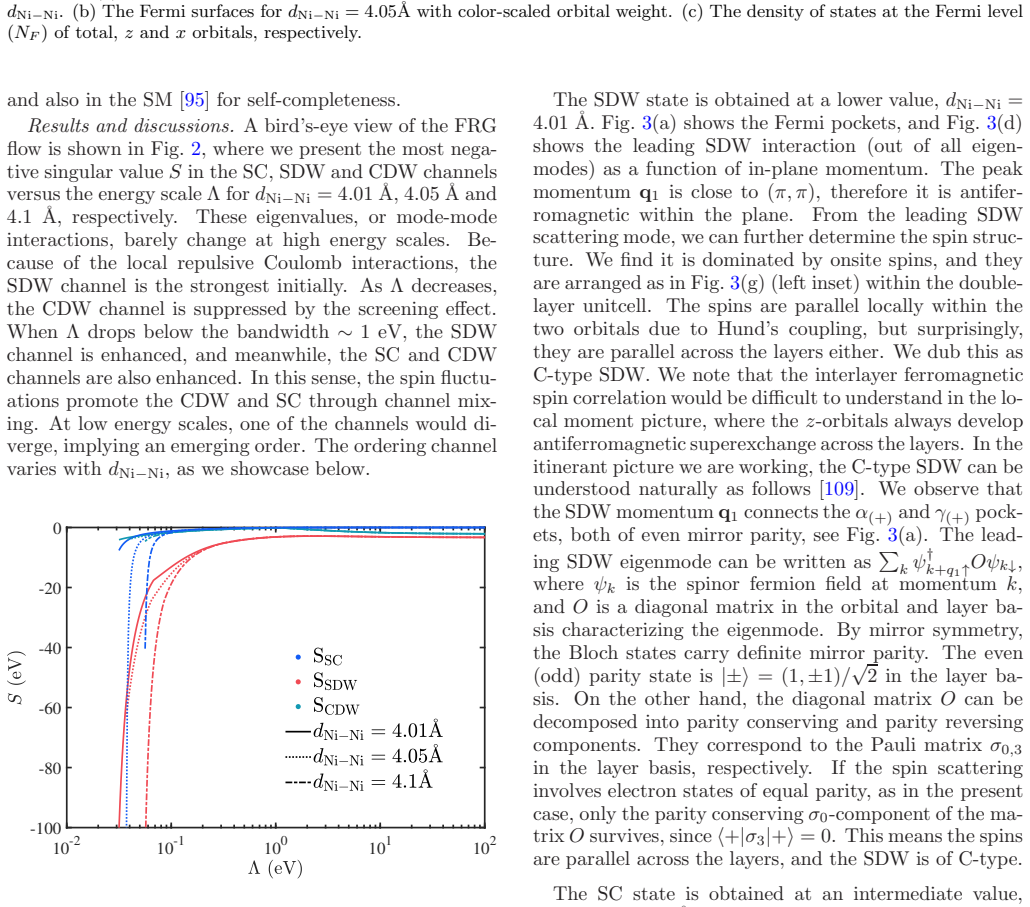
01 ˚ A. Fig. 3(a) shows the Fermi pockets, and Fig. 3(d) shows the leading SDW interaction (out of all eigen- modes) as a function of in-plane momentum. The peak momentum q1 is close to ( π,π ), therefore it is antifer- romagnetic within the plane. From the leading SDW scattering mode, we can further determine the spin struc- ture. We find it is dominated ...
-
[2]
H. Sun, M. Huo, X. Hu, J. Li, Z. Liu, Y. Han, L. Tang, Z. Mao, P. Yang, B. Wang, J. Cheng, D.-X. Yao, G.- M. Zhang, and M. Wang, Signatures of superconduc- tivity near 80 K in a nickelate under high pressure, Nature 621, 493 (2023)
2023
-
[3]
Y. Zhu, D. Peng, E. Zhang, B. Pan, X. Chen, L. Chen, H. Ren, F. Liu, Y. Hao, N. Li, Z. Xing, F. Lan, J. Han, J. Wang, D. Jia, H. Wo, Y. Gu, Y. Gu, L. Ji, W. Wang, H. Gou, Y. Shen, T. Ying, X. Chen, W. Yang, H. Cao, C. Zheng, Q. Zeng, J.-g. Guo, and J. Zhao, Super- conductivity in pressurized trilayer La 4Ni3O10− δ single crystals, Nature 631, 531 (2024)
2024
-
[4]
Li, Y.-J
Q. Li, Y.-J. Zhang, Z.-N. Xiang, Y. Zhang, X. Zhu, and H.-H. Wen, Signature of superconductivity in pressur- ized La 4Ni3O10, Chin. Phys. Lett. 41, 017401 (2024)
2024
-
[5]
X. Chen, J. Choi, Z. Jiang, J. Mei, K. Jiang, J. Li, S. Agrestini, M. Garcia-Fernandez, H. Sun, X. Huang, D. Shen, M. Wang, J. Hu, Y. Lu, K.-J. Zhou, and D. Feng, Electronic and magnetic excitations in La3Ni2O7, Nat. Commun. 15, 9597 (2024)
2024
-
[6]
Z. Liu, M. Huo, J. Li, Q. Li, Y. Liu, Y. Dai, X. Zhou, J. Hao, Y. Lu, M. Wang, and H.-H. Wen, Electronic correlations and partial gap in the bilayer nickelate La3Ni2O7, Nat. Commun. 15, 7570 (2024)
2024
-
[7]
S. Cai, Y. Zhou, H. Sun, K. Zhang, J. Zhao, M. Huo, L. Nataf, Y. Wang, J. Li, J. Guo, K. Jiang, M. Wang, Y. Ding, W. Yang, Y. Lu, Q. Kong, Q. Wu, J. Hu, T. Xiang, H.-k. Mao, and L. Sun, Low-temperature mean valence of nickel ions in pressurized La 3Ni2O7, Phys. Rev. B 111, 104511 (2025)
2025
-
[8]
Y. Li, Y. Cao, L. Liu, P. Peng, H. Lin, C. Pei, M. Zhang, H. Wu, X. Du, W. Zhao, K. Zhai, X. Zhang, J. Zhao, M. Lin, P. Tan, Y. Qi, G. Li, H. Guo, L. Yang, and L. Yang, Distinct ultrafast dynamics of bilayer and tri- layer nickelate superconductors regarding the density- wave-like transitions, Sci. Bull. 70, 180 (2025)
2025
-
[9]
Hou, P.-T
J. Hou, P.-T. Yang, Z.-Y. Liu, J.-Y. Li, P.-F. Shan, L. Ma, G. Wang, N.-N. Wang, H.-Z. Guo, J.-P. Sun, 6 Y. Uwatoko, M. Wang, G.-M. Zhang, B.-S. Wang, and J.-G. Cheng, Emergence of high-temperature su- perconducting phase in pressurized La 3Ni2O7 crystals, Chin. Phys. Lett. 40, 117302 (2023)
2023
-
[10]
Zhang, D
Y. Zhang, D. Su, Y. Huang, Z. Shan, H. Sun, M. Huo, K. Ye, J. Zhang, Z. Yang, Y. Xu, Y. Su, R. Li, M. Smidman, M. Wang, L. Jiao, and H. Yuan, High-temperature superconductivity with zero resis- tance and strange-metal behaviour in La 3Ni2O7− δ , Nat. Phys. 20, 1269 (2024)
2024
-
[11]
Zhang, C
M. Zhang, C. Pei, Q. Wang, Y. Zhao, C. Li, W. Cao, S. Zhu, J. Wu, and Y. Qi, Effects of pressure and doping on Ruddlesden-Popper phases La n+1NinO3n+1, J. Mater. Sci. Technol. 185, 147 (2024)
2024
-
[12]
N. Wang, G. Wang, X. Shen, J. Hou, J. Luo, X. Ma, H. Yang, L. Shi, J. Dou, J. Feng, J. Yang, Y. Shi, Z. Ren, H. Ma, P. Yang, Z. Liu, Y. Liu, H. Zhang, X. Dong, Y. Wang, K. Jiang, J. Hu, S. Nagasaki, K. Kita- gawa, S. Calder, J. Yan, J. Sun, B. Wang, R. Zhou, Y. Uwatoko, and J. Cheng, Bulk high-temperature su- perconductivity in pressurized tetragonal La 2...
2024
-
[13]
L. Wang, Y. Li, S.-Y. Xie, F. Liu, H. Sun, C. Huang, Y. Gao, T. Nakagawa, B. Fu, B. Dong, Z. Cao, R. Yu, S. I. Kawaguchi, H. Kadobayashi, M. Wang, C. Jin, H.-k. Mao, and H. Liu, Struc- ture responsible for the superconducting state in La3Ni2O7 at high-pressure and low-temperature condi- tions, J. Am. Chem. Soc. 146, 7506 (2024)
2024
-
[14]
Y. Zhou, J. Guo, S. Cai, H. Sun, C. Li, J. Zhao, P. Wang, J. Han, X. Chen, Y. Chen, Q. Wu, Y. Ding, T. Xiang, H.-k. Mao, and L. Sun, Investigations of key issues on the reproducibility of high-T c su- perconductivity emerging from compressed La 3Ni2O7, Matter Radiat. Extremes 10, 027801 (2025)
2025
-
[15]
T. Cui, S. Choi, T. Lin, C. Liu, G. Wang, N. Wang, S. Chen, H. Hong, D. Rong, Q. Wang, Q. Jin, J.- O. Wang, L. Gu, C. Ge, C. Wang, J.-G. Cheng, Q. Zhang, L. Si, K.-j. Jin, and E.-J. Guo, Strain- mediated phase crossover in Ruddlesden-Popper nick- elates, Commun. Mater. 5, 32 (2024)
2024
-
[16]
K. Chen, X. Liu, J. Jiao, M. Zou, C. Jiang, X. Li, Y. Luo, Q. Wu, N. Zhang, Y. Guo, and L. Shu, Evidence of spin density waves in La 3Ni2O7− δ , Phys. Rev. Lett. 132, 256503 (2024)
2024
-
[17]
X. Chen, J. Zhang, A. S. Thind, S. Sharma, H. LaBol- lita, G. Peterson, H. Zheng, D. P. Phelan, A. S. Botana, R. F. Klie, and J. F. Mitchell, Polymorphism in the Ruddlesden-Popper nickelate La 3Ni2O7: Discov- ery of a hidden phase with distinctive layer stacking, J. Am. Chem. Soc. 146, 3640 (2024)
2024
-
[18]
Puphal, P
P. Puphal, P. Reiss, N. Enderlein, Y.-M. Wu, G. Khal- iullin, V. Sundaramurthy, T. Priessnitz, M. Knauft, A. Suthar, L. Richter, M. Isobe, P. A. van Aken, H. Tak- agi, B. Keimer, Y. E. Suyolcu, B. Wehinger, P. Hans- mann, and M. Hepting, Unconventional crystal struc- ture of the high-pressure superconductor La 3Ni2O7, Phys. Rev. Lett. 133, 146002 (2024)
2024
-
[19]
H. Wang, L. Chen, A. Rutherford, H. Zhou, and W. Xie, Long-range structural order in a hidden phase of Ruddlesden-Popper bilayer nickelate La 3Ni2O7, Inorg. Chem. 63, 5020 (2024)
2024
-
[20]
Kakoi, T
M. Kakoi, T. Oi, Y. Ohshita, M. Yashima, K. Kuroki, T. Kato, H. Takahashi, S. Ishiwata, Y. Adachi, N. Hatada, T. Uda, and H. Mukuda, Multiband metal- lic ground state in multilayered nickelates La 3Ni2O7 and La4Ni3O10 probed by 139La-NMR at ambient pressure, J. Phys. Soc. Jpn. 93, 053702 (2024)
2024
-
[21]
insula- tor–metal–insulator
M. Xu, S. Huyan, H. Wang, S. L. Bud’ko, X. Chen, X. Ke, J. F. Mitchell, P. C. Can- field, J. Li, and W. Xie, Pressure-dependent “insula- tor–metal–insulator” behavior in Sr-doped La 3Ni2O7, Adv. Electron. Mater. 10, 2400078 (2024)
2024
-
[22]
Z. Dong, M. Huo, J. Li, J. Li, P. Li, H. Sun, L. Gu, Y. Lu, M. Wang, Y. Wang, and Z. Chen, Visualiza- tion of oxygen vacancies and self-doped ligand holes in La3Ni2O7− δ , Nature 630, 847 (2024)
2024
-
[23]
Talantsev and V
E. Talantsev and V. Chistyakov, Debye temper- ature, electron-phonon coupling constant, and three-dome shape of crystalline strain as a func- tion of pressure in highly compressed La 3Ni2O7− δ , Lett. Mater. 14, 262 (2024)
2024
-
[24]
Geisler, L
B. Geisler, L. Fanfarillo, J. J. Hamlin, G. R. Stewart, R. G. Hennig, and P. J. Hirschfeld, Optical properties and electronic correlations in La3Ni2O7 bilayer nickelates under high pressure, npj Quantum Mater. 9, 89 (2024)
2024
-
[25]
J. Yang, H. Sun, X. Hu, Y. Xie, T. Miao, H. Luo, H. Chen, B. Liang, W. Zhu, G. Qu, C.-Q. Chen, M. Huo, Y. Huang, S. Zhang, F. Zhang, F. Yang, Z. Wang, Q. Peng, H. Mao, G. Liu, Z. Xu, T. Qian, D.-X. Yao, M. Wang, L. Zhao, and X. J. Zhou, Orbital-dependent electron correlation in double-layer nickelate La 3Ni2O7, Nat. Commun. 15, 4373 (2024)
2024
-
[26]
Takegami, K
D. Takegami, K. Fujinuma, R. Nakamura, M. Yoshimura, K.-D. Tsuei, G. Wang, N. N. Wang, J.-G. Cheng, Y. Uwatoko, and T. Mizokawa, Ab- sence of Ni 2+/ Ni3+ charge disproportionation and possible roles of O 2 p holes in La 3Ni2O7− δ re- vealed by hard x-ray photoemission spectroscopy, Phys. Rev. B 109, 125119 (2024)
2024
-
[27]
G. Wang, N. N. Wang, X. L. Shen, J. Hou, L. Ma, L. F. Shi, Z. A. Ren, Y. D. Gu, H. M. Ma, P. T. Yang, Z. Y. Liu, H. Z. Guo, J. P. Sun, G. M. Zhang, S. Calder, J.-Q. Yan, B. S. Wang, Y. Uwatoko, and J.-G. Cheng, Pressure-induced superconductivity in polycrys- talline La 3Ni2O7− δ , Phys. Rev. X 14, 011040 (2024)
2024
-
[28]
J. Li, D. Peng, P. Ma, H. Zhang, Z. Xing, X. Huang, C. Huang, M. Huo, D. Hu, Z. Dong, X. Chen, T. Xie, H. Dong, H. Sun, Q. Zeng, H.-k. Mao, and M. Wang, Identification of superconductivity in bilayer nicke- late La 3Ni2O7 under high pressure up to 100 GPa, Natl. Sci. Rev. 12, nwaf220 (2025)
2025
-
[29]
M. Shi, Y. Li, Y. Wang, D. Peng, S. Yang, H. Li, K. Fan, K. Jiang, J. He, Q. Zeng, D. Song, B. Ge, Z. Xiang, Z. Wang, J. Ying, T. Wu, and X. Chen, Absence of superconductivity and density-wave transition in ambient-pressure tetragonal La4Ni3O10, Nat. Commun. 16, 2887 (2025)
2025
-
[30]
Khasanov, I
R. Khasanov, I. Plokhikh, T. J. Hicken, H. Luetkens, D. J. Gawryluk, and Z. Guguchia, Pressure effect on the spin density wave transition in La 2PrNi2O6. 96, Phys. Rev. Res. 7, L022046 (2025)
2025
-
[31]
S. F. R. TenHuisen, G. A. Pan, Q. Song, D. R. Baykusheva, D. Ferenc Segedin, B. H. Goodge, H. Paik, J. Pelliciari, V. Bisogni, Y. Gu, S. Agres- tini, A. Nag, M. Garc ´ ıa-Fern´ andez, K.-J. Zhou, L. F. Kourkoutis, C. M. Brooks, J. A. Mundy, 7 M. P. M. Dean, and M. Mitrano, Magnetic exci- tations in Nd n+1NinO3n+1 ruddlesden-popper nicke- lates observed vi...
2025
-
[32]
Y. Meng, Y. Yang, H. Sun, S. Zhang, J. Luo, L. Chen, X. Ma, M. Wang, F. Hong, X. Wang, and X. Yu, Density-wave-like gap evolution in La 3Ni2O7 under high pressure revealed by ultrafast optical spectroscopy, Nat. Commun. 15, 10408 (2024)
2024
-
[33]
M. Shi, D. Peng, Y. Li, S. Yang, Z. Xing, Y. Wang, K. Fan, H. Li, R. Wu, B. Ge, Z. Zeng, Q. Zeng, J. Ying, T. Wu, and X. Chen, Spin density wave rather than tetragonal structure is prerequisite for superconductiv- ity in La3Ni2O7- δ, Nat. Commun. 16, 9141 (2025)
2025
-
[34]
D. Zhao, Y. Zhou, M. Huo, Y. Wang, L. Nie, Y. Yang, J. Ying, M. Wang, T. Wu, and X. Chen, Pressure- enhanced spin-density-wave transition in double-layer nickelate La 3Ni2O7− δ , Sci. Bull. 70, 1239 (2025)
2025
-
[35]
G. Wang, N. Wang, T. Lu, S. Calder, J. Yan, L. Shi, J. Hou, L. Ma, L. Zhang, J. Sun, B. Wang, S. Meng, M. Liu, and J. Cheng, Chemical versus physical pressure effects on the structure transition of bilayer nickelates, npj Quantum Mater. 10, 1 (2025)
2025
-
[36]
Zhang, C
M. Zhang, C. Pei, D. Peng, X. Du, W. Hu, Y. Cao, Q. Wang, J. Wu, Y. Li, H. Liu, C. Wen, J. Song, Y. Zhao, C. Li, W. Cao, S. Zhu, Q. Zhang, N. Yu, P. Cheng, L. Zhang, Z. Li, J. Zhao, Y. Chen, C. Jin, H. Guo, C. Wu, F. Yang, Q. Zeng, S. Yan, L. Yang, and Y. Qi, Superconductivity in trilayer nickelate La 4Ni3O10 under pressure, Phys. Rev. X 15, 021005 (2025)
2025
-
[37]
Y. Chen, K. Zhang, M. Xu, Y. Zhao, H. Xiao, and L. Qiao, Oxygen deficiency mechanism of La 3Ni2O7− δ under pressure, Sci. China-Phys. Mech. Astron. 68, 247411 (2025)
2025
-
[38]
Abadi, K.-J
S. Abadi, K.-J. Xu, E. G. Lomeli, P. Puphal, M. Isobe, Y. Zhong, A. V. Fedorov, S.-K. Mo, M. Hashimoto, D.-H. Lu, B. Moritz, B. Keimer, T. P. Devereaux, M. Hepting, and Z.-X. Shen, Electronic structure of the alternating monolayer-trilayer phase of La 3Ni2O7, Phys. Rev. Lett. 134, 126001 (2025)
2025
-
[39]
S. Xu, H. Wang, M. Huo, D. Hu, Q. Wu, L. Yue, D. Wu, M. Wang, T. Dong, and N. Wang, Collapse of density wave and emergence of superconductivity in pressurized-La 4Ni3O10 evidenced by ultrafast spec- troscopy, Nat. Commun. 16, 7039 (2025)
2025
-
[40]
C. Liu, M. Huo, H. Yang, Q. Li, Y. Zhang, Z. Xi- ang, M. Wang, and H.-H. Wen, Andreev reflection in superconducting state of pressurized La 3Ni2O7, Sci. China-Phys. Mech. Astron. 68, 247412 (2025)
2025
-
[41]
F. Li, Z. Xing, D. Peng, J. Dou, N. Guo, L. Ma, Y. Zhang, L. Wang, J. Luo, J. Yang, J. Zhang, T. Chang, Y.-S. Chen, W. Cai, J. Cheng, Y. Wang, Y. Liu, T. Luo, N. Hirao, T. Matsuoka, H. Kadobayashi, Z. Zeng, Q. Zheng, R. Zhou, Q. Zeng, X. Tao, and J. Zhang, Bulk superconductivity up to 96 k in pressur- ized nickelate single crystals, Nature 649, 871 (2025)
2025
-
[42]
Zhang, D
E. Zhang, D. Peng, Y. Zhu, L. Chen, B. Cui, X. Wang, W. Wang, Q. Zeng, and J. Zhao, Bulk superconduc- tivity in pressurized trilayer nickelate Pr 4Ni3O10 single crystals, Phys. Rev. X 15, 021008 (2025)
2025
-
[43]
Wang, H.-H
M. Wang, H.-H. Wen, T. Wu, D.-X. Yao, and T. Xiang, Normal and superconducting properties of La 3Ni2O7, Chin. Phys. Lett. 41, 077402 (2024)
2024
-
[44]
Y. Wang, K. Jiang, J. Ying, T. Wu, J. Cheng, J. Hu, and X. Chen, Recent progress in nickelate superconductors, National Science Review 12, nwaf373 (2025)
2025
-
[45]
Z. Luo, X. Hu, M. Wang, W. W´ u, and D.-X. Yao, Bi- layer two-orbital model of La 3Ni2O7 under pressure, Phys. Rev. Lett. 131, 126001 (2023)
2023
-
[46]
Q.-G. Yang, D. Wang, and Q.-H. Wang, Pos- sible s± -wave superconductivity in La 3Ni2O7, Phys. Rev. B 108, L140505 (2023)
2023
-
[47]
Sakakibara, N
H. Sakakibara, N. Kitamine, M. Ochi, and K. Kuroki, Possible high Tc superconductivity in La3Ni2O7 under high pressure through manifesta- tion of a nearly half-filled bilayer Hubbard model, Phys. Rev. Lett. 132, 106002 (2024)
2024
-
[48]
Y. Gu, C. Le, Z. Yang, X. Wu, and J. Hu, Effective model and pairing tendency in the bilayer Ni-based superconductor La 3Ni2O7, Phys. Rev. B 111, 174506 (2025)
2025
-
[49]
Christiansson, F
V. Christiansson, F. Petocchi, and P. Werner, Corre- lated electronic structure of La 3Ni2O7 under pressure, Phys. Rev. Lett. 131, 206501 (2023)
2023
-
[50]
Cao and Y.-f
Y. Cao and Y.-f. Yang, Flat bands promoted by Hund’s rule coupling in the candidate double-layer high- temperature superconductor La 3Ni2O7 under high pres- sure, Phys. Rev. B 109, L081105 (2024)
2024
-
[51]
X. Chen, P. Jiang, J. Li, Z. Zhong, and Y. Lu, Charge and spin instabilities in superconducting La 3Ni2O7, Phys. Rev. B 111, 014515 (2025)
2025
-
[52]
Liu, J.-W
Y.-B. Liu, J.-W. Mei, F. Ye, W.-Q. Chen, and F. Yang, s± -wave pairing and the destructive role of apical-oxygen deficiencies in La 3Ni2O7 under pressure, Phys. Rev. Lett. 131, 236002 (2023)
2023
-
[53]
C. Lu, Z. Pan, F. Yang, and C. Wu, Interlayer-coupling- driven high-temperature superconductivity in La 3Ni2O7 under pressure, Phys. Rev. Lett. 132, 146002 (2024)
2024
-
[54]
Ouyang, M
Z. Ouyang, M. Gao, and Z.-Y. Lu, Absence of electron-phonon coupling superconductivity in the bilayer phase of La 3Ni2O7 under pressure, npj Quantum Mater. 9, 80 (2024)
2024
-
[55]
Zhang, L.-F
Y. Zhang, L.-F. Lin, A. Moreo, T. A. Maier, and E. Dagotto, Structural phase transition, s± - wave pairing, and magnetic stripe order in bi- layered superconductor La 3Ni2O7 under pressure, Nat. Commun. 15, 2470 (2024)
2024
-
[56]
X.-W. Yi, Y. Meng, J.-W. Li, Z.-W. Liao, W. Li, J.-Y. You, B. Gu, and G. Su, Nature of charge density waves and metal-insulator transition in pressurized La 3Ni2O7, Phys. Rev. B 110, L140508 (2024)
2024
-
[57]
Z. Liao, L. Chen, G. Duan, Y. Wang, C. Liu, R. Yu, and Q. Si, Electron correlations and su- perconductivity in La 3Ni2O7 under pressure tuning, Phys. Rev. B 108, 214522 (2023)
2023
-
[58]
Qu, D.-W
X.-Z. Qu, D.-W. Qu, J. Chen, C. Wu, F. Yang, W. Li, and G. Su, Bilayer t− J− J ⊥ model and magnetically mediated pairing in the pressurized nickelate La 3Ni2O7, Phys. Rev. Lett. 132, 036502 (2024)
2024
-
[59]
Yang, G.-M
Y.-f. Yang, G.-M. Zhang, and F.-C. Zhang, Inter- layer valence bonds and two-component theory for high-Tc superconductivity of La 3Ni2O7 under pressure, Phys. Rev. B 108, L201108 (2023)
2023
-
[60]
Jiang, Z
K. Jiang, Z. Wang, and F.-C. Zhang, High- temperature superconductivity in La 3Ni2O7, Chin. Phys. Lett. 41, 017402 (2024)
2024
-
[61]
Huang, Z
J. Huang, Z. D. Wang, and T. Zhou, Impurity and vor- tex states in the bilayer high-temperature superconduc- 8 tor La 3Ni2O7, Phys. Rev. B 108, 174501 (2023)
2023
-
[62]
Qin and Y.-F
Q. Qin and Y.-F. Yang, High- Tc superconductiv- ity by mobilizing local spin singlets and possi- ble route to higher Tc in pressurized La 3Ni2O7, Phys. Rev. B 108, L140504 (2023)
2023
-
[63]
Zhang, H.-K
J.-X. Zhang, H.-K. Zhang, Y.-Z. You, and Z.-Y. Weng, Strong pairing originated from an emergent Z 2 berry phase in La 3Ni2O7, Phys. Rev. Lett. 133, 126501 (2024)
2024
-
[64]
C. Xia, H. Liu, S. Zhou, and H. Chen, Sensitive de- pendence of pairing symmetry on Ni-e g crystal field splitting in the nickelate superconductor La 3Ni2O7, Nat. Commun. 16, 1054 (2025)
2025
-
[65]
Ouyang, J.-M
Z. Ouyang, J.-M. Wang, J.-X. Wang, R.-Q. He, L. Huang, and Z.-Y. Lu, Hund electronic correlation in La 3Ni2O7 under high pressure, Phys. Rev. B 109, 115114 (2024)
2024
-
[66]
Fan, J.-F
Z. Fan, J.-F. Zhang, B. Zhan, D. Lv, X.-Y. Jiang, B. Normand, and T. Xiang, Superconductivity in nick- elate and cuprate superconductors with strong bilayer coupling, Phys. Rev. B 110, 024514 (2024)
2024
-
[67]
S. Ryee, N. Witt, and T. O. Wehling, Quenched pair breaking by interlayer correlations as a key to superconductivity in La 3Ni2O7, Phys. Rev. Lett. 133, 096002 (2024)
2024
-
[68]
B¨ otzel, F
S. B¨ otzel, F. Lechermann, J. Gondolf, and I. M. Eremin, Theory of magnetic excitations in the multilayer nickelate superconductor La 3Ni2O7, Phys. Rev. B 109, L180502 (2024)
2024
-
[69]
Xue and F
J.-R. Xue and F. Wang, Magnetism and su- perconductivity in the t-J model of La 3Ni2O7 under multiband Gutzwiller approximation, Chin. Phys. Lett. 41, 057403 (2024)
2024
-
[70]
Geisler, J
B. Geisler, J. J. Hamlin, G. R. Stewart, R. G. Hennig, and P. J. Hirschfeld, Structural transitions, octahedral rotations, and electronic properties of A3Ni2O7 rare-earth nickelates under high pressure, npj Quantum Mater. 9, 38 (2024)
2024
-
[71]
Jiang, J
R. Jiang, J. Hou, Z. Fan, Z.-J. Lang, and W. Ku, Pressure driven fractionalization of ionic spins results in cupratelike high- Tc superconductivity in La 3Ni2O7, Phys. Rev. Lett. 132, 126503 (2024)
2024
-
[72]
B¨ otzel, F
S. B¨ otzel, F. Lechermann, T. Shibauchi, and I. M. Eremin, Theory of potential impurity scat- tering in pressurized superconducting La 3Ni2O7, Commun. Phys. 8, 154 (2025)
2025
-
[73]
Z. Huo, P. Zhang, H. Shi, X. Yan, D. Duan, and T. Cui, First-principles study of the Pr-doped bilayer nickelate La3Ni2O7, Phys. Rev. B 111, 195118 (2025)
2025
-
[74]
Xi, S.-L
W. Xi, S.-L. Yu, and J.-X. Li, Transition from s± - wave to dx2− y2 -wave superconductivity driven by in- terlayer interaction in the bilayer two-orbital model of La3Ni2O7, Phys. Rev. B 111, 104505 (2025)
2025
-
[75]
J. Zhan, Y. Gu, X. Wu, and J. Hu, Cooper- ation between electron-phonon coupling and elec- tronic interaction in bilayer nickelates La 3Ni2O7, Phys. Rev. Lett. 134, 136002 (2025)
2025
-
[76]
Zhang, H
M. Zhang, H. Sun, Y.-B. Liu, Q. Liu, W.-Q. Chen, and F. Yang, s± -wave superconductivity in pressurized La4Ni3O10, Phys. Rev. B 110, L180501 (2024)
2024
-
[77]
Y.-Q. Liu, D. Wang, and Q.-H. Wang, Variational quan- tum monte carlo investigations of the superconducting pairing in La 3Ni2O7, Phys. Rev. B 112, 014511 (2025)
2025
-
[78]
Jiang, Y.-H
K.-Y. Jiang, Y.-H. Cao, Q.-G. Yang, H.-Y. Lu, and Q.-H. Wang, Theory of pressure dependence of superconductivity in bilayer nickelate La 3Ni2O7, Phys. Rev. Lett. 134, 076001 (2025)
2025
-
[79]
X.-W. Yi, W. Li, J.-Y. You, B. Gu, and G. Su, Unifying strain- and pressure-driven superconduc- tivity in La 3Ni2O7: Suppressed charge and spin density waves and enhanced interlayer coupling, Phys. Rev. B 112, L140504 (2025)
2025
-
[80]
G. Zhou, W. Lv, H. Wang, Z. Nie, Y. Chen, Y. Li, H. Huang, W.-Q. Chen, Y.-J. Sun, Q.-K. Xue, and Z. Chen, Ambient-pressure superconductivity onset above 40 K in (La,Pr) 3Ni2O7, Nature 640, 641 (2025)
2025
discussion (0)
Sign in with ORCID, Apple, or X to comment. Anyone can read and Pith papers without signing in.