Recognition: no theorem link
CVT Archives and Chemical Embedding Measures for Multi-Objective Quality Diversity in Molecular Design
Pith reviewed 2026-05-10 19:10 UTC · model grok-4.3
The pith
CVT archives defined by chemical embeddings outperform uniform grids in multi-objective NLO molecular design.
A machine-rendered reading of the paper's core claim, the machinery that carries it, and where it could break.
Core claim
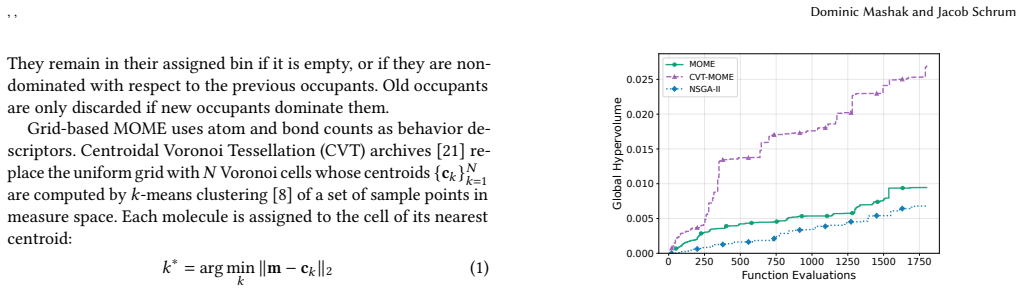
Embedding-based measures in CVT archives yield significantly higher median global hypervolume and multi-objective quality diversity scores, while filling nearly all native archive niches, for the four-objective nonlinear optical molecular design problem.
What carries the argument
Centroidal Voronoi Tessellation (CVT) archives with cells defined by UMAP-reduced ChemBERTa-2 embeddings that capture chemical similarity.
Load-bearing premise
The UMAP-reduced ChemBERTa-2 embeddings meaningfully capture chemical similarity relevant to the four NLO objectives.
What would settle it
A direct comparison showing no significant difference in hypervolume or niche coverage when using uniform grid archives versus the embedding-based CVT on the same NLO design task.
Figures


read the original abstract
Nonlinear optical (NLO) materials are essential for photonic technologies, yet discovering optimal NLO molecules requires balancing multiple competing objectives across vast chemical spaces. Previous work showed that Multi-Objective MAP-Elites (MOME) with grid-based archives discovers diverse, high-quality molecules for electro-optic applications. However, uniform grid partitioning wastes archive capacity on chemically infeasible regions while undersampling high-density areas. We apply MOME with Centroidal Voronoi Tessellation (CVT) archives whose cells are defined by learned embeddings from ChemBERTa-2 Multi-Task Regression reduced via UMAP, capturing chemical similarity beyond simple structural features. We investigate a four-objective NLO molecular design problem: maximizing the $\beta / \gamma$ hyperpolarizability ratio, constraining HOMO-LUMO gap and linear polarizability to target ranges, and minimizing energy per atom. Our results demonstrate that embedding-based measures in CVT archives yield significantly higher median global hypervolume and multi-objective quality diversity scores, while filling nearly all native archive niches.
Editorial analysis
A structured set of objections, weighed in public.
Referee Report
Summary. The manuscript proposes applying Multi-Objective MAP-Elites (MOME) with Centroidal Voronoi Tessellation (CVT) archives whose cells are defined via UMAP reduction of ChemBERTa-2 Multi-Task Regression embeddings, for a four-objective nonlinear optical (NLO) molecular design task (maximize β/γ ratio, constrain HOMO-LUMO gap and linear polarizability to target ranges, minimize energy per atom). It claims that this embedding-based CVT partitioning produces significantly higher median global hypervolume and multi-objective quality diversity scores than uniform grid archives while filling nearly all native niches by better avoiding infeasible regions.
Significance. If the reported gains are statistically robust and the embeddings demonstrably align with objective-space similarity, the work would demonstrate a practical way to improve archive efficiency in quality-diversity algorithms for high-dimensional chemical spaces, potentially reducing wasted evaluations on infeasible molecules in materials discovery pipelines.
major comments (3)
- [Abstract] Abstract: the central claim that embedding-based CVT archives 'yield significantly higher median global hypervolume and multi-objective quality diversity scores' is presented without any numerical values, confidence intervals, number of independent runs, statistical tests, or direct baseline comparisons, preventing evaluation of effect size or reliability.
- [Embedding and archive construction] The weakest assumption—that 2D UMAP projections of ChemBERTa-2 embeddings meaningfully capture similarity with respect to the four NLO objectives—is not supported by any reported analysis (e.g., no within-neighborhood objective-vector variance, no correlation between embedding distance and objective-space distance, or neighborhood purity metrics).
- [Experimental results] No ablation or control experiments isolate whether observed gains arise from CVT geometry, the specific ChemBERTa-2/UMAP representation, archive-size effects, or sampling differences rather than chemically meaningful partitioning.
minor comments (1)
- [Abstract] The abstract and introduction would benefit from explicit definition of 'native archive niches' and 'global hypervolume' at first use.
Simulated Author's Rebuttal
We thank the referee for the constructive and detailed feedback. We address each major comment below and describe the revisions planned for the next version of the manuscript.
read point-by-point responses
-
Referee: [Abstract] Abstract: the central claim that embedding-based CVT archives 'yield significantly higher median global hypervolume and multi-objective quality diversity scores' is presented without any numerical values, confidence intervals, number of independent runs, statistical tests, or direct baseline comparisons, preventing evaluation of effect size or reliability.
Authors: We agree that the abstract would be strengthened by including quantitative details. The body of the manuscript reports median global hypervolume and multi-objective quality diversity scores across independent runs together with statistical comparisons against the grid baseline. In the revision we will update the abstract to state the key numerical results, the number of runs performed, and the statistical tests used. revision: yes
-
Referee: [Embedding and archive construction] The weakest assumption—that 2D UMAP projections of ChemBERTa-2 embeddings meaningfully capture similarity with respect to the four NLO objectives—is not supported by any reported analysis (e.g., no within-neighborhood objective-vector variance, no correlation between embedding distance and objective-space distance, or neighborhood purity metrics).
Authors: This is a fair observation. Although ChemBERTa-2 was pretrained on multi-task chemical regression objectives, the manuscript does not contain explicit quantitative checks of alignment between the 2D embedding and the four NLO objective vectors. We will add an analysis (new figure or appendix) reporting the correlation between embedding-space distances and objective-space distances as well as objective variance within CVT cells to substantiate the partitioning. revision: yes
-
Referee: [Experimental results] No ablation or control experiments isolate whether observed gains arise from CVT geometry, the specific ChemBERTa-2/UMAP representation, archive-size effects, or sampling differences rather than chemically meaningful partitioning.
Authors: We recognize that the current experimental design does not fully disentangle these factors. The primary comparison holds the MOME algorithm and evaluation budget fixed while varying only the archive construction method. To isolate the contribution of the chemical embedding, we will add control experiments in the revision that replace the ChemBERTa-2/UMAP embedding with random or non-chemical embeddings while keeping CVT geometry and archive size constant. revision: yes
Circularity Check
No significant circularity; claims rest on direct experimental comparisons
full rationale
The paper reports empirical outcomes from running Multi-Objective MAP-Elites (MOME) with CVT archives defined via UMAP-reduced ChemBERTa-2 embeddings versus uniform grid archives on a four-objective NLO molecular design task. Central results (higher median global hypervolume and multi-objective QD scores, near-complete niche filling) are presented as measured simulation outputs, not as derivations, fitted predictions, or self-referential definitions. No equations, ansatzes, or uniqueness theorems are invoked that reduce the reported gains to the inputs by construction. The work is self-contained against external molecular property evaluators and benchmarked archive behaviors.
Axiom & Free-Parameter Ledger
axioms (1)
- domain assumption ChemBERTa-2 Multi-Task Regression embeddings reduced by UMAP capture chemical similarity relevant to NLO properties beyond simple structural features
Reference graph
Works this paper leans on
- [1]
-
[2]
Blank and K
J. Blank and K. Deb. 2020. pymoo: Multi-Objective Optimization in Python.IEEE Access8 (2020), 89497–89509
2020
-
[3]
K. Deb, A. Pratap, S. Agarwal, and T. Meyarivan. 2002. A fast and elitist multiobjec- tive genetic algorithm: NSGA-II.IEEE Transactions on Evolutionary Computation 6, 2 (2002), 182–197. doi:10.1109/4235.996017
-
[4]
Jacob Devlin, Ming-Wei Chang, Kenton Lee, and Kristina Toutanova. 2019. BERT: Pre-training of Deep Bidirectional Transformers for Language Understanding. In Proceedings of the 2019 Conference of the North American Chapter of the Association for Computational Linguistics: Human Language Technologies. Association for Computational Linguistics, 4171–4186
2019
-
[5]
David R. Kanis, Mark A. Ratner, and Tobin J. Marks. 1994. Design and con- struction of molecular assemblies with large second-order optical nonlinear- ities. Quantum chemical aspects.Chemical Reviews94, 1 (1994), 195–242. arXiv:https://doi.org/10.1021/cr00025a007 doi:10.1021/cr00025a007
-
[6]
M.G. Kuzyk. 2001. Quantum limits of the hyper-Rayleigh scattering susceptibility. IEEE Journal of Selected Topics in Quantum Electronics7, 5 (2001), 774–780
2001
-
[7]
2010.RDKit: Open-source cheminformatics
Greg Landrum. 2010.RDKit: Open-source cheminformatics. https://www.rdkit.org
2010
-
[8]
Stuart P. Lloyd. 1982. Least Squares Quantization in PCM.IEEE Transactions on Information Theory28, 2 (1982), 129–137
1982
-
[9]
Dominic Mashak and Steven Alexander. 2025. Finding Molecules with Large Hyperpolarizabilities. InMATCH Commun. Math. Comput. Chem., Vol. 94
2025
-
[10]
Dominic Mashak and Steven Alexander. 2025. Finding Molecules with Spe- cific Properties: Simulated Annealing vs. Evolution. InGenetic and Evolutionary Computation Conference Companion. ACM, NY, 759–762
2025
-
[11]
Dominic Mashak and S. A. Alexander. 2025. Benchmarking Hartree-Fock and DFT for Molecular Hyperpolarizability: Implications for Evolutionary Design. arXiv:2511.17767 [physics.chem-ph] https://arxiv.org/abs/2511.17767
work page internal anchor Pith review Pith/arXiv arXiv 2025
-
[12]
Dominic Mashak, Jacob Schrum, and S. A. Alexander. 2026. Multi-Objective Evolutionary Design of Molecules with Enhanced Nonlinear Optical Properties. arXiv:2602.16044 [physics.comp-ph]
work page internal anchor Pith review Pith/arXiv arXiv 2026
-
[13]
Leland McInnes, John Healy, and James Melville. 2018. UMAP: Uniform Man- ifold Approximation and Projection for Dimension Reduction.arXiv preprint arXiv:1802.03426(2018)
work page internal anchor Pith review Pith/arXiv arXiv 2018
-
[14]
Minasian
R.A. Minasian. 2005. Modulation and Demodulation of Optical Signals. In Encyclopedia of Modern Optics. Elsevier, Oxford, 129–138
2005
-
[15]
Jean-Baptiste Mouret and Jeff Clune. 2015. Illuminating search spaces by mapping elites. arXiv:1504.04909 [cs.AI] https://arxiv.org/abs/1504.04909
work page Pith review arXiv 2015
-
[16]
Lucjan Piela. 2020. The Molecule Subject to Electric or Magnetic Fields. InIdeas of Quantum Chemistry (Third Edition). Elsevier, 253–335
2020
-
[17]
Thomas Pierrot, Guillaume Richard, Karim Beguir, and Antoine Cully. 2022. Multi- objective quality diversity optimization. InGenetic and Evolutionary Computation Conference. ACM, NY, 139–147
2022
-
[18]
Bahaa E. A. Saleh and Malvin Carl Teich. 1991.Electro-Optics. John Wiley & Sons, Ltd, NY, Chapter 18, 696–736. doi:10.1002/0471213748.ch18
-
[19]
Q. Sun, X. Zhang, S. Banerjee, P. Bao, M. Barbry, N. S. Blunt, N. A. Bogdanov, G. H. Booth, J. Chen, Zhi-Hao Cui, J. J. Eriksen, Y. Gao, S. Guo, J. Hermann, M. R. Hermes, K. Koh, P. Koval, S. Lehtola, Z. Li, J. Liu, N. Mardirossian, J. D. McClain, M. Motta, B. Mussard, H. Q. Pham, A. Pulkin, W. Purwanto, P. J. Robinson, E. Ronca, E. R. Sayfutyarova, M. Sc...
2020
-
[20]
Attila Szabó and Neil S. Ostlund. 1996.Modern Quantum Chemistry: Introduction to Advanced Electronic Structure Theory. Dover Publications, NY
1996
-
[21]
Vassilios Vassiliades, Konstantinos Chatzilygeroudis, and Jean-Baptiste Mouret
-
[22]
Using Centroidal Voronoi Tessellations to Scale Up the Multidimensional Archive of Phenotypic Elites Algorithm.IEEE Transactions on Evolutionary Computation22, 4 (2018), 623–630
2018
-
[23]
David Weininger. 1988. SMILES, a chemical language and information system. 1. Introduction to methodology and encoding rules.Journal of Chemical Information and Computer Sciences28, 1 (1988), 31–36
1988
-
[24]
Zitzler, L
E. Zitzler, L. Thiele, M. Laumanns, C.M. Fonseca, and V.G. da Fonseca. 2003. Performance assessment of multiobjective optimizers: an analysis and review. IEEE Transactions on Evolutionary Computation7, 2 (2003), 117–132
2003
discussion (0)
Sign in with ORCID, Apple, or X to comment. Anyone can read and Pith papers without signing in.